





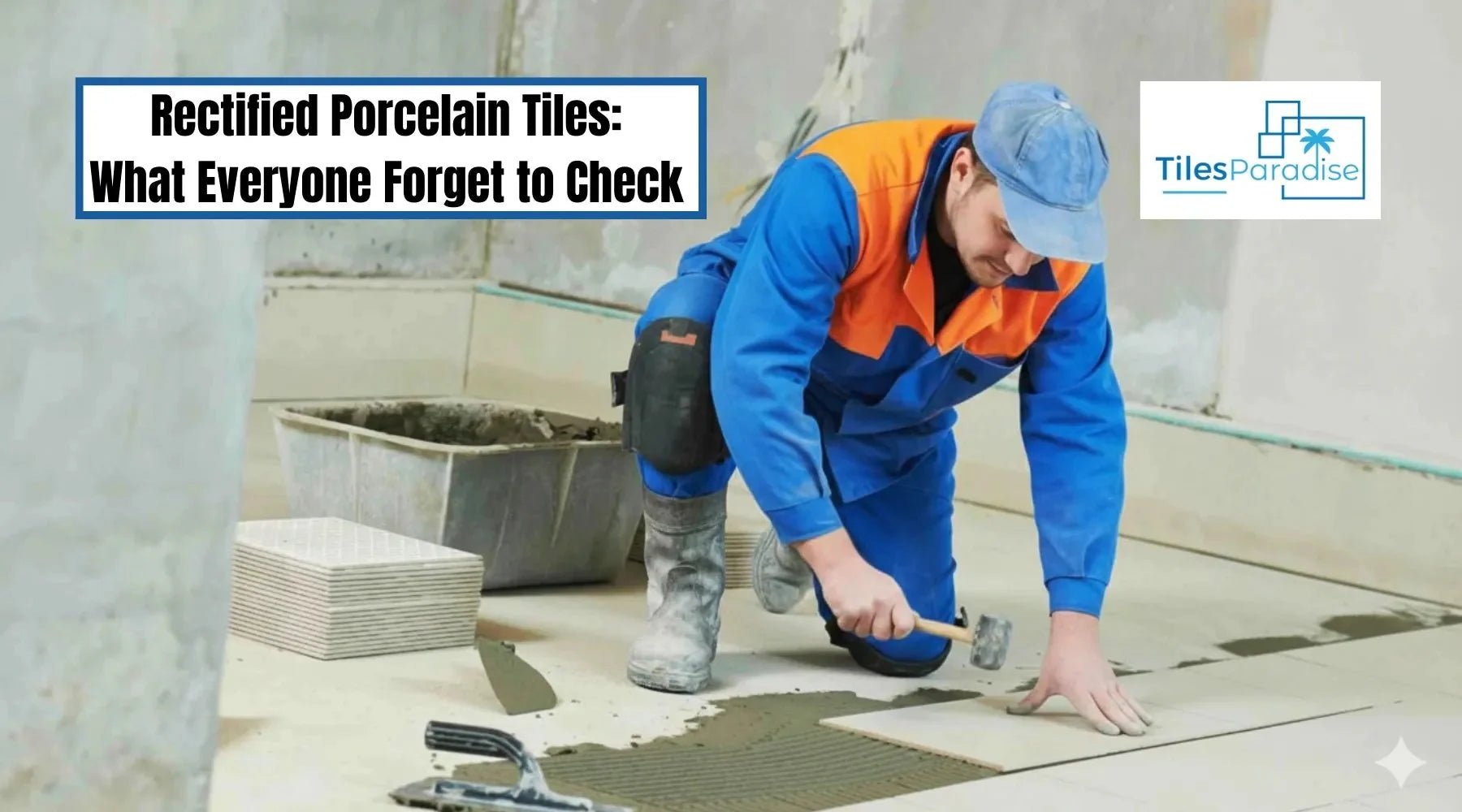
Rectified porcelain tiles draw interest because the edges come out sharp and even. A recent industry review showed that about 62% of buyers look for higher size accuracy when choosing tiles, which places rectified pieces in a strong position. The steady shape comes from a controlled cut after firing, and that step gives each tile a cleaner form.
Homeowners chasing a smooth layout often lean toward narrow joints. Rectified tiles support this goal with edges that line up with less visual break. The layout feels calmer, and the surface reads as one connected space rather than a grid of pieces.
Installers still see questions come up around lippage, substrate flatness and room fit. Around 40% of installation complaints link to uneven surfaces, not the tiles themselves. This guide sets out the facts so you can judge the benefits with clarity and choose rectified porcelain tiles with confidence.
What Are Rectified Porcelain Tiles
Rectified porcelain tiles sit in a class of their own because each edge is corrected after the firing stage. Size shifts of 1 to 3% are common during kiln shrinkage, so factories use diamond cutting systems to bring every piece back to a fixed measurement. This process produces straight lines, sharp corners and far tighter variation than standard pressed tiles, which often show ±1.5 mm differences inside the same batch.

The accuracy gained from post-kiln trimming supports narrow joints and long runs of clean alignment. Surveys from European tile installers show that over 70% choose rectified tiles for layouts that need a smooth visual flow, especially on large-format pieces above 600 mm. Designers also use this precision for patterns that rely on exact corners, like herringbone or basket weave.
Installers value the consistency, yet the sharp profile needs careful handling. The edge shape gives a clean finish, but it also demands a well-prepared base to support tight joints and even height across the surface.
How Rectified Edge Tolerance Improves Tile Size Accuracy
Rectified edge tolerance improves tile size accuracy by using post-firing grinding systems that control deviation to below ±0.5 mm. This produces straighter edges, tighter squareness, and consistent alignment across each batch. The increased precision supports very narrow grout joints, unlike pressed tiles that vary more in size.
How Rectified Edge Tolerance Works
Rectification begins after firing. Porcelain changes size in the kiln because of expansion and contraction, which creates small shifts in shape. Mechanical grinding corrects these shifts by trimming every tile to a fixed working size with straight, square edges. This controlled cut replaces the nominal size with a precise, repeatable measurement that reduces tolerance far beyond what non-rectified tiles achieve.
Quantifying the Accuracy
ISO 10545-2 sets the limits for length, width, straightness, and rectangularity. Rectified tiles hold far tighter ranges than standard pressed tiles.
Dimensional Deviation (Length/Width): Pressed tiles often vary by ±2 to ±3 mm. Rectified tiles hold deviation below ±0.5 mm, improving alignment across the full layout.
Squareness (Rectangularity) Accuracy: Right-angle control stays strict. A 600×600 mm rectified tile sits well within ISO tolerance, producing cleaner and more uniform edges.
Batch Consistency: Each piece is corrected using the same calibrated system, giving consistent dimensions across boxes without the need for heavy sorting.
Practical Benefits of High Accuracy
Minimal Grout Lines: Tight sizing supports joints of 1.5–2 mm, which creates a cleaner and more modern surface.
Aesthetics: Sharp edges produce a continuous visual flow, especially in large formats such as 600×600 mm and above.
Reduced Lippage: Consistent thickness and uniform sizing lower the risk of height differences on flat substrates. Installers often use levelling clips to achieve a smooth finish.
Rectified vs Non-Rectified Porcelain Tiles
Rectified and non-rectified tiles differ in edge accuracy, grout spacing, and installation behavior. Rectified tiles are trimmed after firing to reach tight tolerances, while non-rectified tiles keep the natural variation formed in the kiln. This changes how neat the layout looks and how much skill the installation needs.
Comparison Table
|
Attribute |
Rectified Tiles |
Non-Rectified Tiles |
|
Manufacturing |
Machine-cut after firing; many batches hold ±0.5 mm deviation. |
Kiln-finished; variation often ±1.5-2.5 mm. |
|
Dimensional Variation |
Very low; many European lines stay below 0.3% deviation. |
Higher due to kiln shrinkage differences of 1-3 mm. |
|
Edge Shape |
Sharp edges; micro-bevel of 0.2-0.3 mm common. |
Softer, rounded edges. |
|
Alignment Control |
High accuracy, ideal for long alignments. |
Lower; installers sort tiles by size. |
|
Grout Joint Width |
Narrow joints of 2-3 mm. |
Wider joints of 4-6 mm. |
|
Aesthetic Outcome |
Clean, modern look; over 60% of buyers pick rectified for seamless layouts. |
Traditional look with pronounced joints. |
|
Installation |
Needs flat substrate of 3-5 mm over 2 m. Levelling clips used often. |
More forgiving and DIY-friendly. |
|
Cost |
Higher due to extra processing. |
Lower production cost. |
How Rectified Tiles Create Cleaner Layouts With Narrow Grout Lines
Rectified tiles give a cleaner and more seamless layout because their edges are mechanically trimmed to exact sizes after firing. This high accuracy supports tight grout joints that reduce visible breaks and help the surface look like one continuous sheet.

The Rectification Process
Traditional pressed-edge tiles leave the kiln with small differences in size caused by natural shrinkage during firing. Rectification removes these variations through a controlled, mechanical process:
-
Oversize Firing: Tiles are fired slightly bigger so they can be trimmed down with precision.
-
Precision Cutting: Diamond blades or grinding wheels shape each edge after firing to reach an exact working size.
-
Uniformity: The process produces straight edges and true right angles, making every tile consistent.
How This Achieves Cleaner Layouts
The accuracy gained from rectification brings clear visual and practical benefits:
-
Minimal Grout Lines: Uniform sizing supports grout joints as tight as 2–3 mm, far narrower than those used for non-rectified tiles.
-
Seamless Appearance: Smaller joints break up the layout less and help the floor or wall look smoother, which is useful in smaller rooms.
-
Modern Style: The clean and continuous finish fits well with contemporary design.
-
Easier Cleaning: Narrow joints reduce the areas where dirt and moisture settle.
Do Rectified Porcelain Tiles Increase Lippage Risk
Rectified porcelain tiles do not raise the true risk of lippage; they simply make height changes easier to notice. Their tight joints and sharp edges reveal even a minor step between two tiles, so the issue seems worse than it is. The cleaner the layout, the more visible any irregularity becomes.
Why Lippage Becomes More Visible
Narrow Grout Lines: Rectified tiles use joints of about 2–3 mm. Wider joints on pressed tiles soften small height shifts and mask slight unevenness.
Sharp Edges: Square edges have no bevel, so any rise feels clearer to the touch and eye.
Modern Layouts: A continuous layout draws attention to small variations that would blend into a rustic finish.
Primary Causes of Lippage
Uneven Substrate: Rectified tiles need a flat base. Rigid pieces cannot settle over dips or humps.
Tile Bowing: Large pieces gain a slight curve during firing, which affects alignment if not managed.
Poor Installation: Low mortar coverage, rushed placement, or skipped back-buttering raises edges.
Missing Levelling Systems: Clips and wedges hold tiles steady while the mortar sets.
High Offsets: A 33% offset reduces visible steps on plank-style tiles.
Where Rectified Porcelain Tiles Perform Best Indoors
Rectified porcelain tiles suit indoor rooms where a clean finish, tight alignment, and strong durability matter most. Their precise edges help create a continuous look, especially in areas that carry steady movement or deal with moisture.

Kitchens: Spills, heat, and constant foot traffic place heavy demands on a surface. Porcelain handles this well, and narrow joints support easy cleaning after daily use.
Bathrooms: Low water absorption and reduced grout width support a cleaner finish on floors and walls. The smaller joints limit moisture-holding gaps, which helps with hygiene.
Hallways: These areas take the most wear. The dense body of porcelain keeps its surface steady against scratches from shoes and carried items.
Living Areas: Large pieces laid with thin joints produce a smooth, open layout that suits modern interiors. Good substrate preparation is still needed, as rectified edges highlight any uneven base.
How Uneven Substrates Lead to Rectified Tile Failure
Uneven substrates cause rectified tile failure by creating stress points, lippage, weak mortar contact, and long-term movement that breaks the bond. Rectified tiles have sharp, uniform edges and need a very flat base to stay aligned.
Concentrated Stress and Cracking:
Rigid tiles cannot settle over dips or high spots. Weight then pushes down on unsupported areas, which leads to cracks along edges or grout lines. Large formats face higher risk due to longer spans.
Lippage:
Small height changes become clear with tight joints. A rise of only 1–2 mm creates a visible step and increases edge chipping. Large tiles need a flatness of about 3 mm over 2 m to stay level.
Poor Adhesion:
Uneven floors prevent the 95 percent mortar coverage needed indoors. Voids weaken the bond and cause hollow sounds, movement, or full detachment.
Grout Failure:
Irregular depth leads to cracking, sinking, and water entry, which weakens both the grout and the mortar bed.
Prevention:
-
Ensure the substrate meets flatness standards of 3–5 mm over 2 m before tiling.
-
Repair dips and raised sections with a levelling compound or patching mix.
-
Confirm that screeds and timber floors are dry, rigid, and free from movement.
-
Use the correct trowel notch to achieve strong mortar coverage.
-
Back-butter large tiles to reduce voids and raise bond strength.
-
Install a levelling system to keep edges flush during curing.
-
Keep large tiles within a maximum one-third offset to limit tension along natural bowing.
-
Protect the tiled surface from early foot traffic until the mortar sets properly.
Final thoughts
Homeowners look for tighter alignment and cleaner layouts, and rectified porcelain tiles continue to rise in demand for this reason. Sharp edges and consistent sizing support narrow joints that keep the surface calm and uniform. This controlled look suits modern interiors where visible breaks in the layout reduce visual flow.
The dense porcelain body, low water absorption, and stable shape make rectified tiles a strong choice for kitchens, bathrooms, and hallways. These rooms deal with steady moisture and foot movement, so a surface that stays firm and holds its finish adds long-term value.
Tiles Paradise offers rectified porcelain tiles that combine accuracy, durability, and smooth alignment, giving indoor spaces a cleaner appearance and a surface built to last.
FAQ’s
What is a rectified porcelain tile?
A rectified porcelain tile is trimmed after firing to reach a precise, uniform size. The process gives the tile straight edges and sharp corners, which allows tighter joints and a cleaner, more modern finish across the surface.
Do rectified tiles need grout?
Yes, rectified tiles still need grout. The joints can stay very narrow, but grout is required to stabilize the layout, control movement, and stop moisture or dirt from entering the gaps.
Are rectified tiles worth it?
Rectified tiles suit homeowners who want a smooth, seamless look. Their sharp edges support tighter joints and a polished style, and the reduced grout area makes cleaning easier.
Do rectified tiles cost more to lay?
Rectified tiles often cost more to install because the sharp edges and tight joints need careful alignment. Installers take more time to prepare the base and set each tile correctly.
What is the difference between pressed and rectified porcelain tiles?
Pressed tiles keep their natural kiln-formed edges, which show small size differences. Rectified tiles are cut after firing to improve accuracy, giving them consistent measurements and straighter edges for tighter joints.