





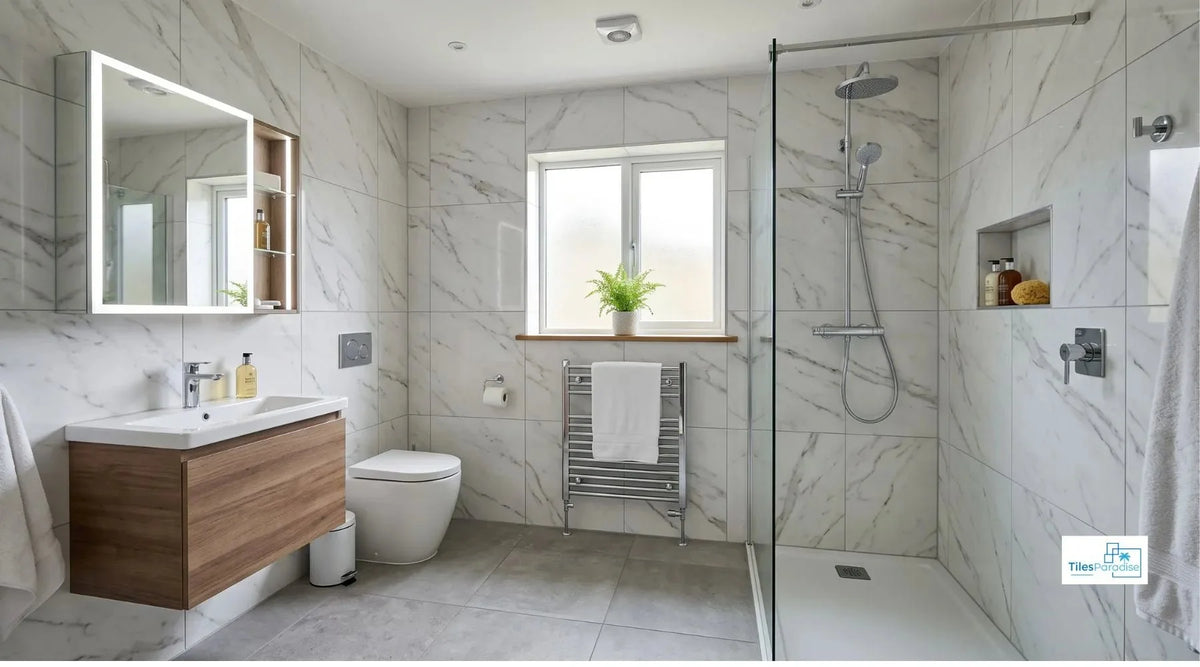
Tiling a standard UK bathroom costs £1,200 to £2,800 in 2026 for a full floor-and-wall retile, supplied and fitted. That is £70 to £160 per square metre, of which labour is £30 to £60 per m². A floor-only job in the same room costs £300 to £800, and half-height walls with a tiled floor costs £750 to £2,200.
Where you buy the tiles moves that total more than most homeowners expect. Priced with tiles from our own range at £19.99–£29.99 per m², the same full retile lands at £65 to £110 per square metre, roughly £850 less on a medium bathroom than the UK average.
Bathroom tiling cost at a glance - UK, 2026
|
Scope |
Small (1.7 × 2.0 m) |
Medium (2.0 × 2.5 m) |
Large (2.5 × 3.0 m) |
|
Floor only |
£300 – £600 |
£400 – £800 |
£550 – £1,200 |
|
Half-height walls + floor |
£750 – £1,700 |
£1,000 – £2,200 |
£1,400 – £3,100 |
|
Full floor-to-ceiling retile |
£1,200 – £2,800 |
£1,600 – £3,700 |
£2,200 – £5,000 |
|
Same, with our tile prices |
£1,150 – £1,950 |
£1,500 – £2,550 |
£2,050 – £3,450 |
|
Typical duration |
2 – 3 days |
3 – 4 days |
4 – 6 days |
Includes tiles, adhesive, grout, silicone and labour. Excludes tile removal, tanking, underfloor heating and plumbing changes, all priced separately below.
How much does it cost to tile a bathroom by room size?
The cost scales with total tiled area in square metres, not floor plan. This is where budgets break: a 5 m² floor sits under roughly 18 m² of wall, so tiling floor-to-ceiling multiplies the job by four.

|
Room type |
Floor |
Full-height walls |
Total tiled |
Full retile (UK avg) |
With our tiles |
|
Cloakroom / en-suite |
2 m² |
~9 m² |
~11 m² |
£750 – £1,750 |
£700 – £1,200 |
|
Small (1.7 × 2.0 m) |
3.5 m² |
~14 m² |
~17.5 m² |
£1,200 – £2,800 |
£1,150 – £1,950 |
|
Medium (2.0 × 2.5 m) |
5 m² |
~18 m² |
~23 m² |
£1,600 – £3,700 |
£1,500 – £2,550 |
|
Large (2.5 × 3.0 m) |
7.5 m² |
~24 m² |
~31.5 m² |
£2,200 – £5,000 |
£2,050 – £3,450 |
Wall areas assume a 2.4 m ceiling with a standard door, one window and a bath or vanity run already deducted.
The room does not change between the low and high end of each band. The specification does: entry-level tile on flat, sound walls in a straight stack bond at the bottom; large-format on walls needing levelling, with a tanked shower zone and cuts around alcoves at the top.
How much does it cost to tile a bathroom floor only?
A bathroom floor alone costs £300 to £800, or £65 to £145 per square metre supplied and fitted.
Floor-only work prices differently from wall work for three reasons:
-
Day-rate minimums apply. A 3.5 m² floor is under half a day, but almost no tiler attends for less than a half-day charge, which is why small floors cost more per m² than large ones.
-
Floors are slower. A tiler lays 10–15 m² of wall tiles a day but only 8–12 m² of floor tiles, because floors need levelling systems and unbroken adhesive coverage underfoot.
-
Floors need a slip rating. UK bathroom floors should be R10 minimum, or R11 in wet rooms and where elderly users or young children are present.
|
Floor area |
Labour only |
Supplied and fitted |
|
2 m² (cloakroom) |
£150 – £280 |
£200 – £450 |
|
3.5 m² (small) |
£180 – £330 |
£300 – £600 |
|
5 m² (medium) |
£220 – £420 |
£400 – £800 |
|
7.5 m² (large) |
£300 – £560 |
£550 – £1,200 |
How much do bathroom tiles cost per square metre?
Bathroom tiles cost £15 to £120 per square metre across the UK market. Across our own 412-line bathroom range the figure is narrower: £19.99 to £44.99 per m², with most of the range between £20 and £30.
|
Tile type |
UK market |
Our range |
Water absorption |
Use |
|
Porcelain, standard format |
£25 – £60 |
£19.99 – £29.99 |
< 0.5% |
Walls and floors |
|
Porcelain, large format 60x120 and above |
£35 – £75 |
£19.99 – £29.99 |
< 0.5% |
Walls and floors |
|
Ceramic |
£15 – £30 |
£22.97 – £44.99 |
3 – 7% |
Walls |
|
Natural stone |
£50 – £120+ |
Not stocked |
Porous |
Feature areas |
Why porcelain is not always the expensive option
Almost every UK cost guide states that ceramic is the budget material and porcelain the upgrade. Across our own catalogue, the opposite is true, and it is worth understanding why, because the same effect exists at any merchant that buys porcelain in volume.
Porcelain costs more to manufacture: it is fired above 1200°C from finer raw materials, which is what pushes water absorption below 0.5% and makes it technically impervious. But manufacturing cost is not shelf price. Shelf price is set by purchase volume, and porcelain in 60x120 cm is the highest-volume format in UK bathroom tiling; 181 of our 399 porcelain lines are 60x120 alone. Decorative ceramic in metro, patterned and 45x45 formats sells in far smaller runs and carries the higher per-m² price.

The practical consequence: check the actual per-m² price of both materials before assuming ceramic saves money. On our range, choosing porcelain over ceramic for a 22 m² bathroom saves roughly £220 and gives you a tile you can also use on the floor and in the shower.
Ceramic tile prices
Our ceramic bathroom range runs £22.97 to £44.99 per m² across 13 lines, metro brick formats, patterned 45x45 and marble-effect 30x60. It is a decorative range rather than a budget one. Ceramic cuts cleanly on a manual score-and-snap cutter, which keeps labour at the bottom of the range, but its 3–7% water absorption confines it to walls and dry-zone floors.
Large-format porcelain tile prices
At £19.99–£29.99 per m², large format at Tiles Paradise costs no more than standard format. The cost lands elsewhere: formats at 60x120 cm and above require the substrate to be flat to within ±3 mm over a 2 m straightedge. Where it is not, levelling compound or backer board is added to the quote before a tile is set, and the tiler drops from 10–15 m² a day to 6–8. Budget the preparation, not the tile.
Marble and stone effect versus real stone
Natural marble costs £50–£120+ per m², is porous, needs sealing before and after fixing, and can stain in a wet bathroom. Marble-effect porcelain replicates Calacatta, Carrara and Statuario patterns at £19.99–£29.99 per m², needs no sealing, and carries the same sub-0.5% water absorption as any other porcelain.
Across our range that covers 60 marble-effect lines, 36 onyx-effect, 31 stone-effect and 16 travertine-effect. The saving on a 22 m² bathroom against real stone is £700 to £2,000 on materials alone, before the sealing labour comes off the bill.
How much does a tiler charge in the UK?
UK tilers charge £30 to £60 per square metre for standard bathroom work in 2026, or £180 to £280 per day outside London and £250 to £400 per day in London and the South East.
|
Basis |
Outside London |
London & South East |
Applies to |
|
Per square metre |
£30 – £60 |
£40 – £75 |
Jobs above ~10 m² |
|
Day rate |
£180 – £280 |
£250 – £400 |
Jobs under ~10 m² |
|
Tile removal |
£25 – £40 per m² |
£35 – £50 per m² |
Retiling |
|
Herringbone, chevron, diagonal |
+15 – 30% |
+15 – 30% |
Setting out and cut volume |
The quote check most homeowners never get told: a tiler sets 10–15 m² of wall tiles or 8–12 m² of floor tiles per day. Large format drops that to 6–8 m². Mosaic drops it to 3–5 m². Divide your tiled area by that figure, multiply by the day rate, and you have an independent labour estimate. A quote assuming materially more m² per day is taking the time out of the finish.
The North East, Scotland and parts of Wales run 10–15% below these bands. London and the South East run 20–35% above.
UK tiling is unregulated - no mandatory licence. The Tile Association (TTA) maintains a register of assessed tilers. Not a price guarantee, but the closest available competence signal.
How many tiles do I need for a bathroom?
Divide total tiled area by the coverage of one tile, then add a waste allowance. Our free tile calculator does this and rounds up to full boxes.
Tiles per square metre by format
|
Format |
Coverage per tile |
Tiles per m² |
Lines we stock |
|
30 × 60 cm |
0.18 m² |
5.6 |
53 |
|
60 × 60 cm |
0.36 m² |
2.8 |
131 |
|
60 × 90 cm |
0.54 m² |
1.9 |
7 |
|
60 × 120 cm |
0.72 m² |
1.4 |
181 |
|
80 × 80 cm |
0.64 m² |
1.6 |
14 |
|
90 × 90 cm |
0.81 m² |
1.2 |
4 |
Waste allowance
|
Layout |
Add |
|
Straight / stack bond |
10% |
|
Brick bond/offset |
12% |
|
Diagonal, herringbone, chevron |
15% |
|
Patterned feature areas |
20% |
Adhesive and grout
|
Application |
Trowel notch |
Coverage |
20 kg bag covers |
|
Small-format wall |
6 mm |
3 – 4 kg/m² |
5 – 6 m² |
|
Standard floor |
10 mm |
4 – 5 kg/m² |
4 – 5 m² |
|
Large-format floor, solid bed |
12 mm |
5 – 7 kg/m² |
3 – 4 m² |
Grout runs 0.5–1.5 kg per m² - large format uses the least. Budget £12 to £20 per m² for adhesive, grout and silicone together. For bathrooms, specify a C2TE S1 flexible adhesive (ISO 13007) as a minimum, S2 for large format or over underfloor heating.
Order the whole job in one batch. Shade and calibration vary between production runs, and reordering mid-job risks a visible mismatch.
How long does it take to tile a bathroom?
A standard UK bathroom takes 2 to 4 working days, plus a curing day before grouting.
|
Stage |
Duration |
Note |
|
Strip out old tiles |
0.5 – 1 day |
Plus skip, £180 – £320 for a 4-yard |
|
Substrate preparation |
0.5 – 1 day |
Levelling, backer board, priming |
|
Tanking, wet areas |
0.5 day + cure |
Two coats with cure between |
|
Wall tiling |
1 – 2 days |
10 – 15 m²/day |
|
Floor tiling |
0.5 – 1 day |
8 – 12 m²/day |
|
Grouting and silicone |
0.5 day |
After 24 h adhesive cure |
A full retile quoted as a single day is skipping either the preparation or the cure.
What is not included in a bathroom tiling quote?
These turn a £1,400 quote into a £2,600 invoice. Ask for each in writing.
|
Item |
Typical cost |
Why it gets excluded |
|
Removing existing tiles |
£25 – £40 per m² |
Quoted as "prep, TBC" until walls are opened |
|
Skip hire/disposal |
£180 – £320 |
Tile waste is 20–25 kg per m² stripped |
|
Levelling compound/plaster repair |
£10 – £22 per m² |
Only visible once old tiles are off |
|
Tile backer board, 6 mm / 12 mm |
£12 – £18 / £18 – £25 per m² |
Required on stud walls and weak substrates |
|
Decoupling membrane |
£15 – £25 per m² |
Prevents cracking over timber or heated floors |
|
Tanking to BS 5385-4 |
£90 – £180 per shower zone |
The most commonly omitted line on a bathroom quote |
|
Electric underfloor heating |
£60 – £110 per m² fitted |
Thermostat often separate, £80 – £150 |
|
Edge trims and profiles |
£6 – £14 per linear metre |
Priced per metre, not per m² |
|
Hidden damage (rot, damp, failed boards) |
£150 – £600+ |
Only discoverable after strip-out |
The line never to cut: tanking. BS 5385-4 governs tiling in wet conditions, and tiles plus grout are not the waterproof layer - the membrane behind them is. A failed shower tray junction that has to be re-tiled costs more than the original tiling job.
How do you work out the cost to tile your own bathroom?
Total = (tiled m² × waste multiplier × tile price per m²) + (tiled m² × £12–£20 supplies) + (tiled m² × £30–£60 labour) + fixed extras
Measure the floor: length × width. 2. Measure the walls: perimeter × ceiling height. 3. Deduct the door, the window and any run hidden by a bath panel or vanity. 4. Apply waste: ×1.10 straight, ×1.15 diagonal or herringbone. 5. Price tiles, supplies and labour as three separate lines. Never accept one round number. 6. Add fixed extras: tanking, removal, skip, trims, underfloor heating.

Worked example - medium bathroom, 2.0 × 2.5 m, 2.4 m ceiling
|
Line |
Calculation |
Cost |
|
Floor area |
2.0 × 2.5 |
5.0 m² |
|
Gross wall area |
perimeter 9.0 m × 2.4 m |
21.6 m² |
|
Deductions |
door 1.7 + window 1.0 + bath/vanity 2.0 |
−4.7 m² |
|
Total tiled area |
5.0 + 16.9 |
22 m² |
|
Tiles to order, +10% waste |
22 × 1.10 |
24.2 m² = 34 tiles at 60x120 |
|
Tiles - Statuario Carrara White Polished 60x120 @ £19.99/m² |
24.2 × £19.99 |
£484 |
|
Adhesive, grout, silicone @ £15/m² |
22 × £15 |
£330 |
|
Tanking, shower zone |
fixed |
£140 |
|
Labour @ £45/m² |
22 × £45 |
£990 |
|
Total |
£1,944 |
|
|
Effective rate |
£1,944 ÷ 22 m² |
£88 per m² |
Note where the money sits: the tiles are 25% of the total. Labour is 51%. That ratio is why "cheaper tiles" rarely rescues a budget, and why substrate condition matters more than the showroom price.
Run your own numbers with the tile calculator - enter your area, pick your format, and it returns tiles, boxes and m² with wastage already added.
Is it cheaper to tile a bathroom yourself?
DIY saves the labour share - 40 to 55% of the total, but only if the substrate is sound and the layout simple.
|
Factor |
DIY |
Professional |
|
Labour |
£0 direct |
£30 – £60 per m² |
|
Tools |
£120 – £400 to buy, £40 – £80/day to hire |
Included |
|
Waste |
15 – 25% |
10 – 12% |
|
Time, medium bathroom |
5 – 10 days part-time |
3 – 4 days |
|
Tanking |
Highest failure point for first-timers |
To BS 5385-4 |
|
If it fails |
Strip, re-prep, re-tile - often more than the original quote |
Workmanship warranty |
Works for DIY: a splashback, a straight-set cloakroom floor, half-height walls in a room with no shower. Usually does not: a tanked shower zone, large-format tiles, walls out of plumb.
Do you pay VAT on bathroom tiling work?
Most UK bathroom tiling carries the standard 20% VAT rate. Two things change what you actually pay.
-
Whether the tiler is VAT-registered. Sole traders below the VAT registration threshold do not charge VAT at all. On a £2,000 job, that is a £400 difference for identical work, and a legitimate reason two quotes differ.
-
Whether the property qualifies for a reduced rate. A 5% rate can apply to homes empty for two years or more, and to work changing the number of dwellings in a building. New-build residential can be zero-rated. These reliefs are conditional and evidence-based - confirm with HMRC or your accountant before assuming them.
Always ask whether a quote is inclusive or exclusive of VAT. It is the most common reason a "cheaper" quote turns out not to be.
How can you reduce the cost of tiling a bathroom?
-
Tile half-height instead of floor-to-ceiling. The largest available saving, removes 40–50% of wall area and takes £600–£1,500 off a full retile. Keep full height in the shower zone only.
-
Compare porcelain and ceramic on actual price, not reputation. On our range porcelain starts below ceramic and works on walls, floors and in the shower.
-
Choose marble-effect porcelain over real stone. Same look, £700–£2,000 less on a 22 m² bathroom, and no sealing labour.
-
Keep the layout straight. Avoids the 15–30% labour uplift and the extra 5–10% waste that herringbone and diagonal carry.
-
Order samples first. A tile sample costs a fraction of a returned pallet.
-
Buy the whole job in one batch to avoid shade variation between production runs and a second delivery charge.
-
Check job-lot and pallet pricing. Job lot deals cut material cost where the quantity matches your area, several run 28–50 m², which covers a full bathroom.
-
Clear the free-delivery threshold in one order. Delivery is free over £499, which most full bathroom orders reach.
Is tiling a bathroom worth it compared with panels or paint?
|
Factor |
Tiling |
PVC panels |
Paint |
|
Installed, medium bathroom |
£1,500 – £3,700 |
£500 – £1,100 |
£200 – £450 |
|
Lifespan |
25 – 50 years+ |
10 – 20 years |
2 – 4 years |
|
Maintenance |
Re-grout and re-silicone every 5 – 10 years |
Wipe clean |
Repaint, mould-prone |
|
Moisture performance |
Excellent over correct tanking |
Good |
Poor in shower zones |
|
Effect on resale |
Strongest of the three |
Neutral to slightly negative |
Neutral |
Over 20 years tiling costs less per year than repainting a humid bathroom every three, and it is the only one of the three a buyer reads as a finished bathroom. Panels win on speed and on rental property.
Shop by type:
Related guides:
- Large-format bathroom tiles
- Rectified porcelain tiles
- Choosing porcelain for a luxury bathroom
- Patterned bathroom floor tiles
Frequently asked questions about bathroom tiling costs
How much does it cost to tile a small bathroom in the UK?
A small bathroom of about 1.7 × 2.0 m costs £1,200 to £2,800 to tile fully, £750 to £1,700 for half-height walls with a tiled floor, and £300 to £600 for the floor alone.
Is porcelain more expensive than ceramic?
Not always. Porcelain costs more to manufacture, but shelf price follows purchase volume, and 60x120 cm porcelain is the highest-volume format in UK bathroom tiling. Across our own range, porcelain starts at £19.99 per m² while ceramic starts at £22.97, because our ceramic range is decorative rather than budget. Check the per-m² price of both before assuming.
How much does it cost to tile a shower enclosure?
A 0.9 × 0.9 m enclosure tiled floor-to-ceiling covers roughly 6–7 m², costing £450 to £1,100 including tanking to BS 5385-4.
Can you tile over existing bathroom tiles?
Yes, if the existing tiles are firmly bonded, flat and free of movement, using a suitable primer and flexible adhesive. It saves £25–£40 per m² in removal, but adds 15–20 mm of build-up that can foul door thresholds, and hides any failure underneath.
How much does underfloor heating add?
£60 to £110 per m² for an electric mat, plus £80 to £150 for the thermostat. On a 5 m² floor that is £380 to £700 on top, and it requires an S2 flexible adhesive.
What percentage of the cost is labour?
Labour is 40 to 55% of a typical UK bathroom tiling total. In the worked example above it is 51% while the tiles are 25%. The share rises above 55% with mosaic or complex patterns.
Should you tile the walls or the floor first?
Walls first is standard. It stops adhesive and grout dropping onto a finished floor, and lets the bottom row of wall tiles sit cleanly on the floor tile line.
How much extra does a wet room cost?
£600 to £1,500 over a standard retile, the formed gradient to the drain, full-floor tanking rather than a shower-zone kit, and the extra cuts across the falls.