





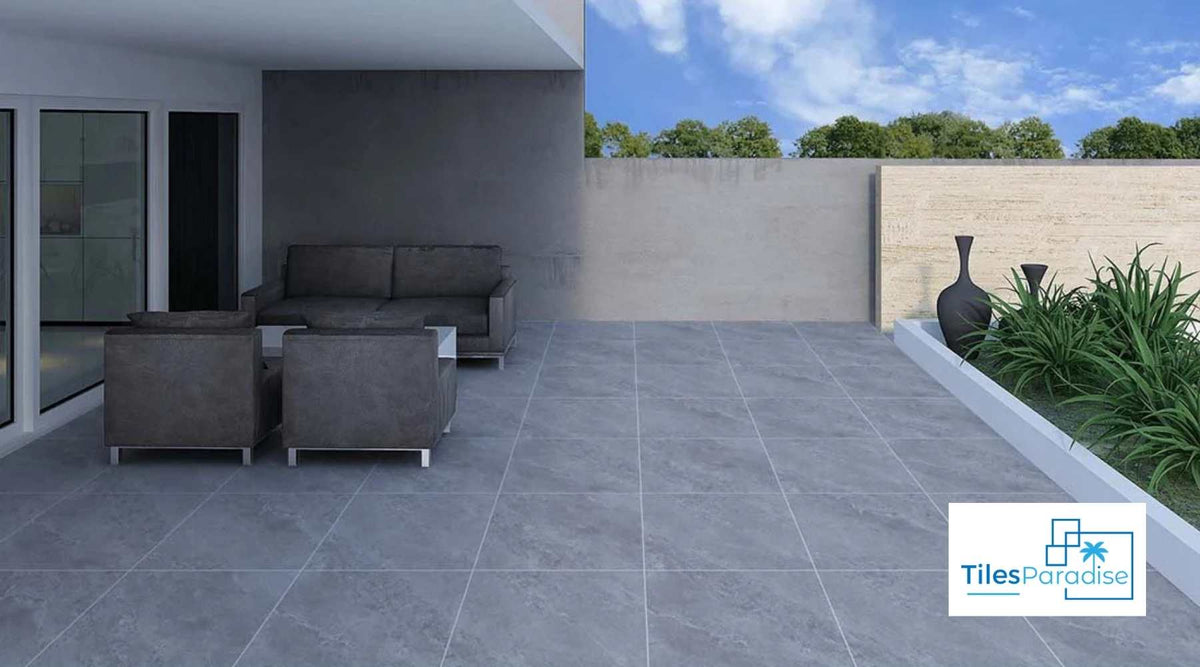
Outdoor tiles are frost-proof, slip-rated porcelain slabs made to sit outside all year, usually 20mm thick with a textured R11 surface. They cover patios, garden paths, terraces, pool surrounds, steps and balconies. They do not crack in frost, fade in sun or stain from a barbecue, and they need no sealing.
Choosing the slab is the easy part. Whether a porcelain patio lasts thirty years or lifts in two winters depends on its height against the house, its slope, the base underneath and how each slab is bonded. This guide covers all of it. Every product figure comes from the live Tiles Paradise outdoor range of 22 tiles, checked on 20 October 2026.
| Material | Outdoor-grade porcelain |
|---|---|
| Thickness | 20mm for patios and paths (21 of our 22 outdoor tiles) |
| Slip rating | R11 (all 22 outdoor tiles we sell) |
| Finish | Matt, textured |
| Sizes | 40×80cm, 60×60cm, 60×90cm, 60×120cm |
| Price | From £32.99 per m² (20mm), up to £59.99 per m² |
| Sealing | Not needed |
What makes a tile an outdoor tile?
In one line: an outdoor tile is dense enough to resist frost, thick enough to bridge an imperfect base, and textured enough to grip in rain.
Frost is the first test. Water that soaks into a tile expands when it freezes and splits the tile from the inside. Porcelain absorbs 0.5% of its weight in water or less, so there is almost nothing inside it to freeze. An indoor ceramic tile soaks up far more and will crack on a patio within a winter or two.
Strength is the second test. Outside, a slab carries garden furniture, dropped plant pots and people on a bed that is never perfectly flat. A 20mm slab spans small dips that would snap a 10mm tile. The third test is grip: rain, leaves and winter algae all sit on the surface, so outdoor tiles have a textured matt face rated R11.
Can indoor tiles be used outside?
Usually not. Indoor ceramic tiles are too porous for frost, and most indoor porcelain is too thin and too smooth for wet ground. A few thinner porcelain tiles are rated for outdoor use, such as the Sky Grey Matt 60×60cm tile at 9.5mm. These must be fully bonded to a concrete base; they cannot be laid on gravel or pedestals like a 20mm slab.
Can outdoor tiles be used indoors?
Yes, but think about height and cleaning first. A 20mm slab plus adhesive sits much higher than an indoor tile, which affects door thresholds. The R11 texture also holds more dirt than a smooth indoor floor. Matching indoor and outdoor floors normally use a 10mm indoor version and a 20mm outdoor version of the same design.
Where can you use outdoor tiles?
In one line: anywhere people walk outside, as long as the base and the drainage suit the spot.
| Location | Best laying method | Watch out for |
|---|---|---|
| Patio against the house | Full mortar bed on a compacted sub-base | Height below the damp-proof course; fall away from the wall |
| Garden path or stepping stones | Dry-laid on gravel, sand or into lawn | Path width vs slab size |
| Seating area away from the house | Dry-laid or mortar bed | Firm, well-drained ground |
| Balcony or roof terrace | Adjustable pedestals | Weight limit; drainage under the slabs |
| Pool or hot tub surround | Full mortar bed | Barefoot grip; pool chemicals on grout |
| Garden steps and front doorstep | Full mortar bed | Exposed cut edges on the step nose |
| Driveway | Engineered base, vehicle-rated slab only | Most patio slabs are not vehicle-rated |
Can outdoor tiles go around a pool?
Yes. A pool surround needs an R11 matt slab, full mortar bedding and a jointing compound that tolerates pool water. People walk there barefoot, so check barefoot grip on the product sheet if it is stated. Rinse chlorine and salt off regularly to protect the joints.

The Paradise Paver Pearl Grey 40×80cm slab in the photo costs £32.99 per m². Smaller 40×80cm slabs suit pool edges and curves, because there is less waste when you cut around the shape.
Can you tile outdoor steps and a front doorstep?
Yes, with 20mm porcelain on a full mortar bed. A cut step nose shows the slab's body, so it is the weak and most visible point. Round the cut edge slightly, or use a matching step tread if the range has one. Choose a mid-tone colour, because front steps collect grit and dark slabs show it.
Can you use outdoor tiles on a driveway?
Only with a slab the maker has approved for vehicles, laid on an engineered base with no voids. Cars put heavy, twisting loads on a few small points. Thicker 30mm slabs are often used for driveways. The Tiles Paradise outdoor range is specified for patios, paths, gardens and terraces, not driveways. For an indoor garage floor, the garage floor tile guide covers the different options.
Are outdoor tiles slippery when wet?
In one line: R11 outdoor porcelain grips well in rain, but algae, ice and moss make any surface slippery.
The R rating comes from a ramp test in work shoes on an oily surface (DIN 51130). R11 is the usual standard for UK patios, and every outdoor tile we sell carries it. A second test, the pendulum test, gives a PTV score; a wet PTV of 36 or more means low slip potential.
The bigger risk is what grows on the slab. Shaded, north-facing patios build up a green film over winter, and that film is slippery on porcelain, stone and timber alike. A wash once or twice a year removes it. In a freeze, treat a porcelain patio like any path: grit or salt it, and brush off the residue once the ice has gone. The guide to non-slip floor tile R ratings compares the outdoor standard with bathrooms and kitchens.
What size outdoor tiles should you choose?
In one line: 60×90cm is the standard UK patio size; choose smaller slabs for paths and curves, larger ones for open terraces.
Weight matters as much as looks, especially for DIY. A 20mm porcelain slab weighs roughly 45kg per m², depending on the maker. That makes a 60×90cm slab about 24kg and a 60×120cm slab about 32kg. Check the exact weight on the product sheet before you plan a lift.
| Size | Approx. slab weight | Best for | From |
|---|---|---|---|
| 40×80cm | About 14kg | Paths, small patios, pool edges, curves | £32.99 |
| 60×60cm | About 16kg | Square spaces, steps, stepping stones | £32.99 |
| 60×90cm | About 24kg | Most UK patios | £32.99 |
| 60×120cm | About 32kg | Large terraces, indoor-outdoor flow | £59.99 |

Measure the narrowest part of the area before you choose. A 60×120cm slab across a 90cm path means cutting every piece, while a 40×80cm or 60×60cm slab fits with far less waste. The Lavezzi Grey 60×120cm slab shown above suits large, open terraces. The large format floor tiles guide explains how big slabs behave in UK gardens as well as indoors. Browse every 60×90cm option in the 60×90cm 20mm outdoor tiles range.
What colour outdoor tiles work best in UK gardens?
In one line: choose the colour against the house walls, not the plants, and remember dark slabs get hot in summer.
- Mid-grey is the safest choice. It sits with brick, render and timber and hides dust and leaves. Most of our outdoor range is grey; see the grey outdoor tiles.
- Beige and warm stone brighten a shaded, north-facing garden and sit warmly with planting. The beige outdoor tiles include the Skyline Rock Beige 60×90cm.
- Anthracite and black look sharp against pale render, but absorb more sun. Dark slabs can get too hot for bare feet on a summer afternoon, and they show pollen and dust. The Skyline Anthracite 60×60cm slab is a deep charcoal grey, and the black outdoor tiles go darker still.
Most outdoor porcelain copies slate, sandstone or limestone. Riven and slate effects look most natural outside, because real stone weathers to a similar texture. The guide to stone effect porcelain tiles explains how those surfaces are made.
How high should a patio sit against the house?
In one line: at least 150mm below the damp-proof course, sloping away from the wall.
The damp-proof course (DPC) is a waterproof layer built into the house wall, usually two or three brick courses above the ground. It stops ground moisture rising into the wall. The finished patio surface should sit at least 150mm below it, as set out in Approved Document C of the Building Regulations. A patio built higher lets rain splash over the DPC and soak into the wall, causing damp inside.

When the levels cannot give 150mm, builders usually add a gravel-filled drainage channel along the wall, or a slotted channel drain, so splash water drains away below the DPC. Agree the finished level with your installer before any digging starts.
Which way should a patio slope?
Away from the house, at about 1 in 60, which is 25mm of fall over every 1.5m. The fall runs towards a drain, a gravel border or the lawn. It is built into the sub-base and bedding, not into the slabs. A flat patio holds puddles, and puddles freeze.
How are outdoor tiles laid?
In one line: on a full mortar bed with primed slab backs, dry on gravel, or raised on pedestals.

- Full mortar bed. The standard for patios against the house. Dig out about 200mm, compact 100–150mm of MOT Type 1 sub-base, then bed each slab on a full, solid mortar bed with the fall built in. Paint a slurry primer on the back of every slab first. Porcelain is so dense that mortar will not grip it otherwise.
- Dry-laid on gravel, sand or grass. For paths, stepping stones and seating areas away from the house. Bed the slabs into compacted grit or sharp sand over a gravel base, with open joints of at least 5mm.
- Pedestals. Adjustable supports under each corner hold the slabs above a balcony, roof or existing surface. Water drains underneath, and slabs lift out for access.
- Over existing concrete or paving. Possible when the old surface is sound, already drains and leaves enough height below the DPC. Bond the slabs with an outdoor-rated adhesive and primed backs.
Never lay slabs on five spots of mortar. The gaps underneath collect water, which freezes and lifts or cracks the slab. Do not lay or joint in rain, or when frost is forecast; mortar and jointing need dry weather above about 5°C to cure.
Do outdoor tiles need grout, and how wide should the joints be?
Yes, bedded patios need jointing, and dry-laid slabs can be left open. Leave joints of 3–5mm on a bedded patio and at least 5mm on dry-laid slabs. Use an outdoor jointing compound made for porcelain paving, either cement-based or resin, not indoor wall grout. Large areas also need movement joints, especially next to walls and steps.
Which adhesive is used for outdoor tiles?
Use a flexible, frost-resistant adhesive classed S1 or S2 when bonding slabs to concrete. S2 is more flexible and suits large slabs and areas that heat up in sun. Always prime the slab backs first.
How much does an outdoor porcelain patio cost?
In one line: 20mm outdoor porcelain from Tiles Paradise costs £32.99–£59.99 per m² for the slabs alone; labour and the base are extra.
Order the area plus 10% for cuts, or 15% for curves, steps and many edges. The table below shows tile costs only, for common patio sizes, at our entry price and at the large-format Lavezzi price. Delivery is free on orders over £499 to the UK mainland.
| Patio area | Order | At £32.99/m² | At £59.99/m² |
|---|---|---|---|
| 30m² | 33m² | £1,088.67 | £1,979.67 |
| 40m² | 44m² | £1,451.56 | £2,639.56 |
| 50m² | 55m² | £1,814.45 | £3,299.45 |
In slab numbers, 33m² of 60×90cm tiles is about 62 slabs, because each slab covers 0.54m². The Skyline Rock Grey 60×90cm slab sits at the £32.99 entry price. The tile calculator works out areas and wastage for you. Labour, the sub-base, primer, mortar and jointing add to the total, and they vary by region and site access, so get an itemised quote.
Porcelain, sandstone or decking: which is better value?
Porcelain usually costs more to buy and lay than Indian sandstone or decking, but it costs least to keep. Sandstone needs sealing and can stain and fade. Decking needs regular treatment and can get slippery and rot over time. Porcelain needs a wash once or twice a year, does not fade, and should last for decades on a sound base.
Can the same floor run from inside to outside?
In one line: yes, by pairing a 10mm indoor tile with a 20mm outdoor version of the same design.
A continuous floor through bi-fold or sliding doors makes both spaces feel larger. The indoor and outdoor surfaces need to meet neatly at the threshold, while the outside still falls away from the house and sits below the DPC. Plan the threshold detail with the door fitter before either floor goes down. For matching indoor stone looks, see stone effect floor tiles for kitchens and living rooms.
How do you clean and look after outdoor tiles?
In one line: brush and wash once or twice a year; porcelain needs no sealing.
- Routine clean: sweep, then wash with warm water and a pH-neutral patio cleaner and a stiff brush.
- Green algae: use a cleaner made for porcelain paving, or a pressure washer on a low setting angled away from the joints.
- After jointing: clean cement or resin residue off the face straight away, before it cures.
- Avoid: strong acid cleaners and repeated vinegar on cement-based joints, which attack the jointing. Use any bleach-based product diluted, keep it off plants and rinse well.
- Stains: barbecue fat and red wine wipe off porcelain with a degreaser; they do not soak in.
Keep a few spare slabs from the same batch. A replacement ordered years later may differ slightly in shade.
Outdoor tile questions, answered
Do outdoor porcelain tiles need sealing?
No. Outdoor porcelain does not absorb water or stains, so it needs no sealer. Some owners seal cement-based joints to keep them clean.
Do outdoor tiles crack in frost?
Outdoor porcelain does not crack from frost on its own. Cracks come from voids under the slab, where water collects and freezes.
How long do porcelain patios last?
Well-laid porcelain patios can last for decades. The joints and the base usually need attention long before the slabs do.
Are outdoor tiles cheaper than decking?
Not usually at the start, but they cost less over time, because they need no staining, oiling or board replacement.
Can you put outdoor tiles on grass or soil?
Not directly. Dig out the turf, lay a compacted gravel base and a grit or sand bed, then set 20mm slabs into it.
Can you lay outdoor tiles over old paving?
Yes, if the old paving is solid, drains away from the house and leaves room below the damp-proof course.
Do outdoor tiles get hot in the sun?
Dark slabs can get hot on summer afternoons. Light grey and beige slabs stay noticeably cooler underfoot.
Can outdoor tiles be used on walls?
Our 20mm outdoor slabs are made for floors. For outdoor walls, use a frost-resistant wall-and-floor tile fixed with a flexible exterior adhesive.
Are 20mm outdoor tiles easy to cut?
They need a wet saw or a heavy-duty cutter with a diamond blade. Cutting is slower than indoor tile, so plan layouts to limit cuts.
The Short Version for Your Outdoor Project
Outdoor tiles succeed or fail below the surface. Choose 20mm, R11 matt porcelain in a size that suits the shape of the space, and a colour that suits the house. Keep the finished level 150mm below the damp-proof course, slope it away from the walls, prime every slab and bed it fully. For the style side of patios, read the patio tile floor guide, and compare every slab we stock in the outdoor floor tiles collection.