





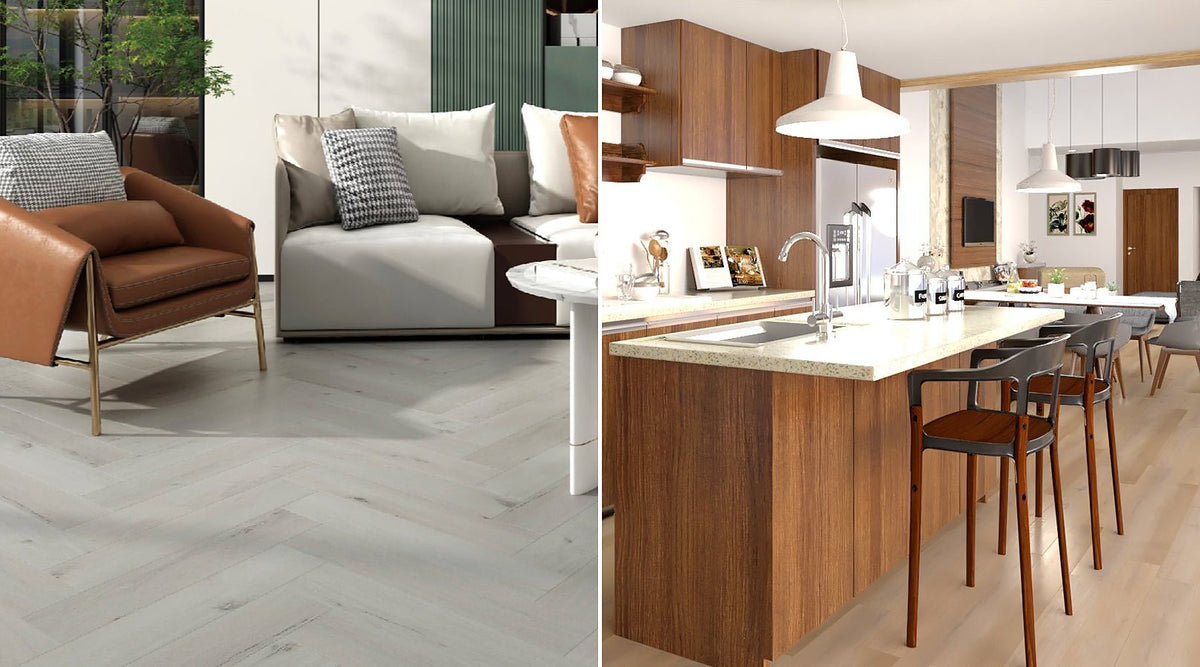
Vinyl floor tiles are PVC-based floor coverings sold as planks, squares or herringbone blocks that copy wood or stone. Most UK buyers now choose rigid SPC click tiles. SPC tiles are 100% waterproof, lock together without glue and float over a flat subfloor. At Tiles Paradise they cost £24.95 to £29.99 per m², come 5.5mm to 6.5mm thick and carry their own underlay.
Vinyl floor tiles cover everything from a 2mm peel-and-stick square to a 6.5mm rigid plank with a stone-polymer core. Those products behave very differently once they are on the floor. This guide explains the types first, then the layers, sizes, prices, rooms, subfloors and fitting steps for the click SPC format. Every price, size and box figure here comes from the live Tiles Paradise product pages, checked on 21 October 2026.
You will finish knowing three things. You will know which vinyl tile suits your room, how many boxes to order and what the floor will cost delivered.
Browse 14 colours in plank and herringbone formats in the SPC click vinyl flooring collection. Order a £1.99 cut sample from any product page before you commit to a full room.
What are vinyl floor tiles?
Vinyl floor tiles are resilient floor coverings made mainly from polyvinyl chloride (PVC), supplied in individual pieces rather than a roll. Each piece carries a printed décor film under a clear protective wear layer. That décor film is what makes vinyl look like oak, walnut, marble or slate. The pieces fix to the subfloor in one of four ways: glue, a self-adhesive back, friction (loose lay) or a click joint.

Vinyl tiles belong to the wider category of vinyl flooring, which includes sheet vinyl sold in 2m, 3m and 4m wide rolls. The tile and plank formats are often called LVT (luxury vinyl tile) or LVP (luxury vinyl plank). The words describe shape and quality, not a single product.
Which types of vinyl floor tiles are sold in the UK?
Five types of vinyl floor tile are sold in the UK. They differ in core, fitting method and how much subfloor preparation they need. The table compares them side by side.
| Type | Core | How it fixes | Subfloor tolerance | Sold at Tiles Paradise |
|---|---|---|---|---|
| SPC click (rigid core) | Stone-polymer composite: limestone powder bound with PVC | Click joint, floats, no glue | Rigid board bridges small dips | Yes, 14 colours |
| WPC click (rigid core) | Wood-polymer composite, foamed and lighter than SPC | Click joint, floats | Similar to SPC, softer underfoot | No |
| Glue-down LVT (flexible) | Thin flexible PVC layers, usually 2–3mm | Fully bonded with adhesive | Needs a smoothed, levelled screed | No |
| Loose lay | Heavy flexible PVC with a grip backing | Weight and friction, sometimes a tackifier | Smooth floor needed | No |
| Self-adhesive (peel and stick) | Thin PVC, often 1.5–2mm | Pre-applied glue backing | Every bump shows through; edges can lift | No |
Tiles Paradise sells the SPC click type only. SPC suits most UK homes because the rigid core hides minor subfloor dips and the click joint needs no adhesive. The next section opens up one SPC tile to show what each millimetre does.
How an SPC vinyl floor tile is built, layer by layer
An SPC vinyl floor tile is built from four bonded layers, each with one job. The Luxura range lists all four on its product pages. Read the layers from the top down.
- Wear layer. A clear PVC film on top takes the scuffs. Luxura uses a 0.5mm scratch-resistant wear layer with a deep embossed texture and a matt finish.
- Décor film. A printed image of oak sits under the wear layer. The emboss on Luxura follows the grain, so the boards feel like timber, not plastic.
- SPC core. The rigid limestone-and-PVC core gives the tile its strength and makes it waterproof right through.
- Backing underlay. Luxura bonds a 1.5mm IXPE acoustic underlay to the back. RegalStone Infinity Plank uses a 5-layer build with an integrated cushion underlay.
| Attribute | Luxura (plank and herringbone) | RegalStone Infinity Plank |
|---|---|---|
| Total thickness | 6.5mm (about ¼ inch) | 5.5mm (about 7/32 inch) |
| Wear layer | 0.5mm (about 20 mil) | Not stated on the product page |
| Underlay | Built-in 1.5mm IXPE acoustic | Integrated cushion layer |
| Joint | Waterproof click-lock | i4F Drop Lock, tool-free |
| Edges and surface | Micro-bevel edges, deep emboss, matt | Matt finish |
| Underfloor heating | Not stated, ask before ordering | Yes, listed as suitable |
| Listed uses | Kitchens, bathrooms, living areas, commercial spaces | Kitchens, bathrooms, living areas, commercial spaces |
Wear layer or total thickness: which number matters more?
The wear layer matters more for lifespan, and total thickness matters more for comfort and fitting. The two numbers are often mixed up. A 6.5mm plank with a 0.5mm wear layer has 0.5mm of clear protection, not 6.5mm. Some UK guides describe "2mm wear layers", which reads like a total-thickness figure for glue-down tiles.
UK retailer guides commonly place a 0.3mm wear layer at medium domestic traffic and 0.5mm or more at busy homes and light commercial use. Luxura sits at that 0.5mm mark. Total thickness decides how well the board bridges small dips and how solid it sounds underfoot. Thickness and core together decide which shape of tile you can buy, which is the next choice.
Plank or herringbone: which vinyl floor tile format suits your room?
Plank-format vinyl floor tiles suit long rooms and open-plan spaces, while herringbone suits hallways, square rooms and period homes. Plank format runs in straight, staggered rows. Herringbone sets short blocks at 90° to each other in a zigzag.

| Format | Size (mm) | Size (inches) | Pieces per m² | Best room shape |
|---|---|---|---|---|
| Luxura plank | 1230 × 180 | 48.4 × 7.1 | 4.52 | Long rooms, open plan |
| Luxura herringbone | 640 × 128 | 25.2 × 5.0 | 12.21 | Hallways, square rooms |
| RegalStone Infinity Plank | 1220 × 230 | 48.0 × 9.1 | 3.56 | Large rooms, fewer joints |
Herringbone boxes hold 16 pieces split into 8 A and 8 B blocks. A and B are mirror images, with the tongue on opposite ends, and they lock in alternate rows to form the zigzag. Herringbone takes longer to lay and produces more offcuts at the walls. RegalStone's 230mm width gives the fewest joints per m². Fewer joints mean faster fitting and a calmer look in big rooms.
Colour comes after format. The 14 colours split into three tones on screen. Light tones are Ash Grey, Galileo Light Grey and Mist Oak. Mid oak tones are Coral, Riverside, Duneside, Seagrove, Portofino, Toranto, Beachfront and Honey Oak. Dark tones are Charred Oak, Voyager Walnut and Stardust Brown. Screens shift colour, so a £1.99 cut sample settles the choice in your own light. With format and tone chosen, the price per room becomes easy to work out.
Vinyl floor tile prices in the UK, per m² and per box
Vinyl floor tiles at Tiles Paradise cost £29.99 per m² for Luxura and £24.95 per m² for RegalStone. Both are priced below their listed RRPs of £39.99 and £29.99. The product pages price per m² and ask for your floor area first. The box figures below are worked out from the stated size and pieces per box.
| Range | Price per m² | RRP per m² | Pieces per box | Coverage per box | Cost per box |
|---|---|---|---|---|---|
| Luxura 1230×180mm plank | £29.99 | £39.99 | 8 | 1.77 m² (19.1 sq ft) | about £53.12 |
| Luxura 640×128mm herringbone | £29.99 | £39.99 | 16 (8A + 8B) | 1.31 m² (14.1 sq ft) | about £39.31 |
| RegalStone Infinity Plank 1220×230mm | £24.95 | £29.99 | 9 | 2.53 m² (27.2 sq ft) | about £63.01 |
Delivery depends on the order value. Orders over £499 ship free on a pallet to UK mainland addresses in 2–4 working days. Orders between £100 and £499 pay £39.99 for standard pallet delivery. Next-working-day and Saturday pallet slots are offered on many postcodes, with options shown at checkout.
How many boxes of vinyl floor tiles do you need?
You need your floor area plus 10%, rounded up to whole boxes. Tiles Paradise recommends a minimum of 10% extra for cuts and waste. The RegalStone fitting sheet says the same. Work it out in three steps.
- Measure the length and width of the room in metres and multiply them. A 5m × 3m room is 15 m².
- Add 10%: 15 m² × 1.1 = 16.5 m². Herringbone and rooms with many corners can need 15%.
- Divide by the box coverage and round up. 16.5 ÷ 1.77 = 9.3, so order 10 boxes of Luxura plank.
| Room | Luxura plank | Luxura herringbone | RegalStone plank |
|---|---|---|---|
| 10 m² (108 sq ft) | 7 boxes, about £372 + £39.99 delivery | 9 boxes, about £354 + £39.99 delivery | 5 boxes, about £315 + £39.99 delivery |
| 15 m² (161 sq ft) | 10 boxes, about £531, free delivery | 13 boxes, about £511, free delivery | 7 boxes, about £441 + £39.99 delivery |
| 20 m² (215 sq ft) | 13 boxes, about £691, free delivery | 17 boxes, about £668, free delivery | 9 boxes, about £567, free delivery |
Buy every box in one order. The RegalStone sheet asks fitters to check that every carton shares the same item and lot number, because shades can differ between production runs. It recommends working from 2–3 cartons at a time to blend the pattern. The returns policy excludes leftovers, so 10% extra is the sensible ceiling for most rooms. Knowing the cost, the next question is where the floor can actually go.
Which rooms suit waterproof click vinyl floor tiles?
Waterproof click vinyl floor tiles suit kitchens, bathrooms, cloakrooms, utility rooms, hallways, living rooms and bedrooms. Both ranges list kitchens, bathrooms, living areas and commercial spaces as intended uses. The SPC core does not swell when wet, unlike laminate with a fibreboard core.

Waterproof planks do not make a waterproof room. The RegalStone sheet states the flooring is not a moisture barrier. Water that reaches the subfloor through the perimeter gap can grow mould under the boards. Wipe spills straight away and seal around baths and shower trays with flexible sealant.
Three places sit outside the SPC comfort zone.
- Walk-in showers and wet rooms. Standing water belongs on a tanked, tiled floor.
- Outdoors and unheated outbuildings. The fitting sheet asks for 16–27°C (60–80°F) and 30–50% humidity before and during fitting.
- Strong sun through glass. The sheet recommends curtains, blinds or solar film against thermal movement. Conservatories need that protection.
Can vinyl floor tiles go over underfloor heating?
Yes, SPC vinyl floor tiles can go over underfloor heating when the product says so. RegalStone Infinity Plank is listed as suitable for underfloor heating. The Luxura pages do not state it, so ask the Tiles Paradise team before laying Luxura over a heated floor. Most LVT and SPC makers cap the floor surface at around 27°C (81°F). Keep the expansion gap clear so the boards can move as they warm. Heating is one condition, and the floor underneath is the other.
What can you lay click vinyl floor tiles over?
Click vinyl floor tiles can be laid over concrete, plywood, OSB, sound hardwood floors, well-bonded ceramic tiles and well-bonded existing vinyl. The RegalStone fitting sheet lists those acceptable subfloors. Each one has a condition.
| Subfloor | Condition before laying |
|---|---|
| Concrete slab or screed | At least 60 days old, fully cured and tested for moisture. A polythene barrier of at least 6 mil (about 0.15mm) between ground and concrete. |
| Plywood, chipboard, OSB | Minimum ½ in (12mm) plywood or ¾ in (18mm) OSB. Dry, with loose boards screwed every 6 in (150mm) along the joists. |
| Existing hardwood | Secure and well bonded. Fix squeaks and loose boards first. |
| Ceramic or porcelain tiles | Well bonded, with grout lines filled flush using a Portland-based levelling compound. |
| Existing vinyl | Well bonded across the whole area. Never over perimeter-glued (edge-stuck) vinyl. |
| Carpet | Not acceptable. Lift it, with its underlay and gripper rods. |
How flat and dry must the subfloor be?
The subfloor must be level to within 3/16 in over a 10 ft radius, which is about 4.8mm over 3m. Fill low spots with a Portland-based levelling compound and grind or sand high spots. Sweep or vacuum every particle away. A ridge of grit under a rigid plank acts as a pivot and strains the joint. Vinyl floor tiles carry their own underlay, so no separate underlay purchase is listed for either range. Ask before adding another layer under the built-in one. With the base ready, the fitting itself follows a fixed sequence.
Fitting click vinyl floor tiles in 8 steps
Fitting click vinyl floor tiles takes 8 steps, taken from the i4F locking-system sheet on the RegalStone product pages. The tools are a tape measure, pencil, chalk line, hand or circular saw, utility knife, rubber mallet, pull bar and ¼ in (6mm) spacers.

- Acclimatise. Leave the boxes flat in the room for at least 12 hours. Hold the room at 16–27°C (60–80°F) and 30–50% humidity from a week before fitting until it is finished.
- Inspect. Check every plank in good light for finish, colour and texture defects. Claims cannot be accepted after a plank is cut or fitted.
- Plan the rows. Divide the room width by the plank width. The last row must be at least 50mm (2 in) wide. Trim the first row when the last would be thinner, so both edge rows match.
- Set the direction and gap. Run planks parallel to the longest outside wall or the main light source. Place spacers for a ¼ in (6mm) gap at every wall, cabinet and door frame. Undercut door casings so the planks slide beneath.
- Start in the left corner. Cut plank 1 in half and place its cut end against the wall, with the grooved edge facing into the room. A full plank starts row 2.
- Lock rows 1 and 2 together. Angle each plank onto the long side, slide it until the short ends meet, then drop it. Tap the short joint lightly with a rubber mallet to engage the lock.
- Stagger every row. Keep end joints at least 200mm (8 in) apart, or 25% of the plank length. No piece shorter than 150mm (6 in) goes into the floor.
- Finish the edges. Use a pull bar to lock the last row. Remove the spacers and cover the gap with skirting or beading fixed to the wall, never to the floor.
Rooms longer than 75 ft (about 22.9m) in any direction need a transition profile. Door thresholds between rooms usually take one too. Herringbone uses the same click principle with a zigzag layout, so follow the layout drawing in its boxes. A floor laid this way still needs the right care to keep its wear layer intact.
How do you clean and protect vinyl floor tiles?
You clean vinyl floor tiles by vacuuming or sweeping grit, then damp-mopping with a cleaner made for resilient floors. Remove excess water so the surface dries quickly. The RegalStone care section adds firm rules.
- No steam mops. Steam can damage the floor.
- No soap-based, caustic or abrasive cleaners. They dull the wear layer.
- No rubber-backed or coco-fibre mats. Both are known to stain resilient floors. Use a barrier mat without a rubber back at outside doors.
- Felt pads under furniture. Fit metal glides of at least 25mm (1 in) under chairs. Office chairs need wide casters of at least 50mm (2 in) or a floor protector.
- Spray polish onto a cloth. Silicone from furniture polish or window cleaner makes the floor very slippery.
- Watch for stainers. Hair dye, nail polish, permanent markers, tar and solvent paints can mark the surface for good.
Those rules complete the main buying and fitting guide. The sections below compare vinyl with other floors and point to room-specific guides.
How do vinyl floor tiles compare with porcelain and laminate?
Vinyl floor tiles are warmer, quieter, lighter and quicker to fit than porcelain, while porcelain lasts longer and resists heat and heavy loads better. SPC weighs far less per m² than porcelain, which matters on upstairs floors and timber joists. Porcelain needs adhesive, grout and curing time. Vinyl clicks together and can be walked on as soon as it is down.
Laminate looks similar to click vinyl but has a fibreboard core that swells in standing water. SPC has no wood fibre, which is why it goes into bathrooms where laminate fails. For a timber look that never wears through, compare these planks with wood-effect porcelain floor tiles. For the full room-by-room logic across every material, the guide to choosing floor tiles by room, size and slip rating covers porcelain and ceramic in depth.
What are the downsides of vinyl floor tiles?
Vinyl floor tiles have four honest downsides. First, sharp points dent and grit scratches over time, even with a 0.5mm wear layer. Second, hot pans and direct sun through glass can mark or move the boards. Third, a worn wear layer cannot be sanded or refinished like wood. Damaged planks are replaced instead. Finally, vinyl is a plastic product and sits below porcelain for lifespan and resale appeal. Shower areas are the clearest limit, and non-slip porcelain bathroom floor tiles remain the safer choice under running water.
Room guides for vinyl floor tiles
Bathrooms
Bathrooms add slip risk, steam and splashes to the checks above. The bathroom guide weighs plank against herringbone in small rooms and explains wear-layer choices for family bathrooms. Read it in vinyl tiles for bathroom floors.
Kitchens with underfloor heating
Kitchens put water, dropped utensils and heat on the same floor. The kitchen guide sets out thermal limits, anti-slip ratings and open-plan colour choices for vinyl kitchen floors over underfloor heating. Heating mats and thermostats are in the underfloor heating kits range.
Wood-effect looks
Wood-effect vinyl competes directly with wood-effect porcelain in kitchens and bathrooms. The comparison of grain, slip and cost lives in wood-effect click vinyl for kitchens and bathrooms.
Do old vinyl floor tiles contain asbestos?
Old vinyl floor tiles can contain asbestos, but new ones do not. The UK banned all asbestos use in 1999, so the risk sits with tiles laid before 2000, especially small square tiles and black bitumen adhesive. Do not sand, drill or break up an old tile floor before it is tested. Click vinyl can often float over a sound old tile floor instead of lifting it, provided that floor is well bonded.
Questions buyers ask about vinyl floor tiles
Are vinyl floor tiles waterproof?
Yes, SPC vinyl floor tiles are waterproof through the core. Water does not swell or soften the planks. The floor as a whole is not a moisture barrier, so spills must be wiped and edges sealed in wet rooms.
Do vinyl floor tiles need underlay?
No, Luxura and RegalStone vinyl floor tiles do not need a separate underlay. Luxura has a 1.5mm IXPE underlay bonded to each plank. RegalStone has an integrated cushion layer. Concrete still needs a polythene moisture barrier below.
Can you lay vinyl floor tiles over ceramic tiles?
Yes, you can lay click vinyl floor tiles over ceramic tiles that are well bonded and flat. Fill the grout lines flush with a Portland-based levelling compound first, so the joints do not telegraph through.
Can you lay vinyl floor tiles on floorboards?
Yes, click vinyl can go over sound floorboards that are screwed down and level. Overboard gappy or uneven boards with 12mm (½ in) plywood first.
Are vinyl floor tiles good with dogs and cats?
Yes, a 0.5mm wear layer copes well with pets, and the waterproof core shrugs off accidents. Claws and trapped grit still leave fine marks over the years. Matt, textured oak hides them better than a flat grey.
Can you put vinyl floor tiles on a wall?
No, both ranges are listed as floor-only products. Wall tiles or wall panels are the right product for walls and splashbacks.
Can you use vinyl floor tiles outside?
No, SPC vinyl floor tiles are for indoor use. Frost, rain and direct sun take them outside the 16–27°C range the fitting sheet requires.
Can click vinyl floor tiles be lifted and reused?
Click vinyl can be unlocked and relaid with care, because no adhesive holds it down. Planks with chipped or bent locking edges should not go back into the floor.
How long do vinyl floor tiles last?
UK flooring retailers commonly quote 15 to 25 years for well-fitted LVT, depending on wear layer, traffic and care. Felt pads, barrier mats and the right cleaner keep a floor towards the top of that range.
Can you return vinyl floor tiles?
Yes, within 14 days of delivery, for unused boxes in their original packaging. Tile and SPC returns carry a handling and restocking fee. Leftovers cannot be returned. Report damage within 2 working days of delivery, with photos taken while the boxes are on the pallet. Extended Delivery Protection (£9.99) gives you longer to report. Check the exact period at checkout.
The verdict on vinyl floor tiles
Vinyl floor tiles earn their place where water, comfort and fitting time matter more than a 40-year lifespan. Rigid SPC click is the format to buy for a UK home today. It is waterproof through the core, floats over most sound subfloors and needs no glue or separate underlay. Choose Luxura at £29.99/m² for a 0.5mm wear layer and the herringbone option. Choose RegalStone at £24.95/m² for wide planks and a heated floor. Measure the room, add 10%, buy every box in one order and keep a 6mm gap at every edge. Do that, and a vinyl tile floor will look right for many years.