





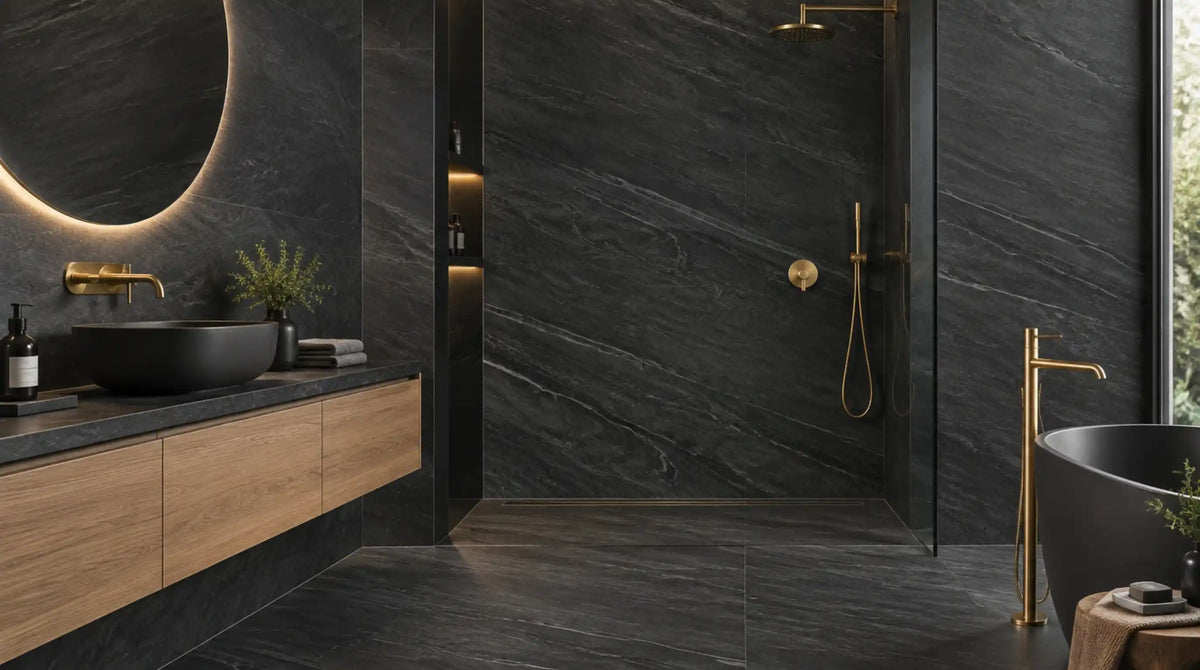
Black bathroom tiles work best when the finish does the talking. A polished black marble effect wall behind a floating vanity throws light back across the room and doubles its apparent depth. A matt black floor absorbs that same light, grounding the space so brass taps and oak grain feel warmer against it. The colour is rarely the hard part. The real decision sits in the finish, the tile format, and the grout colour you pair with them.
Why Black Reads as Luxury in One Bathroom and as a Cave in Another
Two bathrooms can use the exact same tile and feel like opposites: one looks like a boutique hotel suite, while the other feels closed in and slightly gloomy. The tile is not the variable. Light is.
Every surface in a room either returns light or swallows it, and black surfaces swallow most of what reaches them. That is precisely why black works so well as a backdrop for warm metals, pale stone and greenery. It is also why a black bathroom planned with white-bathroom lighting almost always disappoints.
Light Reflectance Value: The Number Behind "It Feels Too Dark"
Light Reflectance Value, or LRV, measures how much light a surface bounces back. The scale runs from 0 to 100, where a pure white tile sits above 80 and most black porcelain lands below 10.
That gap matters more than any design rule, because a room finished in black returns roughly a tenth of the light that an equivalent white room returns. Same window, same bulbs, a completely different atmosphere.
Finish changes how that small amount of light behaves. Polished black reflects it like a dark mirror and sends it travelling in one direction, while matt black scatters almost nothing and reads as a solid, velvety plane. Neither finish is better. They simply perform different jobs, and most bathrooms benefit from using both.
How Much Light a Black Bathroom Genuinely Needs
Plan for roughly double the lighting you would specify for a pale scheme. Ceiling downlights alone are the most common mistake: on gloss tiles they create bright hot spots with heavy shadow pooling between them.
Layer the light instead. Put wall lights or a backlit mirror at face height, where you actually need illumination, and add a low-level strip beneath a floating vanity to lift the floor. Choose warm white lamps around 3000K. Cool white turns black tiles slightly blue and clinical.
Natural light does the rest. A bathroom with a generous window can carry black across every wall, while a windowless cloakroom usually performs better with black on a single feature wall and a lighter tone elsewhere.
Keep 30 LRV Points Between Your Floor and Your Walls
There is a practical reason to avoid tiling a small space in a single black tone. When floor and wall share the same value, the edge between them disappears and your eye loses the corner of the room entirely.
UK accessibility guidance under Approved Document M recommends a difference of at least 30 LRV points between surfaces that need to be told apart. It is written for public buildings, yet it remains excellent advice for a family home, particularly one used by older relatives or young children.
The remedy is simple, and it looks intentional anyway. Pair a matt black floor with a charcoal or warm grey wall, or run black walls above a paler stone effect floor. That contrast gives the room its visual structure.

Matt, Polished or Textured? The Black Finish Decision Matrix
Black bathroom tiles are dark glazed or full-body ceramic and porcelain tiles used on shower walls, floors and splashbacks. Each finish behaves differently in daily use. Polished black reflects light and shows water marks, while matt black hides marks but holds soap scum in its texture.
Choose the finish first. Everything else follows from it.
Polished and High-Gloss Black: Maximum Depth, Maximum Water Spotting
Nothing else delivers that lacquered, liquid look. Polished black marble effect porcelain gives a small bathroom real drama, and the reflection genuinely makes walls recede.
There is a trade-off worth understanding before you order, as polished black shows water spotting more clearly than any other tile colour on the market. Dry droplets leave pale mineral rings that are invisible on white tile and obvious on black.
This is a maintenance habit rather than a defect, and a rubber squeegee kept in the shower resolves it in roughly fifteen seconds a day. Households in hard-water areas should treat that as part of the specification, not an afterthought.
Keep high gloss on walls. Polished black on a bathroom floor is beautiful and slippery, and it rarely suits a family setting.
Matt Black: The Forgiving Everyday Surface
Matt black is the practical default for floors and for anyone who does not want a daily squeegee routine. The surface scatters light, so water marks and fingerprints largely vanish.
The trade-off runs the other way. Matt glazes, particularly anti-slip ones, carry a fine micro-texture that grips the sole of your foot. That same texture holds soap film and shampoo residue, and left unattended it gradually builds into a dull grey bloom across the tile.
Regular cleaning with a pH-neutral product prevents it completely. Our matt bathroom tile buying guide covers the finish in more depth across colours and formats.
Sugar, Fluted and Split-Face Black Textures
Textured blacks sit between the two extremes. Sugar-effect tiles carry a fine sparkle that catches light without committing to full reflection. Fluted and ridged panels throw soft vertical shadows and add real depth behind a bath or basin.
These surfaces are excellent at concealing marks, though they are harder to wipe clean quickly, so they suit feature walls considerably better than shower floors.
| Finish | Light behaviour | Water spots | Best position | Cleaning effort |
|---|---|---|---|---|
| Polished / high gloss | Mirror-like, high reflection | Very visible | Walls, feature panels | High (squeegee daily) |
| Matt | Scatters light, no glare | Barely visible | Floors, full walls | Moderate (weekly wash) |
| Anti-slip matt | Low reflection, textured grip | Barely visible | Wet room and shower floors | Moderate to high |
| Sugar effect | Fine sparkle, part reflective | Low visibility | Shower walls, niches | Moderate |
| Fluted / split face | Shadow and relief | Hidden by texture | Feature walls only | Low frequency, careful method |

What Happens When a Black Tile Chips: Full-Body Versus Glazed Porcelain
This is the detail almost nobody mentions before you buy, and it is the one people regret later.
Why a Pale Biscuit Body Shows on a Dark Floor
Most black tiles are glazed, which means the colour sits in a thin layer on top of a clay body that is usually pale grey or beige. Knock the edge with a dropped shampoo bottle and the glaze chips away.
On a white tile, that chip is almost invisible. On a black floor it becomes a bright pale scar that your eye finds every single time you walk in. Doorways, shower thresholds and the area beside the toilet take the most knocks.
Where Full-Body Black Porcelain Earns Its Premium
Full-body porcelain carries the same colour and mineral mix through the entire thickness of the tile. Chip it, and the exposed material is still black.
The difference in cost is modest, while the difference over ten years of ownership is significant. Full-body remains the sensible choice for any black floor, for stair nosings, and for shower thresholds. Glazed black remains perfectly sensible on walls, where impacts are rare.
Natural black stone behaves differently again, since real marble is porous and requires periodic sealing. The full maintenance picture is set out in our guide to black marble bathroom floor tiles and their long-term cost.
Settle the Slip Rating Before You Settle the Style
A black floor is a safety decision before it is a design decision. Dark tiles conceal standing water, and you cannot see the puddle you are about to step in.
Wet Rooms, Shower Trays and Family Bathroom Floors
Aim for R10 as a minimum on a domestic bathroom floor, and R11 where water falls directly, such as an open walk-in shower or a wet room. Those ratings come from the DIN 51130 ramp test and appear on most technical datasheets. For UK specification work, a pendulum test value of 36 or above marks low slip potential.
Save polished black for the walls, and choose a matt or structured surface wherever water lands directly.
Dust, Hair and Footprints: The Daily Reality of a Dark Floor
Be honest with yourself about this one. Black floors show light-coloured dust, hair and talc the way white floors show mud, and a household with a pale-coated dog will notice the difference daily.
Surface texture helps enormously here. A slightly structured matt surface breaks up the visual field and conceals far more than a perfectly flat one, and fewer grout lines leave fewer places for debris to gather. Browse the anti-slip bathroom floor tiles collection to compare rated surfaces before committing to a floor.

Choose a Grout Colour That Flatters the Tile and the Tiler
Grout covers a tiny share of any tiled wall, often little more than one percent of the surface. On black tile it can be half of what you actually notice.
Why White Grout Exposes Every Lippage Error
Tilers are blunt about white grout on black tile, and they are right. A bright white line turns every joint into a drawn graphic, and your eye follows that grid instead of the expensive tile you actually paid for.
That is fine when the tiling is flawless. It is punishing when it is not. Any lippage, any joint that runs a millimetre wide of its neighbour, becomes impossible to ignore. White grout demands a confident fitter and a genuinely flat wall.
It is also the hardest colour to maintain. Shower walls, splashbacks and floors all darken white grout over time, and the contrast against black makes that ageing obvious.
Gunmetal, Charcoal and the Fitter-Proof Middle Ground
Mid-grey, silver grey and gunmetal are the tiler's recommendation for good reason. The joint reads as a soft shadow rather than a hard line, so small alignment variations simply disappear. The tile stays the hero.
Charcoal or black grout goes further and creates an almost seamless surface, which is the right answer for large-format walls where you want an unbroken plane of colour.
Epoxy Grout for Black Shower Enclosures
Standard cement grout is slightly porous, so in a shower it gradually absorbs soap, shampoo and body oils, and dark cement grout can fade patchily as a result.
Epoxy grout has effectively zero porosity and holds its colour. It costs more and takes longer to apply, so it is worth reserving for the shower enclosure and the wet room floor rather than the whole bathroom.
Preventing Grout Haze on Dark Polished Porcelain
Here is the problem that ruins more black installations than any other. Grout haze is the thin cement film left sitting across the surface after grouting. On white tile you barely see it. On black polished porcelain it reads as a permanent grey cloud, and homeowners often think the tiles arrived faulty.
Prevention is straightforward when your fitter plans for it properly:
- Grout in small sections rather than whole walls at once.
- Change the sponge water constantly, because dirty water spreads the film rather than lifting it.
- Use a clean edge of the sponge for every pass.
- Make a final polish with a dry microfibre cloth once the surface has hazed slightly.
- If a film remains, use a proprietary grout haze remover, never an abrasive cream cleaner.
Ask your tiler how they intend to handle haze on dark polished tile before work starts. A capable fitter will already have an answer.
| Grout colour | Visual result | Fitting skill required | Long-term upkeep |
|---|---|---|---|
| Bright white | Bold graphic grid, Victorian look | Very high | Highest, discolours visibly |
| Silver / mid grey | Soft shadow line, balanced | Moderate | Low |
| Gunmetal / dark grey | Subtle definition, modern | Moderate | Low |
| Charcoal / black | Near seamless surface | Forgiving | Low, epoxy holds colour best |
| Glitter grout | Decorative sparkle in the joint | Moderate | Low |
Grout-Line Density: Why Format Decides Whether Black Feels Calm or Busy
Tile format changes the character of black more than any pattern choice. The reason is arithmetic.
Large Format Panels With Minimal Joints
A wall tiled in 600x1200mm panels carries a fraction of the grout-line length of the same wall in mosaic. Fewer lines mean the black reads as one continuous surface, which is exactly the effect that makes a compact bathroom feel larger.
Rectified edges allow joints as tight as 2mm, so the grid almost vanishes. Larger 1200x1200mm slabs push that further and suit generous walls and open shower enclosures. Buying factory-direct keeps large-format porcelain at a price that competes with far smaller tiles, which is where Tiles Paradise pricing tends to surprise people.
Metro, Hexagon and Mosaic: When Extra Joints Are Worth It
Small formats are not the enemy. They are simply a different statement. A black hexagon floor or a vertically stacked kit-kat panel uses grout lines as pattern, deliberately.
Use them with deliberate intent. Small format works beautifully on one feature area, such as a shower niche, an alcove or the floor alone. Across every surface of a small room it can feel restless.
Making a Small Bathroom Feel Larger in Black
Three moves do most of the work. Run the same large-format tile from floor to wall so the boundary softens, and keep the grout close to the tile tone. Choose one reflective surface, usually the wall behind the mirror, to bounce light back into the room.
The full range of finishes and formats sits in the black bathroom wall and floor tile collection, which is the quickest way to compare matt against polished at the same size.

Pairing Black With Brass, Oak, Terrazzo and Warm White
Black is fundamentally a backdrop colour. It flatters almost anything placed against it, which is why designers reach for it so consistently.
Warm Metals Against Cool Black
Brushed brass and aged gold are the natural partners. That warmth cuts through the coolness of black porcelain and stops the room from feeling severe. Chrome works too, though it reads more clinical and suits gloss finishes better than matt.
Oak and walnut do the same job through grain rather than shine. A timber vanity against a black wall is one of the most reliable combinations in bathroom design.
The Half-Tiled Wall as a Brightness Release Valve
Tiling black to waist height and painting above it is an underrated move. The room keeps its drama at eye level while gaining light above, and it cuts the tile budget noticeably.
Terrazzo and marble effect blacks add a third option, where pale flecks and veining break up the mass of colour without introducing a second material.

Living With Black Tiles in a Hard-Water Area
Most of the UK sits in a hard-water region. Black tile shows limescale earlier than any other colour, so the cleaning routine matters.
The pH-Neutral Weekly Routine
Warm water, a pH-neutral tile cleaner and a microfibre cloth handle almost every situation. Rinse properly, as leftover cleaner residue dulls black surfaces faster than dirt does.
Keep a squeegee in the shower if you have chosen polished tile. Thirty seconds of work removes the droplets before dissolved minerals dry into visible rings. Our guide to cleaning bathroom tile and grout sets out the full routine.
Cleaners That Permanently Damage Black Tiles
A few products cause real harm, and the damage cannot be reversed:
- Acidic limescale removers etch polished glazes and leave a dull patch that no amount of buffing restores.
- Abrasive cream cleaners micro-scratch gloss black and create a permanent cloudy halo.
- Bleach strips pigment from cement grout, so dark joints turn patchy and uneven.
- Steam cleaners used aggressively can lift grout from the joint edge over time.
If limescale has already built up, use a descaler formulated for glazed porcelain, work on a small hidden area first, and rinse thoroughly.
Black Tile Choices by Bathroom Type
| Bathroom type | Recommended finish | Best format | Slip priority | Grout tone |
|---|---|---|---|---|
| Small ensuite | Polished walls, matt floor | 600x1200mm large format | R10 floor | Charcoal, near seamless |
| Wet room | Matt or structured throughout | 600x600mm floor, large wall panels | R11 floor, essential | Dark epoxy in wet zone |
| Family bathroom | Matt, full-body porcelain floor | 600x1200mm walls, 600x600mm floor | R10 minimum | Mid grey, forgiving |
| Downstairs cloakroom | Gloss or sugar effect feature wall | Metro, hexagon or fluted panel | Standard | Grey or contrast, by design |
| Windowless internal room | One black feature wall only | Large format, reflective | R10 floor | Match tile tone |
See the Black in Your Own Light Before You Commit
Black is the one colour that never looks the same in a showroom as it does at home. Showroom lighting is bright, even and usually cool. Your bathroom is none of those things.
Order physical samples and live with them for a few days, propping them against the wall where the finished tile will eventually go. Look at them in morning daylight, under your own bulbs at night, and wet as well as dry. A polished black that looked flat under shop lights often comes alive beside a window.
Sample boxes are sent direct to your door at Tiles Paradise, and full-pallet pricing applies once a project reaches volume. Buying factory-direct is what keeps large-format porcelain affordable on a domestic refurbishment.
Black Bathroom Tile Questions, Answered
Do black tiles make a small bathroom look smaller?
Not automatically. Small dark rooms shrink when the grout grid is busy and the lighting is flat. Large-format black tile with close-toned grout and layered lighting can make a compact bathroom feel deeper, because the corners stop announcing themselves.
What grout colour goes with black bathroom tiles?
Mid grey or gunmetal is the safest and most flattering choice. Charcoal or black gives a seamless modern surface. White grout creates a striking graphic look but demands flawless tiling and more upkeep.
Are black bathroom tiles hard to keep clean?
They are not harder to clean, but marks show sooner. Polished black reveals water spots and limescale, while matt black hides marks and holds soap film instead. A pH-neutral weekly clean handles both.
Should black tiles go on the walls, the floor, or both?
Both works well in rooms with good natural light. In smaller or windowless spaces, use black on the walls or the floor and pair it with a lighter surface. Keep at least 30 LRV points between the two so the room keeps its shape.
Is matt or gloss black better for a shower?
Gloss suits shower walls, where the reflection adds depth and wiping is easy. Shower floors need a matt or structured surface rated R11 for grip. Most successful showers combine the two.