





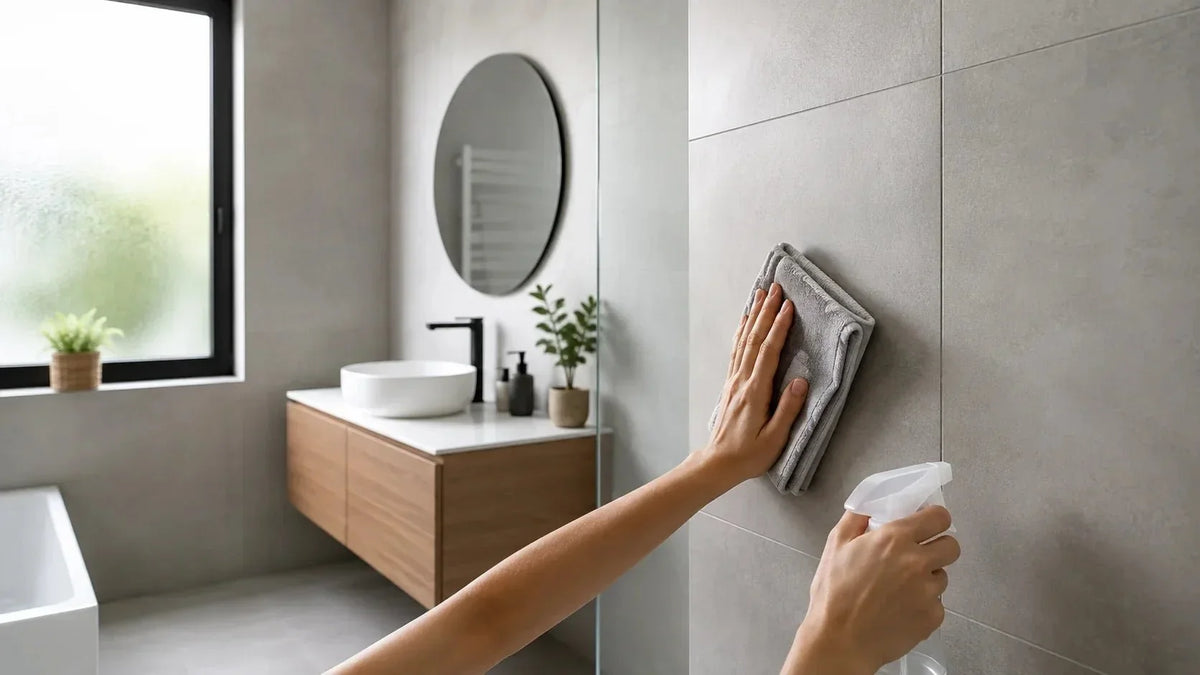
Cleaning bathroom tiles means removing dirt, soap scum, limescale and mould from the tiles and the grout without damaging either. The easiest way is warm water with a little washing-up liquid, a soft sponge, a clean rinse and a dry microfibre cloth. This works on most porcelain and ceramic bathroom tiles.
Harder jobs need a different cleaner. Dirty grout needs a bicarb paste. Limescale needs a mild acid such as white vinegar. Black mould needs a mould spray or hydrogen peroxide. Real marble and other natural stone need a stone-safe cleaner with no acid at all.
This guide shows you each method step by step. It also tells you which products are safe for your tiles, and which ones cause damage you can't undo.
How Do I Clean Bathroom Tiles Step by Step?
To clean bathroom tiles, follow these six steps.
1. Check your tile type. Porcelain and glazed ceramic tiles are easy to clean. Real marble, travertine and limestone need gentler care.
2. Remove loose dirt. Wipe wall tiles with a dry cloth. Sweep or vacuum floor tiles.
3. Put on a mild cleaner. Mix a few drops of washing-up liquid into warm water. Spray or wipe it on and leave it for 2 to 3 minutes.
4. Wipe and scrub gently. Use a soft sponge on the tiles and a soft brush on the grout lines.
5. Rinse with clean water. This removes soap that would dry as a dull film.
6. Dry the tiles. Buff with a clean microfibre cloth to stop water spots and streaks.
For a normal bathroom, this routine takes about 10 to 15 minutes. Do it once a week and you will rarely need a deep clean.
What Do You Need to Clean Bathroom Tiles?
You need a few simple tools and three or four basic cleaners. Most of them are already in your home.
Listed below are the tools for cleaning bathroom tiles.
• Two microfibre cloths, one to wash and one to dry
• A soft, non-scratch sponge
• A soft nylon grout brush or an old toothbrush
• A spray bottle
• A mop and two buckets for the floor
• A squeegee for shower walls
• Rubber gloves
Listed below are the cleaners and what each one does.
|
Cleaner |
Best for |
Safe on |
Take care with |
|
Washing-up liquid in warm water |
Weekly cleaning and light soap scum |
All tiles and grout |
Too much soap leaves a film |
|
Bicarb paste (baking soda) |
Dirty grout and marks |
All tiles and grout |
Rinse it all off |
|
White vinegar and water |
Limescale and water spots |
Porcelain and glazed ceramic |
Never on marble or other stone. Short contact on grout |
|
3% hydrogen peroxide |
Mould stains and grey grout |
Porcelain, ceramic and light grout |
Test on coloured grout. Not for stone |
|
Mould and mildew spray |
Black mould |
Tiles and grout, as the label says |
Never mix with other cleaners |
|
Stone-safe (pH-neutral) cleaner |
Marble and natural stone |
Every tile type |
None |
What Is the Best Cleaner for Bathroom Tiles?
The best cleaner for most bathroom tiles is warm water with a few drops of washing-up liquid. It is cheap, gentle and safe on porcelain, ceramic, grout and sealed stone. Use about half a teaspoon in a 1 litre spray bottle. More soap does not clean better. It only leaves a sticky film that pulls in dirt.
For a set problem, pick the cleaner that fits it.
• Soap scum: washing-up liquid first, then bicarb paste if needed.
• Limescale: white vinegar and water, or a limescale remover. Use these on porcelain and ceramic only.
• Grey grout: bicarb paste.
• Black mould: a mould and mildew spray, or 3% hydrogen peroxide.
• Real marble or natural stone: a stone-safe cleaner, and nothing acidic.
If you prefer natural cleaners, hot water, bicarb and white vinegar handle most jobs. A shop-bought bathroom spray is fine too. Read the label first. Make sure it says it is safe for your tile, and rinse after use.
How Do You Clean Bathroom Wall Tiles?
To clean bathroom wall tiles, loosen the grime with steam, spray a mild cleaner, wipe from top to bottom, then rinse and dry. Working from the top means dirty drips land on tiles you have not cleaned yet.
1. Run a hot shower for 3 to 5 minutes with the door shut. The steam softens soap scum.
2. Open a window. Then spray your soapy water on one section at a time, about 1 metre wide.
3. Leave it for 2 to 3 minutes. Letting it soak means less scrubbing.
4. Wipe in small circles with a soft sponge, starting at the top.
5. Brush the grout lines with a soft brush.
6. Rinse with clean warm water. Change the water when it looks cloudy.
7. Dry with a microfibre cloth.
For high tiles above the bath or shower, use a flat microfibre mop on a long handle. It is safer than standing on the edge of the bath.

How Do You Clean Shower Tiles Without Scrubbing?
To clean shower tiles without scrubbing, let the cleaner do the work. Spray soapy water or a bathroom cleaner on warm, steamy tiles and leave it for 5 to 10 minutes. Wipe with a microfibre cloth, rinse with the shower head and squeegee dry. A steam cleaner also lifts grime with almost no effort on glazed tiles. The less often you let scum build up, the less you ever need to scrub.
How Do You Clean Bathroom Floor Tiles Without Streaks?
To clean bathroom floor tiles without streaks, sweep first, mop with a weak soap mix, go over the floor with clean water and then dry it. Streaks come from three things: dirty mop water, too much cleaner, and letting the floor dry on its own.
1. Sweep or vacuum. Grit under a mop can scratch the tiles.
2. Fill one bucket with warm water and a few drops of washing-up liquid. Fill a second bucket with clean water.
3. Mop in straight lines that overlap. Start in the far corner and work back towards the door.
4. Rinse the mop in the clean bucket often.
5. Mop once more with clean water only.
6. Dry the floor with a dry mop or an old towel.
Polished floor tiles get slippery when wet. Dry them straight away and keep socks off them until they are dry.
Textured and anti-slip floor tiles need a brush, not just a mop. The section on anti-slip tiles below explains why.
How Do You Clean Grout Between Bathroom Tiles?
To clean grout, scrub it with a bicarb paste, leave it for 10 to 15 minutes, then rinse. Grout gets dirty faster than tiles. Most grout is made from cement, so it soaks up soap, dirt and damp. The tiles next to it soak up almost nothing.
1. Mix 3 parts bicarb with 1 part water into a thick paste.
2. Spread it along the grout lines with an old toothbrush or grout brush.
3. Leave it for 10 to 15 minutes.
4. Scrub along the line, not across it. This keeps the grout smooth.
5. Rinse well with clean water and wipe dry.
For stubborn stains, spray a little vinegar and water over the paste. It will fizz. Leave it for 5 minutes, then scrub and rinse. Only do this now and then, as acid slowly wears away cement grout.

How Do I Get Grout White Again?
To get grout white again, use a paste of bicarb and 3% hydrogen peroxide. Leave it for 10 to 15 minutes, scrub along the line and rinse well. Hydrogen peroxide lifts stains and mould marks. Use it on white or light grout, as it can fade coloured grout.
If the grout turns grey again within a few days, the stain goes all the way through. A grout pen or new grout is the fix then.
How Can I Clean Grout Without Scrubbing?
To clean grout with less scrubbing, give the cleaner more time. Spread bicarb paste or an oxygen-based grout cleaner and leave it for 15 to 30 minutes, or as long as the label says. Then a light brush and a rinse is enough. A steam cleaner with a narrow nozzle also lifts dirt from grout with little effort. Use steam only on glazed tiles with grout that is in good shape.
Should You Seal Grout After Cleaning?
Yes, sealing cement grout after a deep clean helps it stay clean for longer. The sealer stops water and dirt soaking in. Let the grout dry fully first, ideally overnight.
To check if your grout needs sealing, drip a little water on it. If it turns darker within a minute, it is soaking in and needs sealing. Most homes reseal every 6 to 12 months. Epoxy grout does not need sealing.
How Do You Remove Limescale From Bathroom Tiles?
To remove limescale from porcelain or ceramic tiles, soak a cloth in 1 part white vinegar and 1 part warm water, press it on the marks for 5 to 10 minutes, then wipe, rinse and dry. Limescale, also called calcium build-up or hard water marks, is the chalky white crust left when hard water dries. It builds up around taps, on shower walls and along the lowest row of tiles.
1. Mix equal parts white vinegar and warm water.
2. Soak a cloth and press it flat onto the limescale. A cloth stays on a wall better than a spray.
3. Leave it for 5 to 10 minutes.
4. Wipe with a soft sponge. Use a plastic scraper on thick spots, never metal.
5. Rinse well with clean water and dry.
On the grout itself, use bicarb paste and a brush rather than soaking it in vinegar. For heavy build-up, repeat the steps rather than using neat acid. A shop-bought limescale remover is stronger. Most are acid-based, so follow the label and rinse well.
Never use vinegar, lemon or limescale remover on marble, travertine, limestone or real terrazzo. Acid eats into these stones and leaves dull marks that cleaning cannot fix. Use a stone-safe cleaner instead.

Why Does Limescale Keep Coming Back?
Limescale comes back because hard water leaves new minerals behind every time it dries on the tiles. The harder your water, the faster it builds up. The Drinking Water Inspectorate classes water as hard above 200 mg/l and very hard above 300 mg/l. Your water company can tell you the hardness for your postcode.
Listed below is our suggested limescale schedule, using the Drinking Water Inspectorate's hardness bands.
|
Water hardness |
Level (mg/l) |
How often to treat limescale |
|
Soft |
Up to 100 |
Every 6 to 8 weeks |
|
Slightly or moderately hard |
100 to 200 |
Every 3 to 4 weeks |
|
Hard |
200 to 300 |
Every 2 weeks |
|
Very hard |
Over 300 |
Every week |
Drying the tiles after each shower is the best way to stop limescale, whatever your water.
How Do You Get Rid of Black Mould on Bathroom Tiles?
To get rid of black mould, protect yourself, wash off soap scum, then put a mould spray or 3% hydrogen peroxide on the grout. Leave it for 10 to 15 minutes, scrub and rinse. Mould grows in grout and silicone, not on the shiny tile face, because those joints stay damp for longer.
UK government guidance on damp and mould says to wear a mask, gloves and goggles when cleaning mould. It says to keep the door shut and a window open during and after the clean. It also says larger areas of mould should only be dealt with by professionals.
1. Put on gloves, goggles and a mask. Open a window and close the door.
2. Wash the area with warm soapy water. Mould sprays can't reach mould under a layer of soap.
3. Spray a mould and mildew cleaner, or 3% hydrogen peroxide, onto the grout.
4. Leave it for 10 to 15 minutes.
5. Scrub along the grout line with a soft brush.
6. Rinse and dry the area fully.
Many mould sprays contain bleach. Never use them with vinegar, limescale remover or toilet cleaner, even one after the other without rinsing.
How Do You Remove Mould From Silicone Sealant?
Most of the time, you can't fully clean mould out of silicone. Mould grows into the silicone, so a spray only fades the marks. If black spots stay after a mould spray, cut out the old silicone. Clean and dry the joint, then run a new bead of bathroom silicone that says it resists mould.
Why Does Mould Keep Coming Back on Grout?
Mould comes back when the bathroom stays damp. Cleaning removes the mould you can see, but only drying and fresh air stop it returning. Run the extractor fan while you shower and for at least 15 minutes after. England's building rules on ventilation (Approved Document F) say a bathroom fan in a room with no opening window should keep running for at least 15 minutes after you leave. Also open a window, squeegee the walls and seal the grout.
How Do You Clean Soap Scum Off Shower Tiles?
To clean soap scum off shower tiles, warm them with shower steam, spray soapy water, leave it for 5 minutes, then scrub with bicarb paste on a soft sponge and rinse. Soap scum is the grey, sticky film made when soap mixes with minerals in hard water. It makes tiles look dull and traps dirt.
For heavy scum on porcelain or glazed ceramic, wipe on vinegar and water (1 to 1) after the soap wash. Vinegar breaks down the mineral part of the scum. Rinse well afterwards.
Bar soap leaves more scum than liquid soap or shower gel. Switching makes your shower tiles easier to keep clean.
How Do You Clean Each Type of Bathroom Tile Safely?
You clean each tile based on what it is made of and how it is finished. Porcelain and glazed ceramic are the easiest to look after. Natural stone is the most delicate. The finish, whether polished, matt or textured, changes how you wipe and dry.
|
Tile type |
Everyday clean |
Limescale |
Never use |
|
Glazed porcelain |
Washing-up liquid in warm water |
Vinegar and water |
Wire wool or scouring pads |
|
Glazed ceramic |
Washing-up liquid in warm water |
Vinegar and water |
Gritty powders or scouring pads |
|
Polished (high gloss) porcelain |
Weak soapy water, then a dry buff |
Vinegar and water, rinse, buff |
Hard rubbing with cream cleaners |
|
Matt porcelain |
Weak soapy water and an extra rinse |
Vinegar and water |
Too much cleaner |
|
Anti-slip and textured |
Soft deck brush and soapy water |
Vinegar and water |
A flat mop on its own |
|
Real marble, travertine, limestone |
Stone-safe cleaner |
A stone-safe scale product |
Vinegar, lemon, bleach, limescale remover |
|
Mosaic |
Slim detail brush |
Vinegar and water on glass or porcelain |
Stiff brushes on old grout |
How Do You Clean Porcelain Bathroom Tiles?
To clean porcelain bathroom tiles, wipe them with warm soapy water, rinse and dry. Porcelain soaks up almost no water. Under the British and European tile standard (BS EN 14411), porcelain takes in 0.5% of its weight in water or less. So stains stay on the surface and wipe away. Glazed porcelain does not need sealing.
How Do You Clean Ceramic Bathroom Tiles?
To clean ceramic bathroom tiles, use mild soapy water and a soft sponge. Ceramic tiles have a glass-like glaze that keeps water out, but the glaze can scratch. Avoid scouring pads, wire wool and gritty powders. Dirt settles into scratches and makes the tiles look dull for good.
How Do You Clean Polished Porcelain Tiles Without Streaks?
To clean polished porcelain tiles without streaks, use very little soap, rinse with clean water, then buff dry with a clean microfibre cloth. Polished tiles show every drip and smear. Streaks almost always mean soap was left behind. One more wipe with clean water and a dry buff fixes it.
How Do You Clean Matt Bathroom Tiles?
To clean matt bathroom tiles, use less cleaner and rinse more. Matt tiles hide water spots well, but their fine texture holds on to soap. Over months this builds up into a grey haze. A soft brush works better than a cloth for a deeper clean.
How Do You Clean Anti-Slip and Textured Floor Tiles?
To clean anti-slip tiles, scrub them with a soft nylon deck brush and soapy water, then rinse well. These tiles grip because the surface is rough. Dirt sits in the tiny dips, where a mop just slides over it. Brush in one direction, then rinse twice. Leftover soap makes the floor slippery, which undoes the point of anti-slip tiles.

Is Marble Effect Porcelain Cleaned the Same Way as Real Marble?
No. Marble effect porcelain is cleaned like any porcelain tile, so vinegar and water is fine on it. Real marble needs gentle, acid-free care. Many bathrooms have marble look porcelain, so it is worth checking which one you have.
Listed below are three ways to tell them apart.
• Check the order or the box. The product name says porcelain, ceramic or marble. On Tiles Paradise, the product title names the material, such as porcelain or ceramic.
• Look at the back of a spare tile. Porcelain has a plain back, often with a ridged pattern. Real stone looks like stone all the way through.
• Look for repeats. Printed porcelain patterns repeat every few tiles. Veins in real marble never repeat.
How Do You Clean Real Marble, Travertine and Limestone?
To clean real marble, travertine or limestone, use a stone-safe (pH-neutral) cleaner and a soft cloth. Never use vinegar, lemon, bleach or limescale remover. These stones are made of calcium carbonate, which acid dissolves. Acid leaves dull patches called etching. Etching is damage, not dirt, and it needs polishing to fix. Seal natural stone about once a year, or when water stops beading on the surface.
How Do You Clean Mosaic Bathroom Tiles?
To clean mosaic tiles, focus on the grout, as it covers far more of the surface than with large tiles. Use a slim detail brush and bicarb paste. Rinse with a well wrung sponge so you don't flood the joints. Seal the grout about once a year.
Can You Use Household Products on Bathroom Tiles?
Yes, most household cleaners are safe on porcelain and ceramic tiles, but a few harm grout or stone. Here is a quick yes or no for the products people ask about most.
Can You Clean Bathroom Tiles With Vinegar?
Yes, on porcelain and glazed ceramic tiles, if you mix it 1 to 1 with water and rinse afterwards. Keep it on grout for short spells only. Don't use it on real marble, travertine, limestone or terrazzo.
Can You Clean Bathroom Tiles With Bleach?
Yes, but only diluted, and only on white grout or glazed tiles. Bleach fades coloured grout, and regular use wears down cement grout. Never mix bleach with vinegar, limescale remover, toilet cleaner or ammonia. The UK Health Security Agency warns that bleach mixed with acid gives off chlorine gas, and bleach mixed with ammonia gives off chloramines. Open a window and wear gloves.
Can You Clean Bathroom Tiles With Baking Soda or Bicarb?
Yes. Bicarbonate of soda, also called bicarb or baking soda, is safe on all tiles and grout. As a paste, it lifts grime from grout and marks from tiles. Rinse it off fully, as dried powder leaves a white film.
Can You Mix Baking Soda and Vinegar to Clean Tiles?
Yes, for grout on porcelain and ceramic, but not for a stronger cleaner. The two cancel each other out. The fizz is what helps, as it lifts dirt out of the grout lines. So spread the paste first, then spray vinegar on top just before you scrub.
Can You Clean Bathroom Tiles With Washing-Up Liquid?
Yes. Washing-up liquid is the safest everyday tile cleaner. Use a few drops per litre of warm water, and rinse after, or the tiles will look dull.
Can You Clean Bathroom Tiles With Hydrogen Peroxide?
Yes. 3% hydrogen peroxide is good for mould stains and grey grout on porcelain and ceramic tiles. Test it on a small patch of coloured grout first. Don't use it on natural stone.
Can You Use The Pink Stuff or Cream Cleaners on Tiles?
Yes, with care. Paste and cream cleaners contain a fine grit. They shift tough marks on glazed tiles. On polished or high gloss tiles, hard rubbing can dull the shine. Test on a hidden spot first and rinse well.
Can You Use Toilet Cleaner or Harpic on Bathroom Tiles?
No. Toilet cleaners are made for toilet bowls, and many contain strong acid or bleach. Acid can eat into grout and stone. Bleach products must never meet acids. The same goes for strong acids such as brick acid (hydrochloric acid). They eat into grout, harm stone and give off harmful fumes. Use a tile or bathroom cleaner instead.
Can You Clean Bathroom Tiles With Sugar Soap?
Yes, on glazed porcelain and ceramic tiles. Sugar soap cuts through grease and grime. Rinse it off with clean water after. Check the label before using it on natural stone.
Can You Use a Magic Sponge on Tiles?
Yes, with care. Magic sponges (melamine sponges) work like very fine sandpaper. They are handy on matt tiles and grout, but they can dull polished or high gloss tiles. Test a hidden spot first.
Can You Use a Steam Cleaner or Steam Mop on Bathroom Tiles?
Yes, on glazed porcelain and ceramic tiles with grout in good condition. Steam lifts grime from grout with no chemicals. Don't steam natural stone, cracked or crumbly grout, or silicone. Vinyl and SPC floors are not tiles, and many makers advise against steam mops on them.
What Should You Never Use on Bathroom Tiles?
Some products and habits cause damage you can't reverse. Listed below are the ones to avoid.
• Mixing bleach with vinegar, limescale remover, toilet cleaner or ammonia, as it releases toxic gas
• Vinegar, lemon or any acid on marble, travertine, limestone or real terrazzo
• Wire wool, metal scrapers and green scouring pads on glazed tiles
• Strong bleach on coloured grout
• A pressure washer indoors, as it can force water behind the tiles
• Wax or oil-based polish on tile floors, as it makes them slippery and holds dirt
• Too much cleaner, as it leaves a sticky film
How Often Should You Clean Bathroom Tiles?
You should give bathroom tiles a quick clean every week and a deeper grout clean every month. A 30 second squeegee after each shower does more than any product.
|
Task |
How often |
Time it takes |
|
Squeegee shower walls |
After every shower |
About 30 seconds |
|
Wipe wall tiles and mop the floor |
Every week |
10 to 15 minutes |
|
Clean the grout with bicarb paste |
Every month |
20 to 30 minutes |
|
Treat limescale |
Every 1 to 8 weeks, based on your water |
About 15 minutes |
|
Seal cement grout |
Every 6 to 12 months |
30 to 60 minutes |
|
Seal natural stone |
About once a year |
Depends on the room |
|
Replace mouldy silicone |
When mould is inside it |
About 1 hour |
How Do You Keep Bathroom Tiles Clean for Longer?
You keep bathroom tiles clean for longer by keeping them dry. Water that dries on tiles leaves limescale, and damp grout grows mould.
Listed below are five habits that make the biggest difference.
1. Squeegee the shower walls after every shower.
2. Run the extractor fan during your shower and for at least 15 minutes after. Open a window if you can.
3. Seal cement grout every 6 to 12 months.
4. Use liquid soap or shower gel instead of bar soap.
5. Keep bottles on a shelf or caddy, not on the tiles, so rings and damp can't form.

What If Your Bathroom Tiles Still Look Dirty After Cleaning?
If your tiles still look dirty after a proper clean, the problem is usually damage, not dirt. Listed below are the common signs and what to do.
• Grout still dark after cleaning: the stain runs right through. A grout pen can hide it on walls. On floors, or where grout is cracked, it is better to learn how to regrout tiles. Pick a grout that resists mould, such as Mapei Ultracolor Plus grout, which Mapei describes as mould-resistant and water-repellent.
• Grout crumbling or missing: water can get behind the tiles. Regrout soon.
• Dull patches on real marble: this is etching. It needs a stone polish or a professional.
• Scratched or chipped glaze: it can't be cleaned away. Replace the tile, and keep a few spares after any tiling job.
• Old tiles you no longer like: tiling over old tiles can be quicker than stripping them, as long as they are firmly stuck.
How Do You Clean Tiles After Grouting?
To clean tiles after grouting, wipe off the grout haze with a damp sponge once the grout firms up, then buff with a dry cloth once it sets. Timing matters, so check how long grout takes to dry before you use the shower. If you are doing the job yourself, our guide on how to grout tiles covers each step. For haze that is still there after a week, use a grout haze remover made for porcelain and follow its label.
Which Bathroom Tiles Are Easiest to Keep Clean?
Glazed porcelain tiles in a large size with thin grout lines are the easiest bathroom tiles to keep clean. Porcelain doesn't soak up stains, and bigger tiles mean less grout to scrub.
Listed below is how tile size changes the amount of grout in each square metre. We worked this out from the tile sizes, ignoring cut tiles at the edges.
|
Tile size |
Grout line length per square metre |
|
5 x 5 cm mosaic |
About 40 metres |
|
10 x 10 cm |
About 20 metres |
|
30 x 60 cm |
About 5 metres |
|
60 x 60 cm |
About 3.3 metres |
|
60 x 120 cm |
About 2.5 metres |
60 x 120 cm tiles have half the grout per square metre of 30 x 60 cm tiles. That means half the scrubbing. Browse our large format 60x120cm bathroom tiles to see the range.
Listed below are more choices that make cleaning easier.
• Rectified edges: rectified porcelain tiles have edges ground to exact sizes, so they can sit with thinner grout joints.
• Matt or gloss: matt tiles hide water spots in hard water areas. Gloss tiles wipe clean fast but show marks. Our matt bathroom tile buying guide compares both.
• Grip on wet floors: anti-slip bathroom tiles keep a wet floor safer. Plan a weekly brush. Our guide to non-slip bathroom floor tiles explains slip ratings.
• Grout colour: mid grey hides marks better than bright white. See our tile grout range.
• The marble look without the upkeep: read marble effect porcelain vs real marble before you choose.
Every glazed tile in our porcelain bathroom tiles range cleans with warm soapy water and a cloth.
Frequently Asked Questions About Cleaning Bathroom Tiles
How do I get bathroom tiles white again?
To get white tiles white again, wash them with warm soapy water, then treat any limescale with vinegar and water. Yellow or grey tiles are usually coated in soap scum or limescale. For grout, use a paste of bicarb and 3% hydrogen peroxide.
How do I make bathroom tiles shiny again?
To make tiles shiny again, remove the soap film. Wash with a weak soap mix, rinse twice with clean water and buff dry. Dull tiles are nearly always coated in leftover cleaner. Scratched glaze can't be polished back.
What do professional cleaners use on bathroom tiles?
Most professional cleaners use a pH-neutral tile cleaner, microfibre cloths, soft grout brushes and steam machines. They let the cleaner soak in rather than scrubbing hard.
Does vinegar damage grout?
Vinegar used now and then is fine, but regular use slowly wears down cement grout. Always rinse it off. Epoxy grout copes with acid much better.
How long should I leave cleaner on bathroom tiles?
Leave soapy water for 2 to 3 minutes, vinegar and water for 5 to 10 minutes, and bicarb paste or hydrogen peroxide for 10 to 15 minutes. For shop-bought products, follow the label.
Can I clean bathroom tiles with just hot water?
Yes, for a quick wipe. Hot water and a microfibre cloth lift light dirt and dust. Soap scum, limescale and mould need a cleaner.
Should I clean mould if I have asthma?
It is best to ask someone else. UK government guidance lists people with asthma and other breathing problems as more at risk from damp and mould. Get professional help for large areas.
Do porcelain tiles need sealing?
No, glazed porcelain tiles don't need sealing. Tiles Paradise product guidance states that porcelain and glazed ceramic tiles do not require sealing. The cement grout between them does benefit from a sealer.
How do I remove stains from bathroom floor tiles?
Most stains on glazed porcelain sit on the surface, so bicarb paste and a soft brush lift them. For rust rings from cans on porcelain or ceramic, rub with a little lemon juice or vinegar, then rinse. For hair dye or make-up on grout, use a paste of bicarb and 3% hydrogen peroxide. On natural stone, use a stone-safe stain remover only.
How long does it take to deep clean bathroom tiles?
A full deep clean of a bathroom's tiles and grout takes about 1 to 2 hours. A weekly clean takes 10 to 15 minutes.
Last Thoughts on Cleaning Bathroom Tiles
Cleaning bathroom tiles comes down to three rules: know your tile, give the cleaner time to work, and dry the surface after. Porcelain and ceramic tiles need little more than warm soapy water and a weekly routine. Grout, limescale and mould each have their own simple fix. Real stone needs gentle care with no acid. Keep the room dry, and your bathroom tiles will stay clean with a few minutes of work each week.