





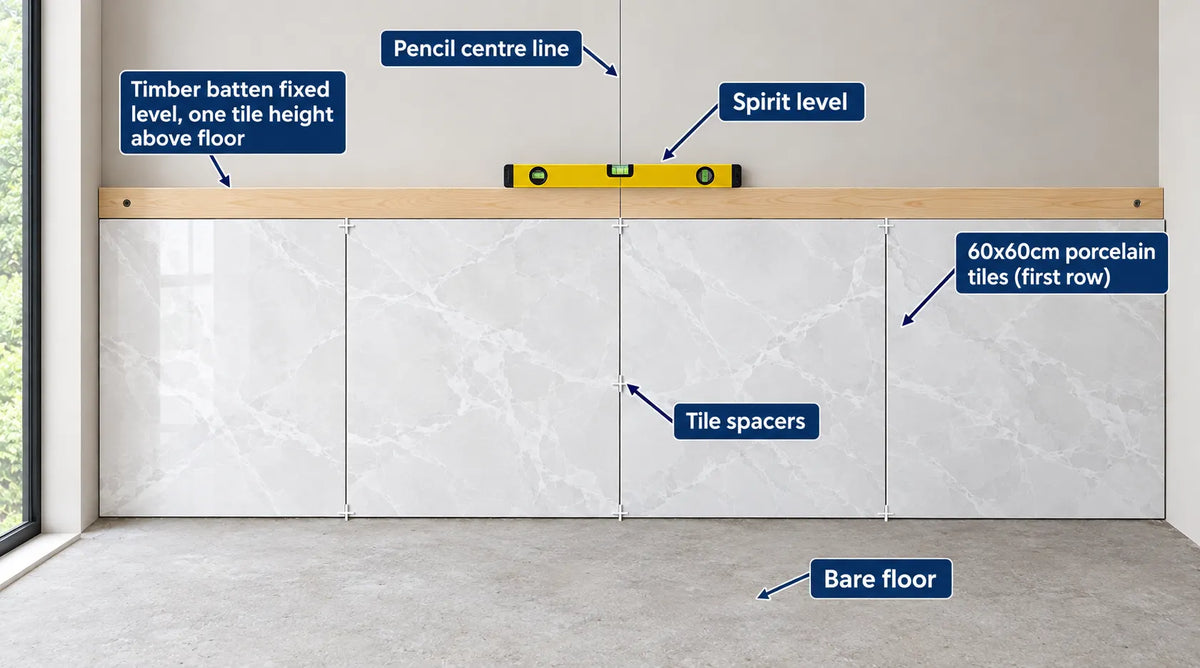
To tile a bathroom, prepare and waterproof the surfaces, set the tiles out from a centre line, fix the walls from a level batten one row above the floor, lay the floor, then fit the bottom wall row, grout once the adhesive has set and seal every corner with silicone. A standard UK bathroom takes a confident DIYer 2 to 4 days, most of which is waiting for adhesive and grout to cure.
Bathroom tiling is the process of fixing ceramic or porcelain tiles to bathroom walls and floors with tile adhesive, then filling the joints with grout. It protects the walls from water and gives the room a hard, easy-clean finish. This guide covers the full job in the order a professional tiler does it, with the numbers a first-timer needs: trowel sizes, weight limits, wait times and joint widths.
Quick guide: how to tile a bathroom in 9 steps
- Strip the room back to a sound, flat surface and fix any loose plaster.
- Board or prime the walls, and level the floor to within 3mm over 2m.
- Tank the shower area with a waterproofing kit.
- Fit the bath and shower tray so the wall tiles can overlap their rims.
- Set out the walls from a centre line and a level batten one tile up.
- Fix the wall tiles with a notched trowel, working up from the batten.
- Set out the floor from its centre, then lay it from the far corner back to the door.
- Remove the batten and cut in the bottom row of wall tiles.
- Grout, then silicone every corner and every edge where tiles meet the bath or tray.
| At a glance | |
|---|---|
| Difficulty | Moderate. Walls are easier than floors. Large tiles are hardest. |
| Time for a family bathroom | 2 to 4 days, including cure times |
| Flatness needed | 3mm or less over 2m |
| Wait before grouting | 24 hours for standard adhesive on floors |
| Wait before showering | About 24 to 48 hours after grouting and siliconing |
What order do you tile a bathroom in?
Tile the bathroom walls first, then the floor, then the bottom row of wall tiles. Most UK tilers fix the walls from a timber batten set one tile above the floor. Dropped adhesive then lands on bare floor, not on new tiles. Once the floor is down, the bottom wall row is cut to sit on top of the floor tiles, so water runs off the wall and over the floor joint rather than into it.
Some tilers lay the floor first and protect it with boards. That order also works. It suits rooms where the floor tile sets the wall layout, such as a matching 60x60cm tile running from floor to wall.
The bathroom suite follows its own order:
- Before wall tiling: first-fix pipes and cables, the bath, the shower tray and any concealed cistern frame. Tiles should overlap the bath and tray rims.
- After tiling: the toilet, basin, vanity unit, taps, towel rail and mirror. Tile the full floor under a toilet or vanity so a future replacement never exposes a bare patch.
- Under the bath: if you want tiles under a freestanding bath or a bath you may change later, lay that floor area before the bath goes in.
What tools and materials do you need to tile a bathroom?
You need a flexible cement-based adhesive, a notched trowel, spacers, a spirit level, a tile cutter, grout, a rubber float and silicone. The table below lists the full kit with typical prices from the Tiles Paradise range (checked September 2026, including VAT).
| Item | What it does | Typical choice | Price guide |
|---|---|---|---|
| Flexible tile adhesive, 20kg | Bonds tiles to walls and floor | BritFlex S1, Mapei Keraflex Maxi S1, Ultra Tile ProFlex S2 | £18.99 to £37.99 a bag |
| Tile grout | Fills the joints | Ultra Tile ProGrout Flexible 3kg, Mapei Ultracolor Plus 5kg | £16.99 to £34.99 |
| Tile backer board | Waterproof, strong base for wet walls | 6mm XPS board, 6mm cement board, 12mm HardieBacker | £10.99 to £21.50 a board |
| Floor levelling compound, 20kg | Flattens uneven floors | BritLevel Flexible (2mm to 18mm bed) | £18.99 a bag |
| Tanking kit | Waterproofs the shower area | Liquid membrane, corner tape, pipe collars | Varies by kit |
| Notched trowel | Spreads an even adhesive bed | 6mm, 8 to 10mm or 10 to 12mm notch (see trowel table) | Tool shop |
| Spirit level and 2m straight edge | Checks level and flatness | 600mm and 1.2m levels | Tool shop |
| Tile cutter | Straight cuts | Manual rail cutter longer than your tile | Tool shop |
| Angle grinder or wet saw with diamond blade | L-shaped and curved cuts | Porcelain-rated blade | Tool shop |
| Diamond core drill bit | Holes for pipes | Sized to the pipe plus 5mm | Tool shop |
| Spacers or levelling clips | Keep joints even and edges flush | 2mm for rectified, 3mm for non-rectified | Tool shop |
| Rubber grout float, sponges, two buckets | Apply and clean grout | Soft rubber face for polished tiles | Tool shop |
| Mixing paddle and drill | Mix adhesive and grout | Slow speed setting | Tool shop |
| Silicone sealant and tile trim | Seals corners, finishes edges | Sanitary silicone, trim matched to tile thickness | Tool shop |
Order 10% more tiles than the measured area for a straight lay, and 15% for a diagonal or herringbone pattern. Add a further 5% for tiles 60cm or longer, because one bad cut on a 60x120cm tile wastes 0.72m².
How do you prepare bathroom walls for tiling?
Prepare bathroom walls by removing old tiles and loose material, checking the wall is flat and strong enough for the tile weight, then priming or boarding it. A wall that fails any of these checks is the most common reason tiles crack, sound hollow or fall off.
Work through these checks in order:
- Remove old tiles and adhesive. Chip them off with a bolster and club hammer. Tiling over old tiles is possible but adds weight and depth, so check the rules first.
- Tap the plaster. Hollow-sounding or crumbling plaster must be cut out and repaired, or the wall boarded over.
- Check flatness. Hold a 2m straight edge against the wall in several directions. Gaps over 3mm need filling, reskimming or boarding.
- Check the weight limit. The surface must carry the tile plus adhesive (see below).
- Let new plaster dry. Fresh plaster needs about four weeks to dry before tiling.
- Prime. Prime gypsum plaster before using a cement-based adhesive. Cement and gypsum react when they are in direct contact, and the bond fails over time. Use the primer the adhesive maker specifies.
How much tile weight can a bathroom wall hold?
A plastered wall holds about 20kg per square metre of tile and adhesive, plasterboard holds 32kg per m², and a cement backer board such as 12mm HardieBacker holds up to 200kg per m². These are the widely used UK limits from the BS 5385 tiling code and the board makers.
| Wall surface | Maximum tile + adhesive weight | Suitable for |
|---|---|---|
| Gypsum plaster (skim on brick or block) | 20kg/m² | Ceramic wall tiles |
| Plasterboard, unskimmed and primed | 32kg/m² | Most ceramic and 9.5mm porcelain tiles outside the shower |
| Cement backer board (12mm HardieBacker) | 200kg/m² | Heavy porcelain, large format, showers |
| Sand and cement render | Heavy tiles | Porcelain and natural stone |

A worked example shows why this matters. A 9.5mm porcelain tile weighs roughly 22kg per m². A flexible adhesive bed adds about 4 to 5kg per m². The total of about 27kg per m² is fine on plasterboard, but it is over the 20kg limit for plaster. For large porcelain tiles on a plastered wall, board the wall or remove the skim first.
Can you tile straight onto plasterboard in a bathroom?
Yes, you can tile onto sound, primed plasterboard in the dry parts of a bathroom, as long as the tile and adhesive weigh under 32kg per m². Do not tile onto skimmed plasterboard, because the skim limits the weight to 20kg per m². Inside the shower enclosure, use a cement or XPS backer board, or tank moisture-resistant plasterboard fully. Standard plasterboard softens when water reaches it through a cracked joint.
Do you need to tank a bathroom before tiling?
Yes, tank any area that gets wet directly: the whole shower enclosure, the wall above a bath with a shower, and the full floor of a wet room. Tanking is a waterproof membrane applied behind the tiles. Grout and tiles are water-resistant, not waterproof, so water that passes a hairline crack needs a barrier behind it.
Walls around a basin or a bath without a shower rarely need tanking. Splashes there dry quickly.
To tank a shower area:
- Prime the surface if the kit asks for it.
- Bed reinforcing tape into the first coat along every internal corner, the wall-to-floor joint and the edge of the tray.
- Fit rubber collars around pipes and the shower valve.
- Apply the liquid membrane in two coats, at right angles to each other.
- Leave it to dry for the time stated on the kit before tiling.
Tank the shower walls to at least the height of the shower head. Tanking to full height is better and costs little extra.
How do you prepare a bathroom floor for tiling?
Prepare a bathroom floor by making it rigid, flat to within 3mm over 2m, clean and primed. The method depends on what the floor is made of.
- Concrete floor: scrape off old adhesive, fill cracks, prime, then pour levelling compound over dips deeper than 3mm. New screeds must be fully dry before tiling.
- Timber floorboards: never tile directly onto floorboards. They move with the seasons and crack the grout. Screw down loose boards, then overboard with a tile backer board or with 15mm to 18mm exterior-grade plywood screwed at close centres.
- Old vinyl or laminate: remove it. Adhesive does not bond reliably to flexible floor coverings.
- Underfloor heating: fit the mat or pipes to the maker's instructions, cover them with levelling compound where needed, and keep the heating off until the adhesive and grout have cured.
BritLevel Flexible, for example, flows from 2mm to 18mm deep, takes light foot traffic after 90 minutes and can be tiled over in 2 to 3 hours. One 20kg bag covers about 5m² at 3mm deep.
How do you set out bathroom tiles?
Set out bathroom tiles from a centre line, so the cut tiles at each end of a wall or floor are equal in size and wider than half a tile. Good setting out is what makes a tiled bathroom look professional. A thin sliver of tile in a corner is the most visible mistake in the room.
- Find the lowest point of the floor. Measure up one full tile height plus one joint from that point and draw a level line around the room.
- Fix a straight timber batten along that line. The first full row of wall tiles sits on it.
- Mark the centre of each wall with a plumb line.
- Dry-lay or use a gauge stick. A gauge stick is a batten marked in tile widths plus joints. Hold it against the wall to see where the cuts fall.
- Move the centre line by half a tile if the end cuts come out smaller than half a tile.
- Plan the top edge. Set the tiled height to a whole number of tile rows where you can. A 30x60cm tile laid landscape gives rows at 0.3m, 0.6m, 0.9m and 1.2m.
- Centre features on focal points, such as the middle of the window, the basin or the shower valve.
For a brick-bond pattern with tiles 60cm or longer, offset each row by no more than a third of the tile length. Large tiles have a slight bow in the middle, and a half offset puts the high point of one tile next to the low edge of the next.
How do you tile a bathroom wall step by step?
Tile a bathroom wall by spreading adhesive over about 1m² at a time, combing it with a notched trowel, pressing each tile in with a slight twist, and working upwards from the batten with spacers in every joint.
- Mix the adhesive. Pour the water into the bucket first, add the powder, and mix at slow speed until smooth and lump-free. Rest it for the time on the bag, then stir again.
- Spread the adhesive. Trowel it onto about 1m² of wall with the flat edge, then comb it with the notched edge held at 45°. Comb in straight lines, not swirls, so air can escape.
- Back-butter larger tiles. For any tile over 30x30cm, skim a thin layer of adhesive across the back of the tile as well. This fills the tile's back pattern and gives a full bond.
- Place the first tile on the batten at your centre line. Press it in and slide it slightly across the ridges, then back.
- Add spacers or clips at every joint as you go.
- Check every few tiles with a spirit level and a straight edge laid across the faces.
- Lift a tile early on to check coverage. The back should be fully covered, not just the ridges.
- Clean as you go. Wipe adhesive off tile faces and rake it out of joints before it sets.
- Cut the edge tiles last, once the full tiles have set enough not to move.
Adhesive has an open time. If the combed ridges have skinned over and no longer stick to a finger, scrape them off and spread fresh adhesive.
What size notched trowel do you need for bathroom tiles?
The trowel notch grows with the tile size: use a 6mm notch for small wall tiles, 8mm to 10mm for tiles between 30cm and 60cm, and 10mm to 12mm for tiles over 60cm.
| Tile size | Trowel notch | Back-butter? |
|---|---|---|
| Up to 20x20cm and metro tiles | 6mm | No |
| 30x30cm to 30x60cm | 8mm | Yes, over 30x30cm |
| 60x60cm | 10mm | Yes |
| 60x120cm and larger | 10mm to 12mm | Yes, always |
Floors use the larger notch in each range, because floor tiles need a solid bed with no hollows.
How do you tile around pipes, windows and corners?
Cut holes for pipes with a diamond core bit about 5mm wider than the pipe, then cover the gap with a pipe collar or silicone. Tile window reveals last, with the cut edge hidden against the window frame and a tile trim on the exposed corner. External corners need either a trim or a 45° mitred edge. Internal corners get a silicone joint, not grout.
How do you tile a bathroom floor step by step?
Tile a bathroom floor by marking two centre lines that cross at right angles, dry-laying tiles from the crossing point, then fixing them in sections from the far corner back towards the door.
- Mark the centre cross. Snap two chalk lines across the room. Check the corner is square with the 3-4-5 rule: 3 units along one line, 4 along the other, and the diagonal should measure exactly 5.
- Dry-lay a row each way. Shift the lines so the perimeter cuts are equal and wider than half a tile.
- Start at the far corner so you finish at the door without kneeling on new tiles.
- Spread adhesive for 2 or 3 tiles at a time, using the larger notch for your tile size, and back-butter every tile.
- Bed each tile with firm pressure and a small slide. Tap it down with a rubber mallet if needed.
- Use levelling clips on tiles 60cm and larger. They hold neighbouring edges flush while the adhesive sets and stop lippage, the step between two tile edges.
- Leave a movement gap of about 5mm around the whole perimeter. The skirting or silicone hides it.
- Keep off the floor until the adhesive has set, usually 24 hours for a standard adhesive.

Choose a floor tile with a slip rating of at least R10 for a bathroom, and R11 for a shower or wet room floor. Matt and textured finishes grip better than polished ones when wet.
How do you tile a shower area?
Tile a shower area after the tray is fixed and the enclosure is tanked. Start with the back wall and finish with the side walls, so the side tiles cover the cut edges of the back wall.
- Leave a gap of about 3mm between the bottom row and the tray or bath rim, and fill it with silicone later.
- Use a flexible adhesive rated for wet areas and give every tile full adhesive coverage. Hollows behind shower tiles collect water.
- Plan a niche or shelf before tanking, so the tanking wraps into it.
- Keep the shower valve and head at the centre of a tile or on a joint line, not near a thin cut.
- On a wet room floor, the tiles must follow the fall to the drain. Large tiles cannot bend to a four-way fall, so use a linear drain with a single-direction fall, or mosaic tiles around a centre drain.
How do you grout and silicone bathroom tiles?
Grout bathroom tiles once the adhesive has set: remove the spacers, rake out any adhesive in the joints, press the grout in diagonally with a rubber float, then sponge off the excess after 15 to 30 minutes. Seal every internal corner and the edge along the bath, tray and floor with silicone, not grout.
| Tiles fixed with | Grout walls after | Grout floors after |
|---|---|---|
| Standard-set cement adhesive | 4 to 8 hours | 24 hours |
| Rapid-set cement adhesive | 1 to 2 hours | 3 to 4 hours |
These wait times are Mapei's figures for Ultracolor Plus grout. The time printed on your adhesive bag always takes priority. BritFlex S1 Semi-Rapid, for example, can be grouted after 6 hours.
Use a flexible grout in showers and over underfloor heating. Ultra Tile ProGrout Flexible and Mapei Ultracolor Plus both suit joints from about 1 to 20mm and both resist mould. Buy all the grout from one batch so the colour matches.
Silicone is the last job. Fill the bath with water before you silicone along its edge. The weight pulls the bath down to its lowest position, so the silicone does not tear the first time someone gets in. Leave the silicone to cure, usually 24 hours, before using the shower.
How long does it take to tile a bathroom?
A standard UK family bathroom takes 2 to 4 days to tile, spread across several days because adhesive and grout need time to cure. The working hours are shorter than the total time.
| Task | Typical time |
|---|---|
| Stripping and preparing surfaces | 4 to 8 hours |
| Boarding or levelling, plus drying | Half a day to 1 day |
| Tanking the shower, plus drying | Half a day |
| Wall tiling, about 10 to 18m² | 6 to 12 hours |
| Floor tiling, about 4m² | 3 to 5 hours |
| Adhesive setting before grouting | Up to 24 hours |
| Grouting and siliconing | 3 to 5 hours |
| Silicone curing before use | About 24 hours |
A professional tiler usually finishes the same room in 2 to 3 days. A small floor on its own can be tiled in a day and grouted the next.
Which tiles are easiest to lay in a bathroom?
Porcelain or ceramic tiles of 30x60cm or 60x60cm are the easiest for a first bathroom. They are light enough to handle alone, cut cleanly on a manual cutter, and forgive small dips in a wall or floor. When choosing, compare these four points:
| Tile feature | Easier for DIY | Harder for DIY |
|---|---|---|
| Size | 30x60cm, 60x60cm | 60x120cm and larger |
| Edge | Rectified (2mm joint, very uniform) | Mixed lots or natural stone |
| Floor finish | Matt, R10 or R11 | Polished on a wet floor |
| Material | Ceramic on walls, porcelain on floors | Heavy porcelain on a plastered wall |
Porcelain is denser and absorbs less water than ceramic, which makes it the better floor and shower tile. Ceramic is lighter and easier to cut, which suits walls outside the shower. Most bathroom tiles in the Tiles Paradise range cost between about £18 and £45 per m².
For a floor that stays wet, the anti-slip bathroom tiles collection groups the matt tiles with R10 and R11 ratings in one place. Before you order, work out the exact area of every wall, the floor and the shower zone with the bathroom tile quantities calculator and wastage guide, which also gives adhesive and grout amounts per m².
How do you tile a bathroom with large 60x120cm tiles?
Tile with large 60x120cm tiles the same way as smaller tiles, but with a flatter surface, a 10 to 12mm trowel, full back-buttering, levelling clips and a second person to lift. A 60x120cm porcelain tile weighs about 16kg, snaps if it bends, and shows every dip underneath as lippage.
- Check the flatness first. The 3mm over 2m tolerance is not optional with large tiles.
- Board the walls if they are plastered, because the weight usually passes the 20kg per m² limit.
- Carry the tile on its edge, never flat, and use suction lifters.
- Offset brick-bond rows by a third, not a half.
- Keep joints at 2mm or more, even with rectified tiles.
The weight rule is also why the wall surface matters so much. A board from the tile backer boards range lets a plastered wall carry heavy porcelain, and it gives the shower a waterproof base before tanking. For the full picture on sizes, flatness and what goes wrong, read the guide to large format bathroom tiles, or browse the 60x120cm large format bathroom tiles once you know your room suits the size.
What are the most common bathroom tiling mistakes?
The most common bathroom tiling mistakes are poor preparation, thin cuts at the edges, and grouting joints that should be sealed with silicone. Each one is easy to avoid once you know it.
- Tiling onto a weak or dusty surface. The tiles are only as strong as the layer under them.
- Ignoring the weight limit of plaster and plasterboard.
- Skipping tanking in the shower. Leaks show up months later, often through the ceiling below.
- Starting from a corner instead of a centre line, which leaves thin slivers at one end.
- Using dabs of adhesive instead of a combed, full bed. Hollow tiles crack under load.
- Using a trowel that is too small for the tile size.
- Grouting internal corners and bath edges. These joints move, so grout cracks there. Use silicone.
- Grouting too early, before the adhesive has set.
- Using grey adhesive under light marble-effect tiles. Grey can show through a light or translucent body. Use white adhesive under white and light tiles.
- Tiling in the cold. Adhesive and grout need a room between 5°C and 35°C.
The grout stage has its own set of errors, from mixing ratios to haze. The step-by-step guide on how to grout tiles covers mixing, sponging and the exact wait times before walking on a floor or using a shower.
How much does it cost to tile a bathroom yourself?
Tiling a bathroom yourself costs the tiles plus about £120 to £270 in adhesive, grout, primer and sealant for a typical room, plus any boards, tanking kit or levelling compound the surfaces need. Tiles themselves cost about £18 to £45 per m² for most bathroom ranges, and a family bathroom needs 20 to 25m² including wastage when fully tiled.
Paying a tiler adds labour, which usually runs £30 to £60 per m². The full breakdown by room size, finish and tiler day rate is in the guide to how much it costs to tile a bathroom.
To choose the right adhesive for your tile, compare the flexible S1 and S2 options in the tile adhesive range. S1 adhesives suit most bathroom walls and floors. S2 adhesives are more flexible, which helps on timber floors and over underfloor heating.
Can you tile over existing bathroom tiles?
Yes, you can tile over existing bathroom tiles if every old tile is firmly bonded, the surface is flat, and the combined weight stays within the wall's limit. Tap each tile first. A hollow sound means it has come loose and must be removed. Clean and key the old glaze, prime it with a primer made for glazed tiles, and remember the new layer adds depth at sockets, window reveals and door frames. The pros, cons and steps are in the guide to tiling over existing tiles.
Bathroom tiling FAQs
Can you tile a bathroom yourself?
Yes, a careful DIYer can tile a bathroom. Walls with 30x60cm or 60x60cm tiles are the best first project. Large 60x120cm tiles, wet room floors and tiling over timber are harder, and many people hire a tiler for those parts.
Do you tile the bathroom floor or walls first?
Most tilers do the walls first from a batten, then the floor, then the bottom row of wall tiles. This keeps adhesive off the new floor and lets the wall tiles overlap the floor joint.
Do you tile before or after fitting the bathroom suite?
Fit the bath, shower tray and concealed cistern frames before tiling the walls. Fit the toilet, basin, vanity unit and taps after tiling.
Can you tile a bathroom floor without removing the toilet?
You can cut tiles around a toilet, but the finish is poor and the joint is hard to seal. Removing a toilet usually takes about an hour. Tile the full floor, then refit it.
Do you tile behind the bath?
Tile the wall behind the bath down to the bath rim. Tile the floor under a bath only if the bath is freestanding or may be replaced with a different size.
Should you tile all bathroom walls?
No. Tile the shower enclosure fully and the wall above the bath and basin. The rest can be half-tiled to about 1.2m or painted with a bathroom paint.
Can you tile a bathroom ceiling?
You can, but only with light tiles on a sound, primed board. The weight limits still apply, and falling tiles overhead are dangerous, so ceiling tiling is best left to a professional.
What size spacers should you use for bathroom tiles?
Use 2mm spacers for rectified tiles and 3mm or more for non-rectified tiles. Floor joints are often slightly wider than wall joints.
Should you use white or grey tile adhesive?
Use white adhesive under white, cream, light marble-effect and translucent tiles. Grey adhesive is fine under mid and dark tiles.
Can you tile onto painted bathroom walls?
Only after preparation. Scrape off loose or gloss paint, sand the surface to give a key, and prime it. The adhesive is only as strong as the paint's bond to the wall.
How soon can you use the shower after tiling?
Wait until the grout is ready for normal use and the silicone has cured, usually 24 to 48 hours after the last job. Mapei Ultracolor Plus grout, for example, is ready for normal use after 24 hours.
How long should tile adhesive dry before walking on it?
Standard adhesive needs about 24 hours before foot traffic. Rapid-set adhesive usually allows light traffic after 3 to 4 hours. Always follow the bag.
Last thoughts on tiling a bathroom
Tiling a bathroom well depends less on skill with a trowel and more on the order of the work: a strong, flat, waterproof surface first, a layout set from the centre, full adhesive coverage, and silicone wherever the room moves. Follow that sequence and a first-time tiler can finish a bathroom that looks professional and stays watertight for years.