





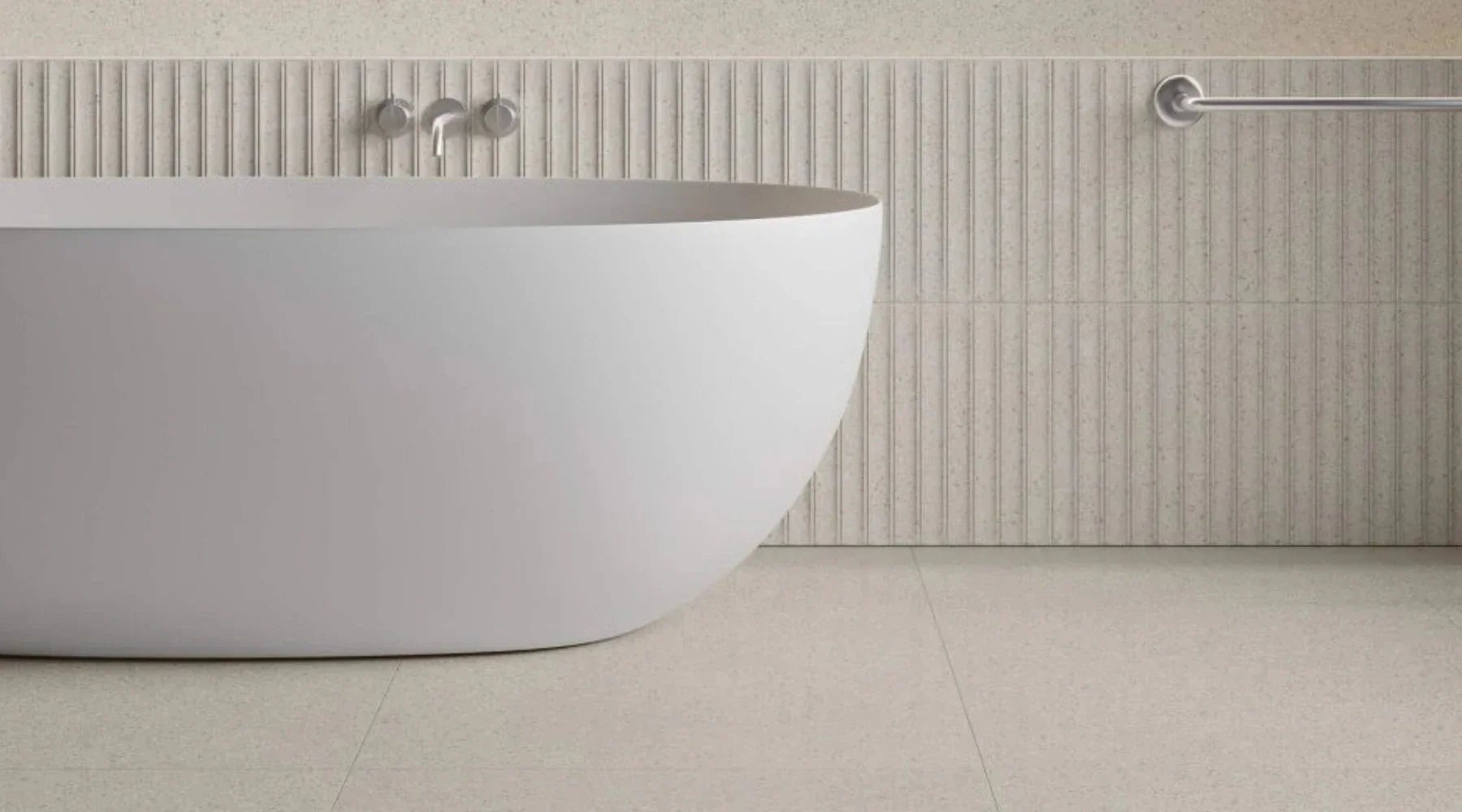
Choosing the right bathroom tile is a technical decision that impacts the safety, longevity, and feel of your home’s most humid room. While ceramic has its place, porcelain is the undisputed gold standard for bathrooms due to its near-zero water absorption and incredible density.
To choose the perfect porcelain tile, you must balance three pillars: Safety (Slip Resistance), Durability (PEI and Mohs Ratings), and Visual Scale.
Porcelain vs. Ceramic: Why is Porcelain Better for Bathroom Floors?
The primary difference lies in the manufacturing process. Porcelain is fired at higher temperatures (typically 1,200–1,400°C) using refined kaolin clay, feldspar, and silica. This results in a vitrified tile that is denser and less porous than standard ceramic.
-
Quantitative Water Absorption: For a tile to be true porcelain (ISO 13006 BIa), it must have a water absorption rate of < 0.5%. Ceramic wall tiles often exceed 10%, making them prone to spalling if moisture penetrates the body.
-
Density & Strength: Porcelain boasts a density of 2.3–2.5 g/cm³. This translates to a breaking strength of approximately 1,300N, making it resilient under the weight of heavy stone vanity units.
-
Hygiene: Because porcelain is nearly waterproof, it prevents the deep-seated growth of bacteria and mould, a critical qualitative advantage in damp shower environments.

Slip Resistance Ratings: What is a Safe R-Rating for Bathroom Tiles?
In a bathroom, the floor is frequently wet, making traction the most critical safety issue. You should look for three specific characteristics:
-
The R-Rating (Ramp Test): For residential bathroom floors, R10 is the standard sweet spot. For wet rooms or walk-in showers, R11 or higher is recommended.
-
DCOF (Dynamic Coefficient of Friction): The current industry standard (ANSI A137.1) requires a DCOF of 0.42 or greater for level interior floors expected to be walked on when wet.
-
PTV (Pendulum Test Value): Often used in the UK and Australia, a PTV of 36+ is the benchmark for ensuring adequate grip on wet, barefoot surfaces.
Tile Durability: What do PEI and Mohs Hardness Ratings Mean?
Durability isn't just about breaking; it's about the surface staying pristine against scratches and foot traffic.
-
PEI Rating (Wear Resistance): This measures how much foot traffic the glaze can handle. For residential bathroom floors, look for a minimum PEI 3. PEI 4 or 5 is generally reserved for commercial spaces like hotels.
-
Mohs Hardness (Scratch Resistance): Porcelain typically scores 7 to 8 on the Mohs scale, making it harder than granite (6–7) and far more scratch-resistant than marble (3–4). This ensures the surface remains pristine even when exposed to abrasive cleaning agents.
 Gloss vs. Matte: Which Porcelain Tile Finish is Best for Bathrooms?
The finish affects both the light levels in your bathroom and your safety.
-
Matte/Honed: These are the workhorses of the bathroom floor. They hide water spots and streaks effectively and generally offer the best slip resistance (often R10).
-
Polished/Glossy: Best reserved for walls. They reflect light, making small, windowless bathrooms feel airy. Avoid using high-gloss porcelain on floors, as the DCOF often drops below the safe 0.42 threshold when wet.
-
Lappato (Semi-Polished): A hybrid finish that provides a subtle shimmer with more grip than a full polish - an excellent qualitative compromise for a master ensuite.
Tile Dimensions: Should I Choose Large Format or Mosaics for a Small Bathroom?
Tile dimensions significantly impact maintenance and visual perception.
-
Large-Format Tiles (e.g., 600x1200mm): These minimize grout lines. Fewer grout lines mean fewer areas for grime to accumulate. For example, a 1200x600mm tile can make a small floor look like a single sheet of stone.
-
Mosaics: Essential for sloped shower floors. Small tiles allow the tiler to create the necessary fall toward the drain.
-
Rectified Edges: Look for rectified porcelain. These tiles are mechanically ground to precise dimensions, allowing for ultra-thin grout lines (as narrow as 1.5mm to 2mm), which enhances the high-end, seamless aesthetic.
 Real-World Selection: What are the Best Porcelain Tile Brands and Products?
When selecting high-performance porcelain, the 60x120cm large-format has become the industry standard for creating a seamless, luxury aesthetic. These tiles offer a quantitative advantage by reducing grout lines by up to 50% compared to standard 60x60cm tiles.
Below are the top-rated marble and onyx effect porcelain products currently leading the market in both durability and design:
|
Product Name |
Dimensions |
Finish & Aesthetic |
Best Application |
|
60x120cm |
Polished Marble Effect |
Brightening small master bathrooms with a classic, high-end look. |
|
|
60x120cm |
Polished Marble Effect |
Creating a dramatic, "moody" feature wall or high-contrast floor. |
|
|
60x120cm |
Polished Porcelain |
Pairing with gold brassware for a maximalist, luxury hotel feel. |
|
|
60x120cm |
Polished Porcelain |
Translucent-depth effect that mimics rare gemstone; ideal for spas. |
|
|
60x120cm |
Polished Porcelain |
Bringing a biophilic, calming "nature" vibe into modern shower zones. |
|
|
60x120cm |
Polished Marble Effect |
Bold statement floors that offer a qualitative "wow factor" and high scratch resistance. |
Buying Checklist: How Many Extra Tiles Should I Order for Wastage?
To avoid project delays and batch-matching nightmares, follow these quantitative buying rules:
-
The 10–15% Rule: Always order at least 10% extra for standard layouts and 15% extra for herringbone or diagonal patterns to account for cuts and breakages.
-
Shade Variation (V-Rating): Check the V-rating on the box. V1 indicates uniform colour, while V4 denotes substantial variation (mimicking natural stone).
-
Batch Matching: Ensure every box has the same Dye Lot/Batch Number. Porcelain is a natural product, and slight temperature shifts in the kiln can cause visible colour differences between production runs.
Non-Slip Bathroom Floor Tiles: How Do I Prevent Bathroom Slips and Falls?
While all porcelain is water-resistant, safety depends entirely on the surface friction. If you are designing a space for children or the elderly, non-slip bathroom floor tiles are non-negotiable. Look specifically for Anti-Slip porcelain that achieves a PTV (Pendulum Test Value) of 36+ or an R11 rating. These tiles often feature a micro-textured surface that provides grip even when covered in soapy water.
-
Pro Tip: For a deeper dive into safety ratings and the best materials for wet zones, read our full guide on non-slip bathroom floor tiles to ensure your renovation is as safe as it is stylish.
Large Bathroom Tiles: Can Large Format Tiles Work in a Small Bathroom?
One of the most common design myths is that small bathrooms require small tiles. In reality, using large bathroom tiles (such as 600x1200mm planks) can actually make a cramped ensuite feel significantly larger. By reducing the number of grout lines, you create an uninterrupted floor plane that tricks the eye into seeing more space.
-
Maintenance Edge: Large-format porcelain isn't just about aesthetics; fewer grout lines mean less scrubbing and a lower risk of mould buildup. Discover the best layouts and installation tricks in our dedicated article on large bathroom tiles to transform your small space into a spa-like retreat.
Final Insights:
To finish your project, prioritize safety and precision. Selecting tiles with an R11 slip rating and a water absorption rate under 0.5% ensures a bathroom that is both durable and secure. By balancing these technical specs with your personal style, you create a high-quality space that withstands daily moisture while maintaining its visual appeal for years.
Finally, always order 10% to 15% extra tiles to account for intricate cuts, breakages, or future repairs. Ensuring you have matching batch numbers from the start prevents tonal inconsistencies later. These practical steps, combined with choosing the right matte or textured finishes, guarantee a professional, long-lasting renovation that enhances your home’s value.
FAQ’s
-
Is porcelain tile good for a bathroom?
Yes. Porcelain tiles are durable enough to be used almost anywhere. They are an excellent choice for floors in high-traffic areas, outdoor patios and by the pool. Their moisture resistance also makes them ideal for bathrooms, kitchens and laundry rooms.
-
What tiles should not be used in a shower?
Avoid using glazed and shiny tiles for the shower floor. Although they look extremely alluring, they do not absorb moisture and can create a disastrous situation in the bathroom.
-
What are the disadvantages of porcelain tile?
Porcelain tiles, while durable, can be challenging due to their high cost, difficult installation (requiring special tools), hardness (making them cold and tough on joints), and potential slipperiness when polished or wet, plus grout lines need maintenance.
-
Why is porcelain tile harder to install?
That's mainly because the firing process and denser material make porcelain somewhat more challenging to cut and handle. As a result, it often requires specialized tools and professional installation.