





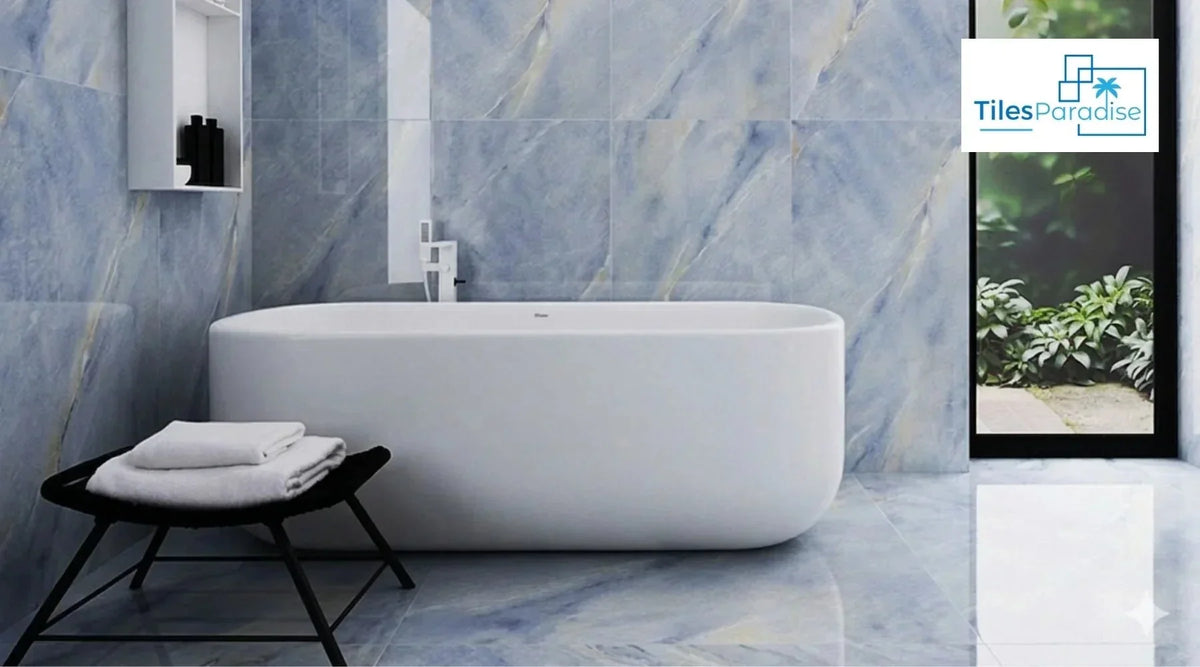
Large bathroom tiles are tiles of 60x60cm or bigger. The most common size in UK bathrooms is 60x120cm. They give you fewer grout lines and a calmer looking room. They also need a flatter floor, a better tiler and more careful planning than small tiles do.
Most advice on this topic stops at "big tiles make a room look bigger". That is true some of the time. This guide shows you how to work out whether it is true for your room, before you order.
What counts as a large bathroom tile?
There is no legal line. In the UK trade, most people call anything from 60x60cm upwards a large format tile.
Here is how the common sizes compare by area.
| Size | Area of one tile | How it is usually described |
|---|---|---|
| 30x60cm | 0.18 square metres | Standard wall tile |
| 60x60cm | 0.36 square metres | Large |
| 80x80cm | 0.64 square metres | Large square |
| 60x120cm | 0.72 square metres | The UK large format default |
| 90x90cm | 0.81 square metres | Extra large square |
| 120x120cm | 1.44 square metres | Slab |

A 60x120cm tile covers four times the area of a 30x60cm tile. That is the whole point of it. You can see the full range in our 60x120cm bathroom tiles collection.
What you gain with large tiles
Fewer grout lines. This is the main one. Fewer lines means less to clean and a surface that reads as one piece rather than a grid.
A calmer looking room. Your eye uses the joints to measure a surface. Take most of them away and the wall stops announcing its size.
Less grout to go grey. Grout is the part of a bathroom that ages worst. Less of it means less of that problem.
A faster wall. A tiler covers more area per tile, so a big plain wall goes up quicker than the same wall in small tiles.
Better looking stone and marble patterns. A marble effect print needs room to show its veining. Cut it into 30cm squares and it looks like a repeat. At 60x120cm it looks like stone. Our marble effect bathroom tiles are mostly made in this size for that reason.
What you give up
The floor and walls have to be flat. This is the big one, and it is covered properly below.
Cuts become obvious. A thin sliver of cut tile is far more noticeable next to a 1.2 metre tile than next to a 30cm one.
Handling gets harder. A 60x120cm porcelain tile is a two person lift and it will snap if it bends.
Cutting costs more time. Every cut is slower, and a chipped edge wastes a whole tile rather than a small one.
Waste goes up in a small or awkward room. More of each tile ends up in the bin.
Do large tiles make a small bathroom look bigger?
Sometimes. Not always. And the reason people give is usually the wrong one.
The real effect is not that big tiles trick the eye about scale. It is that fewer joints give your eye less information to measure the room with. A surface with four joints reads as more continuous than the same surface with twenty.
That effect holds only while the tiles stay whole. As soon as the room forces you to cut on two or three sides, you have swapped a neat grid for an uneven one. An uneven grid draws more attention to the room's size than a regular grid ever did.
So the question is not "are big tiles good for small rooms". The question is "does my room divide into this tile". There is a simple sum for that.
The sum that tells you if your room fits
Do this before you order anything. It takes two minutes and it is the single most useful thing on this page.
Step one. Measure the wall or floor run in centimetres.
Step two. Divide it by the tile length.
Step three. Look at the leftover.
If the leftover is more than half a tile, you are fine. The cut piece will look like a deliberate part of the layout.
If the leftover is less than half a tile, you have a problem. That thin strip will be the first thing anyone sees.
A worked example. Your bathroom floor is 180cm wide. You want 60x120cm tiles laid with the 120cm side across the room.
180 divided by 120 is 1, with 60cm left over. Half a tile is 60cm. So you get one full tile and one half tile on every row. That is a stripe, not a seamless floor.
Now try the same room with the 60cm side across. 180 divided by 60 is exactly 3. Three full tiles, no cuts at all. Same tile, different direction, completely different result.

A second example. Your floor is 210cm wide and you want 60x60cm tiles. 210 divided by 60 is 3, with 30cm left over. Half a tile is 30cm. That is borderline. Shift the whole layout so you cut 15cm off each side instead of 30cm off one, and it will look far better.
That last move is worth knowing on its own. Set the layout out from the centre of the room, not from a corner. Then the leftover splits into two even cuts at each end instead of landing in one lump. Our step by step bathroom tiling guide covers how that is marked out.
Which size suits which room?
| Room | Best size | Why |
|---|---|---|
| Cloakroom under 2 square metres | 30x60cm or 60x60cm | Too many cuts at bigger sizes |
| Small bathroom 3 to 5 square metres | 60x60cm floor, 60x120cm walls | Walls have longer clear runs than floors |
| Standard bathroom 5 to 8 square metres | 60x120cm | The size this format was made for |
| Large bathroom over 8 square metres | 60x120cm or 90x90cm | Enough room to show the format |
| Wet room | 60x120cm walls, mosaic in the wet zone | A big tile cannot follow a shower fall |
| En suite | Depends on the shape, run the sum above | Often long and narrow, so direction matters |
Notice the pattern. Walls usually take a bigger tile than floors in the same room. A bathroom wall often has a clear 2 metre run. The floor has a WC, a basin and a bath eating into it.
If your room is at the small end, our small bathroom tile guide goes through the options in more detail, and the 60x60cm bathroom tiles range is usually the better floor answer there.
Can you use large tiles in a shower?
On the shower walls, yes, and it is one of the best places for them. A shower enclosure is usually a tall narrow box, and a large tile turns three fiddly walls into three clean panels.
On the shower floor, no. A shower floor slopes in two directions at once, towards the drain or the tray. A rigid 60x120cm tile cannot follow that shape. Use a mosaic there instead, and keep the large tile on the walls. Our mosaic bathroom tile guide covers sheet sizes and fixing.
The same applies to a wet room floor. For anything that stays wet, look at the anti slip bathroom tiles range instead.
The flat floor rule nobody tells you
This is where large tile jobs go wrong, and it is worth knowing before you get a quote.
A large tile is rigid. It cannot bend to follow a dip or a bump. So any unevenness underneath shows up as one tile edge standing higher than the one next to it. That step is called lippage. On a polished tile it catches the light along the whole joint and becomes the first thing you notice in the room.
The accepted figure in UK tiling is that the surface should be flat to within 3mm over any 2 metres. Your tiler checks this by laying a 2 metre straight edge on the floor and looking for gaps.

Most bathroom floors and walls in older UK homes are not this flat. That means one of two things.
For a floor, a self levelling compound poured over the existing surface.
For a wall, either boarding it out or having it reskimmed.
Neither is expensive on its own. Both are a real cost that people do not expect, and both are non negotiable with a big tile. Ask about it when you get your quote, not after the tiles arrive.
How large tiles should be laid
Three things matter, and all three are worth saying out loud to whoever fits them.
Solid adhesive, no blobs. The back of the tile needs to be supported everywhere. Some tilers apply five dabs of adhesive and press the tile on. That leaves air under the middle. With a big tile, that air is where cracks start. The right method is a notched trowel across the whole area, and adhesive combed onto the back of the tile as well.
Offset no more than a third. If the tiles are going on in a brick pattern, the offset should be about a third of the tile length, not half. A long tile has a very slight bow in the middle. Put a joint at the halfway point and you put it at the highest part of the tile below, which creates a step. A third offset avoids it, and so does laying them straight stacked.
Levelling clips. These are small plastic clips and wedges that hold two tiles level while the adhesive sets. They are cheap and they make a visible difference on a big tile. A tiler who uses them on large format is a tiler who has done it before.
Grout joints on large tiles
Joints are not decoration. They absorb movement, and they let the tiler hide the tiny size differences between one tile and the next.
Two figures cover most cases.
Rectified tiles: 2mm minimum. Rectified means each tile has been cut to the same exact size after firing, so they all match. That lets you use a narrow joint. Our rectified tile guide explains what it changes.
Non rectified tiles: 3mm or more. These vary slightly in size, and the joint is what absorbs that variation.
Never butt large tiles together with no joint at all. It looks tidy for a year and then something has to give.
On grout colour, mid grey is the safest choice on a floor. It does not disappear and it does not show dirt the way white does. On walls, matching the grout to the tile gives you the most seamless result, which is usually why people chose a big tile in the first place. Our grouting guide covers mixing and application.
Cutting large tiles
Cutting matters more here than with small tiles, because a spoiled cut wastes more.
A wet cutter with a diamond blade is the right tool. Hand cutters struggle past a certain size, and a cheap blade chips the glazed edge. On a polished tile a chipped edge is very visible.
Cuts around a WC pan, a basin pedestal or a pipe are the slow part of any bathroom. With big tiles they are slower still, and they are where a tiler earns the money. This is not a good first tiling job.
Weight and handling
A 60x120cm porcelain tile at normal thickness weighs around 14 to 16kg. A box of two is close to 30kg.
Three practical points follow.
Carry them on edge, never flat. A big tile flexes under its own weight and snaps.
Two people, always, for anything 120cm long.
Check your access. If the bathroom is up two flights and round a tight landing, mention the tile size when you order.
What large bathroom tiles cost
Prices in our range start at £20.00 per square metre for a 60x120cm gloss porcelain and run to about £45.00 for the largest square sizes.
| Size | Price range at Tiles Paradise |
|---|---|
| 60x120cm | £20.00 to £30.00 per square metre |
| 80x80cm | £22.99 to £44.99 per square metre |
| 90x90cm | £44.95 per square metre |
The 60x120cm range is by far the widest, with 185 designs in the large format bathroom collection. The bigger square sizes are specialist and the choice is smaller. There are 14 designs in 80x80cm and four in 90x90cm.
Are large tiles cheaper or dearer overall?
This surprises people, so it is worth being straight about.
The tiles themselves are often cheaper per square metre than a fashionable small tile. A plain 60x120cm porcelain at £20 per square metre costs less than many patterned 20x20cm tiles.
The fitting is usually dearer. Preparing the surface to be flat enough, handling the weight, slower cutting and levelling clips all add labour.
The waste is higher in a small or awkward room.
So a large tile bathroom is not automatically a more expensive bathroom, and it is not automatically cheaper either. In a simple square room with flat walls it can work out about level. In a small awkward room with uneven walls, the big tile version costs more.
Get the quote with the surface preparation itemised, so you can see the two parts separately. Our guide to what it costs to tile a bathroom breaks down the labour side.
Matt or polished in a large format?
Both work, and the choice changes the room more than it does at small sizes.
Polished bounces light around and makes a marble effect look like real stone. It also shows every step between tiles, so it demands a flatter surface and a better tiler. It has less grip when wet, so keep it off shower floors. Browse gloss tiles to compare.
Matt hides small imperfections, grips better underfoot and shows fewer water marks. It is the safer floor choice, especially in a family bathroom. See the matt tiles range, and our matt tile buying guide if you are weighing the two up.

A common and sensible answer is polished on the walls and matt on the floor, in the same colour. You get the shine where it helps and the grip where it matters.
What to say to your tiler
Five questions. The answers tell you a lot.
Will you check the floor with a 2 metre straight edge before you start?
Will you use solid adhesive coverage and back butter the tiles?
What offset are you planning if we go brick bond?
Will you use levelling clips?
Where will the cut tiles fall?
A tiler who is comfortable with large format will answer all five without pausing. One who looks uncertain is telling you something useful.
Mistakes to avoid
- Ordering before doing the division sum. A tile that does not divide into your room will look worse, not better.
- Starting the layout from a corner. Set out from the centre so the cuts split evenly.
- Accepting a quote with no surface preparation in it.
- Letting a tiler use dabs of adhesive on a big tile.
- Using a half brick offset on a 120cm tile.
- Putting a large tile on a shower floor.
- Ordering the exact measured area. Add extra, because waste is higher with big tiles.
- Choosing polished for a family bathroom floor without thinking about grip.
How much to order
Measure each area, multiply length by width, and add them up. Take off the door and window openings.
Then add extra. With large tiles, add 10% for a simple square room and 15% for anything with angles, curves or a lot of edges. That is more than you would add for small tiles, because every wasted cut wastes more tile.
Round up to whole boxes. Tiles are sold by the box, not the tile.
Keep the spares. Shade varies slightly between production batches, so a replacement bought in two years will not match exactly.
The tile calculator does the sums for you, and the tile quantity guide shows the working.
What we stock
The 60x120cm bathroom range is the biggest, with 185 designs in polished, gloss, matt and marble effect. Prices start at £20.00 per square metre.
The 80x80cm range has 14 designs, from £22.99 to £44.99 per square metre, in matt and polished.
The 90x90cm range is four matt porcelain designs in light grey, grey, dark grey and beige, all at £44.95 per square metre.
Free samples are available. Order one before you commit. A large tile looks different in a real room from how it looks on a screen, and the difference is bigger at this size than at any other.
If you want arrangements and colour schemes rather than sizes, our bathroom tile ideas guide covers those, and the large marble effect tile guide goes deeper on that one finish.
Large bathroom tile FAQs
What size is a large bathroom tile?
Anything from 60x60cm upwards is usually called large format. The most common large size in UK bathrooms is 60x120cm.
Do large tiles make a small bathroom look bigger?
They can, because fewer grout lines give your eye less to measure the room with. It only works if the room divides into the tile without leaving a thin cut strip.
What size tile is best for a small bathroom?
60x60cm on the floor and 60x120cm on the walls suits most small bathrooms. Walls usually have longer clear runs than floors, so they take a bigger tile.
Can you use large tiles in a shower?
Yes on the shower walls. No on the shower floor, because a shower floor slopes in two directions and a big rigid tile cannot follow it. Use mosaic there.
How flat does the floor need to be for large tiles?
Flat to within about 3mm over any 2 metres. Your tiler checks it with a 2 metre straight edge. Floors that fail this need a levelling compound first.
Do large tiles need special adhesive?
They need solid coverage rather than dabs, and a flexible adhesive over timber floors or underfloor heating. Tell your tiler what is underneath.
What grout gap for large tiles?
2mm minimum for rectified tiles, 3mm or more for non rectified. Never fit them with no gap.
Are large tiles harder to lay?
Yes. They are heavier, less forgiving of an uneven surface, slower to cut and they need levelling clips. This is not a good first tiling job.
Are large tiles more expensive?
The tiles are often cheaper per square metre than fashionable small tiles. The fitting usually costs more because of the surface preparation and the slower work.
How much do large bathroom tiles cost?
In our range, 60x120cm starts at £20.00 per square metre. 80x80cm runs from £22.99. 90x90cm is £44.95.
How heavy is a large tile?
A 60x120cm porcelain tile weighs roughly 14 to 16kg. Always a two person lift, and always carried on edge.
Can large tiles go on a bathroom wall?
Yes, and walls are often the better place for them. A bathroom wall usually has a longer clear run than the floor does.
What offset should large tiles use?
About a third, not a half. A half offset on a long tile puts the joint at the tile's highest point and creates a visible step.
How much extra should I order?
10% for a simple square room, 15% if there are angles or curves. More than you would add for small tiles, because the waste per cut is higher.
Matt or polished for a large bathroom floor?
Matt for a family bathroom, because it grips better when wet and hides marks. Polished works well on walls and on a dry floor area.
Should you use large tiles?
Use them if your room has clear runs that divide into the tile, if your surfaces are flat or you have budgeted to make them flat, and if you are using a tiler who has done large format before.
Think again if the room is tiny and awkward, if the walls are visibly out of true and the budget is tight, or if you are doing the tiling yourself for the first time.
Run the division sum first. Then order a sample. Those two steps prevent almost every regret people have with large bathroom tiles.