





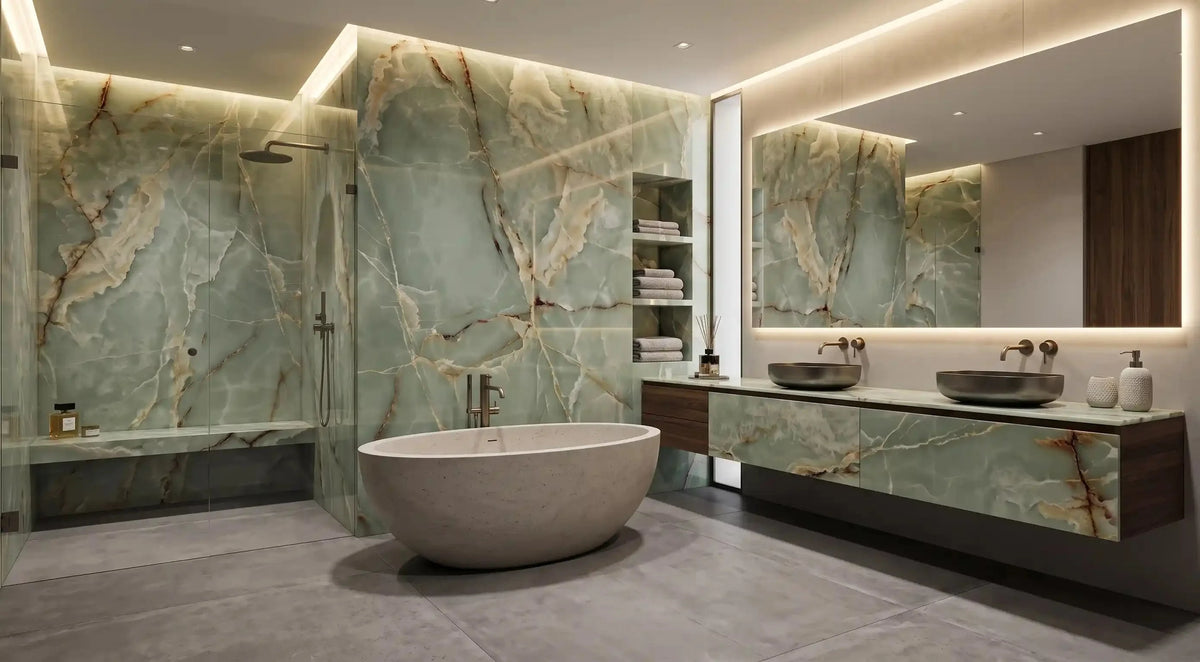
The best small bathroom tile ideas start with the room, not the tile catalogue. A compact bathroom can use small, medium or large tiles successfully when the format, finish, grout and layout suit the actual dimensions, light and wet zones. Large tiles reduce visual breaks, while mosaics and smaller formats handle shower falls, curves, niches and awkward cuts more easily. Porcelain is a versatile option for many wall and floor applications; ceramic is often useful on walls; and every floor tile should be checked for its stated wet-area suitability before purchase.
The goal is not to follow a single rule such as “small room, small tile” or “large tiles always make a room look bigger.” The goal is to create a layout with clean cuts, controlled grout lines, safe surfaces and enough visual continuity for the bathroom to feel intentional rather than crowded.
Small Bathroom Tile Choices at a Glance
| Bathroom situation | Tile direction to consider | Why it can work | What to check |
| Narrow ensuite | Medium or large rectangular tiles | Fewer visual breaks can simplify the room | Edge cuts beside shower, doorway and vanity |
| Windowless bathroom | Light or mid-tone wall tiles with some reflectivity | Helps artificial light travel across the walls | Avoid assuming a polished finish is safe on a wet floor |
| Walk-in shower | Larger wall tiles with smaller or approved floor format | Clean walls plus easier formation of floor falls | Exact floor suitability, waterproofing and drainage |
| Tiny cloakroom | Small decorative wall area or one feature surface | Adds character without covering every plane in pattern | Grout contrast and visual density |
| Family bathroom | Durable, easy-clean porcelain on high-use surfaces | Handles frequent cleaning and daily use well | Finish, slip performance and manufacturer instructions |
| Underfloor-heated floor | Tile compatible with the complete heated-floor build-up | Tile transfers heat efficiently when the system is designed correctly | Substrate, adhesive, grout, movement joints and commissioning |
| Awkward walls or niches | Smaller tiles or mosaics | Easier to cut and wrap around details | Grout maintenance and alignment |
Should a Small Bathroom Have Small Tiles or Large Tiles?
A small bathroom does not automatically need small tiles. Tile size should be chosen after the room has been measured and the proposed grid has been set out.
Large tiles can make a compact bathroom look calmer because there are fewer grout joints interrupting the surface. This is especially effective on straight walls where the tile dimensions land cleanly around corners, shower screens and sanitaryware.
Small tiles still have clear advantages. They are easier to use on curved surfaces, around niches, on detailed feature areas and across shower floors that need to follow a fall towards the drain. Small formats also create texture and pattern that a large slab cannot reproduce.
The practical question is therefore:
Which format gives this particular bathroom the cleanest layout with the fewest awkward cuts while remaining suitable for the surface?
That question is more useful than choosing a tile size only because the room itself is small.
What Tile Size Works Best in a Small Bathroom?
There is no single “best” size for every compact bathroom.
30x60cm tiles
A 30x60cm format is flexible because it works on many wall dimensions and can be laid horizontally, vertically or in an offset pattern. It is easier to handle than a very large slab and can reduce awkward cuts in narrow ensuites.
60x60cm tiles
A 60x60cm square can create a simple, continuous look on floors and larger wall areas. Before choosing it, check whether the room width leaves balanced cuts rather than a narrow strip at one side.
60x120cm and other large formats
Large rectangular tiles can work extremely well in small bathrooms when the wall geometry suits them. Fewer joints can make stone- and marble-effect surfaces read as one broad plane instead of a grid.
Large format is not automatically better, though. If a 60x120cm tile produces multiple thin cuts around a window, niche, shower valve and doorway, a smaller format may create a cleaner finished room.
Mosaics and very small formats
Mosaics are useful where the surface geometry matters more than minimal grout. They can follow curved areas and floor gradients, and they can create a controlled feature in a shower niche or splashback.
The visual trade-off is grout density. More grout lines create more pattern and more maintenance, so the grout colour and cleaning plan should be chosen at the same time as the mosaic.
Porcelain vs Ceramic vs Mosaic Tiles for a Small Bathroom

| Tile type | Best use in a small bathroom | Main strength | Main consideration |
| Porcelain | Floors, walls and many wet-area applications when the product is approved | Dense, durable and low-maintenance | Harder to cut than many ceramic tiles |
| Ceramic | Walls, splashbacks and product-approved floor uses | Lighter, easy to work with and available in many colours | Check exact product suitability for wet floors |
| Mosaic | Shower floors, niches, curves and feature zones | Flexible layout and strong decorative impact | More grout joints to maintain |
| Glass mosaic | Feature walls, niches and decorative strips | Reflects light and adds depth | Usually best as a controlled accent rather than every surface |
| Natural stone | Selected statement surfaces | Unique variation and premium character | May require sealing and a more careful maintenance routine |
Porcelain and ceramic are both broad product categories. Do not assume that every porcelain tile is automatically a safe shower-floor tile or that every ceramic tile is wall-only. The exact product specification determines where it can be installed.
Choose Tiles by Surface: Wall, Floor, Shower or Wet Room
A small bathroom becomes easier to design when it is divided into functional zones.
Bathroom walls
Wall tiles carry the largest visual area. Light-reflecting finishes can brighten a low-light room, while matt or softly textured surfaces create a quieter finish. The wall is also the easiest place to use a bold colour because slip resistance is not a walking-surface concern.
General bathroom floor
A bathroom floor needs to tolerate regular foot traffic, cleaning and water exposure. Choose a product that the manufacturer identifies as suitable for the intended floor application. If the bathroom is used frequently by children, older people or anyone with reduced mobility, surface grip deserves more weight than gloss or photographic appearance.
Shower floor
The shower floor is a separate decision from the rest of the bathroom floor. It stays wetter, may need a fall to a drain and places more emphasis on grip and drainage geometry. Small tiles and mosaics are often useful here because they can follow changes in plane more easily, but the exact tile and installation system still need approval for the application.
Shower walls and bath surrounds
These areas need materials designed for repeated water exposure, but the visible tile surface is only one part of the assembly. Waterproofing behind the tile is addressed later in this guide.
Which Tile Colours Make a Small Bathroom Look Bigger?
Light colours are useful in compact bathrooms because they reflect more available light, but colour alone does not determine perceived space.
A small bathroom often feels bigger when four choices work together:
-
the tile colour is not visually heavy for the available light;
-
the grout does not create an unnecessary grid;
-
the tile format avoids excessive cuts and joints;
-
walls and floors have a clear visual relationship.
White and off-white
White, ivory and warm off-white tiles create a bright background and pair easily with chrome, black, brass or coloured fittings. Warm whites are often more forgiving than very blue whites in windowless bathrooms.
Beige, cream and warm stone
Warm neutrals soften a compact bathroom without creating strong visual boundaries. Stone- and travertine-effect porcelain can add movement while keeping the overall palette calm.
Grey
Pale and mid-grey tiles suit modern bathrooms, but the undertone matters. A grey that looks neutral in a bright showroom may look cooler under artificial bathroom lighting. Samples are especially useful here.
Blue and green
Pale blue, sage and muted green can create depth without making a room feel heavy. Deeper blue or forest green can still work in a small bathroom when used deliberately on one wall, inside a shower zone or with lighter adjacent surfaces.
Black and other dark colours
Dark tiles are not forbidden in small bathrooms. Black, charcoal and deep brown can create depth and make white sanitaryware stand out. The risk comes from covering every surface in a low-light room without a lighting plan. Use darkness as a design decision, not as a default.
Matt, Gloss or Polished: Which Finish Works Best?
Finish should be selected by surface and use, not by appearance alone.
Gloss and polished walls
Reflective wall finishes can help a compact room feel brighter by bouncing light from mirrors, windows and ceiling fittings. They also emphasise marble, onyx and high-variation patterns.
Matt walls
Matt tiles reduce glare and can make a small bathroom feel softer and more architectural. They work particularly well with wood furniture, brushed metal and stone-effect designs.
Bathroom floors
A floor finish must be chosen for the exact wet-use requirement. Never assume that a polished wall-and-floor tile is appropriate for every wet floor just because the product name includes “floor.” Check the manufacturer’s stated slip performance and intended installation area.
How Grout Changes the Look of a Small Bathroom
Grout can make a small bathroom feel calm or busy.
Matching grout
A grout colour close to the tile colour reduces the visible grid. This is useful when the goal is a continuous surface, especially with large-format or pale tiles.
Contrasting grout
A contrasting grout makes every tile edge more visible. That can be intentional with metro, herringbone, hexagon or patterned tiles, but it increases visual activity in a compact room.
Grout on mosaic surfaces
Mosaics contain far more joint area than large tiles, so the grout becomes part of the colour scheme. Choose the grout before installation rather than treating it as a final technical detail.
For wet areas, use the grout system specified for the installation and follow the product manufacturer’s instructions. “Water-resistant grout” should not be used as a substitute for proper waterproofing behind the tiled finish.
Tile Layout Patterns That Work in Small Bathrooms
Vertical stack
A vertical rectangular layout draws the eye upward and can make a low wall feel taller. It works well behind a vanity, inside a shower or across a narrow feature wall.
Horizontal brick bond
Horizontal layouts can emphasise width. This is useful on a narrow wall where the design needs to pull the eye sideways rather than upward.
Herringbone
Herringbone creates movement and works best when it has enough uninterrupted surface to read clearly. In a very small bathroom, limit a strong herringbone pattern to a defined area if every wall would otherwise become visually busy.
Straight grid
A straight grid is the quietest layout. It is particularly effective with marble- or stone-effect porcelain where the surface pattern should remain the main feature.
Continuous wall-and-floor colour
Using closely related wall and floor colours reduces visual boundaries. The tiles do not need to be the same size or finish; the continuity can come from tone.

Best Tile Ideas for a Windowless Small Bathroom
A windowless bathroom needs a lighting-aware tile plan.
Start with a sample under the actual artificial lighting. Look at it beside the vanity, sanitaryware and metal finishes. A tile that appears warm in daylight can look cooler under a different colour temperature.
Useful directions include:
-
warm white or cream wall tiles;
-
pale stone-effect porcelain;
-
restrained marble veining;
-
a gloss or polished wall surface paired with a floor finish chosen for grip;
-
matched grout to reduce visual fragmentation;
-
one controlled darker feature rather than multiple competing patterns.
A mirror and good layered lighting can amplify the effect, but the tile should still look balanced when the bathroom is used at night.
Small Ensuite and Cloakroom Tile Ideas
An ensuite or cloakroom often contains more obstacles per square metre than a larger bathroom. The main challenge is therefore not simply “making it look bigger”; it is avoiding an untidy grid of cuts.
Before choosing the tile:
-
mark the door opening;
-
mark the toilet, basin and vanity;
-
mark the shower tray or bath edge;
-
mark niches, windows and boxed pipework;
-
test where the tile joints will land.
A medium format may outperform a very large tile if it gives cleaner edges around those fixed points. A small feature tile can then be used where it adds detail without complicating the whole room.
Small Bathroom Shower Tile Ideas
A compact shower works well when the wall and floor have different jobs.
For the walls, larger or medium tiles can reduce joints and simplify cleaning. For the shower floor, an approved smaller format or mosaic can make drainage falls easier to form. The two surfaces can still feel coordinated by sharing colour, stone effect or grout tone.
A niche is a good place to introduce a smaller decorative tile because the area is naturally framed. Measure the niche around the intended tile module so that the finished edges do not rely on thin slivers.
Are Bathroom Tiles Waterproof?
Tile and grout create a durable finished surface, but they should not be treated as the complete waterproofing system for a shower or wet room.
The Tile Association’s UK technical guidance notes that water-resistant adhesive and grout are not a substitute for a suitable waterproof tanking system in wet areas. Waterproofing needs to protect the relevant background and junctions before the finished tile is relied upon.
For a small bathroom renovation, confirm the waterproofing plan before choosing decorative finishes. This is especially important in:
-
shower enclosures;
-
wet rooms;
-
niches;
-
penetrations around valves and pipework;
-
areas where water repeatedly reaches the same wall or floor junction.

Small Bathroom Tiles and Underfloor Heating
Porcelain, ceramic and many approved mosaics can work with underfloor heating, but compatibility applies to the whole floor assembly, not just the tile.
The installer should account for:
-
the substrate or screed;
-
the heating system;
-
the tile adhesive;
-
the grout;
-
movement accommodation;
-
the tile format;
-
the manufacturer’s commissioning procedure.
Large-format tiles place more emphasis on flatness, bedding and movement control. The safest buying question is therefore not “Does porcelain work with underfloor heating?” but “Is this exact tile and installation system approved for my heated floor build-up?”
How to Measure and Order Tiles for a Small Bathroom
1. Measure each tiled surface separately
For a rectangular floor:
length × width = floor area in m²
For walls, measure each wall section and subtract large openings only when appropriate to the ordering method.
2. Add an allowance for cuts and breakage
Tiles Paradise product calculators commonly recommend adding an allowance for cuts and breakage. The exact allowance should increase for diagonal layouts, complicated rooms and high-pattern matching.
3. Plan the grid before ordering
A simple sketch can reveal whether the chosen tile leaves very narrow cuts at edges. Changing the starting point or format before ordering is cheaper than fixing an awkward layout during installation.
4. Order the project quantity together
Shade and calibre can vary between production batches. Ordering the required quantity together reduces the risk of needing a later batch that looks slightly different.
5. Keep spare tiles after installation
A few matching spares are useful for future repairs, especially when a range is discontinued.
Small Bathroom Tile Installation: Practical Sequence
A simplified planning sequence is:
-
confirm the substrate is sound and suitable;
-
design the wet-area waterproofing where required;
-
set out the tile grid on walls and floors;
-
identify cuts around fixed fittings;
-
select the adhesive system for the tile and substrate;
-
install tiles with the required coverage and joint spacing;
-
allow the system to cure as specified;
-
grout with the correct product;
-
seal movement and perimeter joints with the specified flexible sealant;
-
allow the installation to cure before normal wet use.
Complex waterproofing, heated floors, large panels and difficult substrates are good reasons to use a competent professional rather than treating the project as a basic DIY job.
How to Clean and Maintain Small Bathroom Tiles
Maintenance depends on the tile material and grout.
For porcelain and glazed ceramic, routine cleaning normally focuses on removing soap residue, limescale and standing moisture without using an unnecessarily aggressive cleaner. Natural stone needs a product compatible with the stone and any sealer.
In a compact bathroom, ventilation matters because steam is concentrated in a small volume. Wipe persistent standing water, run the extractor fan as designed and clean grout before discolouration becomes established.
More grout means more maintenance. This is one reason to think about grout density when choosing mosaics or small-format tiles for large areas.
Small Bathroom Tile Decision Checklist
Before ordering, confirm:
-
Room: exact wall and floor dimensions
-
Layout: where full tiles and edge cuts land
-
Surface: wall, general floor, shower floor, niche or wet room
-
Material: porcelain, ceramic, mosaic, glass or stone
-
Finish: appropriate for the actual surface use
-
Colour: tested in the bathroom’s real light
-
Grout: matching or contrasting by design
-
Waterproofing: planned separately for wet areas
-
Heating: full system compatibility checked if underfloor heating is present
-
Quantity: cuts, breakage and pattern allowance included
-
Sample: colour, finish and texture checked before the full order
-
Delivery: current checkout timing and cost checked for the postcode
There is no single tile that makes every small bathroom better. The strongest design is the one that fits the room’s geometry, moisture, lighting and daily use without forcing a visual trick that does not suit the space.
Shop and Explore Small Bathroom Tiles at Tiles Paradise
If you are ready to move from planning to product selection, use these related Tiles Paradise resources:
-
Browse the small bathroom tiles collection for current materials, colours and finishes.
-
Compare wider bathroom floor tile options when floor performance is the priority.
-
Read the complete bathroom tile ideas guide for broader bathroom layouts, colours and finishes.
-
Use the mosaic bathroom tiles guide when planning shower floors, niches or small-format feature zones.
-
Review the tile sample service before choosing colour and finish from a screen.
-
See a current large-format example in the Statuario Mercury Grey 60x120cm porcelain tile.
Frequently Asked Questions
What is the best tile for a small bathroom?
There is no single best tile for every small bathroom. Porcelain is a versatile choice for many floors and walls, ceramic offers broad wall-design options, and mosaics are useful on shower floors, niches and awkward surfaces. Choose the exact product by surface, wet-area suitability, layout and maintenance needs.
Do small tiles make a small bathroom look smaller?
Not automatically. Small tiles create more grout lines, which can make a large surface look busier, but they can work very well as mosaics, feature walls or shower-floor tiles. Colour, grout contrast, finish and layout affect perceived space as much as tile size.
What tile size makes a small bathroom look bigger?
A medium or large tile can make a compact bathroom look calmer by reducing grout lines, but the best size is the one that lands cleanly within the room dimensions. A smaller format can look better when a very large tile would create multiple awkward cuts.
Are porcelain or ceramic tiles better for a small bathroom?
Porcelain is generally the more versatile option for high-use floors and wet applications because of its dense body. Ceramic is lighter, easier to cut and available in many wall designs. Always check the exact product specification rather than choosing by material name alone.
Can I use large tiles in a small bathroom?
Yes. Large tiles can work in a small bathroom when the room dimensions allow balanced cuts and the substrate is suitable. They reduce the number of grout joints, but they require more careful handling, flatness and layout planning.
Are small bathroom tiles suitable for a shower?
Many are, but suitability depends on the exact product and whether it is being used on the wall or floor. Shower floors need particular attention to grip, drainage and waterproofing.
Can I use bathroom tiles over underfloor heating?
Many porcelain, ceramic and mosaic products can be installed over suitable underfloor-heating systems. Confirm the tile, substrate, adhesive, grout, movement and commissioning requirements as one complete system.
What grout colour is best for a small bathroom?
Matching grout creates a calmer, more continuous surface. Contrasting grout makes the pattern stronger. Choose based on whether you want the tile pattern to recede or become a feature.
Where can I buy small bathroom tiles online in the UK?
Tiles Paradise sells small bathroom tiles online through its dedicated collection. Use the collection filters to compare current material, colour, finish and availability rather than relying on an article’s static stock list.
Can I order a sample before choosing small bathroom tiles?
Yes, Tiles Paradise provides a tile sample service on eligible products. Sampling is particularly useful in small bathrooms because artificial lighting can change how grey, white, beige, blue and green surfaces appear.
How much does small bathroom tile delivery cost in the UK?
Delivery options and costs depend on the order and postcode. Check the current shipping information and checkout rather than relying on a fixed delivery figure in an evergreen buying guide.
Are “waterproof tiles” enough for a shower or wet room?
No. A tile finish is not a substitute for a properly designed waterproof background or tanking system in wet areas. The waterproofing plan should be confirmed before tiling begins.
Are clearance, lifetime-warranty, antibacterial or eco-certified small bathroom tiles available?
These attributes change by product and require first-party verification. Check the current product page or contact Tiles Paradise for the exact range rather than assuming that every small bathroom tile carries these features.