





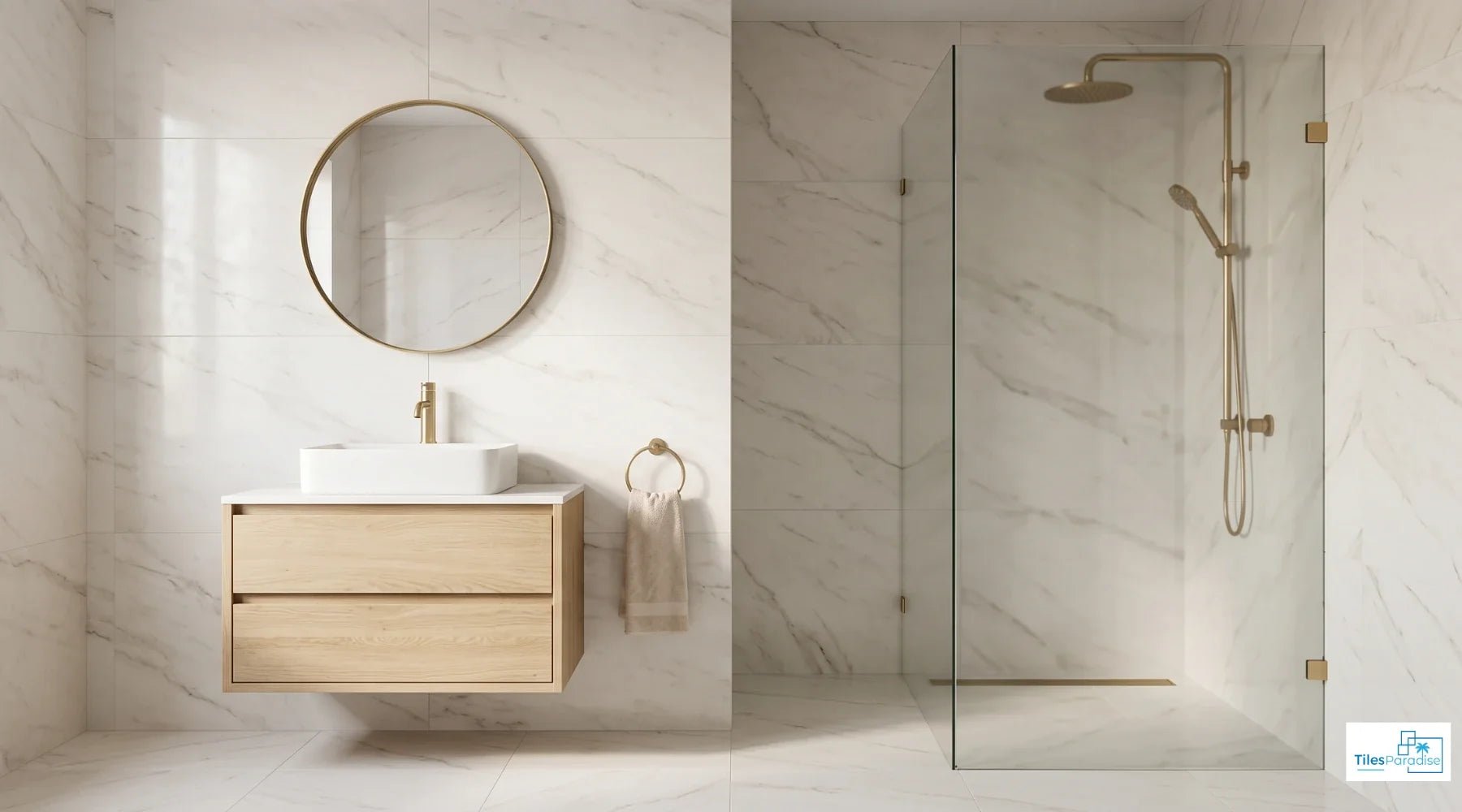
The best bathroom tile ideas pair a waterproof material with a layout, format and grout colour that suit the exact room you have. Porcelain handles floors, walls and wet zones with no sealing. Large pale formats stretch a small room. Matt finishes give grip underfoot while gloss bounces light around a wall. Everything after that, colour, pattern, texture and style, is personality layered on top of those four decisions.
A bathroom is the hardest room in a house to tile well. It is usually the smallest room, it holds the most moisture, it carries the most fixed obstacles, and it is the room where a single wrong choice is visible from the doorway every single morning. That combination is why so many bathrooms end up looking almost right rather than right.
This guide runs through every decision in order: material, wall, floor, layout, size, colour, grout, then the room-specific cases. It finishes with the practical numbers most inspiration articles skip, including slip ratings, costs per square metre, and how many tiles to actually order.
What Makes a Bathroom Tile Idea Work in Practice?
A bathroom tile idea works when the material, format, finish and layout all suit the room's moisture level, dimensions and light, not when the photograph looks good. The gap between a saved image and a finished bathroom is almost always one of these four variables.
Four constraints decide whether an idea survives contact with a real room.
Moisture zone. A splashback behind a basin, the wall inside a shower enclosure, and an open wet room floor are three different environments. Each one narrows your material and finish options before aesthetics get a vote.
Room dimensions. A 60 × 120 cm tile in a 1.7 m wide cloakroom leaves a sliver cut against the far wall. The same tile in a 2.4 m bathroom lands cleanly. Format has to be checked against the actual measurement, not chosen from a photo.
Light. Bathrooms are frequently windowless or north-facing. A cool grey tile that reads elegant in a south-facing showroom reads flat and blue in an internal en-suite. Light is not a detail. It changes the colour you actually bought.
Grout. Grout occupies far more visual area than people expect. On a 30 × 60 cm wall with 2 mm joints, grout is roughly 1% of the surface. On a mosaic panel it can be 15%. Grout colour is a design decision, not a finishing touch.
Get those four right and almost any style works. Get one wrong, and the most beautiful tile in the range still looks off.
Which Tile Material Suits Each Bathroom Surface?
Porcelain suits every bathroom surface, ceramic suits walls and light-use areas, and natural stone suits statement surfaces where you accept sealing and maintenance. Material is the first decision because it silently rules out half the ideas that follow.
| Material | Water absorption | Best surfaces | Sealing | Trade-off |
|---|---|---|---|---|
| Porcelain | Under 0.5% (BIa) | Floors, walls, showers, wet rooms | None | Harder to cut; slightly higher cost than ceramic |
| Ceramic | 3 to 10% | Walls, splashbacks, low-traffic floors | None | More porous, softer body, less suited to wet floors |
| Natural stone | Varies by stone | Statement floors and feature walls | Regular, with pH-neutral products | Etches with acidic cleaners; needs ongoing care |
| Glass mosaic | Nil | Feature panels, niches, borders | None | Grout-heavy; expensive per square metre |
Porcelain is fired at higher temperatures and pressed at higher pressure than ceramic, which is what produces the sub-0.5% water absorption figure. That single property is why porcelain works in a shower, on a bathroom floor and in an unheated en-suite without any additional protection. If you want one material for the whole room, this is it.
Ceramic remains the right call for walls. It is lighter, easier to cut around pipework and awkward corners, and available in the glossy, colour-rich glazes that make metro and zellige-style tiles look the way they do.
Effect tiles have quietly replaced most natural stone. A marble-effect or stone-effect porcelain reproduces the veining and tonal depth of the real material through digital printing, then behaves like porcelain, with no sealing, no etching and full slip rating options. For anyone who wants the look without the maintenance calendar, this is the practical answer.
What Are the Best Bathroom Wall Tile Ideas?
The strongest bathroom wall tile ideas either run one tile continuously across every wall, or restrict decoration to a single defined area and keep everything else plain. Walls fail when a scheme sits between those two positions.
Full-height tiling in one large format
Running a single 60 × 120 cm or 120 × 120 cm tile from floor to ceiling on every wall produces the seamless, hotel-like result that dominates current bathroom design. Fewer joints mean fewer visual interruptions, and the room reads as a carved volume rather than a set of surfaces. Match the grout to the tile and the joints effectively disappear. This works best in marble-effect and stone-effect ranges where the pattern carries the interest.
Half-height tiling with paint above
Tiling to roughly 1.1 m and painting above splits the wall into two horizontal bands. It protects against splashes where splashing actually happens, softens the room acoustically, and cuts the tile budget in half. It suits period properties and rooms where the sanitaryware is traditional. Finish the top edge with a trim or a bullnose tile rather than a raw cut.
Metro and brick-format tiles
Metro tiles have survived a century because the format is forgiving. The same tile reads traditional in a standard 50% offset, contemporary stacked vertically, and graphic in herringbone. Bevelled edges push it traditional; flat rectified edges push it modern.
A single mosaic or patterned feature panel
Restrict pattern to one area, behind the basin, inside a shower recess, or as a full-height panel behind a freestanding bath, and keep the remaining walls plain in a colour drawn from the pattern. This gives a bathroom a focal point without giving it a headache.
Fluted, ribbed and three-dimensional tiles
Fluted tiles create shadow that shifts through the day, which adds depth to a scheme built entirely from neutrals. Use them on one wall or a vanity front. Across a whole room they become busy, and the recesses collect more limescale than a flat surface.
Zellige and handmade-look glazes
The irregular surface of a zellige-style tile catches light unevenly, which is exactly the point. Every tile reads slightly differently, so the wall has movement without pattern. Accept that the surface will not be flat and the joints will not be perfectly even. That variation is the product, not a defect.
Vertical stacking
Laying a rectangular wall tile vertically in a straight stack draws the eye upward and adds perceived ceiling height. In a room with a low ceiling, this is one of the cheapest structural illusions available.
What Are the Best Bathroom Floor Tile Ideas?
A bathroom floor tile has to earn its place twice, once on grip and durability and once on appearance. Any floor idea that ignores the first test is a hazard rather than a design.
Large-format matt porcelain
The default modern floor: a 60 × 60 cm, 60 × 120 cm or 90 × 90 cm matt porcelain in a stone or concrete effect. Fewer grout lines, easier cleaning, and a calm continuous plane that lets the sanitaryware stand out. Matched grout takes it further.
Wood-effect planks
Wood-effect porcelain gives a bathroom the warmth of timber with none of the water risk. Laid in long planks it also lengthens a narrow room visually. Herringbone versions add pattern in a neutral palette.
Terrazzo and speckled surfaces
Terrazzo does something no plain tile can: it disguises. Water spots, dust and hair vanish against a speckled ground, which makes it one of the most practical floors in a family bathroom. It also brings colour into a scheme without committing a whole wall to it.
Hexagons
A hexagon floor sits between geometric and classic. In small formats it also delivers extra grout lines, which quietly improves grip. That is useful in a shower area or a wet room where a straight-edged tile would be too slick.
Chequerboard
Two colours in a square format, laid straight or on the diagonal. It carries a heritage association that suits period homes, cloakrooms and traditional sanitaryware. Diagonal laying widens a narrow floor; straight laying is calmer.
Patterned and encaustic-effect floors
A heavily patterned floor gives you permission to keep every wall plain. This is the highest-impact, lowest-risk way to give a small bathroom character, because the pattern is contained within a defined rectangle rather than wrapping the room.
Concrete-effect porcelain
Flat, tonal and slightly industrial. Concrete effect works with matt black brassware, dark timber and minimal schemes. It is the least demanding floor to coordinate with, because it has almost no colour of its own.
Pebble and small mosaic
Reserved for shower floors and wet room falls, where the tile has to follow a slope towards a drain. The high grout ratio provides grip; the small unit size lets the surface curve.
Which Tile Layout Pattern Should You Choose?
The layout pattern changes the perceived proportions of a room more than the tile itself does, and it also changes how much tile you need to order. This is the decision most people make last and should make third.

| Layout | Visual effect | Best for | Extra tile to order |
|---|---|---|---|
| Straight grid (stack bond) | Calm, modern, grid-like | Large-format tiles, minimal schemes | 10% |
| Brick bond (50% offset) | Traditional, softens the grid | Metro tiles and formats under 60 cm | 10 to 12% |
| One-third offset | Modern, staggered, no lippage | Any tile over 60 cm long | 12 to 15% |
| Vertical stack | Adds ceiling height | Low-ceiling bathrooms, en-suites | 10% |
| Herringbone | Movement, texture, craft | Feature walls and floors | 20% |
| Chevron | Directional, sharp, formal | Feature walls | 20% |
| Diagonal (45 degrees) | Widens a narrow floor | Small square floors | 15% |
| Basketweave or mosaic | Detail, grip, heritage | Shower floors, cloakrooms | 12 to 15% |
The one rule that saves most large-format installations
Never lay a tile longer than 60 cm at a 50% offset. Long-format tiles have a slight natural bow through the middle from the firing process. At a 50% offset, the highest point of one tile meets the lowest point of its neighbour, and the result is lippage: a visible, feelable step at every joint. A one-third or one-quarter offset moves those points out of alignment and the surface stays flat.
This single detail is the difference between a large-format wall that looks like a slab and one that looks like a mistake. Most photographs online show large-format tiles at a straight stack or a one-third offset for exactly this reason.
Matching the layout to the room's problem
- Room feels narrow: lay rectangular floor tiles across the short dimension, or use a diagonal grid.
- Ceiling feels low: stack rectangular wall tiles vertically and run them to the ceiling.
- Room feels busy: straight grid, large format, matched grout.
- Room feels bland: herringbone on one surface only.
What Tile Size Works Best in Your Bathroom?
Match tile size to the room's smallest usable run, not to the room's overall floor area. A format only works if it lands without a sliver cut somewhere visible.

| Format | Typical use | Suits |
|---|---|---|
| Mosaic (under 10 cm) | Shower floors, niches, borders | Sloped surfaces and grip-critical zones |
| 30 × 60 cm | Walls and floors | Small bathrooms, cloakrooms, awkward layouts |
| 60 × 60 cm | Floors, occasionally walls | Standard family bathrooms |
| 60 × 120 cm | Walls and floors | Medium to large bathrooms, seamless schemes |
| 90 × 90 cm and 120 × 120 cm | Floors and feature walls | Large bathrooms and open wet rooms |
The common advice that small rooms need small tiles is wrong. A small bathroom benefits from fewer grout lines, not more, because grout lines are the visual clutter that makes a compact room feel busy. A 60 × 120 cm tile in a 2 m × 2 m bathroom will look larger, not smaller, than a 20 × 20 cm tile in the same room.
What genuinely limits format is the cut. Before committing, divide your wall length by the tile length and look at the remainder. A remainder under about 8 cm produces a sliver cut that is fragile, hard to fix and immediately visible. If that happens, either shift to a smaller format, or plan the layout so the cut falls in the least visible corner rather than beside the door.
Mixing formats works if you follow proportion. Pair a tile with another at roughly double or half its size, such as a mosaic shower floor with a large-format wall, or a 30 × 60 cm wall with a 60 × 120 cm floor. Formats that are close in size read as an error rather than a decision.
How Do You Build a Bathroom Tile Colour Scheme?
Choose the floor colour first, pick a wall colour from the same temperature family, then add one accent and stop there. Bathroom colour schemes fail through addition, not restraint.
Warm neutrals
Almond, sand, greige and soft beige have replaced cool grey as the default. They flatter skin tones under artificial light, they pair with brass, oak and off-white sanitaryware, and they age slowly. This is the lowest-risk palette available.
Cool greys and monochrome
Still the most versatile scheme for modern properties, particularly with chrome or matt black brassware. Grey needs a warm counterweight somewhere, whether timber, brass, or a warm-toned grout, or the room reads clinical.
Greens
Sage, olive and eucalyptus have become the most requested colour in bathroom design because they sit halfway between neutral and colour. They work full-height in a small room without overwhelming it.
Deep and dark schemes
Charcoal, ink navy, forest and matt black. Counter-intuitively, dark tiles work extremely well in windowless cloakrooms and en-suites, because they remove the contrast between wall and shadow instead of fighting it. The room stops reading as small and starts reading as intentional.
The light correction nobody mentions
A north-facing or windowless bathroom shifts every colour cooler and darker. The same tile that looks warm grey in a showroom will read blue-grey in an internal en-suite. Two corrections work:
- Choose a tile one to two steps warmer than the shade you actually want.
- Fit lighting at a warmer colour temperature, around 3000K, with a high colour rendering index, so the tile's real colour is reproduced rather than flattened.
Tone-on-tone
Use three different formats of the same colour, a mosaic, a rectangle and a large slab, across floor, wall and niche. The result has depth and shadow without any colour contrast at all. It is the most sophisticated scheme available and the hardest to get wrong.
Which Grout Colour and Grout Type Should You Use?
Match the grout to the tile when you want a seamless surface, and contrast it when you want the tile shape to read as a pattern. There is no third option worth choosing.

| Grout choice | Effect | Use when |
|---|---|---|
| Exact match to tile | Joints disappear; surface reads as one plane | Large formats, small bathrooms, minimal schemes |
| One shade darker than tile | Joints softly visible; hides staining | Floors, family bathrooms, practical schemes |
| Strong contrast | Tile shape becomes the pattern | Metro, hexagon, herringbone, chequerboard |
| Mid-grey on white | The safe middle ground | Almost any white tile scheme |
Never use brilliant white grout on a bathroom floor. It stains within months regardless of how well it is sealed. A light warm grey delivers the same brightness and stays looking clean for years.
Cementitious or epoxy?
Cementitious grout is standard, easy to apply and easy to repair. It is porous, so it needs sealing and it will discolour over time in a shower.
Epoxy grout is non-porous, stain-resistant and effectively waterproof. It costs more, sets faster and is less forgiving to work with, but inside a shower enclosure or across a wet room floor it is the better long-term decision. Many installers use epoxy in wet zones and cementitious elsewhere.
Joint width follows the tile edge
Rectified tiles are mechanically cut to an exact size after firing, so they can be laid with a 2 mm joint. Pressed, or non-rectified, tiles have a slight size variation and a softer edge, and need roughly 3 mm to absorb it. Trying to lay a pressed tile at 2 mm produces uneven joints. Check which you are buying before you plan a seamless look.
How Do You Make a Small Bathroom Look Bigger With Tiles?
Reduce the number of visual interruptions. Every grout line, colour change and material transition tells the eye where a surface ends, and a room full of endings reads as small.

Run the same tile from the floor up the walls. Removing the floor-to-wall transition is the single most effective trick available. The eye reads one continuous surface and loses the reference point that defines the room's edges.
Go large and pale. A large-format tile in almond, soft white, pale grey or sand reflects light and cuts grout lines to a minimum. This is the exact opposite of the old advice and it is the correct advice.
Match the grout. Once the tile is chosen, a matched grout removes the last grid of lines. On a small floor this alone changes the perceived size noticeably.
Tile to the ceiling. Stopping tile at 1.1 m in a small room creates a horizontal band that cuts the wall in half. Running to the ceiling, particularly with vertically stacked rectangles, lifts it.
Use gloss on walls, matt on the floor. Gloss wall tiles redistribute both daylight and artificial light around a compact room. Matt floors keep grip. This is a light-management decision as much as a style one.
Contain the bold choice. Keep pattern and strong colour inside one defined area, such as a shower niche, a single splashback, or a patterned floor, so the rest of the room stays quiet.
Float the vanity. Continuing the floor tile underneath a wall-hung vanity keeps the whole floor plane visible, which reads as more floor than there actually is.
What Are the Best Shower and Wet Room Tile Ideas?
A shower is the wettest, most viewed and most demanding surface in the bathroom, so specification comes before styling here. The tile has to grip when wet, resist constant moisture, and follow a slope if there is no tray.
Enclosed shower with a tray
- Walls: large-format porcelain, run full height, minimum joints. The fewer joints inside a shower, the less grout there is to maintain.
- Niche: this is the one place to use mosaic, a bold colour or a metallic. It is small, contained, and it gives the shower a focal point.
- Tray surround: keep the same tile as the walls and finish the edge with a matching trim rather than a contrasting one.
Walk-in shower with a tiled floor
- Floor: small format or mosaic, so the surface can follow the fall to the drain without heavy cutting. Minimum R11.
- Grout: epoxy, throughout the wet zone.
- Contrast: a darker mosaic floor against pale walls defines the shower zone visually and hides limescale.
Open wet room
- The whole floor becomes the shower floor. Slip rating governs everything: R11 as a minimum across the entire tiled floor, not just the shower end.
- Continuity matters more than pattern. One tile across the whole floor, running under the shower screen if there is one, is what makes a wet room read as luxurious rather than as a room with a drain in it.
- Tanking is not optional. The waterproofing membrane behind the tile is what makes a wet room a wet room. The tile is the finish, not the barrier.
Pebble and textured shower floors
Pebble mosaic gives organic texture and excellent natural grip, and it curves easily into a gradient. It has more grout than any other option, so pair it with epoxy and accept a slightly more textured feel underfoot.
Which Tile Ideas Suit an En-Suite or a Cloakroom?
Small rooms tolerate bold decisions better than large ones, because the commitment is smaller and the room is used briefly. These two spaces follow different rules from a main bathroom.
Cloakroom and downstairs WC
A cloakroom is often under 2 m² with one basin, one toilet and no natural light. That combination is an invitation rather than a restriction.
- Go dark or go patterned. A deep green, ink navy or heavily patterned tile turns a functional space into the most memorable room in the house. There is no shower, so slip and moisture demands are minimal.
- Tile one wall, paint the rest. The wall behind the basin does the work. Everything else stays plain.
- Use a small format. With runs this short, a 30 × 60 cm or smaller tile lands cleanly where a large format would leave awkward cuts everywhere.
- Light it properly. A well-lit mirror does more for a dark cloakroom scheme than any tile choice.
En-suite
An en-suite is usually windowless, narrow, and adjacent to a bedroom it should relate to.
- Borrow the bedroom's temperature. If the bedroom is warm and neutral, the en-suite should not be cool grey. Continuity across the doorway makes both rooms feel larger.
- Run the floor tile to the ceiling on the shower wall. In a narrow en-suite this vertical continuity is the only way to add perceived height.
- Skip the feature wall. There is rarely enough wall area for a feature to read as anything other than clutter. Use a niche instead.
- Warm the light. Windowless rooms need warm-temperature, high-CRI lighting or every tile colour flattens.
How Do You Choose Slip-Resistant Bathroom Floor Tiles?
Match the slip rating to the zone: R10 for a dry bathroom floor, R11 inside a shower or across a wet room, and a small format wherever the floor has to fall to a drain. Slip resistance is measured, not estimated.

| Rating | Meaning | Where it belongs |
|---|---|---|
| R9 | Low slip resistance | Bathroom walls only, not floors |
| R10 | Normal slip resistance | Dry bathroom floors, outside the shower |
| R11 | Increased slip resistance | Shower trays, wet room floors, family bathrooms |
| R12 to R13 | High slip resistance | Commercial and heavy wet areas; textured underfoot at home |
The second measure to check is DCOF. A dynamic coefficient of friction of 0.42 or above is the accepted benchmark for a floor that will be walked on wet. Reputable tile specifications list it alongside the R rating.
How finish drives grip
- Polished: reflective, beautiful, and unsuitable for any bathroom floor.
- Matt: the standard bathroom floor finish, typically R10.
- Structured or textured: deliberately profiled for grip, typically R11 or above.
- Honed stone: matt but smooth; grip depends on the specific stone and its sealing.
The grout-line grip effect
Smaller tiles produce more grout lines, and grout lines produce friction. This is why mosaic remains the correct choice for a shower floor even when the tile itself is not highly rated: the joints do the work. It is also why a large-format floor needs its slip rating checked more carefully than a small-format one.
What Are the Best Bathroom Tile Ideas by Design Style?
Pick one style direction and let it decide the material, format and colour together. Coherence comes from committing, not from combining.
| Style | Tile direction | Format | Palette |
|---|---|---|---|
| Modern minimal | Large-format marble or concrete effect porcelain | 60 × 120 cm, 120 × 120 cm | Soft white, greige, pale grey |
| Traditional | Bevelled metro walls, patterned floor | 7.5 × 30 cm walls, 20 × 20 cm floor | White, monochrome, soft green |
| Spa and natural | Stone-effect matt porcelain, wood-effect planks | 60 × 60 cm, plank formats | Sand, taupe, warm stone |
| Industrial | Concrete-effect floors, brick-effect walls | Large floors, small brick walls | Charcoal, slate, matt black |
| Mediterranean | Zellige-style gloss, terracotta tones | 7.5 × 30 cm, 10 × 10 cm | Terracotta, ochre, sea green |
| Coastal | Soft gloss walls, whitewashed wood-effect floor | Metro walls, plank floor | Sea glass, chalk, pale blue |
| Japandi | Matt, fine-textured, undecorated | 30 × 60 cm, 60 × 60 cm | Off-white, pale oak, soft black |
| Boutique hotel | Dark tone-on-tone, polished onyx effect | Large format, matched grout | Deep green, port, charcoal, brass |
| Maximalist | Large-scale pattern as waterproof wallpaper | Any, one surface only | Whatever the pattern dictates |
How Do You Combine Wall and Floor Tiles Without Clashing?
Use no more than two tiles across three surfaces, and keep them in the same colour temperature. This is the rule that separates a designed bathroom from a collected one.
The two-tile, three-surface rule
A bathroom has three main tiled surfaces: floor, general walls, and the wet zone. Two different tiles across those three surfaces is the ceiling. A third only works if it is contained inside a niche or a border.
Four reliable pairings
Same tile, different finish. Matt on the floor, polished or gloss on the walls, identical colour. Maximum coherence, and it solves the grip problem at the same time.
Neutral floor, coloured wall. A stone-effect or concrete-effect floor takes any wall colour above it. This is the most flexible starting point if you have not decided on colour yet.
Patterned floor, plain wall. The floor supplies all the personality; the wall supplies calm. Pull the wall colour from the palest tone inside the floor pattern.
Large wall, small floor. A large-format wall tile with a mosaic or hexagon floor gives scale contrast without colour contrast.
The temperature rule
Never pair a warm tile with a cool one. A warm beige floor under a cool grey wall reads as a mistake even when neither tile is at fault. Check both against a white sheet of paper in daylight: one will lean yellow or pink, the other blue or green. Keep them on the same side.
Where to break the transition
If the floor and wall tiles differ, the transition needs a deliberate edge, such as a matching trim, a shadow gap, or a skirting tile cut from the floor material. A raw butt joint between two different tiles is where most schemes visibly fall apart.
Where Should You Tile, and Where Should You Not?
Tile every surface that gets wet, plus any surface where continuity improves the room, then stop. Tiling everything is a common and expensive mistake.
Always tile:
- Inside the shower enclosure, full height, plus 30 cm beyond the opening
- The full bathroom floor, wall to wall, including under a wall-hung vanity
- The bath surround to at least 30 cm above the shower head, or 1.8 m if the bath is used as a shower
- A splashback behind every basin, minimum 30 cm
Consider tiling:
- All four walls to full height, if you want the seamless look and the budget allows
- The bath panel, in the floor tile, to visually reduce the bath's bulk
- A window reveal inside the shower zone
Do not tile:
- The ceiling. It gathers condensation, it is expensive to install, and it makes the room feel lower. Use a moisture-resistant paint.
- Behind a fully enclosed vanity or bath panel where no surface is visible and no water reaches. This is pure wasted cost.
- A wall with poor ventilation and no waterproofing. Tile does not fix damp; it hides it and makes it worse.
- Every wall of a very small cloakroom. The room needs one soft surface or it becomes an echo chamber.
How Much Do Bathroom Tiles Cost per Square Metre?
Bathroom tiles typically fall into three tiers, and the tile itself is usually the smaller half of the total cost. Adhesive, grout, trims, waterproofing and labour make up the rest.
| Tier | Typical range per m² | What you get |
|---|---|---|
| Budget | £12 to £25 | Standard ceramic wall tiles, basic porcelain floors, common formats |
| Mid-range | £25 to £50 | Rectified porcelain, marble and stone effects, large formats, better slip ratings |
| Premium | £50 to £120 and above | Large-format slabs, book-matched veining, natural stone, designer collections |
Additional materials, including adhesive, grout, primer, trims, tanking and matting, typically add £10 to £20 per square metre.
Where the money actually goes. In a standard bathroom, tile is often 30 to 40% of the tiled-surface cost and labour is the rest. That ratio matters, because upgrading from a budget tile to a mid-range one raises the total project cost by far less than the price difference suggests. The tile is the part you look at every day; it is rarely the right place to save.
Ways to lower the total without lowering the standard:
- Tile half-height on non-wet walls and paint above
- Use one premium tile in the shower and a coordinating budget tile elsewhere
- Choose a straight grid layout, since herringbone costs 20% more in tile and considerably more in labour
- Buy discontinued or surplus stock when the quantity covers the whole area
How Many Tiles Do You Need for a Bathroom?
Calculate the surface area in square metres, subtract nothing under 1 m², then add a wastage percentage set by your layout. Under-ordering is far more damaging than over-ordering, because batch shades change.
The calculation
- Floor: length × width = floor area in m².
- Walls: measure each wall's width × height, then add them together.
- Deduct only large openings. Subtract a doorway or a full window. Do not deduct a basin, a toilet or a small window, because the tile behind and around them still gets cut and the offcuts are rarely reusable.
- Add wastage: 10% for a straight grid, 12 to 15% for offset or diagonal, 20% for herringbone or chevron.
- Round up to full boxes. Tiles are sold by the box, and a box covers a fixed area.
A worked example
A 2.2 m × 1.8 m bathroom with 2.4 m walls, fully tiled, in a one-third offset:
- Floor: 2.2 × 1.8 = 3.96 m²
- Walls: (2.2 + 1.8 + 2.2 + 1.8) × 2.4 = 19.2 m²
- Less a door opening, roughly 1.7 m² = 17.5 m²
- Total: 3.96 + 17.5 = 21.46 m²
- Plus 15% wastage = 24.7 m², so order 25 m² rounded up to full boxes.
Two rules that prevent a disaster
Order the whole job in one delivery, from one batch. Tiles are fired in batches and shade varies between them. The batch number is printed on the box. A top-up order three weeks later can arrive visibly different.
Keep the offcuts and the spare box. A cracked tile in five years is a ten-minute repair with a matching spare and a full re-tile without one.
Do Bathroom Tiles Work With Underfloor Heating?
Porcelain is the best possible surface for underfloor heating, because it conducts heat efficiently and does not move as it warms. Not every tile idea survives a heated floor, so check this before committing.
- Thickness matters. A thinner tile transfers heat faster. Anything from 8 to 10 mm performs well; very thick natural stone and 20 mm outdoor-grade porcelain slow the system down considerably.
- Porcelain outperforms stone. Its density gives it high thermal conductivity and low expansion. Natural stone works but responds more slowly and needs its sealant checked for heat compatibility.
- The adhesive has to be flexible. A rigid adhesive under a heated floor cracks as the floor cycles through heating and cooling. Use a flexible, heat-rated tile adhesive and, on timber substrates, a decoupling matting layer.
- Warm the floor gradually. Bring a new heated floor up to temperature slowly over several days after the adhesive has fully cured, never immediately.
If you are pairing underfloor heating with a plank format, our guide to wood effect porcelain tiles and underfloor heating covers thermal performance and expansion joints in detail, which matters more with long plank formats than with square tiles. For a bathroom specifically, wood effect bathroom tiles and their slip ratings set out which plank finishes stay safe underfoot over a heated floor.
What Preparation Does a Bathroom Need Before Tiling?
The substrate decides whether your tile idea is buildable at all, and it is the one thing you cannot fix afterwards. Most tiling failures are preparation failures.
Check the wall's load capacity first. Standard plasterboard carries roughly 32 kg per square metre of tile. A large-format porcelain at 10 mm plus adhesive can approach that limit, and natural stone exceeds it easily. If the numbers are close, a tile backerboard is not optional. Our breakdown of substrate weight limits for marble wall tiles walks through the exact weight calculations for heavy wall formats in wet areas.
Tank every wet zone. A liquid or sheet waterproofing membrane behind the tile inside a shower or across a wet room is what actually stops water reaching the structure. Tile and grout are water-resistant, not waterproof.
Level the substrate. Large-format tiles are unforgiving. Any deviation in the wall or floor transfers directly into lippage at the joints. A flat substrate is a prerequisite for a seamless large-format look, not a bonus.
Use decoupling matting over timber floors. Timber moves; tile does not. Matting absorbs that differential and prevents cracked tiles and failed grout.
If you are pricing up the whole job rather than just the tiles, our full cost breakdown of how much it costs to tile a bathroom separates materials, preparation and labour so you can see where the budget genuinely goes.
How Do You Keep Bathroom Tiles Looking New?
Porcelain and ceramic need routine cleaning only, while natural stone needs a maintenance schedule. Choose accordingly at the start rather than discovering it later.
- Porcelain and ceramic: warm water and a pH-neutral cleaner. No sealing, ever. Avoid abrasive pads on polished finishes.
- Natural stone: pH-neutral products only. Acidic cleaners, vinegar and limescale removers etch marble and limestone permanently. Reseal on the manufacturer's schedule.
- Grout: seal cementitious grout in wet zones and re-seal periodically. Epoxy grout needs neither.
- Limescale: wipe shower walls down after use in hard-water areas. This is the single habit that keeps a dark or polished tile looking new.
- Silicone: replace it every few years. Discoloured silicone makes a perfectly good tiled surface look tired.
Our guides to sealing and maintaining marble bathroom floor tiles and to honed marble bathroom floor tiles go through sealer types and re-sealing intervals for anyone choosing real stone over a porcelain effect. If the stone is running through a hallway as well as the bathroom, our marble floor tiles for hallways guide covers the higher-traffic maintenance schedule.
Which Bathroom Tile Mistakes Should You Avoid?
Most bathroom tile regret traces back to one of eight decisions, and all eight are avoidable before anything is ordered.
- Laying a long-format tile at a 50% offset. Lippage at every joint. Use a one-third or one-quarter offset on anything over 60 cm.
- Ordering from more than one batch. Visible shade variation across a single wall. Order the whole job at once and check the batch number.
- Using a polished tile on the floor. It looks superb and it is genuinely dangerous when wet.
- White grout on a floor. It stains within months.
- Under-ordering. A 10% margin on a herringbone floor is not enough, because angled cuts waste far more.
- Choosing tile before lighting. The colour you approve under showroom lighting is not the colour you will live with.
- Three or more different tiles in one room. The room stops reading as a scheme.
- Ignoring the cut at the door. A sliver cut in the most visible corner is the detail you will notice forever.
Two guides go deeper on the specification side of these errors. Our guide to large marble effect tiles, size and finish covers the format and lippage issues specific to big veined tiles, and marble effect tiles, porcelain durability and slip-rated finishes explains why a polished finish belongs on a wall rather than a floor. If you are laying a plank format, anti-slip wood effect floor tiles covers the grout and grip pairing that plank layouts get wrong most often.
Which Bathroom Tile Trends Will Still Look Good in Ten Years?
Trends that are structural, meaning format, finish and layout, outlast trends that are decorative. This is the most useful filter to apply before committing to anything currently popular.
| Current trend | Verdict | Reasoning |
|---|---|---|
| Large-format, minimal grout | Timeless | A structural preference, not a fashion. It has strengthened for a decade. |
| Warm neutrals replacing grey | Timeless | Neutrals cycle in temperature but never leave. |
| Marble effect | Timeless | Marble has been a luxury surface for two thousand years. |
| Matt finishes on floors | Timeless | Driven by safety, not fashion. |
| Wood effect | Timeless | Warm, neutral and pattern-free. |
| Fluted and ribbed texture | Durable | Texture ages more slowly than colour or pattern. |
| Deep green and navy | Durable | Deep saturated colours date more slowly than pastels. |
| Terrazzo | Cyclical | Strongly associated with a specific period. Use on floors, where it is replaceable. |
| Chequerboard | Cyclical but heritage-backed | Reads as period rather than dated. |
| Colour drenching | Trend | High impact, high commitment, likely to feel of its moment. |
| Bold large-scale pattern | Trend | Keep it to one contained surface. |
The resale rule. If you may sell within five years, keep the large permanent surfaces neutral and put personality into the things that change cheaply, such as paint, brassware, mirrors and textiles. If you are staying, choose what you actually like.
Two comparisons help here. Our guide to marble effect porcelain versus real marble explains why the effect version has become the mainstream choice, and our guide to stone effect matt porcelain tiles covers the neutral, texture-led surfaces that are hardest to date. For the darker, more dramatic end of the scale, onyx effect tiles shows how veining and depth behave over time.
How Should You Test Tiles Before You Buy?
Order samples and live with them for at least 48 hours in the actual room. A tile seen in a showroom under retail lighting is a different product from the same tile in a windowless en-suite.
- Order three to four samples, not one. You are comparing, not confirming.
- View them in the actual bathroom, propped against the wall where they will be laid.
- Check in daylight and again at night, under the lighting you will actually use.
- Wet the sample. Colour deepens and the slip characteristic becomes obvious. This is the test people skip and regret.
- Hold them against everything else, including sanitaryware, paint, vanity, brassware and the flooring in the adjoining room.
- Lay them on the floor and stand on them barefoot if it is a floor tile. Texture is a tactile decision.
- Check the technical specification, not just the look: water absorption, slip rating, rectified or pressed, and recommended joint width.
Our reference on porcelain water absorption, slip rating and thickness explains what each figure means and which ones matter for a bathroom. When you are ready to see the real material, order cut samples through our tile sample service and check them in your own light before committing to a full order.
Bathroom Tile Ideas: Frequently Asked Questions
What is the best tile for a bathroom?
Porcelain. It absorbs under 0.5% water, requires no sealing, and comes in matt slip-resistant finishes for floors and polished finishes for walls, so one material can cover the entire room. Browse the full bathroom tiles range by colour, format and finish.
Are large tiles good in a small bathroom?
Yes. Large tiles reduce grout lines, and grout lines are the visual clutter that makes a small room feel busy. Keep the colour pale and match the grout to the tile. Large format 60x120cm bathroom tiles are the usual starting point, with 30x60cm bathroom tiles as the fallback where a big format will not land cleanly.
Should bathroom floor tiles be matt or gloss?
Matt or textured on floors for grip; gloss on walls, where it reflects light without creating a slip risk. Compare the matt tiles and gloss tiles ranges side by side.
What slip rating do bathroom floor tiles need?
R10 as a minimum on a dry bathroom floor, R11 inside a shower enclosure or across a wet room, and a small-format mosaic anywhere the floor falls towards a drain. Our guide to non slip bathroom floor tiles sets out the ratings by zone, and slip resistant grey marble effect floor tiles shows how a marble look can still meet them. Shop the range at anti slip bathroom tiles.
How many extra tiles should I order?
Add 10% for a straight grid, 12 to 15% for offset or diagonal, and 20% for herringbone or chevron. The full working, including wall-by-wall measurement and material quantities, is in our guide to calculating bathroom tile quantities and wastage.
What grout colour should I use?
Match the grout to the tile for a seamless surface; contrast it when you want the tile shape and layout to read as a pattern. Avoid brilliant white on floors. See the grout range for colour matching and epoxy options.
Can I tile over existing bathroom tiles?
Sometimes, if the existing tiles are sound, flat, well bonded and the added weight stays within the substrate's limit. It is usually a false economy, because it raises the floor or wall level and hides problems you would rather find.
Do I need to tile all four walls?
No. Tile the wet zones fully and the splashbacks, then decide the rest on budget and taste. Half-height tiling with paint above is a legitimate design choice, not a compromise. Start with the bathroom wall tiles range.
Which tile colour makes a bathroom look bigger?
Pale warm neutrals such as almond, sand, soft white and greige reflect the most light while avoiding the coldness of stark white. Colour matters less than continuity: the same tile across floor and walls does more than any single shade. Browse beige bathroom tiles, cream bathroom tiles and white bathroom tiles.
Which colours suit a bold or dramatic bathroom?
Deep green, navy, charcoal and black all work, particularly in a windowless room. See green bathroom tiles, blue bathroom tiles, black bathroom tiles and grey bathroom tiles.
Is natural stone worth it in a bathroom?
Only if you want the maintenance. Marble, limestone and travertine are beautiful and demanding. A marble-effect porcelain gives the same look with no sealing and better slip options. Our comparisons of beige marble tile finish and sealing, black marble tile durability and veining, green marble tiles, real stone versus porcelain effect and gold marble effect porcelain tiles set out the trade-offs by colour. Shop the look at marble effect bathroom tiles.
What tile size should I use in a shower?
Large format on the walls to minimise joints, and small format or mosaic on the floor so it can follow the fall to the drain.
Can I mix tile styles in one bathroom?
Two tiles across three surfaces is the working limit, and both should share a colour temperature. A third tile only works inside a contained area such as a niche.
Which tiles suit a windowless bathroom?
Either pale warm tiles with warm high-CRI lighting, or a deliberately dark scheme that stops fighting the lack of daylight. The middle ground, a mid-tone cool grey, is the one combination that reads flat. A well-lit LED mirror does as much work here as the tile itself.
What do I need besides the tiles?
Adhesive, grout, primer, trims and, in wet zones, waterproofing. Everything is in the adhesives and accessories range, and job lot deals are worth checking if one tile can cover the whole room.