





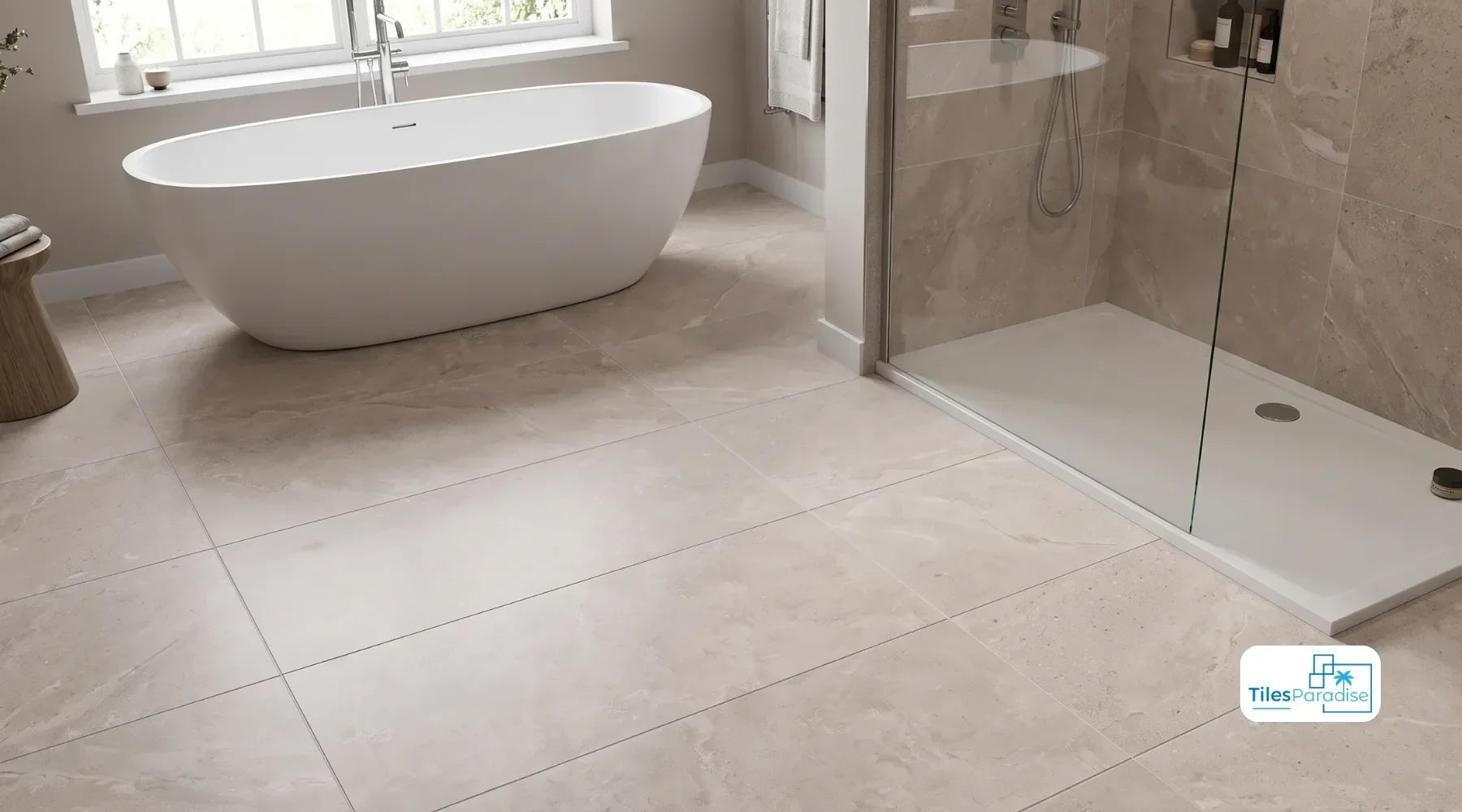
Siltstone Stone Effect Matt Porcelain Wall & Floor Tile is a rectified, through-body porcelain tile with a structured matt ("carving") surface that reproduces the fine, even grain of natural siltstone, supplied in 30x60cm, 60x60cm and 60x120cm formats and in three colourways - Natural, Grey and Blanco.
It is rated for both wall and floor use indoors; it does not require sealing, and its low water absorption makes it suitable for bathrooms, wet rooms, kitchens and hallways. This guide covers what the finish actually is, the full size and colour matrix, the technical specifications that matter in UK installations, how much you need per m², and how to lay large-format stone effect porcelain without lippage.
What Is a Stone Effect Matt Porcelain Tile?
A stone effect matt porcelain tile is a porcelain tile whose surface reproduces the colour, grain and texture of a natural stone using high-definition digital printing and a pressed relief, while retaining porcelain's low porosity and high mechanical strength. The stone is imitated visually; the performance is porcelain's.
Three properties separate it from a plain matt tile: the decoration (a photographic scan of real stone, printed across multiple non-repeating faces), the relief (a pressed micro-texture aligned to the print, so the tile feels like the stone it depicts), and the body (a vitrified porcelain biscuit rather than a porous ceramic one).
What Is Siltstone as a Natural Rock?
Siltstone is a clastic sedimentary rock composed predominantly of silt-sized grains, which measure between 3.9 and 62.5 micrometres on the Udden–Wentworth grain-size scale. That places it directly between mudstone (finer) and sandstone (coarser).
Two geological facts explain the look, and no competing product page states either of them.
First, grain size. Because silt grains are smaller and far more uniform than sand grains, natural siltstone carries a fine, quiet, low-contrast grain rather than the visible speckle of sandstone or the heavy directional veining of marble.
Second, fissility. Siltstone is a mudrock with a low clay-mineral content, and it is distinguished from shale precisely by its lack of fissility; shale splits into thin parallel sheets, siltstone does not. The absence of that layered splitting is why a siltstone face reads as one continuous, evenly bedded surface instead of a stack of visible laminations.
Together, those two properties are exactly what the Siltstone porcelain range reproduces: a calm sedimentary surface with soft tonal drift and no dominant pattern. It is the reason the range works as a full-room floor and wall finish without becoming visually busy, a limitation that marble-effect and terrazzo tiles both have. (Historically, the same qualities made siltstone a prized carving stone; the fine-grained siltstone quarried at Wadi Hammamat was worked into statuary and cosmetic palettes in ancient Egypt because it resisted flaking.)

What Does a "Structured Matt" or "Carving" Finish Mean?
A structured matt finish is a matt glaze combined with a pressed three-dimensional surface relief. On the Siltstone range, this is described by the supplier as a carving finish: the mould presses shallow grooves and undulations that follow the printed sedimentary bedding lines, so light catches the surface the way it catches real quarried stone.

Practical consequences:
-
Grip improves. Micro-texture increases the friction coefficient of the wet surface compared with a flat matt tile.
-
Glare disappears. Matt surfaces diffuse light instead of reflecting it, so ceiling spotlights do not create hotspots, an advantage in small UK bathrooms with low ceilings.
-
Footprints and smears do not show. Matt porcelain hides water marks and limescale film far better than polished porcelain.
-
Cleaning takes slightly more effort. Texture holds soil in a way a polished face does not. See the maintenance section below.
What Does "Rectified" Mean on a Porcelain Tile?
Rectified means each fired tile has been mechanically ground on all four edges to an exact nominal dimension with a squared, unbevelled edge. A non-rectified ("pressed edge") tile carries a dimensional tolerance and a slightly rounded edge, which forces a wider grout joint to disguise it.
Because the Siltstone range is rectified, it can be laid with a narrow 2–3mm grout joint, which is what produces the near-seamless slab look in large formats. It also means the tile is unforgiving: on an uneven substrate, a rectified square edge shows lippage immediately.

What Sizes and Colours Does the Siltstone Range Come In?
The range is built on a three-by-three matrix - three formats, three colourways, so a single scheme can run a small format on the wall and a large format on the floor without a colour break.
|
Format |
Aspect |
Natural |
Grey |
Blanco |
|
30x60cm |
1:2 rectangle |
✔ |
✔ |
✔ |
|
60x60cm |
Square |
✔ |
✔ |
✔ |
|
60x120cm |
1:2 large format |
✔ |
✔ |
✔ |
All nine SKUs share the same finish (matt, carving), the same edge treatment (rectified) and the same wall-and-floor suitability.
Which Siltstone Colour Suits Which Room?
-
Siltstone Natural stone effect tiles: A warm beige/ivory sedimentary tone. It is the correct choice for north-facing UK rooms, which receive cool indirect light all day; a warm-toned floor counteracts that blue cast. It also pairs naturally with oak, walnut and brushed brass.
-
Siltstone Grey stone effect tiles: A neutral mid-grey. Best for south-facing and heavily glazed rooms where warmth is already abundant, and for schemes built around anthracite, chrome or matt black brassware. It is also the most forgiving colour for hallway and utility floors.
-
Siltstone Blanco stone effect tiles: A soft white/off-white. It maximises perceived room size in small bathrooms, cloakrooms and en-suites. Pair it with a grout one shade darker than the tile, never brilliant white, or the joints will yellow visibly within two years.

A practical scheme that uses the matrix properly: Blanco 60x120cm on the walls, Grey or Natural 60x60cm on the floor, same family, same finish, clear tonal separation.
How Many Tiles and Boxes Do You Need Per m²?
|
Format |
Tile area |
Tiles per m² (approx.) |
Notes |
|
30x60cm |
0.18 m² |
5.56 |
Supplied 5 tiles per box (0.90 m² per box) |
|
60x60cm |
0.36 m² |
2.78 |
Confirm box quantity on the product page |
|
60x120cm |
0.72 m² |
1.39 |
Confirm box quantity on the product page |
Because a single 60x120cm tile covers 0.72 m², a 10 m² floor needs only fourteen tiles, which is also why every miscut is expensive in that format.
Pallet quantities for the 30x60cm format run to roughly 61 m² per pallet, which is why this range appears in job-lot and pallet pricing rather than only in single-box retail.
Order 10% over your measured area for a straight (stack or brick) layout, and 15% if you are laying diagonally, working around a complex wet-room former, or using 60x120cm where every cut is a large piece of waste.

What Are the Technical Specifications That Matter?
Confirm the exact certified values for your chosen SKU on the product page before specifying. The figures below explain what each specification governs and what a porcelain tile of this class is normally expected to achieve.
|
Attribute |
What it governs |
What to look for |
|
Water absorption |
Frost resistance, staining, wet-area suitability |
Porcelain is classified under BS EN 14411 group BIa at ≤0.5% |
|
Slip resistance (R rating) |
Barefoot and shod grip, DIN 51130 ramp test |
R9 is standard indoor; R10–R11 for wet areas and thresholds |
|
Slip resistance (PTV) |
UK-preferred pendulum value, BS 7976 |
PTV ≥36 is the low-slip-risk threshold used in UK specification |
|
Abrasion resistance (PEI) |
Surface wear under foot traffic |
PEI 3–4 covers domestic floors; PEI 4–5 for commercial |
|
Thickness |
Handling, adhesive bed, threshold heights |
9–10mm is typical for indoor porcelain; 20mm is outdoor paver only |
|
Shade variation (V rating) |
How much tile-to-tile colour drift is intended |
Stone effects typically sit at V2–V3 by design |
Is It Suitable for Underfloor Heating?
Yes. Porcelain has high thermal conductivity and low thermal mass relative to timber or vinyl, so it heats quickly and radiates evenly; it is the best-performing floor finish over both water and electric underfloor heating. Two conditions apply: use a flexible S1-classified C2 adhesive rather than a standard cement adhesive, and commission the heating system properly (off during installation, then raised gradually over several days after the adhesive has fully cured).
Can It Be Used Outdoors?
The 9–10mm indoor formats are for internal use. Porcelain of this class is frost-resistant by absorption, but external paving needs a 20mm thickness and an R11-class textured surface to carry load and provide grip in rain and frost. If you want stone-effect continuity between an internal floor and a patio, specify a 20mm outdoor porcelain paver in a matching tone rather than laying the 10mm tile outside.
Where Can Siltstone Stone Effect Tiles Be Installed?
-
Bathrooms and en-suites: Walls and floors. The matt surface prevents spotlight glare; the low absorption handles constant humidity. Porcelain does not need sealing.
-
Wet rooms and shower enclosures: Permitted, provided the substrate is tanked. Inside a gradient shower floor, use a smaller format with a confirmed R10–R11 slip rating; 60x120cm cannot follow a fall to a central gully without cutting.
-
Kitchens: Floors, splashbacks and full walls. Matt porcelain resists oil, wine, coffee and citrus staining without sealing, which real limestone does not.
-
Hallways, utility rooms, boot rooms: The correct application for Grey, which hides grit tracked in from outside.
-
Living rooms and open-plan spaces: 60x120cm with a 2mm joint reads as continuous stone flooring rather than as tiling.
-
Not suitable: External paving, driveways, or any load-bearing outdoor surface at 10mm thickness.

How Do You Install 60x120cm Stone Effect Porcelain Correctly?
Large format is where most UK installations fail, and the failures are all avoidable.
Get the Substrate Flat Before Anything Else
For large format, the substrate must be flat to approximately ±3mm over a 2m straightedge. Correct it with a levelling compound before you open a single box. Adhesive is not a levelling product; trying to "bed out" a dip is the single most common cause of lippage and hollow tiles.
Use the Right Adhesive and the Right Coverage
Specify a C2 cement-based adhesive with S1 deformability for floors, underfloor heating, and any large-format wall run. Use the solid-bed method with back-buttering: notch the substrate, skim the back of the tile, and aim for 100% coverage on floors and in wet areas. Voids under a large tile become cracks the first time something heavy is dropped.
Cap the Offset at 20%
Never lay a 60x120cm tile in a 50% brick bond. Large-format tiles have a permitted manufacturing bow along the long edge, so a half-offset places the highest point of one tile against the lowest point of its neighbour, guaranteeing lippage. Limit the offset to a maximum of 20% (roughly 240mm on a 1200mm tile), or use a straight stack bond. Use a levelling clip system throughout.
Set the Joint at 2–3mm and Choose Grout Deliberately
Rectified edges permit a 2mm joint, but never butt tiles together; movement has to go somewhere. Match the grout tone to the tile for a monolithic stone look, or go one to two shades darker for a defined grid. Movement joints are required at perimeters, at internal corners, over structural joints, and in large floor bays.
Dry-Lay Before You Fix
Stone effect ranges use multiple printed faces to avoid visible repetition, and are usually specified at V2–V3 shade variation. Open several boxes, mix them, and dry-lay 6–8 m² to confirm you are distributing the tonal range evenly rather than clustering the darkest faces in one corner.
How Much Does Stone Effect Porcelain Cost Per m²?
Stone effect porcelain in these formats generally sits in the mid range of the UK tile market, above plain white ceramic, well below quarried natural stone. Price is driven by format (60x120cm carries a premium over 30x60cm), by whether the tile is rectified, and by order volume: pallet and job-lot quantities reduce the per-m² rate substantially on whole-room and multi-room jobs.

The true cost comparison is against natural stone, and it is not close:
|
Cost factor |
Siltstone porcelain |
Natural limestone/sandstone |
|
Sealing on installation |
Not required |
Required |
|
Re-sealing |
Never |
Periodically, for the life of the floor |
|
Staining from wine, oil, citrus |
Resistant |
Vulnerable if seal lapses |
|
Acid-based cleaner damage |
None |
Etching |
|
Colour and thickness consistency |
Manufactured and consistent |
Natural variation, calibration needed |
|
Weight per m² |
Lower |
Higher |
Over ten years, the sealing and maintenance line alone usually reverses any upfront saving on natural stone.
How Does Siltstone Compare to Other Tile Effects?
|
|
Stone effect matt |
Marble effect polished |
Wood effect |
Terrazzo |
|
Visual weight |
Quiet, low contrast |
High contrast veining |
Directional plank grain |
Busy speckle |
|
Glare under spotlights |
None |
High |
Low |
Low |
|
Shows water marks |
No |
Yes |
No |
No |
|
Best room use |
Whole-room floors and walls |
Feature walls, statement floors |
Living spaces, hallways |
Small areas, feature zones |
|
Barefoot grip when wet |
Better (textured) |
Poorer (polished) |
Varies |
Varies |
The short version: choose polished marble effect when you want a focal point, and matt stone effect when you want the surface to sit behind the room rather than compete with it.

How Do You Clean and Maintain Matt Stone Effect Porcelain?
-
Routine: sweep or vacuum first, then mop with a pH-neutral tile cleaner. Grit is abrasive; water alone just moves it around.
-
Avoid: soap-based and "mop and shine" products. They deposit a film that dulls a matt surface and collects dirt in the texture. This is the number-one cause of "my matt tiles look cloudy" complaints, and it applies across the whole matt tiles category, not only to stone effects.
-
Avoid: acidic descalers and bleach on grout joints, which erode cement grout over time.
-
Textured surfaces: occasionally work a soft brush along the grain of the relief rather than across it.
-
Sealing: the tile never needs it; this is true of porcelain tiles generally, because a vitrified body cannot absorb sealer. Cement grout benefits from a grout sealer in showers and behind hobs.
-
Steam cleaning: acceptable on porcelain; keep it off freshly cured grout.
What Do Buyers Get Wrong When Ordering Stone Effect Tiles?
-
Ordering the exact measured area. Cuts, breakages and future repairs all need surplus. Order 10–15% over - our guide to calculating bathroom tile quantities works through walls, floors and wastage with a worked example.
-
Ordering in two batches. Shade is matched within a production batch, not across batches. Order the whole job at once, including the surplus - for whole-room and multi-room quantities, pallet and job lot pricing makes ordering in one go cheaper than ordering twice anyway.
-
Judging colour from a screen. Monitor calibration, room orientation and artificial lighting all shift a beige or grey substantially. Order a physical tile sample and view it in the actual room at both midday and night - a screen cannot show you how Natural behaves in a north-facing bathroom.
-
Choosing brilliant white grout with Blanco. It yellows and makes the tile look grey by contrast. Select matching grout at the same time as the tile, not as an afterthought at the till.
-
Assuming any adhesive will do. For 60x120cm tiles over underfloor heating, specify an S1 flexible tile adhesive rated C2 for deformability and laid to solid-bed coverage. A standard C1 adhesive under a large-format tile is a failure waiting to happen.
-
Skipping substrate preparation. Over timber floors and underfloor heating, an uncoupling matting layer absorbs substrate movement that would otherwise crack the tile or the grout, and in a shower enclosure the walls need tanked tile backer boards behind the tile rather than plasterboard.
-
Ignoring the 20% offset rule. The most common source of lippage complaints in large-format installations.
-
Buying 10mm tiles for a patio. Continuity outdoors requires a 20mm paver.
Which Format Should You Choose for Which Room?
Format decides how a room reads far more than colour does.
-
30x60cm small format tiles: Shower floors that need a fall to the gully, narrow cloakrooms, splashbacks, and any surface with a lot of cuts around sanitaryware.
-
60x60cm medium format tiles: The general-purpose floor size for kitchens, hallways and utility rooms; square grids read as calm and need less setting-out than rectangles.
-
60x120cm large format tiles: Walls and floors in bathrooms and open-plan spaces where the aim is fewest possible grout lines.
The same logic runs across the wider bathroom tiles, kitchen tiles and hallway tiles ranges, and across floor tiles as a whole.
What Are the Alternatives to a Stone Effect?
If a quiet sedimentary surface is not the look you want, three neighbouring styles solve different problems. Marble effect tiles give high-contrast veining for a feature wall or a statement floor. Terrazzo tiles bring colour and speckle into small zones such as a cloakroom or a splashback. Wood effect tiles deliver directional plank grain with porcelain's water resistance, which suits hallways and open-plan living.
Where grip is the deciding factor rather than appearance, start from the non-slip floor tiles range and work back to the aesthetic or, for shower floors and family bathrooms specifically, from the bathroom anti-slip tiles range. Our guide to porcelain tile water absorption, slip ratings and thickness explains how to read those figures before you commit. For continuing a stone-effect scheme past the back door, the 20mm outdoor porcelain pavers carry the load and grip that a 10mm indoor tile cannot.
Within the stone effect family itself, colour choice is usually a light-and-orientation decision: grey tiles for bright south-facing rooms, beige tiles and cream tiles for cool north-facing ones.
Frequently Asked Questions
Do stone effect porcelain tiles need sealing?
No. Porcelain is vitrified and non-porous, so it cannot absorb sealer or stains. Only cement grout joints may benefit from sealing.
Are matt stone effect tiles slippery in a bathroom?
Matt and structured surfaces provide more wet grip than polished ones. For shower floors and wet rooms, specify a tile with a confirmed R10–R11 rating or a PTV of 36 or above.
Can Siltstone tiles be used on both walls and floors?
Yes. All nine SKUs across the three formats and three colourways are rated for wall and floor use.
What grout joint should be used with rectified tiles?
2–3mm. Rectified edges permit a narrow joint, but tiles must never be butted together.
Which is best for a small bathroom - 30x60cm or 60x120cm?
60x120cm on the walls, counter-intuitively. Fewer grout lines make a small room read as larger. Keep the smaller format for shower floors that need a fall.
Are these tiles suitable for underfloor heating?
Yes, with a flexible S1-classified C2 adhesive and a properly commissioned heat-up cycle.
Is porcelain better than real siltstone or limestone?
For performance, yes: no sealing, no etching, no staining, consistent thickness. Natural stone retains an advantage only where genuine geological uniqueness is the requirement.