





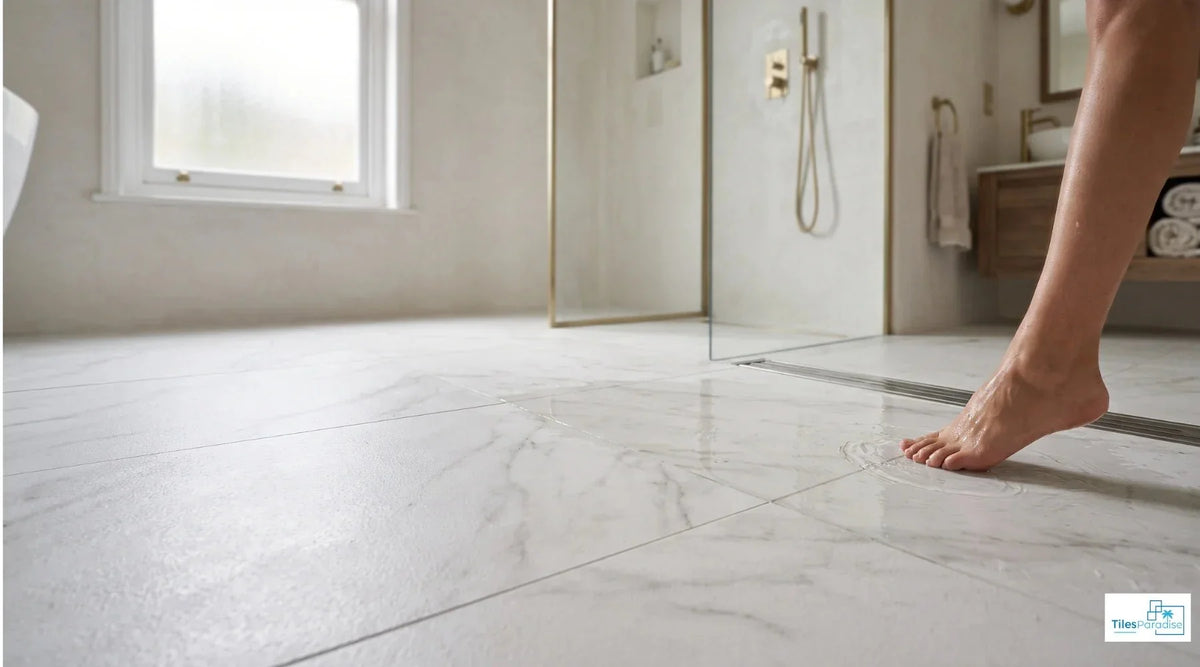
Non-slip marble bathroom floor tiles are marble or marble-effect floor tiles whose surface finish achieves a wet slip-resistance value high enough to be classed as low slip risk in a bathroom in the UK, a wet Pendulum Test Value (PTV) of 36 or above.
Natural marble is metamorphosed limestone made almost entirely of calcium carbonate, so its slip performance depends entirely on how the surface is finished; marble-effect porcelain reproduces the same veining in a vitrified body with a water absorption below 0.5%. The critical point most buyers miss is that the "R11" label printed on a tile box was not measured in a bathroom, was not measured on bare feet, and cannot be converted into a PTV.
This guide sets out which rating actually governs a UK bathroom floor, which finishes and formats reach it, and how to keep it once the floor is in service.
Which Slip Rating Actually Applies to a UK Bathroom Floor?
A UK bathroom floor is specified on a wet Pendulum Test Value of 36 or above, measured with the Slider 55 rubber, because bathrooms are used barefoot on wet surfaces. Everything else on a tile datasheet is secondary.
What is a Pendulum Test Value (PTV)?
A Pendulum Test Value is the slip-resistance score produced when a weighted, rubber-shod pendulum arm swings across a floor, and the friction it meets is measured. The test was standardised as BS 7976 and is now published within BS EN 16165 Annex C. The Health and Safety Executive adopted the pendulum as its standard method, and the UK Slip Resistance Group publishes the guidelines that UK courts rely on in slip-injury cases.
The values fall into three bands:
|
Wet PTV |
Slip potential |
What it means in a bathroom |
|
36 and above |
Low |
The accepted specification target |
|
25 – 35 |
Moderate |
Requires a documented risk assessment |
|
0 – 24 |
High |
A known hazard once wet |
The 36 threshold was not chosen arbitrarily. It was calibrated against recorded slip-accident data for able-bodied adults walking in a straight line on a level surface, which is why a sloped wet-room floor needs more, as set out below.
Why the Pendulum Slider Matters More Than the Number
A PTV quoted without naming the slider is not usable for a bathroom. Two rubbers are used:
-
Slider 96 (Four-S) represents a shod foot. This is the default in most published test data.
-
Slider 55 (TRL) has a hardness consistent with bare skin and represents a barefoot user.
A polished tile can return an acceptable Slider 96 figure and a poor Slider 55 figure. Bathrooms, en-suites, wet rooms and shower zones are barefoot environments, so ask for the Slider 55 wet result. If a supplier can only produce a Slider 96 number, treat the barefoot performance as unproven.
What Do R9, R10, R11, R12 and R13 Actually Measure?
R ratings come from the DIN 51130 ramp test, in which an operator wearing cleated safety boots walks on a tiled ramp lubricated with motor oil while the ramp is tilted until they slip. The resulting angle produces a class from R9 (lowest) to R13 (highest).

That test describes an industrial workshop floor. It does not describe a bare foot on shampoo-diluted water. R ratings remain useful as a relative texture indicator; an R11 tile is tiles unambiguously more textured than an R9 tile from the same range, but they are not a bathroom safety measurement.
Does R11 Mean a Tile Has a PTV of 36?
No. There is no valid conversion between an R rating and a Pendulum Test Value. The two tests use different contaminants, different footwear, different mechanics, and different scales. Conversion tables that map "R11 = PTV 36+" are published widely and are not supported by either standard. Specify the actual test result you need, and request the certificate for that result.
What Are A, B and C Barefoot Ratings?
The A/B/C classes come from the DIN 51097 ramp test, which is the barefoot equivalent of DIN 51130: the operator is barefoot, and the surface is wetted with a surfactant solution rather than oil. The classes are defined by the slip angle achieved:
|
Class |
Slip angle |
Typical application |
|
A |
12° – 18° |
Barefoot walkways, dry or occasionally wet |
|
B |
18° – 24° |
Showers, changing areas, pool surrounds |
|
C |
Over 24° |
Steps into water, steeply falling wet zones |
For a domestic shower zone, class B is the working minimum and class C is the safer specification. Manufacturers publish A/B/C data far less often than R ratings, so it is worth asking specifically.
What Changed With BS EN 16165?
BS EN 16165 is the European standard that superseded BS 7976-2 and the DIN ramp tests. Its annexes cover different methods: barefoot ramp, shod ramp and pendulum among them, and results from one annex cannot be compared with results from another. The ramp annexes now report a slip angle rather than an R or A/B/C class, which is why older R and ABC labels still circulate alongside the newer angle figures. When you receive a datasheet, note which annex or legacy standard produced each number before comparing two products.
What Rating Should You Specify Zone by Zone?

A bathroom is not one surface. Specify by zone:
|
Zone |
Wet exposure |
Target specification |
|
Dry floor away from the bath and shower |
Occasional splash |
Wet PTV 36+ (Slider 55) |
|
Splash zone beside the bath, basin and WC |
Frequent wet feet |
Wet PTV 36+ (Slider 55), R10 or higher texture |
|
Shower zone / wet-room floor |
Constant water, soap, sloped |
Wet PTV 36+ corrected for the fall, plus DIN 51097 class B or C |
|
Step or threshold into a sunken tray |
Water plus a level change |
Highest available class; contrast the edge visually |
Can Natural Marble Be Non-Slip on a Bathroom Floor?
Natural marble can be specified as a non-slip bathroom floor only when the surface is honed, brushed, tumbled, sandblasted or bush-hammered and the finished product carries a wet PTV of 36 or above. Polished marble cannot, and no sealer changes that.
Why Polished Marble Fails in a Wet Bathroom
Polishing closes and flattens the stone surface to a reflective plane. Once a water film forms on that plane, there is very little asperity left for a foot to key into, and wet slip resistance collapses. Polished marble is a wall, vanity, and feature material. It is not a wet floor material.
Which Marble Finishes Improve Grip?

|
Finish |
How it is produced |
Grip when wet |
Trade-off |
|
Polished |
Ground to a reflective gloss |
Poor |
Shows every etch mark |
|
Honed |
Grinding stopped before gloss |
Improved |
Slightly more absorbent; still needs testing |
|
Brushed/antiqued |
Abrasive brushes soften and texture the face |
Good |
Softened veining definition |
|
Tumbled |
Tumbled to round edges and open the surface |
Good |
Rustic look; wider joints |
|
Sandblasted |
Abrasive blasting opens the surface |
Good |
Matt, slightly chalky appearance |
|
Bush-hammered |
Mechanically pitted |
Very good |
Harder to clean; strong texture underfoot |
A honed finish is the usual starting point for a marble bathroom floor because it gives grip without an aggressive texture, but "honed" is a process description, not a rating. Two honed marbles from different quarries can test differently.
What Is Etching, and Does Sealing Prevent It?
Etching is a chemical reaction in which acid dissolves the calcium carbonate at the marble surface, leaving a dull mark. Staining is different: it is a liquid absorbed into the pore structure. An impregnating sealer reduces absorption and therefore resists staining. It does not prevent etching.
In a bathroom, the realistic acid sources are limescale removers, some proprietary bathroom sprays, certain toilet cleaners and vinegar-based homemade solutions. On honed marble, an etch mark blends into the matt surface and is often invisible. On polished marble it announces itself. This alone is a strong argument for honed marble on a bathroom floor.
How Hard Is Marble, and Will It Scratch?
Marble sits at roughly 3 to 4 on the Mohs hardness scale, which is soft relative to fired porcelain. Grit carried in on feet is harder than the stone, so a marble bathroom floor will accumulate fine surface wear over years. Honed and textured finishes disguise this; polished finishes do not.
What Does Marble Need That Porcelain Does Not?
Natural marble on a bathroom floor requires: an impregnating sealer applied after installation and reapplied periodically; pH-neutral cleaning only; immediate removal of acidic products; and acceptance that etch marks and wear patterns are part of owning stone. If that maintenance commitment is not realistic for the household, the honest answer is to specify marble-effect porcelain instead.
How Does Marble-Effect Porcelain Compare With Natural Marble?
Marble-effect porcelain is a vitrified ceramic tile printed and textured to reproduce marble veining, and for a wet bathroom floor it outperforms natural marble on water resistance, acid resistance and maintenance while giving up genuine stone depth and translucency.
|
Attribute |
Natural marble |
Marble-effect porcelain |
|
Composition |
Metamorphosed limestone, calcium carbonate |
Kaolin clay, feldspar and silica, fired and vitrified |
|
Water absorption |
Porous; varies by quarry |
Below 0.5% (BS EN 14411 group BIa) |
|
Sealing |
Required, then reapplied periodically |
Not required for the tile body |
|
Acid etching |
Vulnerable |
Not vulnerable |
|
Staining |
Vulnerable if the sealer lapses |
Highly resistant |
|
Hardness |
Roughly Mohs 3–4 |
Substantially harder |
|
Slip performance |
Depends entirely on finish; must be tested |
Depends on finish; textured and structured surfaces reach higher values |
|
Veining |
Unique to every tile; no repeats |
Printed from a limited number of face patterns |
|
Large formats |
Heavy; needs a sound structural floor |
Lighter per m² at the same size; rectified edges give tight joints |
|
Underfloor heating |
Suitable; needs flexible adhesive |
Suitable; dimensionally stable |
|
Cost |
Higher material and higher lifetime maintenance |
Lower material and near-zero maintenance |
For a working bathroom floor — the surface that gets wet daily and cleaned weekly — marble-effect porcelain is the lower-risk specification. Natural marble earns its place on a vanity top, a bath panel, a niche or a feature wall, where water contact is intermittent and the stone's depth is visible.
Are Marble-Effect Porcelain Tiles Automatically Non-Slip?
No. Porcelain is manufactured in polished, glossy, satin, matt and structured finishes, and a polished marble-effect porcelain is as unsuitable for a wet floor as polished stone. The non-slip performance comes from the surface texture, not from the material. Ask for the wet PTV of the specific finish and size you intend to buy.
Which Tile Format and Layout Gives the Best Grip?
Grip in a bathroom comes from two sources: the texture of the tile face and the number of grout joints per square metre. Format choice controls the second.
Do Large-Format Tiles Work on a Bathroom Floor?
Large-format tiles such as 600×1200 mm work well across the main bathroom floor. Fewer joints means less grout exposed to constant moisture, an easier surface to clean, and a visually larger room. The limitation is geometry: a large rigid tile cannot follow a curved fall towards a drain.
Why Do Mosaics Grip Better in the Shower Zone?
Mosaic and small-format tiles concentrate a high density of grout joints into the shower area. Each joint sits marginally below the tile face and interrupts the water film, so the foot meets a broken rather than continuous wet plane. The same many-piece construction lets the tiler form an accurate fall toward the drain, which large-format tiles cannot do without back-cutting.
What Is the Practical Format Strategy?
Use large format on the main floor and small format or mosaic inside the shower zone. This is a technical decision as much as a design one, and it also creates a deliberate visual boundary that signals the wet area, useful for older users and children.
|
Format |
Best zone |
Grip contribution |
|
600×1200 mm / 800×800 mm |
Main floor |
Texture only |
|
600×600 mm |
Main floor, smaller rooms |
Texture plus modest joint density |
|
300×600 mm |
Main floor, tight layouts |
Higher joint density |
|
Mosaic 25–100 mm |
Shower zone, drain fall |
Texture plus high joint density |
What Grout Should Be Used?
Use a flexible, water-resistant grout throughout, and fill every internal corner and every junction with the bath, tray or screen using flexible silicone rather than rigid grout. Rigid grout in a movement joint cracks. On marble, check that the grout and any pigment are stone-safe before use, because some grout additives can stain light stone.
How Should Non-Slip Marble Bathroom Floor Tiles Be Installed?
A slip rating is a property of the finished floor; the tile installation determines whether the specified performance is actually delivered.
What Does the Subfloor Need to Be?
The structural floor must be rigid enough that deflection does not crack tiles or open the waterproofing junctions. Suspended timber floors usually need overboarding or a decoupling membrane before large-format tile or stone is laid. Marble is heavier per square metre than porcelain of the same thickness, so the structural check matters more with stone.
Is Tanking Required?
Any floor in a wet room or level-access shower must be tanked, and the tanking must be continuous into the wall junctions. No tile finish, grout or sealer compensates for an unwaterproofed substrate. In a conventional bathroom with an enclosed cubicle or a bath, tanking is still recommended around the wet zone.
What Fall Should the Floor Have?
A tiled wet-area floor is normally laid to a fall of between 1:80 and 1:100 toward the drainage point, so surface water drains without ponding and does not migrate outside the intended wet zone. Standing water is both a slip hazard and, on marble, a source of darkening and mineral deposits. Drainage design falls under Building Regulations Part H.
Which Adhesive Should Be Used?
Use a flexible, polymer-modified adhesive suitable for the substrate and for the tile. For natural marble and for light-coloured marble-effect porcelain, use a white adhesive: grey adhesive can show through translucent stone and through some light porcelain bodies. Solid bed coverage matters — voids under a floor tile become failure points under load and under water.
Do You Need Movement Joints?
Yes. Perimeter movement joints and, on larger floors, intermediate movement joints prevent the stresses of thermal expansion — especially over underfloor heating — from lifting or cracking tiles.
How Do You Keep the Floor Non-Slip After Installation?
Slip resistance is not fixed at installation. It falls in service, and the cleaning regime is part of the specification.
What Actually Reduces Slip Resistance Over Time?
Soap scum, body oils, conditioner residue, limescale, and most commonly the residue left by cleaning products that were not rinsed off. Each builds a thin film that sits in the surface texture and smooths it. A floor certified at PTV 40 when new can be measurably slipperier after a year of poor cleaning. This is the single most overlooked factor in bathroom slip safety.
What Cleaning Regime Preserves It?
-
Clean with a pH-neutral cleaner only. On marble, this is not optional.
-
Rinse with clean water after washing and remove the rinse water. Residue is the problem.
-
Use a soft brush on textured or mosaic surfaces; a flat mop skims over texture and leaves the troughs dirty.
-
Never use vinegar, lemon, bleach-based sprays, or limescale removers on natural marble.
-
Avoid abrasive pads on any polished or honed surface.
Which Sealer Should Be Used on Natural Marble?
Use an impregnating (penetrating) sealer, which sits within the pore structure and leaves the surface texture unchanged. Avoid topical sealers, waxes, and "shine restorer" products on a bathroom floor: they form a film on top of the tile that can measurably reduce wet slip resistance, and they wear unevenly.
How Often Should Marble Be Resealed?
Most impregnating sealers on a bathroom floor are reapplied every 12 to 18 months, and honed marble typically needs it sooner than polished because it is marginally more absorbent. Do not work from the calendar alone — drop water on the floor in several places and watch it. If it beads, the sealer is working. If it darkens the stone within a few minutes, reseal.
Do Marble-Effect Porcelain Tiles Need Sealing?
No. A porcelain tile in group BIa of BS EN 14411 absorbs less than 0.5% water, so the body does not need sealing. Cement-based grout joints are the porous element in a porcelain floor, and a grout sealer is worth applying there.
What Determines the Cost of a Non-Slip Marble Bathroom Floor?
Cost is driven by five variables, in roughly this order of impact:
-
Material: natural marble carries a substantially higher material cost per square metre than marble-effect porcelain of comparable appearance.
-
Format: large-format and rectified tiles cost more per square metre than standard sizes, and mosaic sheets carry a high cost per square metre for a small area.
-
Finish: brushed, tumbled, sandblasted and structured finishes involve extra processing and cost more than a standard matt face.
-
Installation: large formats, sloped wet-room falls, tanking and mosaic drain zones all raise labour cost. Stone is slower to cut and set than porcelain.
-
Lifetime maintenance: sealing consumables, resealing labour and occasional professional restoration are real recurring costs on natural marble and effectively zero on porcelain.
Order samples before committing. Slip resistance is difficult to judge from a photograph, and the safest assessment is to wet a sample and stand on it barefoot.
The Six Questions to Ask Before You Buy
Ask the supplier for these in writing. A supplier who cannot answer them cannot demonstrate the floor is fit for a wet area.
-
What is the wet Pendulum Test Value, and which slider was used: 96 or 55?
-
Is there a DIN 51097 A/B/C class, or a BS EN 16165 barefoot ramp angle?
-
Does the certificate apply to this exact finish and size, or to another product in the range?
-
What is the water absorption figure, and which BS EN 14411 group does the tile fall into?
-
For natural stone: which sealer is recommended, and does it change the slip value?
-
Can I have a sample to test wet, barefoot, before ordering?
How Do Non-Slip Marble Floor Tiles Work With Underfloor Heating?
Dense tile and stone are ideal underfloor heating finishes because their high thermal conductivity transfers heat efficiently from the element to the surface. BS EN 1264 sets the physiologically agreed maximum floor surface temperature at roughly 9 °C above room temperature, which gives about 29 °C in an occupied room.
Two practical requirements follow. Use a flexible adhesive and grout rated for underfloor heating so thermal movement does not crack the bed, and commission the system gradually rather than switching it to full output on day one. Marble is compatible with underfloor heating; the failure mode is always the adhesive and joint detailing, not the stone. Browse marble effect floor tiles for formats that suit heated floors.
What Should You Specify for Older or Less Mobile Users?
Specify above the minimum. The PTV 36 benchmark was calibrated for able-bodied adults walking in a straight line on a level floor, so users who are frail, elderly or unsteady, and any floor with a fall, need a higher target. In accessible bathrooms, the shower zone should be specified at the top of the available range, and a contrasting tile colour at the wet-zone edge helps visually impaired users identify the boundary without a physical upstand. Accessibility of floor finishes is addressed under Building Regulations Part M, and ventilation — which controls how long the floor stays wet — under Part F.
Our bathroom anti-slip tiles collection groups the textured options suited to these specifications.
Can You Make an Existing Marble Bathroom Floor Non-Slip?
Yes. A professional anti-slip micro-etching treatment chemically opens the marble surface at a microscopic scale, increasing wet friction without adding a visible coating and without changing the appearance of the stone. Because it modifies the surface rather than sitting on top of it, it does not peel or wear in patches the way a topical coating does.
Two conditions make it worthwhile. First, insist on pendulum readings recorded before and after the treatment on your actual floor; that is the only proof the work achieved anything. Second, understand that the treatment has a service life and will need reapplying; quoted durability varies considerably by product and by traffic, so get it in writing.
Anti-slip mats, adhesive strips and textured tape are short-term measures only. If the floor is being replaced anyway, specifying a correctly rated tile from the non-slip floor tiles range is a better outcome than treating a floor that was never suitable.
Which Marble Colours Suit a Bathroom Floor?
Colour affects perceived cleanliness more than performance, but three patterns are consistent in UK bathrooms:
-
White and light grey marble Carrara-type veining maximises reflected light in a small or windowless bathroom, and shows limescale less than dark stone. Explore marble effect bathroom tiles.
-
Beige and cream marble is warmer, forgiving of dust and hair between cleans, and pairs with brushed brass and timber vanities.
-
Dark grey and black marble is dramatic and excellent for a feature floor, but it shows water spotting and limescale most clearly, so it demands the most consistent cleaning routine.
Whichever colour you choose, the finish decides the slip performance. A dark honed floor and a white honed floor from the same range perform the same.
Common Mistakes to Avoid
-
Buying on the R rating alone. It was measured in boots, on oil.
-
Assuming a certificate for one tile covers the whole range. Different finishes and sizes test differently.
-
Using polished tile on the floor to match a polished wall. Match the veining, not the finish.
-
Applying a topical sealer or shine product to a bathroom floor. It can reduce grip.
-
Cleaning with limescale remover on marble. It etches the surface permanently.
-
Laying large-format tile into a drain fall. Use mosaic or small format in the shower zone.
-
Skipping tanking because the tile is waterproof. The tile is; the substrate is not.
-
Not rinsing after cleaning. Residue is the most common cause of a floor becoming slippery over time.
Frequently Asked Questions
Are marble bathroom floor tiles slippery?
Polished marble is slippery when wet. Honed, brushed, tumbled and sandblasted marble, and textured marble-effect porcelain, can reach the wet PTV 36 benchmark — but only a test certificate confirms it for a specific product.
Is R10 enough for a bathroom floor?
R10 is a reasonable texture indicator for a main bathroom floor, but it is not a bathroom safety measurement. Specify the wet PTV instead, and treat the R rating as supporting information.
What is the difference between an R rating and a PTV?
An R rating comes from a ramp test in safety boots on motor oil and produces a class from R9 to R13. A PTV comes from a pendulum test and produces a number. They measure different things and cannot be converted between.
Do I need a different tile inside the shower?
Usually yes. The shower zone is wetter, soapier, and sloped, so it should be specified above the level-floor benchmark and in a format that can follow the fall — normally mosaic or small format.
Does sealing marble make it less slippery?
An impregnating sealer should not change the surface texture. A topical sealer or wax can reduce slip resistance and should not be used on a bathroom floor.
How often do marble bathroom floor tiles need resealing?
Typically every 12 to 18 months, sooner on honed marble. Confirm with a water-bead test rather than the calendar.
Do marble-effect porcelain tiles need sealing?
The tile body does not. Cement-based grout joints benefit from a grout sealer.
Can I use natural marble in a wet room?
It is possible with a honed or textured finish, correct tanking, a correct fall and disciplined maintenance — but marble-effect porcelain is the lower-risk specification for a constantly wet, sloped floor.
What tile size is best for a small bathroom floor?
A 600×600 mm or 300×600 mm format usually suits small rooms; large format also works and reduces grout lines, provided the tiler can cut around fixtures cleanly.
Can I order a sample first?
Yes, and you should. Wet the sample and stand on it barefoot before committing to a full order through our tile sample service.
Where to Go Next
If you are specifying the floor now, start with the bathroom floor tiles range and filter by finish. For the marble look specifically in a low-maintenance body, see bathroom porcelain tiles and matt tiles, which is where the textured, wet-area-appropriate finishes sit.
For a fuller comparison of the two materials, read white marble effect porcelain vs real marble tiles. If the floor continues out of the bathroom, our marble floor tiles hallway guide covers the different demands of a transitional zone. Adhesives, flexible grout, and tanking products are grouped under adhesives and grout.