





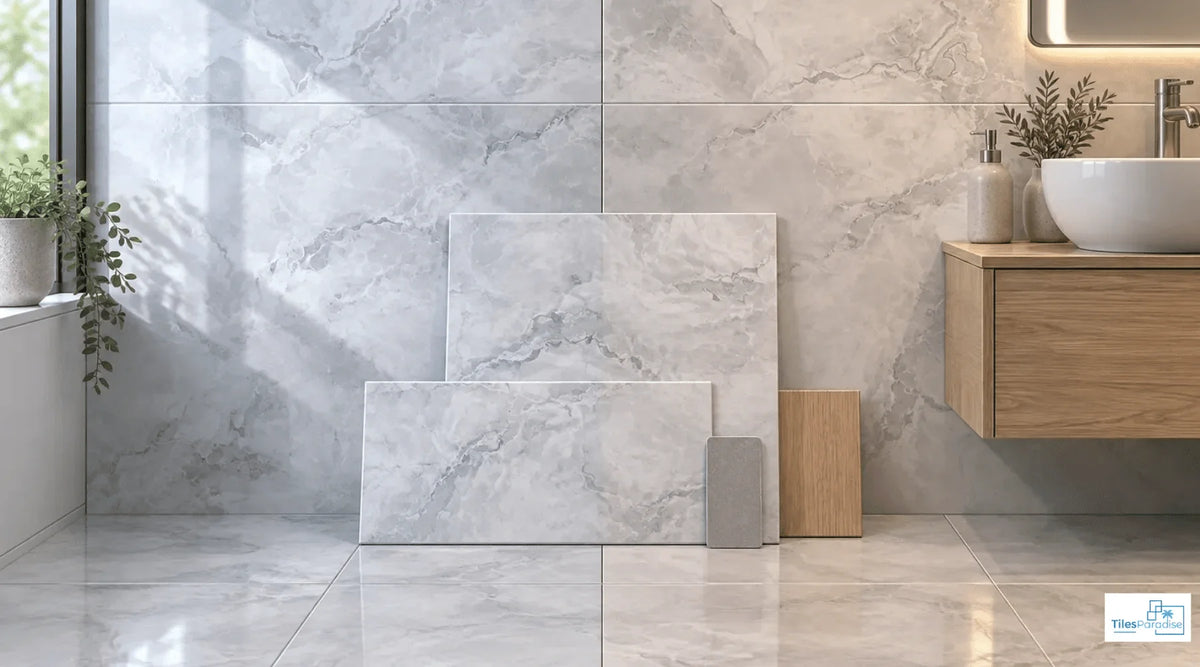
Grey bathroom tiles are ceramic, porcelain, stone or glass tiles whose neutral colour can connect a bathroom floor, wall, shower and fittings without forcing every surface to match. The best choice is not simply the prettiest grey. It is the tile whose material, finish, format and tested performance suit the exact place where it will be installed.
For most UK bathrooms, floor-rated matt porcelain is the strongest starting point for the main floor. A polished grey porcelain can work beautifully on a dry feature wall or shower wall, but it should not be treated as a shower-floor tile unless the exact product has suitable wet and barefoot slip-test evidence. Tiles and grout are also not the waterproofing layer. A shower or wet room needs the correct tanking system behind the finished surface.
This guide starts with the decisions that affect safety and installation, then moves to size, shade, grout, lighting, price and style.
Grey Bathroom Tiles at a Glance
| Decision | Practical starting point |
| Best all-round floor material | Porcelain marked for floor use |
| Best wall material | Porcelain or suitable glazed ceramic |
| Best wet-floor finish | Matt or textured tile with verified wet slip data |
| Best choice for a small room | Light or warm grey with a balanced layout |
| Best grout for a seamless look | A shade close to the tile |
| Best grout for easier visual maintenance | Mid-grey, subject to the tile design |
| Best luxury combination | Grey stone or marble effect with warm wood and brushed metal |
| Best 2026 update | Warm grey, greige, texture and layered lighting instead of a cold all-grey scheme |
| Typical waste allowance | 10 percent, or more for complex patterns |
Which Grey Tile Works in Each Part of a Bathroom?
Choose the bathroom zone before choosing the shade. A product marked for walls and floors may still be a poor fit for a continuously wet shower floor, while a polished tile that is unsuitable underfoot may be ideal on the wall.
| Bathroom zone | Strong starting point | Evidence to check | Avoid assuming |
| Shower wall | Porcelain or glazed ceramic approved for wall use | Tile weight, substrate capacity, adhesive compatibility and waterproof backing system | “Water-resistant tile” means the wall assembly is waterproof |
| Shower floor | Floor-rated matt or textured porcelain, often in a format that follows the drain falls cleanly | Wet pendulum result and appropriate barefoot test data for the exact product | A matt finish, R rating or “anti-slip” label alone proves barefoot safety |
| Main bathroom floor | Floor-rated matt porcelain | Wet slip data, floor suitability, underfloor-heating compatibility and movement requirements | Every wall-and-floor tile performs equally when wet |
| Dry feature wall | Polished, matt or textured porcelain | Wall suitability, weight and pattern variation | A polished wall finish is automatically suitable for a wet floor |
| Bath surround | Glazed ceramic or porcelain approved for the wall | Waterproofing at wet zones, sealed penetrations and compatible joint materials | Grout will stop water reaching the background |
| Vanity splashback | Ceramic, porcelain, glass or suitable natural stone | Cleaning method, sealing requirement and reaction to cosmetics | All stone tolerates acidic cleaners |
| Accessible bathroom | Low-glare floor tile with verified wet and barefoot performance | Product test report, drainage, threshold design and user-specific risk assessment | More grout lines can replace tested surface performance |
What order should you make the decisions in?
Use this sequence so that colour does not hide a technical mismatch:
-
Identify the exact surface: wall, dry floor, main bathroom floor or shower floor.
-
Confirm that the manufacturer approves the tile for that surface.
-
For any wet floor, request numerical slip-test evidence for the exact tile and finish.
-
Check that the wall or floor build-up can support the tile and remain stable.
-
Choose a format that fits the room and the drainage geometry without awkward cuts.
-
Confirm waterproofing, adhesive, grout and movement-joint requirements as one system.
-
Test the shade, finish and grout in the room under daylight and evening lighting.
-
Calculate full-box quantity, waste, delivery access and spare-tile storage before ordering.
That order prevents a common renovation mistake: buying a striking tile first, then discovering that the finish, weight, size or performance does not suit the intended area.
Which Finish Is Best for Grey Bathroom Tiles?
The best finish depends on water exposure, cleaning tolerance and the amount of light in the room. Finish names describe appearance, but they do not replace test data.

Matt grey tiles
Matt tiles reduce glare and usually show fingerprints and drying streaks less than a highly polished surface. They suit main bathroom floors, family bathrooms and calm stone-effect schemes. Some matt tiles have added texture, while others feel almost smooth. A matt label therefore does not prove a particular slip rating.
Polished grey tiles
Polished tiles reflect windows and artificial light, which can give a pale grey or marble-effect wall greater depth. They are useful on vanity walls, bath surrounds and other wall areas where a reflective finish is wanted. Water spots, soap film and fine surface marks are normally easier to see on a dark polished tile.
A polished product may be sold for wall and floor use, but that broad suitability is not permission to use it inside a shower floor. Ask for wet test evidence before using any polished tile where people will stand with wet bare feet.
Textured grey tiles
Textured tiles can increase surface contact and disguise minor marks, but deeper texture also holds soap residue and limescale more readily. Choose a texture that can be reached with a soft nylon brush and rinsed properly. Highly uneven finishes can be uncomfortable under bare feet and harder to detail around drains.
Gloss ceramic wall tiles
Gloss ceramic can be a practical wall choice in a compact bathroom because it is often lighter than porcelain and easy to wipe. Check the product label carefully. A wall-only ceramic tile must never be fitted to the floor.
| Priority | Finish to consider first | Main trade-off |
| Lower glare and easier day-to-day appearance | Matt | Still needs exact wet performance data on a floor |
| Strong light reflection on a wall | Polished or gloss | Shows water marks and is not automatically suitable for wet floors |
| More tactile, stone-like appearance | Textured matt | Requires more deliberate cleaning |
| Simple family bathroom floor | Floor-rated matt porcelain | Colour and texture should be checked with a real sample |
| Coordinated luxury scheme | Polished wall tile with a related matt floor tile | Confirm the two versions match in undertone and calibre |
What are the most popular grey bathroom tile styles?
Marble-effect porcelain, soft stone effect, concrete effect, onyx-style veining, metro tiles and small mosaics cover most current grey bathroom looks. Marble and onyx effects add movement, while stone and concrete effects create a quieter background. Metro tiles make the joint pattern part of the design. Mosaics are useful for details and some complex floor falls only when the exact product is approved and tested for that surface.
Choose the style after the surface requirements are fixed. A realistic printed pattern should be checked across several tile faces so repeats can be distributed before fixing.
What Does an Anti-Slip Label Actually Prove?
An anti-slip label is a product description, not a numerical test result. Before specifying a grey tile for a shower or wet-room floor, ask for the test method, result, wet condition, footwear condition and exact product reference.
The commonly displayed R rating comes from a shod-foot ramp test using oil. It can help compare flooring in some settings, but it does not directly reproduce a barefoot person standing on a soapy shower floor. Wet barefoot areas need evidence that matches wet barefoot use.
The UK Health and Safety Executive uses the following wet pendulum bands when interpreting floor data:
| Wet Pendulum Test Value | HSE slip-potential band |
| 0 to 24 | High |
| 25 to 35 | Moderate |
| 36 or above | Low |
A value of 36 or above does not make every bathroom installation risk-free. Drainage, contamination, cleaning, surface wear, slope, footwear and the user all affect risk. It is, however, much stronger evidence than an unexplained “non-slip” statement.
What should you ask the retailer or manufacturer?
Ask these five questions in writing:
-
What is the wet Pendulum Test Value for this exact colour, size and finish?
-
Was the product tested in the direction in which it will be walked on?
-
Is there separate wet barefoot test data for shower or pool-surround use?
-
Does the report cover the current production version, not a similar tile in the range?
-
Are there cleaning products or sealers that could change the tested surface?
If a product page says “anti-slip” but does not show a numerical value, do not invent one from the finish name. Request the technical data sheet before committing it to a shower floor. This is especially important for older users, children, people with reduced mobility and level-access wet rooms.
Is Porcelain or Ceramic Better for a Grey Bathroom?
Porcelain is usually the more versatile choice for a bathroom floor because it is dense, durable and available in many floor-rated finishes. Ceramic is often lighter, easier to cut and cost-effective for walls. The exact product approval matters more than the material name alone.
| Material | Useful characteristics | Good starting use | Important limitation |
| Porcelain | Very low water absorption, dense body, broad floor and wall range | Main floors, walls and many wet-area applications | Heavier and harder to cut; finish still needs slip evidence |
| Glazed ceramic | Lighter, easy to wipe and often easier to cut | Bathroom walls and splashbacks | Many products are wall-only |
| Natural stone | Unique shade and texture in every piece | Feature walls and suitable floors where maintenance is accepted | May need sealing and stone-safe cleaners; some stone reacts to acid |
| Glass mosaic | Reflective, small format and useful on curves or details | Niches, splashbacks and selected feature areas | Adhesive can show through; floor and slip suitability must be confirmed |
| Marble or stone-effect porcelain | Natural-looking pattern with routine porcelain care | Coordinated walls and floors | Printed faces can repeat; inspect several pieces before fixing |
Porcelain is generally classified at no more than 0.5 percent water absorption, but low absorption does not make the completed shower waterproof. Water can pass through or around grout joints, corners, penetrations and movement joints. A compatible tanking membrane or approved waterproof board system must protect the background in the wet zone.
Do porcelain bathroom tiles need sealing?
Most glazed porcelain does not need sealing. Some polished, unglazed or specialist porcelain may have different instructions, so follow the product data. Natural stone often needs an impregnating sealer, and the correct product depends on the stone. Sealing a tile does not remove the need for waterproofing behind the installation.
Which Grey Shade Works With Your Light?
The room’s light changes grey more than a product photograph suggests. North-facing daylight can exaggerate blue or green undertones. Warm artificial light can pull the same tile towards beige or taupe. Dark polished grey also reflects the colour of nearby walls, towels and cabinetry.
| Room condition | Grey to sample first | Why | Balance it with |
| Small room with little daylight | Pale warm grey or soft greige | Reduces a cold cast while keeping the room light | Off-white, pale oak and warm-neutral lighting |
| Bright south-facing room | Mid-grey, charcoal or cooler stone grey | Strong daylight can support more depth | White sanitaryware, timber or brushed metal |
| Windowless bathroom | Warm mid-grey with controlled contrast | Avoids a flat blue-grey box under artificial light | Layered ceiling, mirror and wall lighting |
| Hard-water area | Mid-tone matt or softly patterned grey | Hides dried mineral spotting better than flat charcoal gloss | Mid-grey grout and regular squeegee use |
| Spa-style room | Warm stone grey or greige | Feels softer beside timber and natural textures | Oak, walnut, linen tones and brushed nickel |
| Dramatic ensuite | Charcoal or dark marble effect | Creates depth in a controlled, well-lit space | Warm wood, off-white and targeted wall lighting |
How do you test a grey tile sample properly?
Use a full-day sample test instead of holding one piece under a showroom light:
-
Place the sample vertically on the wall and horizontally on the floor. The angle changes reflection and colour.
-
View it in morning daylight, afternoon daylight and with the evening lights on.
-
Put it beside the proposed sanitaryware, vanity material, metal finish and two grout samples.
-
Wet half of the surface. Check colour change, water spotting, glare and how the texture feels.
-
Move the sample to the darkest corner and the shower area.
-
Photograph it from the doorway, but make the final decision with your eyes because phone processing can alter grey.
-
If the tile has veining, request more than one sample or view several faces so one piece does not misrepresent the range.
This test is more useful than choosing a shade name such as silver, ash or graphite. Those names are not standardised between manufacturers.
Are Large Grey Tiles Suitable for a Small Bathroom?
Yes. Large grey tiles can work in a small bathroom when the walls and floor are flat, the cuts are balanced and the format can follow the room geometry. Room size alone does not decide tile size.

A 60x120cm tile can reduce grout lines and create a calm surface on a straight wall. It can also create waste or narrow edge cuts in a room filled with niches, boxed pipes and short returns. A 30x60cm tile is easier to set out around obstacles. A 60x60cm tile can suit a simple main floor, but a large rigid piece is harder to form around multi-directional shower falls.
| Format | Where it often works well | Where it needs caution |
| 30x60cm | Compact walls, awkward returns, bath panels and layouts with several cuts | More joints than a large format; still requires a planned set-out |
| 60x60cm | Main bathroom floors and square wall modules | Drain falls, small offsets and narrow rooms may produce awkward cuts |
| 60x120cm | Full-height walls, feature walls and simple open floors | Requires a flat background, suitable handling equipment and skilled fixing |
| Mosaic or small format | Curves, niches and floors with complex falls when the product is floor-rated | More grout to clean; grout does not replace slip-tested tile performance |
How should a small room be set out?
Dry-plan the key wall from the main doorway and the main floor axis before adhesive is mixed. Check the cuts at both ends, the alignment with the vanity and shower screen, and the height of horizontal joints around a bath or niche. Move the starting line when a centred layout creates a thin strip at a visible edge.
Running rectangular wall tiles horizontally can emphasise width. A vertical stack can emphasise height. Neither layout changes the physical dimensions, so choose the direction that aligns cleanly with the room’s dominant lines and produces the best cuts.
What Grout Colour Works With Grey Bathroom Tiles?
The safest grout choice is usually close to the tile’s background colour. A tonal joint makes the whole surface feel calmer. A contrasting joint highlights every tile and every small alignment variation.
| Grey tile | Grout direction | Visual effect | Maintenance note |
| Pale grey | Pale or silver grey | Soft, continuous surface | More forgiving than bright white in daily use |
| Warm grey or greige | Warm grey or taupe-grey | Preserves the warm undertone | Test beside wood and off-white finishes |
| Mid-grey | Matching mid-grey | Balanced and practical | Often disguises routine discoloration well |
| Charcoal | Charcoal or dark grey | Dramatic, low-contrast field | Dried limescale may be more visible |
| Veined grey marble effect | Grout matched to the background, not the strongest vein | Keeps the pattern readable without drawing a grid | Cure a sample because wet grout appears darker |
| Grey metro tile | Tonal for calm, contrasting for a graphic grid | Layout becomes more visible as contrast rises | Contrast also exposes imperfect joints |
The Tile Association summarises minimum joint guidance as follows: wall tiles with a facial area below 0.1 square metre and no side longer than 600mm should have joints of at least 2mm. Wall tiles from 0.1 to 1 square metre with no side longer than 1200mm should have joints of at least 3mm. Floor-tile joints should not be less than 3mm. Product tolerances, substrate, tile type and the installer’s specification can require wider joints.
Do not assume that a rectified edge permits a 1mm joint. Rectification makes dimensions more consistent, but tiles, backgrounds and buildings still move.
What Colours Complement Grey Bathroom Tiles?
Grey works best when another material supplies warmth, contrast or colour. Match the accompanying colour to the grey undertone rather than treating every grey as neutral.
Grey and white
White sanitaryware gives grey a clear reference point. Soft white usually feels warmer beside greige and warm stone effects. Brilliant white creates stronger contrast against charcoal and cool silver grey.
Grey and wood
Oak softens pale and mid-grey. Walnut adds depth to charcoal or grey marble effect. Use wood on a vanity, shelf or framed mirror rather than trying to match several timber tones across the room.
Grey and green
Sage, olive and moss bring a natural note to warm or mineral grey. Muted greens are easier to live with than a highly saturated accent across a large wall.
Grey and blue
Navy creates a strong, tailored contrast. Dusty blue works with pale grey when the room has enough warmth from timber, textiles or lighting to prevent the palette feeling cold.
Grey and metal finishes
Brushed nickel is quiet and adaptable. Brass or aged bronze adds warmth. Matt black creates sharp outlines but can make a small room feel visually busy when used on every fitting.
How do you make a grey bathroom look expensive without overdesigning it?
Use fewer, better-coordinated decisions:
-
continue one wall tile across the main sightline
-
align tile joints with the vanity, niche and screen where practical
-
combine a reflective wall with a safer matt floor in the same colour family
-
repeat one metal finish instead of mixing three unrelated finishes
-
use layered lighting rather than one harsh ceiling source
-
choose a grout that supports the tile instead of drawing an accidental grid
-
finish exposed edges with a deliberate trim or mitred detail specified by the installer
Precise set-out, clean junctions and suitable lighting normally make a room feel more resolved than adding another decorative surface.
Are Grey Bathroom Tiles Outdated in 2026?
Grey bathroom tiles are not outdated, but the cold all-grey formula has lost appeal. A room with the same flat blue-grey tone on every wall, floor, cabinet and accessory can feel impersonal. Current bathrooms use warmer neutrals, visible texture, natural timber, softer whites, selective colour and mixed matt and polished surfaces.
The useful 2026 direction is not to replace grey with one new colour. It is to make grey part of a layered palette. Warm grey and greige work with oak and brushed nickel. Charcoal works with walnut and warm light. Pale stone grey works with off-white, sage or muted blue. A tile with natural movement normally ages better than a flat colour chosen only because it is fashionable.
Can Grey Bathroom Tiles Be Used With Underfloor Heating?
Many porcelain tiles can be used with electric or water-based underfloor heating, but the whole build-up must be compatible. Product approval for the tile is only one part of the specification.
Confirm all of the following before installation:
-
the exact tile is marked as compatible with underfloor heating
-
the substrate is dry, stable and within the heating-system requirements
-
the primer, levelling compound, membrane, adhesive and grout are approved for the system
-
movement joints and perimeter movement are designed, not filled rigidly
-
cables or pipes are tested before, during and after tiling as required by the system maker
-
the heating remains off during the specified curing period
-
commissioning starts only at the time and rate stated by the adhesive and heating manufacturers
An uncoupling membrane may be specified to manage differential movement, but it must form part of an approved assembly. Do not choose adhesive only by colour. Choose it by tile material, format, substrate, bed depth, wet-area exposure and heating compatibility.
How Much Do Grey Bathroom Tiles Cost?
Tile price is calculated from the measured area, waste allowance and full-box rounding. Labour, preparation, waterproofing and accessories can cost more than the tile, so a tile-only figure should not be presented as a complete renovation price.
Quantity formula
For a rectangular floor:
length × width = floor area
For four full-height walls:
(2 × room length + 2 × room width) × tiled height - openings = wall area
Then:
(floor area + wall area) × waste factor = order area
Use 1.10 for a straightforward 10 percent allowance. Complex patterns, diagonal layouts, fragile products or rooms with many corners may need more. Buy full boxes from one batch and keep spare pieces for future repairs.
Worked medium-bathroom example
Assume a room is 2.4m long, 2.0m wide and tiled to 2.4m high. Doors and windows total 3.0 square metres.
| Calculation | Result |
| Floor: 2.4 × 2.0 | 4.80m² |
| Walls: (2 × 2.4 + 2 × 2.0) × 2.4 | 21.12m² |
| Less openings | 18.12m² wall area |
| Floor plus walls | 22.92m² |
| Plus 10 percent waste | 25.21m² before full-box rounding |
In the live Tiles Paradise catalogue check used for this guide, the selected in-stock grey porcelain examples ranged from £19.99 to £31.99 per square metre. At those prices, 25.21 square metres would cost approximately £503.95 to £806.47 for tiles only, before box rounding.
The estimate excludes delivery, adhesive, grout, primer, levelling, backer board, tanking, trims, movement profiles, underfloor heating, labour, waste removal and repairs to the background. Live prices and stock can change, so recalculate on the product page before ordering.
How Should Grey Bathroom Tiles Be Installed?
A professional installation treats the tile as the visible finish of a complete system. The result depends on the background, waterproofing, set-out, coverage, joints and curing as much as the tile itself.
Professional installation sequence
-
Survey the walls and floor for flatness, movement, moisture and load capacity.
-
Confirm tile weight, format, substrate and the fixing-system specification.
-
Repair or replace unstable backgrounds. Do not tile directly to a timber wall background.
-
Allow new gypsum plaster to cure and dry. The Tile Association states a minimum curing period of four weeks.
-
Install the specified waterproofing system in showers and wet rooms, including tapes, corners, collars and drain connections.
-
Set out the whole room so visible cuts, joints, niches and sanitaryware align deliberately.
-
Mix the correct adhesive to the product instructions and achieve the required full contact, especially with large-format tiles and wet areas.
-
Maintain the specified joint width and include movement joints at the required positions.
-
Grout, clean and seal only where the product system requires it.
-
Protect the finish during curing and commissioning. The Tile Association advises allowing at least 14 days after tiling before a newly tiled shower is used.
Can you install grey bathroom tiles yourself?
A competent DIYer may be able to tile a simple dry splashback or a small, flat wall with a manageable ceramic format. Large porcelain, wet-room floors, shower tanking, underfloor heating, heavy wall tiles and multi-plane drainage are poor places to learn through trial and error.
Use a qualified tiler when failure could cause a leak, unsafe floor, cracked heated installation or expensive rework. Ask for the proposed waterproofing system, adhesive coverage method, movement-joint plan and relevant experience, not only a square-metre labour price.
What adhesive should be used on plasterboard?
Use an adhesive that its manufacturer approves for the tile material, tile size, plasterboard type and exposure. A large porcelain tile may exceed the capacity of a background that can accept a small ceramic wall tile. In a shower, moisture-resistant plasterboard alone should not be treated as the waterproofing layer. Follow the board, tanking and adhesive system as one specification.
How Do You Clean Grey Bathroom Tiles?
Clean grey tiles according to their material and texture. Start with the mildest effective method and rinse away residues, because detergent film can make a floor look dull and affect grip.
Routine for porcelain or glazed ceramic
-
Remove loose grit with a soft brush or vacuum head suitable for hard floors.
-
Use warm water and a correctly diluted pH-neutral cleaner.
-
Agitate textured surfaces with a soft nylon brush instead of adding more chemical.
-
Rinse with clean water.
-
Dry polished walls and dark tiles with a microfibre cloth or squeegee.
-
Keep shower drainage clear so water does not sit on the surface.
How do you remove hard-water marks?
First confirm the tile and grout materials. Use a manufacturer-approved limescale cleaner on compatible porcelain or ceramic, test it in a hidden area, protect nearby metal and rinse thoroughly. Do not use acidic limescale remover on limestone, marble or other acid-sensitive natural stone. Avoid abrasive pads on polished surfaces.
Repeated hard-water staining is easier to control with a short routine: squeegee after showering, improve ventilation and clean before a thick mineral layer develops.
Which grey tiles are easiest to maintain?
A mid-grey matt or softly patterned glazed porcelain is normally forgiving because it avoids the strong water spotting of dark polished tile and the residue traps of deep texture. Grout quantity, ventilation, water hardness and cleaning habits can matter more than the grey shade itself.
What Usually Goes Wrong With Grey Bathroom Tiles?
The most expensive problems are rarely caused by the colour. They come from choosing a finish or installation system that does not match the surface.
| Symptom | Likely cause | Prevention |
| Floor feels slippery when wet | Finish chosen from a marketing label without suitable test evidence, or cleaner residue left on the floor | Verify wet and barefoot data, maintain drainage and rinse cleaning residue |
| Shower leaks into an adjoining room | Tiles or water-resistant grout were treated as the waterproofing layer | Use a complete tanking system with sealed corners and penetrations |
| Large tiles show lippage | Background was not flat, set-out was poor or adhesive coverage was inconsistent | Survey flatness, use the correct fixing method and employ an experienced large-format tiler |
| Cracks appear over underfloor heating | Heating was commissioned too early, movement was restrained or the build-up was incompatible | Follow one approved system and its curing and commissioning schedule |
| Grout looks patchy | Inconsistent mixing, early washing or uneven drying | Measure water, mix consistently and follow cleaning times |
| Dark tile looks constantly marked | Hard-water residue, soap film or unsuitable cleaner | Sample the finish wet, squeegee and use the correct cleaner |
| Printed stone pattern repeats | Too few faces were viewed before fixing | Open several boxes and dry-lay the pattern before installation |
| Thin cuts appear at corners | Tile size was chosen before the set-out was tested | Plan both ends of each run and adjust the starting line before fixing |
| Replacement tile does not match | Different production batch or no spare stock retained | Order one batch and store labelled spares |

Grey Bathroom Tile Buying Checklist
Before paying for a full order, confirm each point:
-
exact product name, colour, size and finish
-
wall, floor or wall-and-floor approval
-
wet slip result for a main bathroom floor
-
wet barefoot evidence for a shower or wet-room floor
-
thickness, rectification and pattern variation
-
square metres per box and the number of full boxes required
-
one production batch for the whole visible area
-
underfloor-heating compatibility where applicable
-
substrate, waterproofing, adhesive and grout compatibility
-
cured grout sample beside the tile
-
delivery method and kerbside access
-
inspection and damage-reporting deadline
-
change-of-mind return conditions and restocking charge
-
whether leftover boxes can be returned
-
enough labelled spare tile for a future repair
Do not allow installation to begin before every box has been checked for colour, calibre, visible damage and the correct product. A cut or fixed tile is usually no longer returnable.
Which Grey Tiles From Tiles Paradise Fit Different Briefs?
The following shortlist uses specifications and prices visible on Tiles Paradise product and collection pages on 15 August 2026. It is a decision aid, not a substitute for the current product data sheet. Stock and price can change.
| Product | Verified public specifications | Best brief to consider | Important limit | Checked price |
| Gemstone Onyx Grey Matt 60x60cm | Porcelain, matt, 9.5mm, rectified, wall and floor, underfloor-heating compatible | Budget-conscious mid-format wall or main-floor scheme | No numerical slip result was visible, so request evidence before wet-floor specification | £19.99/m² |
| Statuario Mercury Grey Matt 60x120cm | Porcelain, matt, 9.5mm, rectified, wall and floor, underfloor-heating compatible | Light marble-effect full-height wall or simple large-format floor | “Anti-slip” appears in the name, but a numerical result was not visible | £22.99/m² |
| Statuario Mercury Grey Matt 30x60cm | Porcelain, matt, 9.5mm, rectified, wall and floor, underfloor-heating compatible | Same pale marble look in an easier format for compact or cut-heavy layouts | Confirm exact slip data for shower or wet-room floors | £23.95/m² |
| Athos Grey Marble Effect Matt 60x120cm | Porcelain, matt, 9.5mm, rectified, wall and floor, underfloor-heating compatible | Large grey marble-effect wall or floor where a matt finish is preferred | The page uses “anti-slip” without a visible numerical value | £31.99/m² |
| Makrana Dark Grey Polished 60x60cm | Porcelain, polished, 9.5mm, rectified, wall and floor, underfloor-heating compatible | Dark reflective wall, vanity backdrop or suitably assessed dry floor | Do not assume a polished finish is suitable for a shower floor | £21.99/m² |
| Ozial Dark Grey Gold Polished 60x120cm | Porcelain, polished, 8.5mm, rectified, wall and floor, underfloor-heating compatible | Dramatic feature wall with grey and gold movement | Better treated as a wall or assessed dry-floor option unless wet slip evidence is supplied | £24.99/m² |
Start with the grey bathroom tile collection, then filter by the surface and finish already selected in this guide. Buyers comparing materials can also browse porcelain tiles, while finish-led searches can be narrowed to matt tiles or polished and gloss tiles.
For size-led planning, compare 30x60cm tiles, 60x60cm bathroom tiles and 60x120cm bathroom tiles. Use the bathroom anti-slip tile collection to build a shortlist, then request the exact numerical test report before confirming a wet-floor product.
Once the tile is fixed, price the complete compatible system rather than improvising at installation. Compare current grout, tile adhesive and tile backer boards, then confirm product compatibility with the tile, substrate, wet zone and heating system.
What services and buying terms are currently visible?
-
Selected product pages offered a £1.99 cut sample when checked. Samples are listed as non-returnable and non-refundable.
-
Product pages offered postcode-based delivery options, including standard pallet and faster services where available.
-
Tile and SPC deliveries are described as kerbside pallet deliveries.
-
Product pages ask customers to inspect goods before cutting or installation and report damage promptly.
-
The site advertises trade deals and interest-free finance, subject to the current eligibility and checkout terms.
The site currently displays conflicting wording for the free-delivery threshold, delivery times, free versus paid samples and 14-day versus 30-day returns. Until those pages are aligned, check the tile sample service, shipping policy and returns policy immediately before ordering. Save the terms shown at checkout.
No public showroom address, in-house fitting service, custom cutting service, bespoke tile-design service, product-specific extended warranty or independently verified eco-certification was found during this review. Contact Tiles Paradise before travelling or relying on any of those services. For bulk opportunities, check the current job-lot deals.
Frequently Asked Questions
Are grey tiles good for a bathroom?
Yes. Grey is easy to coordinate and available in wall, floor, matt, polished, stone-effect and marble-effect formats. The correct material and performance for the surface matter more than the colour.
What are the disadvantages of grey bathroom tiles?
Cool grey can feel cold under blue-white lighting, charcoal can show limescale, polished finishes can show streaks, and deep textures need more cleaning. A sample test reveals these issues before a full order.
What is the best grey for a small bathroom?
A pale warm grey or soft greige is a reliable starting point, but a well-lit small bathroom can also support charcoal. Balanced cuts, lighting and contrast have more impact than a rule that small rooms must use pale tiles.
Can the same grey tile be used on walls and floors?
Yes, when the exact product is approved for both surfaces and the wall can support it. Wall-only tiles must not be used on floors. A wall-and-floor label still does not prove shower-floor slip suitability.
Can polished grey tiles be used in a shower?
Polished porcelain can be used on a suitable shower wall. Do not use it on a shower floor unless the exact product has appropriate wet and barefoot test evidence.
Are grey bathroom tiles waterproof?
No tile finish should be treated as the waterproofing system. Porcelain absorbs very little water, but joints, corners and penetrations remain. Showers and wet rooms need a compatible tanking system behind the tiles.
What grout colour is best with light grey tiles?
Pale or silver-grey grout normally creates the calmest result and is often more forgiving than bright white. Cure a sample beside the tile because wet grout and screen colours are unreliable.
What wall colour works with dark grey bathroom tiles?
Soft white, warm off-white, muted sage, taupe and pale clay can balance dark grey. Match the paint to the tile’s undertone and view both under the final lighting.
Which grey bathroom tiles are easiest to clean?
Mid-grey glazed porcelain with a matt or softly patterned face is usually forgiving. Dark polish shows mineral deposits, while deep texture needs more brushing and rinsing.
Do grey tiles work with white bathroom fixtures?
Yes. White sanitaryware gives grey a clean contrast. Off-white walls and warm timber can prevent the combination feeling stark.
Are large-format tiles suitable for small bathrooms?
Yes, if the substrate is flat and the tile produces balanced cuts. Test the layout around doors, niches, pipes and the shower before ordering.
Can grey porcelain tiles be used with underfloor heating?
Many can, but the exact tile and the primer, membrane, adhesive, grout, movement joints and commissioning method must all be compatible with the heating system.
How much should you allow for waste?
Ten percent is a common starting allowance for a straightforward layout. Complex patterns, many corners, diagonal laying or fragile products may require more. Round the result up to full boxes.
What trims work with grey bathroom tiles?
Brushed stainless, chrome, black, brass and colour-matched trims can all work. Choose the trim depth from the tile plus adhesive build-up, and coordinate it with the main metal finish.
Where can you buy grey bathroom tiles online in the UK?
Tiles Paradise sells grey porcelain and ceramic bathroom tiles online with samples on selected products and postcode-based delivery options. Confirm live stock, price, delivery and returns at checkout.
Does Tiles Paradise offer free grey tile samples?
The current wording is inconsistent. Product and sample-service pages showed paid samples, including £1.99 cut samples on selected tiles, while some collection and footer text referred to free samples. Use the current product-page price as the order reference.
Can leftover grey tiles be returned?
Current product-page wording says leftovers are not returnable and change-of-mind returns are subject to conditions and a restocking fee. Read the live return policy before ordering and calculate full boxes carefully.
Does Tiles Paradise install bathroom tiles?
No public in-house installation service was verified during this review. Ask sales whether a current referral option exists, and verify any installer’s qualifications, insurance and wet-room experience independently.
Is there a Tiles Paradise showroom?
No public showroom address was verified on the website during this review. Contact the company before making a journey.
Are eco-certified grey bathroom tiles available?
No product-specific environmental certification was verified for the shortlisted grey tiles. If this affects procurement, request an Environmental Product Declaration, recycled-content evidence and manufacturing certification for the exact product.
Which grey tiles are suitable for an accessible bathroom?
Start with a level, low-threshold layout, a floor tile supported by relevant wet slip-test evidence, a finish that does not create strong glare and grout contrast that makes changes of level easier to see. Slip resistance is only one part of accessibility. Drainage, falls, grab rails, transfer space, lighting and professional assessment also matter.
Can matt and polished grey tiles be mixed?
Yes. A practical combination is matt porcelain on the floor and polished or gloss tile on a feature wall. Keep the undertones related, repeat one tile size or grout colour and view the combination under the final lighting before buying.
Which grey tile colours should be avoided?
There is no universally bad grey. Avoid a cool blue-grey in a poorly lit room if the sample already looks cold, a very dark polished surface where hard-water spotting will be frustrating, and any shade that clashes with the fixed sanitaryware or stone. More importantly, avoid choosing colour before surface suitability and test evidence.
Can a grey bathroom tile layout be visualised before ordering?
Yes. Start with scaled wall elevations and a floor plan showing actual tile dimensions, grout joints and cuts. A digital room visualiser can help with colour and broad pattern, but it cannot confirm true shade, surface feel, print variation or slip performance. Use it alongside real samples and a dry set-out.
Does Tiles Paradise offer custom cutting, design consultations or supply-and-fit packages?
None of those services was verified on the public website during this review. Ask for written confirmation before including them in a project specification. A local tiler or bathroom designer may quote separately for layout, cutting and installation.
How should grey natural stone be sealed?
Use only the sealer and cleaning system specified for the exact stone. Test it on a spare piece first because an impregnating or colour-enhancing product can alter the shade. Porcelain made to imitate stone should not automatically be sealed.
Can damaged grey tiles be repaired or restored?
Stained grout and failed sealant can often be renewed, but a cracked or chipped tile is normally replaced. Keep spare tiles from the same batch because a later batch may differ in shade and calibre. Investigate movement, impact or substrate failure before replacing a cracked tile.
How should old bathroom tiles be disposed of?
Do not put construction waste into ordinary household recycling unless the local authority specifically accepts it. Ask the local council, licensed waste carrier or installer about rubble and ceramic disposal. Reuse intact tiles as spares or for small projects where practical.
Where can customer ratings and brand comparisons be checked?
Use reviews as a service check, not as a substitute for technical data. Compare recent verified-purchase reviews, independent retailer feedback, batch consistency, complaint handling and documented product performance. Tiles Paradise did not display enough verified product-level review data on the shortlisted pages to produce a defensible brand ranking.
Are finance, trade prices or renovation bundles available?
The site advertises interest-free finance and trade or job-lot opportunities, subject to current terms. A fixed full-bathroom tile bundle was not verified. Compare the delivered total for the exact quantity, including full-box rounding, samples, adhesive, grout, trims, tanking, delivery and waste.
How do you find a qualified bathroom tiler?
Ask for recent wet-room or bathroom examples, public-liability insurance, a written scope, substrate and tanking details, movement-joint planning and the proposed product system. Check who owns responsibility for setting out, falls, plumbing penetrations, protection and any workmanship guarantee. Obtain comparable written quotations rather than choosing from a headline day rate.
Final Decision
Choose grey bathroom tiles by surface first and colour last. Use floor-rated matt porcelain as the starting point for a main floor, demand wet and barefoot evidence for a shower floor, use polished tile mainly where reflection is useful, waterproof the background, test a real sample and plan the full installation system before buying.