





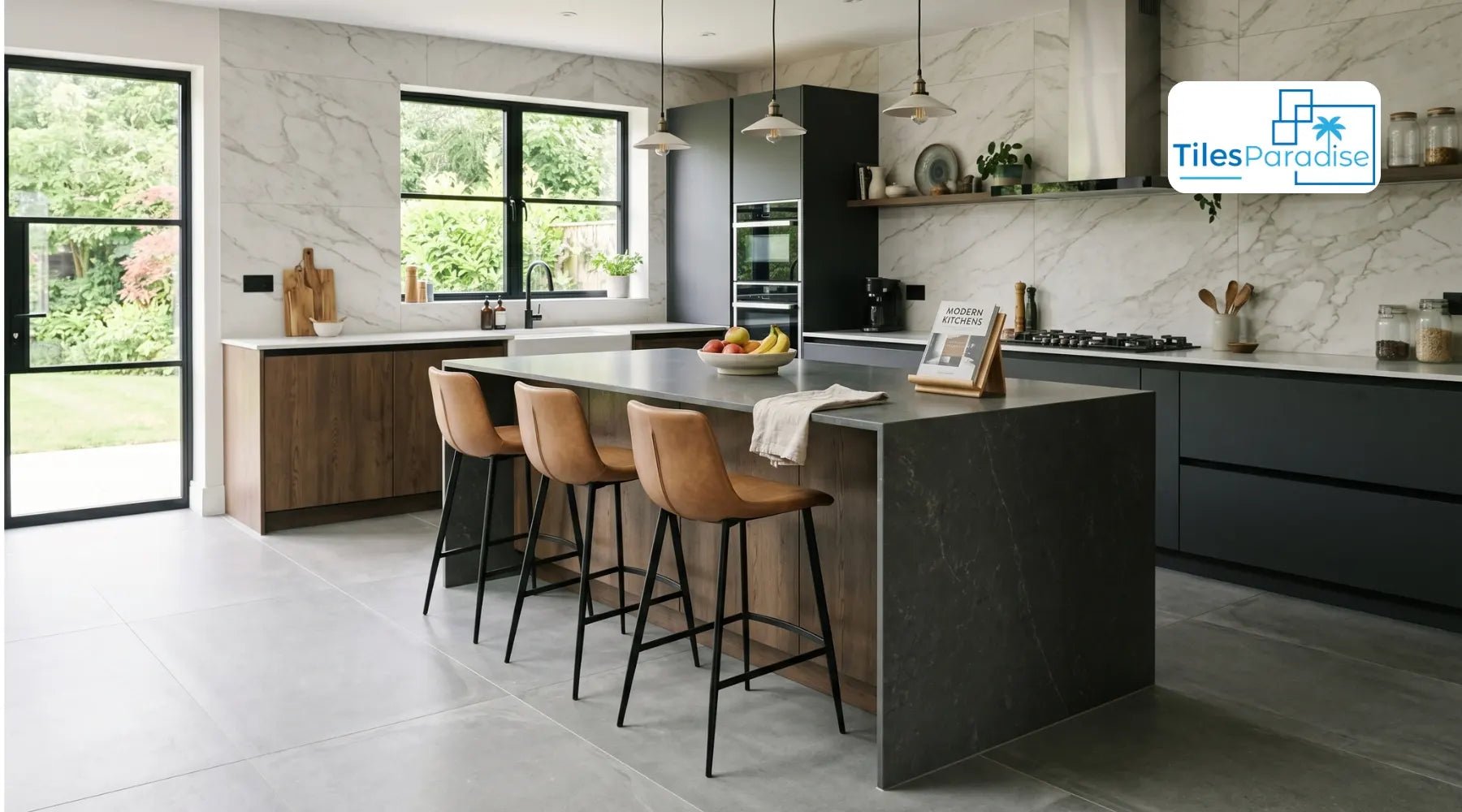
Choosing the best large format porcelain kitchen floor tiles for open plan kitchens with underfloor heating demands attention to format size, material density, slip resistance rating, and thermal compatibility simultaneously. Getting any single factor wrong creates lasting problems at floor level, from cracked tiles to failed adhesive bonds and poor heat transfer.
Large kitchen floor tiles have redefined open plan design across UK homes. Formats now span 600x600mm to 1200x1200mm, creating seamless, low-grout floors that can increase the perceived size of a kitchen by up to 15% and deliver a finish that lasts 20 years or more with minimal upkeep.
What Size Is Classified as Large Format for Kitchen Floor Tiles?
Large kitchen floor tiles begin at 600x600mm and rise through 600x1200mm, 800x800mm, 900x900mm, and 1200x1200mm formats, with sizes above 900mm on any single edge classified as extra large kitchen floor tiles in standard UK tile specifications. For kitchen diners above 25m², a 600x600mm tile is the minimum advisable format; a 600x1200mm or 800x800mm reads far better at scale and avoids the grid-heavy repetition that smaller formats create across wide open floors. Extra large kitchen floor tiles at 1200x1200mm suit open plan extensions where a continuous surface runs uninterrupted from the cooking zone through the dining area.
|
Format Size |
Classification |
Best Application |
|
600x600mm |
Large |
Standard kitchens, 20m²+ |
|
600x1200mm |
Large Format |
Open plan, kitchen diners |
|
800x800mm |
Large Format |
Contemporary open plan spaces |
|
900x900mm |
Extra Large |
Large open plan extensions |
|
1200x1200mm |
Extra Large |
Premium open plan spaces |
Browse the full kitchen floor tiles range for size options across all available formats.
Porcelain or Ceramic: Which Material Wins on Large Kitchen Floors?
Large porcelain kitchen floor tiles outperform ceramic on every functional measure for UK kitchen conditions: water absorption below 0.5%, PEI Class 4 or 5 abrasion resistance, and frost-proof density for open plan spaces extending toward glass rear extensions or bi-fold doors. Large ceramic kitchen floor tiles are a cost-effective option for utility areas and lighter-traffic zones, but for the primary kitchen floor, porcelain hardness and stain resistance make it the stronger long-term choice. The porcelain kitchen tiles collection covers the full range of formats, finishes, and colour options for UK kitchen floors.
How Do Fewer Grout Lines Improve Large Kitchen Floor Maintenance?
Large format kitchen floor tiles reduce grout intersections to just 3 to 7 joints per square metre, compared to over 80 joints in mosaic formats, cutting the surface area exposed to kitchen grease, spills, and bacteria significantly. Fewer grout lines also reduce visual fragmentation of the floor plane, a perceptual effect that can make a kitchen look up to 15% larger in compact galley or L-shaped layouts common across UK terraced homes. For homeowners comparing formats, the medium format 60x60cm tiles offer a useful midpoint where a full large format run is not practical.
What Slip Resistance Rating Do Large Kitchen Floor Tiles Require?
For UK domestic kitchen floors, a minimum slip resistance of R10 is required on large format tiles, rising to R11 in busy family kitchens where wet spills from cooking are a daily occurrence. Matt, textured, and Punch Matt finishes on big kitchen floor tiles consistently achieve R10 or above, while polished and high-gloss surfaces fall short of safe traction standards in wet kitchen conditions. Large light grey kitchen floor tiles and large white kitchen floor tiles in a matt or textured finish deliver the optimal balance of safety, brightness, and clean aesthetic.
Slip resistance quick reference:
• R9 — Dry areas only, not suitable for kitchen floors
• R10 — Minimum for domestic kitchen floors with low to moderate traffic
• R11 — Recommended for busy family kitchens and open plan kitchen diners
• R12+ — Commercial kitchens and wet room applications
Are Large Format Tiles Effective Over Kitchen Underfloor Heating?
Large format porcelain kitchen floor tiles are among the most thermally efficient choices for underfloor heating (UFH) because fewer grout lines create fewer thermal interruptions between the heat source and the tile surface above. The best size range for UFH performance in UK kitchens sits between 600x600mm and 600x1200mm; formats exceeding 1200mm on any single edge require perimeter expansion joints and full adhesive back-buttering to manage repeated thermal expansion safely. Always specify S1 class flexible adhesive and C2 flexible grout when laying big floor tiles kitchen-wide over electric mat or water-fed screed UFH systems.
UFH installation checklist for large kitchen floor tiles:
1. Confirm substrate flatness: within plus or minus 2mm per 2m span (BS 5385)
2. Specify S1 class adhesive for thermal movement tolerance
3. Apply C2 flexible grout with minimum 3mm joint width over all UFH zones
4. Install perimeter expansion joints every 5 to 8 metres across the floor
5. Follow a gradual warm-up protocol: increase temperature by 5°C per day to prevent thermal shock
The 60x120cm rectangular large tiles range includes porcelain formats rated for UFH installation across UK kitchen floors.
What Subfloor Preparation Do Large Kitchen Floor Tiles Demand?
Under BS 5385, any subfloor receiving large kitchen floor tiles must achieve flatness within plus or minus 2mm over a 2-metre span; deviation above this threshold causes big grey kitchen floor tiles to rock, delaminate, or crack under foot traffic. Concrete screed and rigid cement backer board are the two preferred substrates in UK kitchens; suspended timber floors in Victorian and Edwardian terraced houses require a structural load assessment before installation, as the combined weight of extra large kitchen floor tiles and adhesive can exceed standard joist capacity. Full adhesive back-buttering of each tile is non-negotiable at large formats to eliminate hollow spots that accelerate tile failure under everyday foot load.
Which Colours Suit Large Kitchen Floor Tiles in Open Plan Spaces?
Large grey kitchen floor tiles are the most-specified colour in UK open plan kitchens currently, pairing cleanly with white, navy, sage, and natural wood cabinetry while concealing daily grime better than light alternatives. Large white kitchen floor tiles amplify brightness in rear extensions with limited natural light, while large beige kitchen floor tiles and large cream kitchen floor tiles deliver the warm, organic aesthetic that defines UK interior design in 2026. For a bolder palette, large black kitchen floor tiles, green kitchen tiles, blue kitchen tiles, and gold kitchen tiles create distinctive contrasts with natural wood, marble, or white island units.
|
Colour |
Best Cabinet Match |
Light Reflection |
|
Large grey kitchen tiles |
White, navy, natural wood |
Medium |
|
Large white kitchen tiles |
Any colour scheme |
High |
|
Large beige kitchen tiles |
Warm wood, cream |
Medium-High |
|
Large cream kitchen tiles |
Sage, green, terracotta |
High |
|
Large black kitchen tiles |
Brass, white, copper accents |
Low |
Explore the grey kitchen floor tiles and white kitchen tiles collections for current options, or browse beige kitchen tiles and cream kitchen tiles for warmer, nature-inspired kitchen floors.
How Do Laying Patterns Affect Large Kitchen Floor Tile Visual Impact?
Straight lay (stack bond) suits 600x1200mm and large square kitchen floor tiles at 1200x1200mm in open plan kitchens because it preserves the uninterrupted run of the floor surface and produces the least cutting waste on large format kitchen tiles. An offset pattern at 33% or 50% suits 600x600mm and 800x800mm big tile kitchen floor layouts, adding directional movement without fragmenting the visual field across wide, connected floor planes. Large hexagon floor tile kitchen layouts and large hexagon kitchen floor tiles introduce a geometric focal point for an open plan feature zone, pairing well with patterned kitchen tiles as a contrasting accent border.
Which Stone and Marble Finishes Perform Best on Large Kitchen Floors?
Large stone kitchen floor tiles in travertine, limestone, and slate-effect porcelain reproduce the warmth and tactile depth of natural stone without the porosity and staining risk that genuine stone brings to a working kitchen environment. Large marble effect kitchen floor tiles in 600x1200mm formats replicate continuous veining across the full floor plane, delivering a luxury aesthetic at a fraction of the cost of real marble and with significantly better stain resistance. For a distinctive alternative, onyx kitchen tiles in kitchen large format tile sizes introduce rich amber and dark tonal variation that stone-effect and concrete-effect surfaces cannot replicate.
Explore the full marble effect kitchen tiles range for veined porcelain options across all large format sizes.
How Do Large Floor Tiles Coordinate with Kitchen Wall Tiles?
Selecting kitchen wall tiles that coordinate with large floor tile formats creates visual continuity across the full kitchen elevation, making the space feel more considered as a whole. The key principle is contrast in scale: pairing a large format floor tile with a smaller format wall tile, such as a large subway tiles kitchen splashback or a metro format, creates clear definition between horizontal and vertical surfaces. A large format tile splashback in the same finish family as the floor tile unifies the kitchen scheme without creating visual competition between surfaces.
Modern Kitchen Wall Tiles Ideas to Match Grey and White Cabinets in Small Kitchens
Large grey tile kitchen floor options paired with white gloss metro tiles on the splashback wall create the most effective light-amplifying contrast scheme for small UK kitchens with grey cabinetry. For white cabinets, a textured stone-effect wall tile in warm cream or taupe coordinates with large light grey kitchen floor tiles or large grey kitchen floor tiles without creating a flat, monochrome result. For a full breakdown of size, colour, and layout combinations for small kitchen wall and floor tile schemes, the kitchen wall tile colour, size, and layout ideas guide covers the most effective pairings for UK kitchens with limited natural light.
Cream Gloss Kitchen Wall Tiles Splashback
A cream gloss kitchen wall tiles splashback reflects ambient and task lighting back across the countertop zone, visually lifting the kitchen and contrasting cleanly with large cream kitchen floor tiles or large beige kitchen floor tiles on the floor surface below. Gloss cream wall tiles work particularly well in rear-extension kitchens where the splashback wall faces inward, away from the primary natural light source, with the reflective glaze compensating for reduced daylight penetration across the cooking zone. For cream gloss tile sizes, finishes, and layout guidance specific to kitchen splashback installations, the cream gloss kitchen wall tiles splashback guide provides comprehensive advice for coordinated kitchen schemes.
Final Insights
Large format porcelain kitchen floor tiles combine low water absorption, high abrasion resistance, UFH compatibility, and minimal grout maintenance in a single product choice that delivers both design impact and structural performance for UK kitchens. The Tiles Paradise UK kitchen tiles collection brings together all format sizes, colour palettes, and finish types to support the full range of UK kitchen renovation projects, from compact galley updates to large open plan extensions.
For a compact galley refresh or a full open plan extension, the right kitchen large floor tiles format makes the biggest visual and functional difference at floor level. Confirming subfloor flatness, selecting the correct slip resistance rating, and specifying the right adhesive class before any big kitchen floor tile installation prevents costly failure and guarantees a floor surface that performs strongly for decades.