





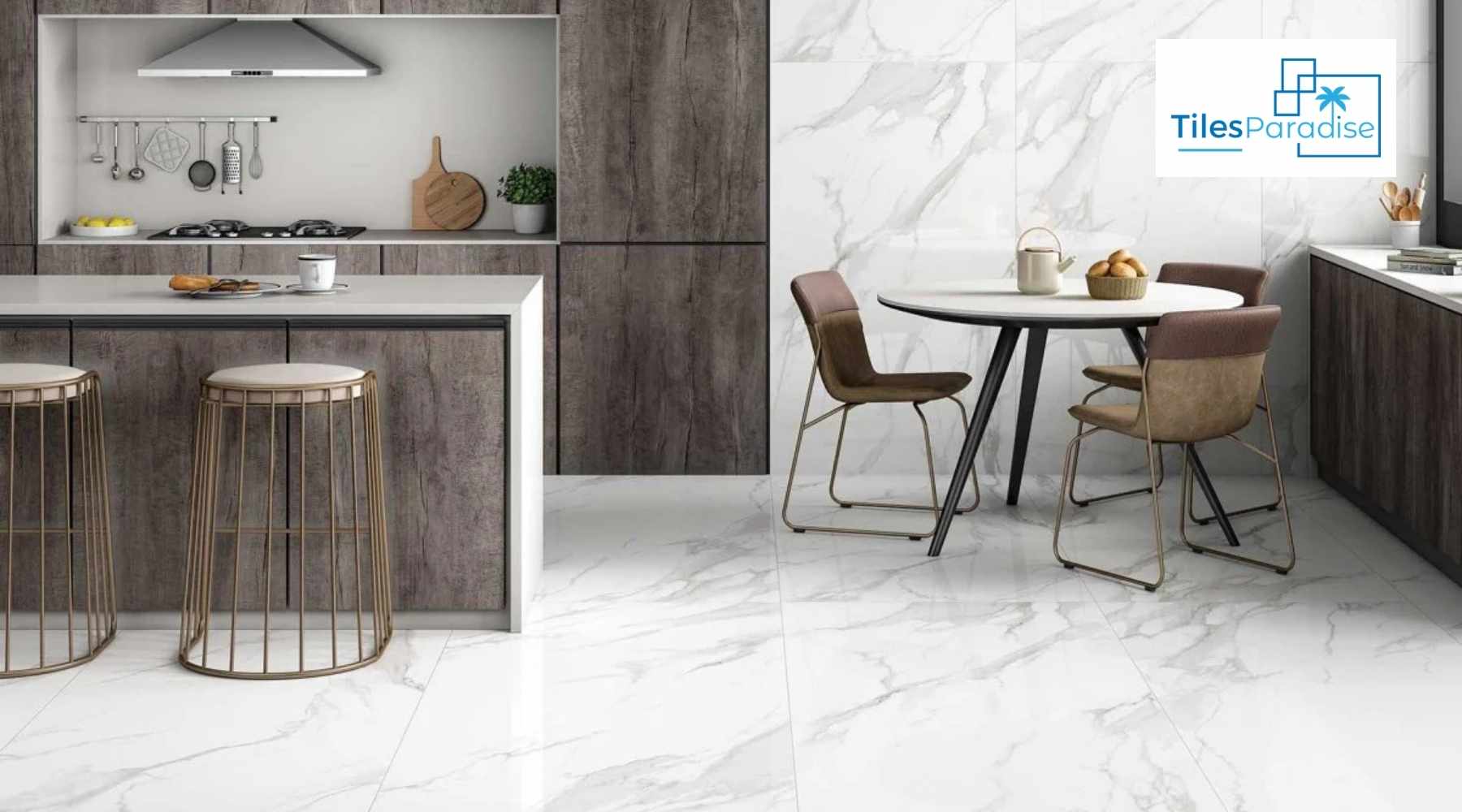
Few flooring materials match the visual authority of marble. Marble floor tiles for bathroom and kitchen spaces have defined luxury interiors for centuries, and that reputation is fully earned. The natural veining, tonal depth, and light-reflective quality of marble create a finish that no manufactured material has truly replicated. From Carrara white to Marquina black, the range of marble and marble effect options available today suits every interior direction and budget.
Choosing the right marble tile flooring is not just an aesthetic decision. It involves understanding finish types, porosity ratings, grading systems, room suitability, and the practical difference between natural stone and porcelain alternatives. This guide covers every factor needed to make a confident, informed choice.
Polished vs Honed Finish: Which Is Right for Each Room?
Finish is the single most important specification decision when selecting a marble tile floor for any space. Polished marble delivers a high-gloss, mirror-like surface that amplifies veining detail and reflects light dramatically, making it ideal for low-traffic areas, feature walls, and living room floors. However, a polished surface becomes slippery when wet, which makes it a poor choice for wet rooms without anti-slip treatment.
Honed marble has a smooth, matte surface that absorbs light rather than reflecting it, providing better underfoot traction in kitchens, hallways, and bathroom floors. The trade-off is that honed finishes are slightly more porous than polished, requiring more frequent sealing to resist staining. A quick reference for finish selection:
|
Finish |
Sheen Level |
Best Room |
Slip Risk When Wet |
Sealing Frequency |
|
Polished |
High gloss |
Living rooms feature walls |
Higher |
Every 1-2 years |
|
Honed |
Matte |
Bathrooms, kitchens, hallways |
Lower |
Every 12 months |
|
Tumbled/Brushed |
Textured |
Rustic spaces, wet areas |
Lowest |
Every 12 months |
Carrara, Calacatta, Marquina: Marble Types and Colour Guide
The most searched and specified marble varieties each carry distinct visual identities rooted in their geological origin. Carrara marble, quarried in Tuscany, Italy, features a soft white to light grey base with delicate feathered veining, making it the most widely used variety for floor marble tiles across both contemporary and traditional interiors. Calacatta is rarer and commands a higher price, characterised by a brighter white background and bold, high-contrast veining in gold or deep grey tones.
For buyers drawn to dark drama, Marquina black marble originates from northern Spain and delivers a deep jet-black base with crisp white veining. The Marquina Black Gold Marble Effect Porcelain captures this aesthetic in a frost-resistant, low-maintenance porcelain format. For a neutral mid-tone, the grey marble tile floor category, represented by options like the Venus Carrara Grey Marble Effect, bridges the gap between cool white and deep charcoal.

White Marble Floor Tiles for Bathroom: Design and Safety Guide
White marble floor tiles are the dominant choice for bathroom flooring globally, and the reasons are well established. White tones amplify natural and artificial light, making smaller bathrooms feel more open, while the subtle variation of natural veining prevents the space from feeling stark or clinical. Marble bathroom floor tile in white or pale grey coordinates effortlessly with chrome, brushed nickel, brass, and matte black fixtures.
For wet area safety, the finish choice is critical. A honed or matt marble bathroom floor tile dramatically reduces slip risk compared to polished alternatives. The Carrara White Matt Marble Effect Porcelain delivers an authentic Carrara aesthetic in a matte-finish porcelain that meets bathroom safety requirements without compromising on appearance. The Invisible Marble Gloss Porcelain suits drier bathroom zones, such as feature walls and vanity surrounds, where the polished finish can be safely used.
Black Marble Floor Tiles: Bold Colour Choices That Work
Black marble floor tiles command attention in any room and perform particularly well in spaces where a deliberate design statement is the goal. Black and white marble floor tiles in checkerboard or large-format layouts have become a defining feature of high-end hospitality design, translating equally well into residential hallways, en-suites, and kitchen floors. The key to making black marble work in smaller spaces is large tile formats, which minimise grout lines and preserve visual continuity.
The Sky Golden Black Marble Effect Porcelain introduces gold veining into a deep black base, producing a dramatic Calacatta-inspired contrast suited to contemporary luxury interiors. Black and white marble floor tiles also pair well with warm timber joinery, concrete surfaces, and minimalist white sanitaryware. The Nazione Black Porcelain extends the black marble aesthetic to outdoor terraces and garden areas.

Real Marble vs Marble Effect Porcelain: Key Differences Explained
This is the comparison most buyers need before committing to either option. Natural marble is a porous metamorphic stone that requires sealing before installation and periodic resealing every 12 to 24 months to prevent staining from acids, oils, and moisture. Without consistent maintenance, natural marble etches, stains, and gradually loses its surface quality. The floor tiles white marble look, achieved with real stone, is unmatched in depth, but the ownership commitment is significant.
Marble effect porcelain tiles replicate the veining, tonal variation, and surface texture of natural marble using high-definition printing technology, fired into a non-porous ceramic body with water absorption below 0.5%. No sealing is required, acid etching is not a risk, and cleaning requires only a standard floor cleaner. The Onyx Cream Marble Effect Polished Porcelain and Onyx Light Grey Marble Effect demonstrate how convincingly modern porcelain replicates natural stone at a fraction of the maintenance burden. For busy households and commercial spaces, marble-effect floor tiles deliver the aesthetic with practical durability.
Marble Tile Vinyl Flooring: What Buyers Need to Know
Marble tile vinyl flooring, and marble vinyl tile flooring are searched heavily by buyers working with tighter budgets or who need a floating floor solution over existing substrates. Luxury vinyl tile (LVT) in marble effect finishes offers cushioned underfoot comfort, DIY-friendly click installation, and full waterproofing, making it a practical choice for rental properties, children's bathrooms, and basement rooms where moisture management is a priority.
The limitation of marble tile vinyl flooring compared to porcelain or natural stone is longevity and visual depth. Vinyl surfaces scratch more easily under heavy furniture and do not carry the light-reflective quality of real or porcelain marble. For permanent, high-value installations, porcelain marble effect floor tiles represent significantly better long-term value and visual return. The full floor tile collection covers every price point and format from entry-level to premium large slab.

Marble Mosaic Floor Tile: Pattern, Detail, and Feature Use
Marble mosaic floor tile brings intricate pattern and texture to spaces where full-format tiles would feel too uniform. Mosaic tile formats, typically running from 2.3x2.3cm chips to 5x5cm squares set on mesh backing, are commonly specified for shower trays, bathroom wet areas, feature insets, and transition strips between larger tile formats. The small format allows mosaic layouts to conform to curved or irregular floor shapes without significant cutting waste.
The Cassia California Polished introduces a warm stone-tone that coordinates well with mosaic border detailing. For those interested in mosaic tile patio floor applications or interior room combinations using mosaic and marble formats together, the mosaic floor tiles guide for bathrooms and kitchens provides layout combinations, grout colour recommendations, and format pairings across both wet and dry room applications.
Marble Floor Tile Grading: Grade A, B and C Explained
One content area almost entirely absent from competitor guides is marble grading, yet it directly affects what a buyer receives. Marble is commercially graded on a three-tier system that most suppliers do not openly communicate:
-
Grade A: Consistent colouring, tight veining, minimal pitting or fissures. Suitable for feature installations and high-end residential use.
-
Grade B: Minor natural imperfections including small pits, fissures, or tonal variation. Acceptable for most residential flooring applications.
-
Grade C: More pronounced variation, fissures, and filling. Used in commercial applications where individual tile character is less critical.
Understanding grading helps explain price variation across marble floor tiles that appear visually similar at first glance. Higher grades require more selective quarrying and processing, which is reflected in the cost. Porcelain marble effect tiles bypass grading entirely because consistency is controlled at the manufacturing stage, making them a more predictable specification for large-area flooring projects.
Marble Floor Tile Maintenance: Sealing, Cleaning, and Longevity
Natural marble flooring tiles require sealing before installation and a consistent maintenance schedule to preserve surface quality. A penetrating sealant applied before grouting prevents adhesive and grout residue from absorbing into the stone. After installation, natural marble floors benefit from resealing once or twice annually, depending on traffic levels and room type. Acidic substances such as citrus juice, vinegar, and wine-based cleaners cause etching on polished marble surfaces and must be avoided.
Daily maintenance for marble tile flooring is straightforward: dry-sweep to remove grit particles that scratch the surface underfoot, and use only pH-neutral stone cleaner for mopping. Avoid steam cleaners on natural marble, as prolonged heat and moisture exposure can compromise the sealant layer. Porcelain marble effect tiles require no sealing and tolerate standard household cleaners without risk of etching, staining, or finish degradation, making maintenance a genuine differentiator between the two options.

Best Porcelain Outdoor Floor Tiles
From Marble Aesthetics to Exterior Performance
The best porcelain outdoor floor tiles combine the visual appeal of natural stone with the technical properties required for exterior use: frost resistance, low water absorption, R11 slip rating, and sufficient thickness to handle ground load and temperature cycling. For buyers who want to carry a marble-inspired aesthetic from interior to exterior spaces, stone-effect porcelain in 20mm thickness achieves that continuity without the fragility of real marble outdoors.
The Crystal Brown Marble Effect Anti-Slip Porcelain and Athos Gold Marble Effect Anti-Slip Matt combine marble-look aesthetics with anti-slip certification for use in covered outdoor areas, conservatories, and sheltered terraces. The best outdoor flooring and tiling guide covers material specifications, thickness requirements, and anti-slip ratings for all exterior tile applications.
Best Porcelain Tile for Outdoor Patio Floor
Carrying Interior Design Language to Garden Spaces
Buyers who want to visually connect an interior marble scheme with an outdoor patio floor can achieve that continuity through coordinated porcelain ranges that offer matching or complementary finishes in both interior and exterior specifications. The standard for outdoor patio porcelain is 20mm thickness, R11 slip resistance, and frost-proof certification, properties that natural marble cannot reliably meet without specialist treatment and ongoing maintenance.
The Egeo Marble Brown Semi-Polished bridges the gap between interior and transitional outdoor-covered spaces with a semi-polished stone-effect finish suited to conservatories, covered patios, and garden rooms. For a full breakdown of outdoor tile specifications and installation guidance, the patio tile floor guide provides detailed comparisons across formats, thicknesses, and surface treatments suitable for UK climate conditions.
Final Insights
Marble floor tiles remain one of the most enduringly popular flooring choices because nothing else delivers the same combination of natural uniqueness, visual depth, and perceived luxury. Whether opting for real natural stone or high-quality marble effect porcelain, the right specification comes down to matching the tile's technical properties to how a space is actually used.
From white marble floor tile for bright, open bathrooms to bold black marble floor tiles in statement hallways, the range of formats, finishes, and sizes available today means there is a marble tile solution for every room, every style, and every budget. Choosing the right grading, finish, and material type upfront protects the investment for the long term.
FAQ’s
-
Are marble tiles good for floors?
Marble is a high-density stone, therefore making it an appropriate choice for flooring for areas with lots of traffic or continuous use.
-
Do marble floors need grout?
Yes. Grout plays a significant role in the overall appearance of your marble tile installation. Choose a grout that complements the color of your marble and is suitable for use with natural stone.
-
What is a cheaper alternative to marble flooring?
Many designers are turning to porcelain tiles, ceramic tiles, and natural stone as marble alternatives due to their durability and aesthetic appeal.
-
How long do marble floors last?
While marble flooring may be known for being quite sophisticated, you can rest assured it doesn't compromise durability for its aesthetic appeal. When installed properly, marble floors can last you two decades or more. Regular maintenance will also help extend durability.
-
Why is marble not used in kitchens?
Marble is a porous stone, which means it can absorb liquids. Spills like coffee, wine, or juice can leave stains if not wiped up quickly. This can make upkeep challenging in a busy family kitchen.