





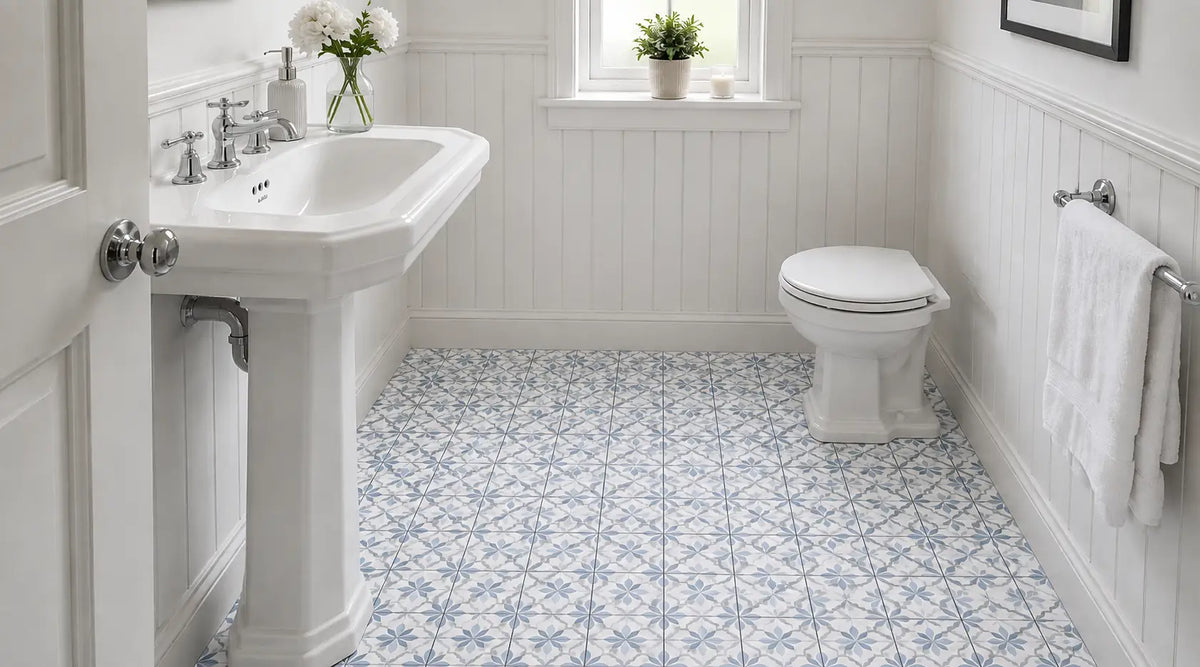
Patterned bathroom floor tiles are decorative floor tiles printed or glazed with a repeating design, such as a Victorian geometric, a Moroccan motif or a subtle star, that turns the floor into the main feature of a bathroom. The safest choice for most homes is a matt porcelain pattern, laid with grout that matches the background colour.
A patterned floor looks simple in a photograph, yet it hides more decisions than a plain one. Homeowners worry that a bold design will make a small bathroom feel cramped, that the style will date before they sell, or that the grout will turn grey and spoil the design. Others buy a beautiful tile, then find the pattern is cut in half at the doorway, or that the glaze feels slippery once the floor is wet after a shower.
This guide works through those problems in the order you will meet them. It starts with the pattern styles and colours that suit different bathrooms, then explains how tile size and pattern scale change a small room. After that come slip safety, grout, layout planning, the fear of a dated look, and a clear way to work out how many tiles to order and what they cost.
What Counts as a Patterned Bathroom Floor Tile?
A patterned floor tile carries a design on its face, so the decoration comes from the tile itself. A tile pattern is different: it describes how plain tiles are arranged, such as brick bond, herringbone or chequerboard. Both ideas appear in searches for "bathroom floor tiles with pattern", so it helps to know which one you want before you shop.
Most patterned bathroom floor tiles made today are porcelain or ceramic, with the design printed by digital inkjet and sealed under a glaze. Traditional encaustic tiles are different, because encaustic tiles are made from coloured cement pressed into moulds. Porcelain and ceramic "encaustic effect" tiles copy that handmade look without the sealing and staining problems of real cement.
Patterned floor tiles come in two common formats. Small 20x20cm (200x200mm) squares suit Victorian and encaustic designs, and each tile often holds one full motif. Larger 45x45cm (450x450mm) squares suit bolder geometrics, where a single tile can carry a big, graphic shape.
Which Patterned Tile Styles Suit a Bathroom Floor?
Pattern style sets the mood of the whole bathroom before colour does. Five style families cover almost every design on the market, and each one suits a different type of home.
Victorian and Encaustic Effect Patterns
Victorian patterns use repeating stars, crosses, petals and diamonds, usually on 20x20cm tiles. Victorian designs feel at home in period terraces and townhouses, yet they also warm up a plain new-build bathroom. Blue and white, black and white, and grey and white are the most versatile Victorian colourways.
Geometric Patterns
Geometric tiles use hexagons, triangles, chevrons and interlocking lines. A geometric floor looks crisp and modern next to matt black taps and white sanitaryware. Monochrome geometrics are the easiest to live with, because the design reads as texture from a distance.
Moroccan and Mediterranean Patterns
Moroccan tiles use curved medallions and lantern shapes, often in warm terracotta, teal or indigo. Moroccan patterns bring a relaxed, holiday feel to a bathroom. Balance a Moroccan floor with plain walls, natural wood and woven textures so the room does not feel crowded.
Floral and Star Patterns
Floral tiles use stylised petals and leaves, while star tiles repeat a simple four or eight-point star. Both designs suit cottage bathrooms and cloakrooms. Star patterns in soft grey or sage green give a gentle, calm look that works well in family bathrooms.
Subtle and Faded Patterns
Subtle patterned bathroom floor tiles use low-contrast colours, such as grey on grey or cream on beige, or a worn "aged" print. A subtle pattern adds interest without dominating the room. Subtle designs are the safest choice when you plan to sell within a few years.
|
Style |
Typical tile size |
Best room character |
Contrast level |
|
Victorian / encaustic effect |
20x20cm |
Period homes, classic family bathrooms |
Medium to high |
|
Geometric |
20x20cm or 45x45cm |
Modern and industrial bathrooms |
High |
|
Moroccan / Mediterranean |
20x20cm |
Relaxed, warm, boho schemes |
Medium to high |
|
Floral / star |
20x20cm |
Cottage bathrooms, cloakrooms |
Low to medium |
|
Subtle / faded |
20x20cm or 45x45cm |
Any style, resale-friendly |
Low |
Which Colour Patterned Floor Tile Suits Your Bathroom?
The best colour for a patterned bathroom floor depends on contrast, light and the colours already fixed in the room, such as the bath, basin and wall tiles. Contrast matters most. A high-contrast pattern looks bold and graphic, while a low-contrast pattern in the same design looks calm and soft.

Black and White Patterned Floor Tiles
Black and white patterned bathroom floor tiles are the most timeless option, because the combination has been used in bathrooms for more than a century. A black and white floor suits both chrome and matt black brassware. Keep walls white or pale grey so the floor stays the focus.
Blue and White Patterned Floor Tiles
Blue patterned bathroom floor tiles feel fresh and clean, and blue links naturally with water. Dusty blue looks soft and vintage, while navy or cobalt looks crisp and coastal. Blue and white patterns pair well with brushed brass taps and white metro wall tiles.
Grey Patterned Floor Tiles
Grey patterned floor tiles are the easiest colour to fit into an existing bathroom. Pale grey patterns suit small rooms, and dark grey patterns hide everyday marks. Grey works with almost every tap finish, so grey is a safe choice when the sanitaryware is staying.
Green and Sage Green Patterned Floor Tiles
Green and sage green patterned floor tiles bring a natural, calm feel to a bathroom. Sage green looks best with warm white walls, oak furniture and brass fittings. Deeper forest greens suit larger bathrooms with good daylight.
Beige, Cream and Brown Patterned Floor Tiles
Beige, cream and brown patterned floor tiles create a warm, traditional look. Cream patterns soften a north-facing bathroom that receives cool daylight. Brown and terracotta patterns suit Mediterranean and rustic schemes, especially next to natural wood.
Pink Patterned Floor Tiles
Pink patterned bathroom floor tiles give a playful but gentle result. Blush pink with grey or white reads as soft rather than bright. Pair a pink pattern with white walls and brushed gold taps for a balanced, modern finish.
Light changes every colour. Warm white bulbs (around 2700K) make cream, pink and brown patterns look richer, while cool white bulbs (around 4000K) sharpen blue, grey and black. Always check a sample under your own bathroom lighting at night, not only in daylight.
How Do Patterned Floor Tiles Work in a Small Bathroom?
Patterned floor tiles work very well in a small bathroom, as long as the pattern scale suits the floor area. A medium-scale design on 20x20cm tiles usually looks best in a cloakroom or en-suite, because the eye sees several full repeats and reads the floor as one continuous surface. A very large motif can look cut off in a narrow room, since only one or two repeats fit between the walls.

Contrast affects space as much as size does. A low or medium-contrast pattern makes a small floor feel larger, while a strong black and white pattern draws attention to the exact edges of the room. A high-contrast design can still work in a small space when the walls stay plain and light.
Visible floor area also changes the effect. Wall-hung toilets and floating vanities let the pattern run to the wall, which makes the floor look bigger. A bulky pedestal basin breaks the design into small, awkward pieces.
|
Bathroom size |
Recommended tile size |
Recommended pattern |
|
Cloakroom under 2 m² |
20x20cm |
Small or medium motif, low to medium contrast |
|
En-suite 2 to 5 m² |
20x20cm |
Medium motif, any contrast with plain walls |
|
Family bathroom 5 to 8 m² |
20x20cm or 45x45cm |
Medium or large motif |
|
Large bathroom over 8 m² |
45x45cm |
Large geometric, or a patterned "rug" zone |
Should the Walls Be Patterned Too?
Walls should usually stay plain when the floor is patterned. One patterned surface gives the room a clear focal point, while two competing patterns make a bathroom feel busy. Plain white, cream or soft grey wall tiles let the floor design stand out.
A second pattern can work when the two designs share one colour and differ in scale. A small patterned floor pairs well with a plain wall and a thin border that repeats the darkest floor colour. Designers often follow a 60/30/10 balance: about 60% plain surfaces, 30% pattern and 10% accent colour.
Colour from the floor can travel up the room in small doses. A towel, a painted door or a vanity front in the same blue or green ties the scheme together without adding another pattern.
Porcelain, Ceramic, Encaustic Cement or Vinyl?
Porcelain is the best material for most patterned bathroom floors, because porcelain is dense, hard and absorbs very little water. Ceramic patterned tiles also work on bathroom floors with light to normal foot traffic, and ceramic tiles are often thicker and lighter to cut. Real encaustic cement tiles need sealing, and patterned vinyl is a budget alternative with a much shorter life.
|
Material |
Water absorption |
Sealing needed? |
Durability on a bathroom floor |
Typical use |
|
Porcelain |
Very low (under 0.5%) |
No |
Very high |
Any bathroom floor, including busy family bathrooms |
|
Ceramic |
Low to moderate (glazed face) |
No |
Good for normal home use |
En-suites, cloakrooms, walls and floors |
|
Encaustic cement |
High |
Yes, and resealing over time |
Good, but stains without care |
Heritage restorations |
|
Patterned vinyl / LVT |
Waterproof surface |
No |
Moderate, can dent and scratch |
Short-term or budget refits |
The Victorian patterned tiles at Tiles Paradise are 6mm porcelain, and the Twilight and Birbin patterned tiles are ceramic between 9.5mm and 10mm thick. All of these tiles are listed as suitable for underfloor heating. Real cement encaustic tiles still have a place in listed buildings, but porcelain encaustic effect tiles give the same look with far less upkeep.
Can Patterned Tiles Go on a Wet Bathroom Floor?
Patterned tiles can go on a bathroom floor that gets wet, but the tile must have enough grip for bare, wet feet. A general domestic bathroom floor usually needs an R10 rating, and a walk-in shower or wet room floor needs R11, or a wet Pendulum Test Value (PTV) of 36 or more. Matt finishes grip better than satin or gloss finishes.
|
Bathroom zone |
Minimum slip performance |
Best patterned finish |
|
Bathroom and cloakroom walls |
No rating needed |
Matt, satin or gloss |
|
Main bathroom floor |
R10, or PTV 36+ when wet |
Matt |
|
Walk-in shower or wet room floor |
R11, or PTV 36+ (above 42 preferred for barefoot use) |
Anti-slip or structured matt |
Slip rating is the one detail you should confirm before buying any patterned floor tile. Many decorative patterned tiles, including the patterned ranges sold at Tiles Paradise, do not list an R rating on the product page. Ask for the technical data sheet before laying a patterned tile on a floor that gets wet. If the rating is unconfirmed, use the patterned tile on the dry part of the floor and a slip-rated plain tile inside the shower.
Satin patterned tiles, such as the Birbin Monochrome range, are listed for walls and light floor use. Satin tiles suit cloakroom floors and feature walls better than floors beside a bath or shower.
What Colour Grout Suits Patterned Floor Tiles?
Grout that matches the background colour of the tile is the best choice for most patterned floors. Matching grout makes the joints disappear, so the design flows from tile to tile as one continuous surface. Contrasting grout frames each tile and turns the floor into a visible grid.
|
Pattern colour |
Recommended grout |
Effect |
|
Black and white |
Mid grey or light grey |
Hides dirt, softens the grid |
|
Blue and white |
Light grey or white |
Keeps the design fresh and clean |
|
Grey on grey |
Mid grey |
Seamless, calm floor |
|
Cream, beige or brown |
Warm beige or sand |
Warm, joined-up look |
|
Green or sage |
Light grey or warm white |
Soft, natural finish |
Bright white grout on a bathroom floor shows dirt quickly. Mid or light grey grout usually looks cleaner for longer. Use a flexible, mould-resistant grout, and seal cement grout in the areas that get splashed.
Joint width matters for the pattern too. Non-rectified 20x20cm tiles usually need joints of about 2 to 3mm, because pressed edges vary slightly. Keep every joint the same width, since uneven joints make a repeating motif look crooked.
How Should the Pattern Be Laid Out?
The pattern should be centred on the main view of the room, usually the doorway, so the full motif sits in the middle of the floor and cuts fall at the edges. A dry lay before any adhesive goes down shows exactly where each cut will fall. Designs made from four tiles need extra care, because one rotated tile breaks the whole repeat.

Centred Full-Floor Layout
A centred full-floor layout covers the whole bathroom with pattern. Start from the centre line of the doorway, then work outwards so the smallest cuts end up under the bath panel, vanity or toilet. A full-floor pattern suits small bathrooms best.
Border Layout
A border layout surrounds the patterned area with one or two rows of plain tiles. The border hides uneven cuts along walls that are not perfectly square, which is common in older UK homes. A plain black or white border also gives a Victorian floor an authentic finish.
Rug Layout
A rug layout places a rectangle of pattern in the middle of a plain floor, like a tiled rug. The rug effect suits large bathrooms, where a full patterned floor could feel overwhelming. A rug zone in front of a freestanding bath or a double vanity creates a clear focal point.
Brick Pattern or Straight Lay?
Most patterned square tiles must be laid straight, in a grid, because a brick offset would break the printed design. Brick bond and herringbone suit plain rectangular tiles instead. For a patterned look with plain tiles, a black and white chequerboard or a herringbone layout creates the pattern through the arrangement, not the print.
Will Patterned Bathroom Floor Tiles Date?
Classic patterned floors date very slowly, because Victorian, black and white and subtle geometric designs have stayed in fashion for well over a hundred years. Designs linked to one short trend, such as very bright multicoloured patchwork, are more likely to feel dated within ten years.
Some estate agents and designers warn that bold, highly personal tiles can narrow buyer appeal and cost money to replace. That concern applies most to loud colours and busy patchwork across every surface. A patterned floor with plain walls is far easier to live with, and buyers can change towels and paint without touching the tiles.
Three choices lower the risk: pick a colour that already exists in the room, limit pattern to one surface, and choose a design with a long history. If you plan to sell within five years, a subtle or monochrome pattern is the most resale-friendly option.
How to Clean and Care for Patterned Floor Tiles
Patterned porcelain and ceramic tiles need only a pH-neutral floor cleaner and warm water. Printed designs sit under a glaze, so normal cleaning does not wear the pattern away. Avoid bleach and acid cleaners on grout, because harsh chemicals break down grout and sealer over time.
Grout needs more care than the tiles. Wipe splashes near the bath and toilet regularly, and clean grout joints with a soft brush every few weeks. Busy patterns hide small marks well, which is one practical reason families choose patterned bathroom floors.
How Many Patterned Tiles Should You Order, and What Do They Cost?
Order the floor area plus 10% extra for a straight, full-floor layout, and plus 15% for a centred layout, a border, a rug or any diagonal cut. Patterned tiles waste more than plain tiles, because cut pieces often cannot be reused without breaking the design.
|
Tile size |
Tiles per m² |
Coverage per tile |
|
20x20cm (200x200mm) |
25 |
0.04 m² |
|
45x45cm (450x450mm) |
About 4.94 |
0.2025 m² |
A worked example shows the maths. A small en-suite floor measuring 1.8m x 2.2m has an area of 3.96 m². With 10% extra, the order is about 4.4 m², which is 110 tiles at 20x20cm or 22 tiles at 45x45cm. With 15% extra for a border layout, the order is about 4.6 m², or 115 tiles at 20x20cm. At £42.99 per m², 4.4 m² of Victorian Vertex Blue porcelain costs about £189.16.
Every production run has its own batch number and shade. Buy the full quantity in one order so every tile comes from the same batch, and keep a few spare tiles in case one cracks later.
Patterned Floor Tile Prices and Specifications at Tiles Paradise
The table below shows patterned wall and floor tiles in stock at Tiles Paradise in September 2026. Prices include VAT and are per square metre. Prices and stock change, so check the product page before ordering.
|
Tile |
Material |
Size |
Thickness |
Finish |
Price per m² |
Best bathroom use |
|
Victorian Vertex Blue Matt |
Porcelain |
20x20cm |
6mm |
Matt |
£42.99 (RRP £58.99) |
Floors and walls, blue and white Victorian look |
|
Victorian Crest Black Matt |
Porcelain |
20x20cm |
6mm |
Matt |
£41.99 (RRP £57.99) |
Floors and walls, black and white heritage look |
|
Twilight Blue Matt |
Ceramic |
20x20cm |
9.5mm |
Matt |
£39.99 (RRP £59.99) |
En-suite and cloakroom floors, walls |
|
Twilight Grey Matt |
Ceramic |
45x45cm |
9.5mm |
Matt |
£44.99 (RRP £55.99) |
Larger bathroom floors, walls |
|
Birbin Monochrome Grey Satin |
Ceramic |
45x45cm |
10mm |
Satin |
£42.99 (RRP £59.99) |
Walls and light floor use, such as cloakrooms |
All five tiles are listed as suitable for underfloor heating. None of the product pages lists a slip rating, so confirm slip performance with the team before using a tile on a floor that gets wet. At the time of writing, standard pallet delivery is free on UK mainland orders over £499.
Plan the Rest of Your Patterned Bathroom
A patterned floor is one decision in a wider bathroom plan, and the guides below cover the next steps in more depth.
If the bathroom is short on space, our guide to small porcelain floor tiles for bathrooms and kitchens explains how tile size affects compact rooms. Monochrome fans can compare layouts in our black and white floor tiles buyer's guide, and period homeowners can explore heritage styling in our Victorian bathroom style guide. For patterned floors in kitchens and hallways as well as bathrooms, read our patterned floor tiles guide to types, sizes and materials.
When you are ready to choose a design, browse the full patterned wall and floor tiles collection for Victorian, geometric and monochrome options. For the shower area, pair your patterned floor with tiles from our non-slip bathroom floor tiles collection, where each range is chosen for wet-zone grip.
Patterned Bathroom Floor Tiles FAQ
Are patterned floor tiles a good idea for a bathroom?
Yes, patterned floor tiles are a good idea for most bathrooms. A patterned floor adds character, hides small marks and splashes, and leaves the walls free for plain, easy-clean tiles. Choose a matt porcelain or ceramic tile and confirm the slip rating for any wet area.
Do patterned floor tiles make a small bathroom look smaller?
No, patterned floor tiles do not make a small bathroom look smaller when the scale and contrast are right. A medium-size motif on 20x20cm tiles, plain light walls and wall-hung furniture help the floor look wider. Very large, high-contrast motifs are the designs most likely to crowd a tiny room.
What is the best tile for a bathroom floor?
Matt porcelain is the best tile for most bathroom floors, because porcelain absorbs very little water and resists wear. Choose R10 or better for the main floor and R11 inside a walk-in shower. Pattern, colour and size are then a matter of style.
What is the difference between bathroom tiles and floor tiles?
Floor tiles are made strong enough to take foot traffic, while some bathroom wall tiles are too thin or too soft for floors. Many tiles, including most patterned porcelain and ceramic ranges, are rated for both walls and floors. Always check the product page says "wall and floor" before using a tile underfoot.
Can you put patterned tiles on a bathroom floor with underfloor heating?
Yes, porcelain and ceramic patterned tiles work well with underfloor heating. Porcelain and ceramic both conduct heat efficiently and stay stable when warm. Use a flexible adhesive and grout, and follow the heating supplier's warm-up schedule.
Do patterned porcelain tiles need sealing?
No, glazed patterned porcelain and ceramic tiles do not need sealing, because the glaze already protects the printed design. Real encaustic cement tiles do need sealing. Sealing the grout joints near the shower and bath helps grout resist stains and mould.
Is patterned vinyl better than patterned tiles for a bathroom floor?
Patterned vinyl is cheaper and warmer underfoot, but patterned tiles last much longer. Vinyl can dent, scratch and lift at the joints if water gets underneath. Porcelain patterned tiles keep their colour and surface for decades with basic care.