





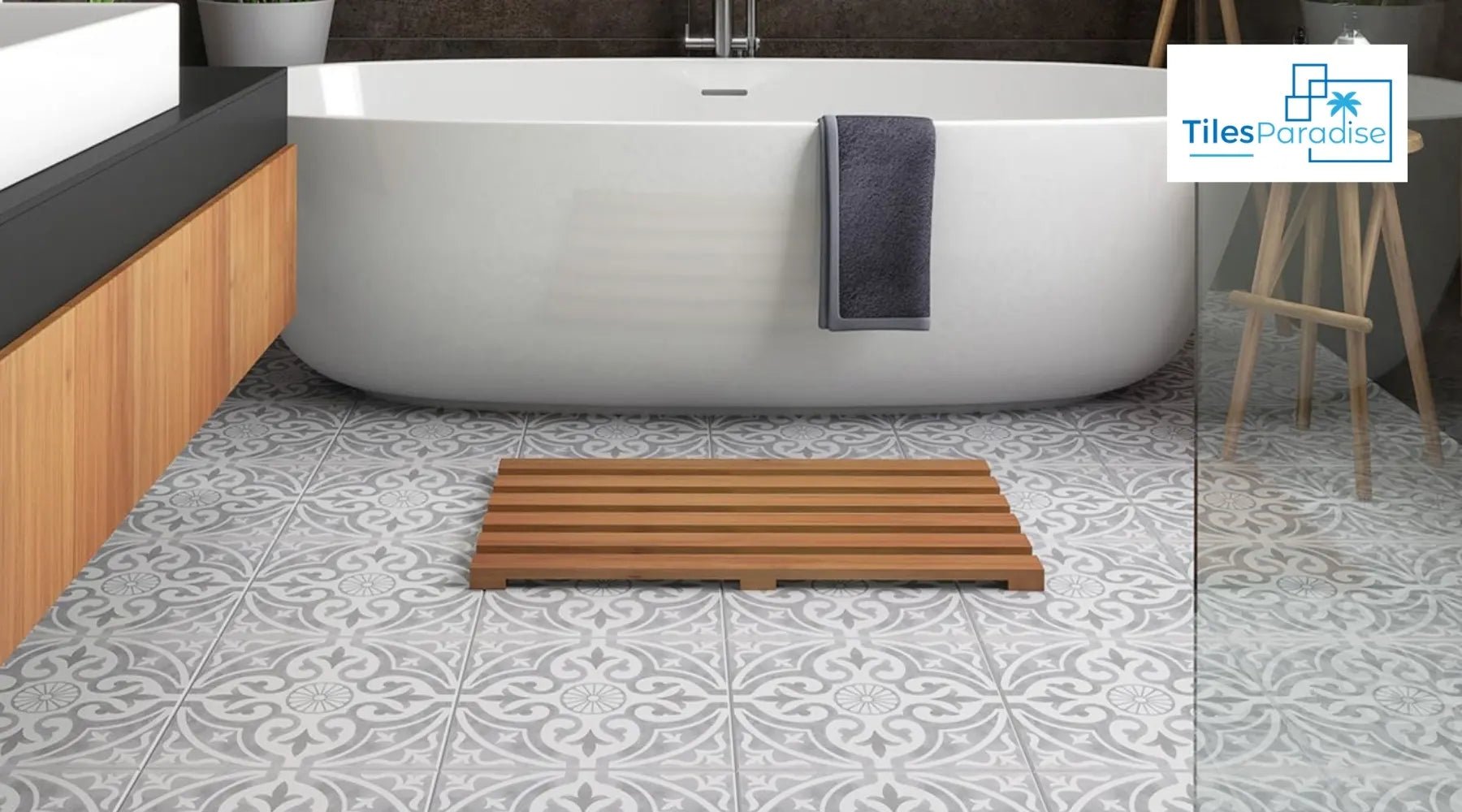
Few design movements have left a stronger mark on British interiors than the Victorian era. Victorian bathroom tiles carry that heritage forward with intricate geometric patterns, bold monochrome contrasts, and rich matt surfaces, bringing period authenticity to any bathroom renovation. From terraced houses in Manchester to townhouses in Edinburgh, this tile style continues to lead UK interior trends year after year.
The reason is simple: Victorian-style bathroom tiles balance ornamental detail with genuine practicality. Porcelain construction delivers the hardwearing, low-absorption surface a bathroom demands, while the geometric patterning creates a visual impact that plain tiles never achieve. For UK homeowners seeking a floor or wall finish with real character, Victorian tiles bathroom designs remain an unmatched choice.
What Defines Victorian Tile Patterns and Geometry?
The defining characteristic of Victorian bathroom tile design is geometric repetition. Pattern elements interlock across a surface to create a unified composition, where each tile contributes to a larger visual rhythm that reads as highly crafted and intentional.
Common geometric motifs include:
-
Star and cross formations: Angular intersections that create strong directional movement across a floor
-
Petal and floral geometry: Softened curves within a strict grid, referencing botanical illustration popular in Victorian print culture
-
Diamond and vertex grids: Sharp angular compositions with high graphic contrast
-
Encaustic-style inlay effects: Contrasting colours within a single tile face, replicating the look of authentic encaustic cement
The Victorian Vertex Grey Matt porcelain tile is a strong example of angular geometry executed in contemporary porcelain, where sharp vertex lines meet in a structured repeat that works as well on a bathroom wall as on a period floor. Equally distinctive is the Victorian Petal Grey Matt, where curved botanical forms soften an otherwise precise geometric layout.

Porcelain vs Ceramic: Material Performance for Victorian Tiles
The material behind a Victorian bathroom floor tile determines how it performs over years of daily use. Porcelain and ceramic are both fired clay products, but porcelain is fired at significantly higher temperatures, typically above 1200°C, producing a denser, harder, and far less porous body.
|
Property |
Porcelain |
Ceramic |
|
Water Absorption |
Below 0.5% |
Up to 3% |
|
Hardness (Mohs) |
7–8 |
5–6 |
|
Suitable for Wet Areas |
Yes |
Walls only (low traffic) |
|
Frost Resistance |
Yes |
No |
|
PEI Wear Rating |
4–5 (floor grade) |
0–3 |
For a Victorian-style bathroom floor tile, porcelain is the correct specification. The sub-0.5% water absorption rate means the tile body will not absorb moisture from steam or splashing over time, eliminating the risk of swelling, staining, or structural tile failure. A PEI rating of 4 or above confirms suitability for residential floor use in high-traffic rooms, including family bathrooms.
The Victorian Crest Grey Matt 20x20cm and Victorian Classic Black Matt 20x20cm are both manufactured from porcelain, wall and floor rated, with matt finishes that provide natural grip underfoot without requiring additional anti-slip treatment.
20x20cm Format: Why Size Matters in Period Bathrooms
The 20x20cm tile format is the historically accurate dimension for Victorian-style bathroom floor tiles and remains the most widely used size in authentic period restorations across the UK. The compact square format enables the intricate geometric repeats that define the style. Larger tiles would distort the pattern scaling and lose the fine detail that gives Victorian floor tiles bathroom installations their visual richness.
From a practical standpoint, the smaller format also offers several installation advantages:
-
Better adaptability around fixed bathroom furniture: Fewer large cuts at pedestals, bath panels, and doorways
-
Increased grout line frequency: Contributes to slip resistance without additional surface treatment
-
Easier pattern alignment: Essential when installing a geometric repeat across a non-square room
The 20x20cm dimension also scales well for use as a feature wall panel or half-height dado. A popular approach in UK bathrooms combines Victorian patterned tiles below the dado line with plain matt tiles above.
Colour Palettes: Grey, Black and Period-Accurate Tones
Authentic Victorian colour palettes were constrained by the pigments and firing technologies of the era. The result was a refined range of tones that remain highly relevant in contemporary UK bathroom design:
-
Deep charcoal and jet black: High-contrast geometric floors, often paired with white or cream grounds
-
Slate and mid-grey: A versatile neutral with strong period authenticity
-
Terracotta and buff: Warm earth tones, common in hallway and utility installations adapted for bathrooms
-
Heritage navy and burgundy: Richer accent tones used in border tiles and feature panels
For contemporary UK bathrooms, the grey palette is the strongest commercial choice. Grey sits comfortably against brass, matte black, and chrome fixtures, meaning a Victorian tile bathroom floor in grey reads as period-authentic but remains compatible with modern sanitaryware.
The Victorian Vertex Grey Matt, Victorian Crest Grey Matt, and Victorian Petal Grey Matt all sit within this palette, offering three distinct geometric compositions in a consistent neutral tone. The Victorian Classic Black Matt provides the high-contrast option for monochrome schemes or as a border element within a mixed floor layout.
 Grout Colour, Joint Width and Installation Precision
The quality of a Victorian bathroom tile installation is determined as much by grout specification as by the tile itself. Geometric patterns demand precise joint alignment. Any deviation in spacing or angle accumulates across the floor and distorts the pattern repeat visibly by the time it reaches the far wall.
Recommended specifications for Victorian patterned porcelain tiles:
-
Joint width: 2–3mm, narrow enough to maintain the visual continuity of the pattern and wide enough to accommodate minor dimensional variation
-
Grout colour: Mid-grey or charcoal for grey tile ranges; white for high-contrast black and white installations; coloured grout as an intentional design choice to emphasise the geometric boundary
-
Adhesive type: Flexible tile adhesive (S1 or S2 classification) for bathroom floors to accommodate thermal movement
-
Surface preparation: Subfloor must be level to within 3mm over 2 metres; any movement or flex will crack grout joints in a rigid porcelain installation
Victorian Tiles on Bathroom Walls: Feature Panels and Dado Lines
The application of Victorian-style bathroom tiles on walls is a distinct design decision from flooring. On walls, patterned tiles create a focal point, used as a full feature wall behind a freestanding bath, a half-height dado across all four walls, or a contained panel within a shower enclosure.
Key considerations for wall applications:
-
Feature wall: A single patterned wall behind a freestanding bath or opposite the entrance creates maximum visual impact with minimum tile quantity. Framing the panel with a plain tile border in a complementary tone defines the edges cleanly.
-
Dado height: The traditional dado line sits at approximately 900mm to 1200mm, roughly chair-rail height. Patterned Victorian tiles below with plain matt tiles above is the most period-accurate treatment.
-
Grout on walls: A non-sanded grout for 2–3mm wall joints achieves a cleaner, smoother surface finish than sanded alternatives.
Pairing bathroom tiles with Victorian patterned designs on the floor with a plain vertical tile on the walls is the safest compositional approach. It allows the geometric pattern to read clearly without visual competition from the wall surface.
Bathroom Layout Planning: Tile Quantity and Pattern Repeat
Ordering the correct quantity of Victorian bathroom floor tiles requires accounting for the geometric pattern repeat in addition to the standard 10% wastage allowance. A pattern repeat is the minimum area over which the design completes one full cycle before it begins again. In a geometric repeat, tiles must be cut at every edge to maintain the visual continuity of the composition.
To calculate tile quantity accurately:
-
Measure the total floor area in square metres (length x width)
-
Add 10% for standard cutting wastage
-
Add a further 5% for pattern repeat wastage at room edges
-
Round up to the nearest full box quantity to avoid ordering from a different batch
Batch variation in fired porcelain is a known factor. Tiles from separate production batches can display subtle differences in tone and surface texture that become visible once installed. Ordering all tiles from a single batch ensures colour and texture consistency across the full bathroom floor tiles Victorian installation.
Black and White Tiles for Luxury Bathroom
The monochrome palette is the most enduring expression of Victorian bathroom design. Black and white tile schemes, from classic chequerboard floors to graphic geometric arrangements, work across both period and contemporary UK interiors. For a full guide to pattern layouts, tile formats, and styling combinations in black and white, read the black and white bathroom tile ideas guide.
Vinyl Tiles for Bathrooms: SPC Click Flooring
For spaces where a floating floor installation is preferable, or where budget priorities shift the specification away from porcelain, SPC click vinyl tiles offer waterproof performance with wood and stone-effect finishes. The vinyl tile flooring for bathroom covers format options, wear layer specifications, and installation guidance for UK bathrooms.
Final Thoughts
Victorian bathroom tiles bring a depth of pattern, historical authenticity, and material quality that few other flooring styles can match. Porcelain construction ensures the durability and moisture resistance a bathroom demands, while the geometric designs, available in vertex, crest, petal, and classic formats, provide a richness of visual detail suited to both period restorations and contemporary interiors looking to add genuine character.
Browse the full Victorian patterned porcelain range at Tiles Paradise UK and order samples to assess pattern scale, colour tone, and surface texture in actual bathroom lighting before committing to a full order. At 20x20cm, a single sample tile gives an accurate impression of how the geometric repeat will read across a complete floor.