





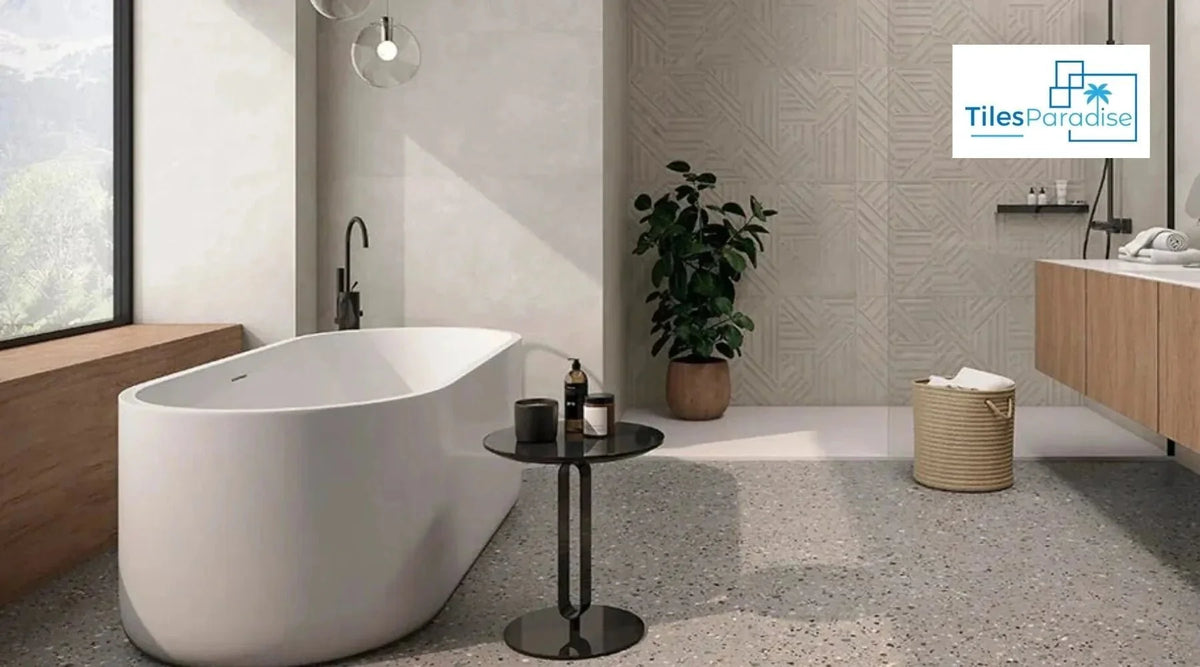
Terrazzo bathroom tiles combine a distinctive speckled appearance with practical tile performance, making them suitable for many bathroom floors, walls, shower areas and feature zones. For most UK bathroom renovations, porcelain terrazzo-effect tiles offer a practical combination of water resistance, low maintenance, durability and design flexibility.
The important distinction is between authentic terrazzo and terrazzo-effect porcelain. They can look similar, but their composition, porosity, maintenance requirements, weight and installation considerations are different.
This guide explains how to choose between them, select the right size and finish, use terrazzo safely in wet areas, coordinate colours and grout, and avoid common buying and installation mistakes.
Are Terrazzo Tiles Good for Bathrooms?
Yes, but the right specification depends on where the tile will be used.
Bathroom terrazzo tiles need to cope with moisture, cleaning, foot traffic and, in floor areas, wet-foot slip risk. Porcelain terrazzo-effect tiles are particularly practical because porcelain has low water absorption and is available in finishes designed for floors and walls.
For a bathroom renovation, assess five things before choosing a terrazzo tile:
-
Material – authentic terrazzo, cement-based terrazzo, resin-based terrazzo or porcelain terrazzo-effect.
-
Application – wall, floor, shower wall, shower floor or wet room.
-
Surface finish – matt, natural, textured or polished.
-
Slip-resistance test data – use the manufacturer's stated rating and test method.
-
Format – the tile size must suit the room layout, falls, drainage and number of cuts.
For most homeowners who want the terrazzo appearance without specialist maintenance, porcelain terrazzo-effect is the practical starting point.
If you are comparing terrazzo with other porcelain options, the porcelain bathroom tiles collection is useful for comparing material, finish and format choices across the wider range.
Real Terrazzo vs Terrazzo-Effect Porcelain
The biggest buying decision is whether you want genuine terrazzo or a porcelain tile that reproduces the terrazzo appearance.
|
Feature |
Authentic Terrazzo |
Porcelain Terrazzo-Effect |
|
Construction |
Aggregate chips in cement or resin matrix |
Porcelain tile with terrazzo-style surface |
|
Water absorption |
Depends on material and sealing |
Low when correctly manufactured |
|
Sealing |
Often required |
Usually not required |
|
Maintenance |
Higher |
Lower |
|
Design consistency |
Natural variation |
Controlled factory appearance |
|
Weight |
Can be relatively heavy |
Typically easier to handle |
|
Bathroom suitability |
Product-specific |
Widely available for bathroom use |
|
Cleaning |
Requires material-appropriate products |
Generally straightforward |
|
Best for |
Authentic material and bespoke projects |
Practical residential renovations |
Authentic terrazzo can provide genuine aggregate depth and a more material-led appearance, but cement-based terrazzo is porous and may require sealing and ongoing care.
Porcelain terrazzo-effect tiles are different. The terrazzo pattern is reproduced on a porcelain body, giving you the visual character of terrazzo without treating the surface like natural cement-based terrazzo.
If low maintenance is your priority, porcelain terrazzo-effect is usually the easier choice.
You can see the current Terrazzo Tiles UK collection to compare the available porcelain terrazzo formats and colourways at Tiles Paradise.
Which Type of Terrazzo Tile Is Best for a Bathroom?
There is no single “best” terrazzo tile for every bathroom.
For a bathroom floor
Choose a floor-rated porcelain terrazzo-effect tile with a matt or suitably textured surface and verified slip-resistance data.
For a wider selection of suitable products, compare these with the bathroom floor tiles range, where terrazzo, marble-effect, porcelain and non-slip options can be evaluated by application.
For a shower wall
You have more freedom because the main concern is moisture resistance and the suitability of the tile for wall installation rather than underfoot grip.
The bathroom wall tiles collection is useful if you want to combine terrazzo with a plain or contrasting wall finish.
For a shower floor
Prioritise wet-area suitability, slip resistance, drainage and tile format before colour or pattern.
For this application, compare terrazzo with dedicated anti-slip bathroom tiles, particularly where the floor will regularly be exposed to water.
For a feature wall
You can choose a stronger pattern, larger aggregate appearance or polished finish because the surface is not carrying foot traffic.
For a low-maintenance renovation
Porcelain terrazzo-effect is usually the simplest option because it avoids the sealing routine associated with many authentic cement-based terrazzo products.
Can You Use Terrazzo Tiles in a Shower or Wet Room?
Yes, but do not assume that every terrazzo tile is suitable for every wet area.
The key distinction is wall versus floor.
A terrazzo-effect porcelain tile suitable for a shower wall is not automatically the right choice for a shower floor. Shower floors experience direct water exposure, barefoot traffic and a sloped surface leading towards the drain.
Before using a terrazzo tile on a shower floor, check:
-
Floor suitability
-
Wet-area suitability
-
Slip-resistance test data
-
Surface finish
-
Tile dimensions
-
Drainage and falls
-
Manufacturer installation instructions
For dedicated wet areas, the non-slip floor tiles range provides another useful benchmark for comparing matt and anti-slip surface options.
How to Choose Terrazzo Tiles for a Shower Floor
Shower floors require more careful specification than ordinary bathroom floors.
1. Avoid choosing based on appearance alone
A glossy terrazzo tile can look excellent in photographs but may not provide the surface characteristics you want under wet feet.
A matt or appropriately textured tile is generally a better starting point for wet floors.
You can compare different surface treatments in the matt finish tiles collection, which includes porcelain options across several sizes and applications.
2. Check the manufacturer's slip data
Do not rely on the word “anti-slip” alone.
Look for the actual test information supplied by the manufacturer, such as an R classification or Pendulum Test Value where provided.
3. Consider tile size
Smaller formats can be useful on shower floors because more grout joints can help accommodate changes in floor direction and drainage falls.
For larger bathroom floor areas, compare the visual effect of different formats in the bathroom floor tiles range before deciding.
4. Check the substrate and waterproofing
A tile is not the waterproofing system.
Shower areas and wet rooms need the correct tanking or waterproofing system beneath the tiles, followed by the appropriate adhesive, grout and movement detailing.
Terrazzo Tile Sizes: 60×60, 60×120 and Other Formats
Tile format changes both appearance and installation.
60×60cm terrazzo tiles
60×60cm is a strong all-round format for bathrooms.
It works particularly well when you want:
-
A balanced floor grid
-
Moderate grout coverage
-
Easy alignment with common bathroom layouts
-
A contemporary but not oversized appearance
The current Terrazzo Tiles collection at Tiles Paradise includes 60×60cm porcelain terrazzo tiles in multiple colourways.
60×120cm terrazzo tiles
60×120cm creates a more continuous appearance with fewer grout joints.
It can work well on:
-
Large bathroom walls
-
Feature walls
-
Spacious floors
-
Wet-room walls
-
Contemporary bathroom layouts
If you want to compare the visual and practical benefits of large-format tiles beyond terrazzo, the 60×120cm bathroom floor tile options provide a broader reference point.
Before choosing a large format, check the room dimensions and cutting requirements. A large tile that produces narrow slivers around several walls can look worse than a smaller, better-proportioned format.
Small-format terrazzo tiles
Smaller terrazzo tiles can work particularly well in:
-
Shower floors
-
Compact bathrooms
-
Cloakrooms
-
Feature zones
-
Niches
-
Decorative borders
The important factor is not simply “small versus large”. It is how the format interacts with the room geometry, drainage and grout layout.
What Is the Best Terrazzo Tile Size for a Small Bathroom?
For a small bathroom, there is no universal rule that says “large tiles always make the room look bigger”.
Large tiles can reduce grout lines and create visual continuity. However, a format that requires excessive cutting can create awkward joints around toilets, basins, door openings and shower trays.
For a compact bathroom, consider:
60×60cm: balanced and versatile.
30×60cm: useful where the room is narrow or rectangular.
Small-format or mosaic: useful around shower floors, curves, niches and complex cuts.
Lighter terrazzo bases can also make the room feel brighter, particularly when natural light is limited.
If you want to compare warmer neutral options for a compact bathroom, the beige bathroom tiles collection provides several porcelain formats and finishes that can sit comfortably alongside terrazzo.
Terrazzo Colours, Chip Density and Bathroom Style
Terrazzo is not defined by one colour.
The visual result comes from three connected attributes:
Base colour + aggregate colour + chip density
A white base with fine grey flecks produces a very different result from a beige base with large blue, green or terracotta chips.
White terrazzo
White terrazzo creates a bright, clean appearance and works well with:
-
Chrome
-
Brushed brass
-
Black fittings
-
Natural wood
-
Pale green
-
Soft beige
Grey terrazzo
Grey terrazzo is easier to integrate into contemporary bathrooms and can create a quieter background for stronger wall colours.
If grey is the direction you want, compare terrazzo against the wider grey tiles collection to see how different grey tones and finishes change the overall scheme.
Beige and cream terrazzo
Warm terrazzo works particularly well with:
-
Oak-effect finishes
-
Brass
-
Bronze
-
Cream sanitaryware
-
Warm white walls
The beige bathroom tiles range is useful for building a warm neutral palette around terrazzo.
Black and white terrazzo
High-contrast terrazzo creates a stronger graphic effect. Use it carefully in smaller rooms because heavy contrast can make the surface visually busier.
For alternative black bathroom schemes, compare terrazzo with the black bathroom tiles collection.
Colourful terrazzo
Blue, green, pink or terracotta chips can work particularly well as a feature rather than covering every surface.
Chip Density Matters More Than Most Buyers Expect
Two terrazzo tiles can have the same base colour but look completely different because of chip density.
Fine chips create a quieter, more uniform surface.
Medium chips provide visible texture without dominating the room.
Large chips create a stronger decorative statement.
For a small bathroom, a very dense or high-contrast terrazzo can become visually busy. A softer pattern can give you the character of terrazzo without overwhelming the space.
Always order a physical sample where possible and view it under your bathroom's actual lighting.
Matt vs Polished Terrazzo Tiles for Bathrooms
Finish is both a design and performance decision.
Matt terrazzo
Matt finishes are generally better suited to bathroom floors because they reduce glare and can provide a more tactile surface.
They also work well with contemporary and natural bathroom schemes.
The matt tiles collection includes porcelain wall-and-floor options across 60×60cm, 60×120cm and other formats.
Polished terrazzo
Polished terrazzo has a stronger reflective quality and can emphasise the aggregate pattern.
It is often better suited to:
-
Bathroom walls
-
Feature walls
-
Vanity areas
-
Dry zones
Do not select a polished surface for a wet floor simply because it looks more luxurious. Check the manufacturer's wet slip-resistance data first.
Slip Resistance: R Ratings, PTV and Wet Bathroom Floors
Slip resistance should be treated as a specification, not a marketing adjective.
You may see R ratings on UK tile product pages, while some suppliers also provide Pendulum Test Values. These tests are not interchangeable numbers, so avoid treating one rating system as a universal conversion chart.
The safest buying process is:
-
Confirm the tile is intended for floor use.
-
Confirm it is suitable for wet areas if required.
-
Check the manufacturer's actual test data.
-
Check whether the finish changes the tested performance.
-
Consider how the floor will be used.
-
Follow the manufacturer's installation and cleaning instructions.
For a broader comparison of wet-area surfaces, see the anti-slip bathroom tiles range.
How to Pair Terrazzo Tiles with Grout
Grout can change the appearance of a terrazzo floor more than expected.
Matching grout
A grout close to the terrazzo base colour creates a quieter, more continuous surface.
This is useful when you want the terrazzo pattern rather than the individual tile shape to dominate.
Contrasting grout
A darker or contrasting grout makes each tile more visible.
This can work well with geometric or decorative layouts but can also make a small bathroom appear busier.
Practical rule
If the terrazzo already has a strong pattern, use grout to calm the composition.
If the terrazzo is subtle, contrasting grout can add definition.
Terrazzo Bathroom Tiles and Underfloor Heating
Porcelain and ceramic tiles are commonly used over underfloor heating because they transfer heat efficiently.
Terrazzo-effect porcelain can therefore be a strong choice for bathrooms with electric or wet underfloor heating systems, provided the tile, adhesive, grout and heating installation are compatible.
The important point is that the tile is only one part of the system.
Your installer should account for:
-
Substrate condition
-
Heating system specification
-
Flexible adhesive
-
Flexible grout
-
Movement
-
Manufacturer installation requirements
How to Install Terrazzo Bathroom Tiles
A good terrazzo tile can still fail if the installation is poor.
Before tiling
Check that the substrate is:
-
Stable
-
Clean
-
Dry where required
-
Sufficiently flat
-
Suitable for the chosen tile
In shower and wet-room areas, install the appropriate waterproofing system before tiling.
Plan the layout
Dry-lay the first rows where possible.
Check:
-
Door openings
-
Shower trays
-
Niches
-
Vanity units
-
Toilet positions
-
Wall corners
-
Drain positions
Avoid ending the layout with very narrow slivers of tile.
Adhesive
Use an adhesive appropriate for the tile material, substrate and wet-area application.
Large-format porcelain may require additional attention to adhesive coverage and back-buttering according to the manufacturer's instructions.
Movement
Movement joints should follow the relevant installation requirements rather than being treated as optional decoration.
For complex bathrooms, particularly large-format or heated floors, professional installation is worth the cost.
How to Clean and Maintain Terrazzo Bathroom Tiles
Maintenance depends on whether the tile is authentic terrazzo or porcelain terrazzo-effect.
Porcelain terrazzo-effect tiles
Routine maintenance is generally straightforward:
-
Remove loose dirt regularly.
-
Mop with a suitable neutral cleaner.
-
Wipe spills promptly.
-
Avoid abrasive cleaning pads.
-
Follow the tile manufacturer's cleaning instructions.
Authentic terrazzo
Authentic terrazzo may require:
-
Initial sealing
-
Periodic resealing
-
pH-neutral cleaning products
-
Prompt removal of acidic spills
-
Material-specific stain treatment
Do Terrazzo Tiles Need Sealing?
The answer depends on the material.
Porcelain terrazzo-effect: usually no sealing.
Cement-based terrazzo: often requires sealing.
Resin-based terrazzo: follow the manufacturer's specification.
Never assume that “terrazzo” automatically means either sealed or unsealed.
Check the technical sheet for the exact product.
Terrazzo Bathroom Tiles: Pros and Cons
Advantages
-
Distinctive speckled appearance
-
Works with modern and traditional bathrooms
-
Wide range of colours
-
Strong design flexibility
-
Available in porcelain formats
-
Suitable for walls and floors when product-rated
-
Works well with neutral colour palettes
-
Can complement brass, black and chrome fittings
-
Large formats can reduce grout visibility
-
Porcelain versions are relatively low maintenance
Disadvantages
-
Highly patterned surfaces can become visually busy
-
Polished surfaces may be unsuitable for wet floors
-
Authentic terrazzo can require sealing
-
Large tiles can create difficult cuts in compact rooms
-
Poorly specified shower-floor tiles can create slip concerns
-
Incorrect installation can cause cracking, lippage or water-management problems
-
Strong terrazzo patterns may limit future design changes
The biggest mistake is treating terrazzo as a purely aesthetic purchase.
Choose the material and performance specification first. Then choose the pattern.
How Much Do Terrazzo Bathroom Tiles Cost?
Terrazzo tile prices vary significantly according to:
-
Material
-
Porcelain quality
-
Tile size
-
Finish
-
Pattern complexity
-
Brand
-
Country of manufacture
-
Availability
-
Installation requirements
At the time of writing, the Tiles Paradise Terrazzo Tiles collection lists Gobi Terrazzo 60×60cm products at £39.99 per m², although prices and availability can change.
Do not compare tile price alone.
The total project cost also includes:
Tiles + wastage + adhesive + grout + waterproofing + trims + labour + delivery
A cheaper tile can become more expensive if it requires difficult installation or extensive cutting.
Which Terrazzo Bathroom Tile Should You Choose?
Use this quick decision guide:
|
Your priority |
Recommended direction |
|
Lowest maintenance |
Porcelain terrazzo-effect |
|
Authentic material |
Genuine terrazzo |
|
Shower wall |
Bathroom-rated porcelain or suitable terrazzo |
|
Shower floor |
Tested wet-area, floor-rated matt/textured tile |
|
Small bathroom |
Light base + sensible format |
|
Large bathroom |
60×120cm or larger where layout allows |
|
Strong feature wall |
Higher-contrast or larger-chip terrazzo |
|
Calm spa look |
White, cream or soft grey terrazzo |
|
Warm luxury |
Beige/cream + brass |
|
Modern contrast |
White terrazzo + black fixtures |
|
Underfloor heating |
Compatible porcelain/ceramic system |
|
Minimal grout appearance |
Large-format tile where practical |
If terrazzo is not quite the look you want, compare it with marble-effect bathroom tiles, which provide another porcelain route for creating a premium bathroom scheme.
Terrazzo Bathroom Tile Buying Checklist
Before ordering, check all of these:
-
Is it authentic terrazzo or terrazzo-effect?
-
Is it porcelain or ceramic?
-
Is it rated for floor use?
-
Is it suitable for wet areas?
-
What slip-resistance test data is provided?
-
Is the finish matt, natural or polished?
-
Is the format suitable for your room?
-
Will it work on the shower floor?
-
Does it require sealing?
-
Is it compatible with underfloor heating?
-
What adhesive does the manufacturer specify?
-
What grout width is recommended?
-
How much wastage should you allow?
-
Have you checked the tile under your actual bathroom lighting?
-
Have you ordered a physical sample?
Where to Buy Terrazzo Bathroom Tiles in the UK
If you are looking for porcelain terrazzo-effect tiles for a bathroom project, compare the technical specification rather than choosing from photographs alone.
The current Tiles Paradise terrazzo range includes Gobi Terrazzo 60×60cm matt porcelain wall-and-floor tiles in colourways including Nude, Blue, Black and Grey.
You can also compare terrazzo against the wider premium bathroom tiles range when building a complete bathroom scheme.
Final Verdict
Terrazzo is a strong bathroom tile choice when the visual character of the surface is matched with the correct technical specification.
For most UK residential renovations, porcelain terrazzo-effect tiles are the most practical option because they combine the terrazzo appearance with low maintenance and broad bathroom usability.
The best tile is not simply the one with the most attractive pattern.
Choose according to material → application → wet-area performance → finish → format → colour → maintenance.
That sequence prevents most of the common mistakes buyers make when selecting terrazzo bathroom tiles.
Frequently Asked Questions
Are terrazzo tiles suitable for bathrooms?
Yes. Terrazzo tiles can be used in bathrooms when the specific product is suitable for the intended wall or floor application. Porcelain terrazzo-effect tiles are particularly practical for residential bathrooms.
Can terrazzo tiles be used in a shower?
Yes, provided the selected product is rated for the application. Shower walls and shower floors should be assessed separately because floor surfaces need appropriate wet slip-resistance performance.
Are terrazzo tiles slippery?
They can be, depending on the material, surface finish and wet conditions. Do not judge safety from appearance alone. Check the manufacturer's slip-resistance test data before using a tile on a wet floor.
For additional options, compare the non-slip bathroom floor tiles collection.
Do porcelain terrazzo tiles need sealing?
Porcelain terrazzo-effect tiles normally do not require sealing. Authentic cement-based terrazzo is different and may require sealing and periodic resealing.
Are terrazzo tiles good for small bathrooms?
Yes. Light-coloured terrazzo can work particularly well in compact bathrooms. Tile format should be selected according to the room dimensions, cuts, drainage and grout layout rather than using a universal “large tiles make rooms bigger” rule.
Can terrazzo tiles be used with underfloor heating?
Porcelain and ceramic terrazzo-effect tiles can be compatible with underfloor heating. Always check the tile manufacturer's specification and use an installation system designed for heated floors.
Is real terrazzo better than porcelain terrazzo?
Neither is universally better. Real terrazzo is the better choice when authentic material character is the priority. Porcelain terrazzo-effect is generally better when low maintenance, consistent appearance and straightforward residential installation are the priority.
How do you clean terrazzo bathroom tiles?
Porcelain terrazzo-effect tiles can generally be cleaned with a suitable neutral cleaner and water. Authentic terrazzo needs material-specific care and may require sealing. Avoid acidic or abrasive cleaners unless the manufacturer specifically recommends them.
How much extra tile should I order?
The required allowance depends on room shape, tile size, layout and cutting. A simple rectangular room may need less waste than a bathroom with multiple corners, niches and fixtures. Ask your installer to calculate the final quantity before ordering.
Should I order a terrazzo tile sample?
Yes. A sample lets you evaluate the base colour, chip density, surface texture, grout relationship and appearance under the actual lighting in your bathroom.