




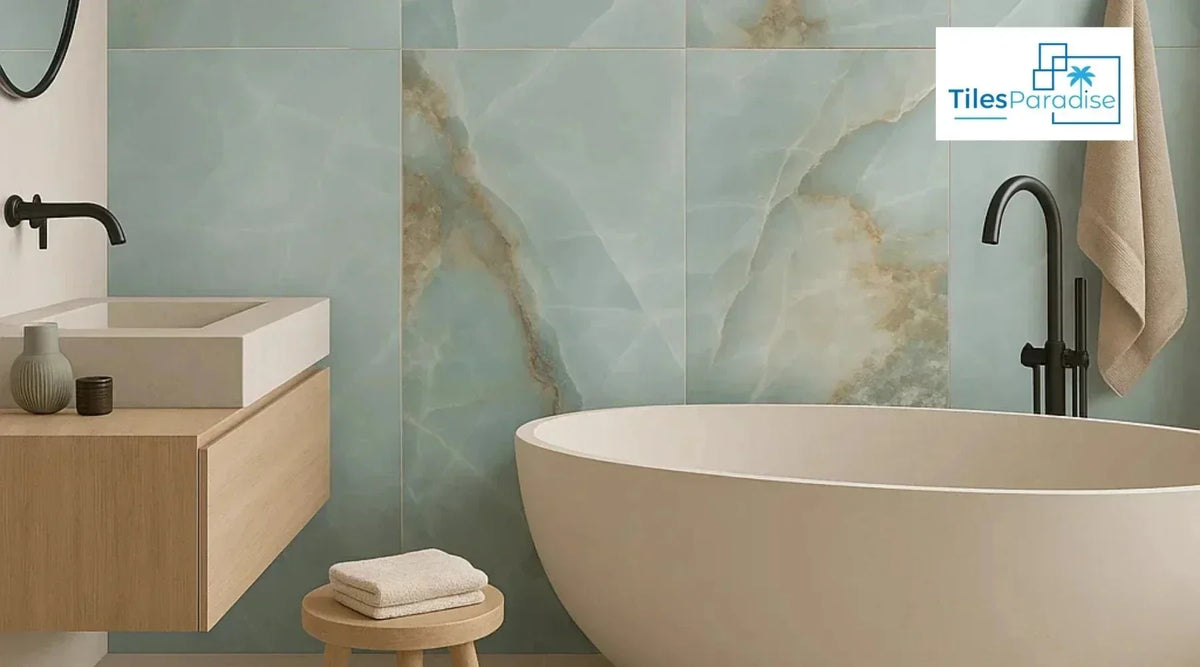
Onyx bathroom tiles are wall and floor tiles that show the soft, banded veining of onyx stone. You can buy them as natural onyx, which is a soft banded calcite stone, or as onyx-effect porcelain, which prints the same look onto a hard, non-porous tile. For most UK bathrooms, onyx-effect porcelain is the practical choice. It needs no sealing, it costs far less, and it comes in large 60x120cm formats that keep grout lines to a minimum.
This guide answers the questions buyers ask most before they order. It covers real onyx versus porcelain, which finish is safe underfoot, which colour and size suit your room, what it costs, and how to fit and clean it.
Onyx bathroom tiles at a glance (Tiles Paradise range, September 2026)
| What you want to know | Answer |
|---|---|
| Material | Porcelain with an onyx-effect print (not natural stone) |
| Price | £17.99 to £54.99 per m²; most 60x120cm tiles cost £22.99 to £29.99 per m² |
| Sizes | 30x60cm, 60x60cm, 80x80cm and 60x120cm |
| Finishes | Polished, gloss, satin and matt |
| Thickness | 8.5mm to 10.5mm, depending on the range |
| Water absorption | Under 0.5%, so the tile body needs no sealing |
| Underfloor heating | Suitable, when fixed with a flexible adhesive |
| Polished tiles on a shower floor? | No. Use polished onyx on walls and dry floors only |
What Are Onyx Bathroom Tiles?
Onyx bathroom tiles are tiles made from, or made to look like, onyx stone. Their defining feature is flowing, cloud-like banding in white, cream, green, blue, black, pink or gold tones. The banding looks deeper than marble veining, which is why onyx reads as a statement surface.
Two very different products share the name. Natural onyx tiles are cut from quarried stone. Onyx-effect tiles are porcelain tiles with a high-definition print and a polished, satin or matt surface. Every onyx tile sold by Tiles Paradise is onyx-effect porcelain.
Is Onyx a Real Stone or a Marble?
True onyx is a banded form of chalcedony, a silica mineral with a Mohs hardness of 6.5 to 7. The "onyx" used for bathroom slabs and tiles is usually a different stone. It is banded calcite, often called onyx marble, cave onyx or Mexican onyx (source: the Wikipedia entry for onyx).
Calcite has a Mohs hardness of 3. That is soft enough to scratch with a steel blade and to etch with mild acids such as lemon juice or some limescale removers. This single fact explains most of the care advice you read about natural onyx showers.
Real Onyx vs Onyx-Effect Porcelain: Which Is Better for a Bathroom?
Onyx-effect porcelain is better for most bathrooms because it resists water, stains and acids, and it needs no sealing. Natural onyx wins only on one thing: it lets light pass through, so it can be backlit.
| Feature | Natural onyx (calcite) | Onyx-effect porcelain |
|---|---|---|
| Hardness | Mohs 3; scratches easily | Hard fired ceramic surface; resists everyday scratches |
| Water absorption | Porous; must be sealed | Under 0.5%; no sealing needed on the tile |
| Reaction to acids | Etches (dull marks) | Unaffected; only the grout needs care |
| Sealing | Needed regularly, usually every 6 to 12 months | Not needed on the tile body |
| Translucency | Translucent; can be backlit | Opaque; cannot be backlit |
| Pattern | Every slab is unique | Several printed faces per range, so the pattern varies across a wall |
| Weight and handling | Brittle; needs a specialist fitter | Handled like any large porcelain tile |
| Cost | Usually several times the price of porcelain | £17.99 to £54.99 per m² at Tiles Paradise |
The porcelain advantage comes from how the tile is made. Porcelain is pressed and fired at high temperatures until the body becomes vitrified. Tiles in the lowest water absorption group of the European standard EN 14411 absorb 0.5% or less of their weight in water. Our onyx product pages state "under 0.5%" wherever the manufacturer supplies the figure.
If you are weighing porcelain against real stone more generally, our guide to white marble-effect porcelain versus real marble tiles explains the same trade-offs for marble.
Are Onyx Tiles Good for a Bathroom?
Yes. Onyx-effect porcelain tiles are good for bathroom walls, shower walls, bath surrounds and dry bathroom floors. The one place to avoid a polished onyx tile is a wet floor, such as a walk-in shower tray area or a wet room floor, because a polished face becomes slippery when wet.
Natural onyx is a harder call. It suits a low-use feature wall or a vanity backsplash. It is a poor fit for a family shower, because shampoo, limescale removers and hard water can etch the surface.
Which Onyx Tile Finish Is Safe for a Bathroom Floor?
A matt or dedicated anti-slip finish is the safe choice for bathroom floors that get wet. Polished, gloss and satin onyx tiles belong on walls and on floors that stay dry.

| Finish | Look | Slip resistance | Best bathroom use |
|---|---|---|---|
| Polished / gloss | Mirror-like shine, deepest colour | Lowest; our polished onyx tiles are rated R9 where stated | Walls, shower walls, bath panels, dry floors |
| Satin | Soft sheen, less glare | Between polished and matt | Walls, dry floors, hallways into the bathroom |
| Matt | No reflection, calmer veining | Higher grip than polished; our matt onyx ranges are rated R9 where stated | Main bathroom floors |
| Dedicated anti-slip | Textured surface | Typically R10 to R11 | Shower trays, wet room floors, family bathrooms |
Many buyers assume every matt tile is anti-slip. That is not always true. Several of our matt onyx ranges, such as Elegant Onyx and Rossato, carry an R9 rating. R9 is fine for a normal bathroom floor that you dry after use. For a level-access shower or wet room floor, choose a tile from our anti-slip bathroom tiles range and keep the onyx on the walls.
What Do R9, R10 and R11 Mean?
R ratings come from the German ramp test, DIN 51130. A tester walks on an oiled tile while the ramp tilts, and the angle at which they slip sets the rating.
- R9: slip at 6° to 10°. Suits dry indoor floors.
- R10: slip at 10° to 19°. Suits bathroom floors that get splashed.
- R11: slip at 19° to 27°. Suits shower floors and wet rooms.
UK specifiers also use the pendulum test. A wet pendulum test value (PTV) of 36 or more counts as low slip potential. Our guide to non-slip bathroom floor tiles covers both tests in more depth.
Which Onyx Colour Suits Your Bathroom?
The right onyx colour depends on how much light your bathroom gets and how bold you want it to feel. Pale onyx makes small rooms feel bigger. Jewel-tone onyx works best as one feature wall rather than every surface.
White and Ivory Onyx
White onyx is the safest choice for small, windowless or north-facing bathrooms. It bounces light and hides the grid of grout lines better than plain white tiles. Ocean Onyx White polished 60x120cm has four different tile faces, so the veining varies across a run. For a calmer wall with less glare, Alba Onyx White comes in a satin 60x120cm and a matt 60x60cm.
Cream and Beige Onyx
Cream and beige onyx give a warm, spa-like feel. They pair well with oak vanities, brushed brass taps and soft lighting. Good options include Emola Cream (polished, four sizes), Rossato Crema (matt) and Gemstone Onyx Warm Beige (matt 60x60cm).
Green Onyx
Green onyx is the most-clicked onyx tile on our site in Google Search, ahead of blue and cream. Deep green with gold-toned brassware creates a boutique hotel look. Use it on one wall behind the bath or basin, then keep the other walls white or cream. Our Onyx Green porcelain tile guide shows it in full rooms.
Blue Onyx
Blue onyx ranges from soft sky blue to deep teal. It suits coastal and contemporary bathrooms. Onyx Blue and Venetia Onyx Blue cost £24.99 per m² in 60x120cm. The Spanish-made Rodas Onyx Blue is thicker, at 10.5mm, and comes in three sizes.
Black and Grey Onyx
Black onyx makes a dramatic, moody bathroom, but it shows water marks and limescale more than pale colours do. It works best on a feature wall with good lighting. Grey onyx is the quieter middle ground. Emola Grey even comes in an 80x80cm floor size. Read our Nebula Black Onyx tile guide before you commit to a black floor.
Pink, Purple and Gold-Veined Onyx
Pink onyx softens a bathroom without making it feel sugary, especially with brushed gold fittings. Jewel Onyx Purple is our boldest option. Gold-veined onyx, such as Persian Onyx Gold White and Aurora Onyx Gold, adds shine without a busy pattern. Our Persian Onyx porcelain tile guide compares its 60x60cm and 60x120cm versions.
Which Onyx Tile Size Is Best for a Bathroom?
60x120cm is the best size for most onyx bathrooms, because the large face shows the banding properly. It needs half as many tiles as 60x60cm and about a quarter less grout line per square metre. Smaller sizes make sense for small floors, awkward layouts and budget DIY jobs.

| Size | Area per tile | Tiles per m² | Tiles per box | Coverage per box | Best for |
|---|---|---|---|---|---|
| 60x120cm | 0.72m² | about 1.4 | 2 | 1.44m² | Shower walls, feature walls, open floors |
| 80x80cm | 0.64m² | about 1.6 | 3 | 1.92m² | Larger square floors |
| 60x60cm | 0.36m² | about 2.8 | 4 | 1.44m² | Small floors, cloakrooms, DIY fitting |
| 30x60cm | 0.18m² | about 5.6 | 5 to 6 | 0.90 to 1.08m² | Niches, half-height walls, small walls |
Box contents come from our product pages. Always check the listing for the exact range you choose.
Large tiles do not make a small bathroom look smaller. The opposite usually happens, because fewer joints make the surface read as one piece. The trade-off is fitting: a 60x120cm tile needs a very flat wall or floor and two people to lift it. You can browse every size in our 60x120cm large format bathroom tiles collection.
How Much Do Onyx Bathroom Tiles Cost in the UK?
Onyx-effect porcelain bathroom tiles at Tiles Paradise cost £17.99 to £54.99 per m², with most 60x120cm tiles between £22.99 and £29.99 per m². Premium Spanish ranges, such as Pamesa Lux Noor, sit at the top of that range. Natural onyx usually costs several times more, before you add specialist fitting.
These are tile prices only. Budget separately for adhesive, grout, trims, levelling clips, delivery and labour.
Worked example 1: a small bathroom floor
- Floor: 1.8m x 2.0m = 3.6m²
- Add 10% for cuts: 3.96m²
- 60x120cm boxes cover 1.44m², so you need 3 boxes (4.32m²)
- At £22.99 per m²: about £99 in tiles
Worked example 2: two shower walls
- Walls: 0.9m and 1.2m wide, both 2.1m high = 4.41m²
- Add 10% for cuts: 4.85m²
- You need 4 boxes of 60x120cm (5.76m²)
- At £24.99 per m²: about £144 in tiles
Prices are correct at the time of writing (September 2026). Check the product page for the current price and stock.
How Many Onyx Tiles Do You Need?
To work out how many onyx tiles you need, measure each surface in metres, multiply width by height, add the areas together and add 10% for cuts and breakages. Then divide by the coverage of one box and round up.
- Measure the width and height of every wall or floor you plan to tile.
- Multiply to get square metres, and subtract large windows or doors.
- Add 10%, or 15% for diagonal layouts and rooms with many pipes and corners.
- Divide by the box coverage (1.44m² for 60x120cm and 60x60cm tiles) and round up.
Our tile calculator does the maths for you. Order everything at once, because tiles from one order come from the same production batch. A later top-up order can differ slightly in shade.
How Do You Fit Large Onyx-Effect Tiles in a Bathroom?
Large onyx-effect tiles need a flat surface, a flexible adhesive, full adhesive coverage and a levelling clip system. Get these four things right and the banding flows across the wall with no lips between tiles.
- Flat substrate: large formats show every dip. Many manufacturers ask for no more than 3mm deviation over 2m.
- Strong enough backing: tile backer board or a cement-based render suits walls, and a screed or boarded subfloor suits floors. Gypsum plaster has a weight limit, commonly 20kg per m² including adhesive, that large porcelain can exceed, so check with your tiler.
- Waterproofing: tank shower walls and wet floors before tiling. Porcelain is waterproof, but grout joints are not.
- Adhesive: use a flexible (S1) porcelain adhesive, and back-butter every tile so there are no hollow spots.
- Levelling clips: they stop lippage, which is very visible on a polished face.
- Joint width: rectified tiles allow a 1.5mm to 2mm joint. Our guide to rectified porcelain tiles explains why.
The UK code of practice for tiling is BS 5385. A qualified tiler will follow it for wet areas.
Can You Lay Onyx Tiles Over Underfloor Heating?
Yes. Our onyx-effect porcelain tiles are suitable for use over electric and water underfloor heating. Use a flexible adhesive and follow the heating maker's start-up schedule, which raises the temperature slowly after the adhesive has cured.
What Grout Colour Goes With Onyx Tiles?
Match the grout to the background colour of the tile, not the veining. White or ivory onyx suits bright white or jasmine grout. Green, blue and grey onyx suit a mid-grey or silver grout. Black onyx suits anthracite or black grout. A contrasting grout draws a grid across the pattern and makes the onyx look less like stone.
How Do You Clean Onyx-Effect Porcelain Without Dulling It?
Clean onyx-effect porcelain with warm water, a pH-neutral cleaner and a microfibre cloth or mop, then squeegee shower walls after use. The tile itself needs no sealing.
The grout is the weak point, not the tile. Acidic descalers and neat vinegar can wear cement-based grout over time, so use them sparingly and rinse well. Bleach can discolour coloured grout. Polished tiles show water spots, so a quick wipe after showering keeps the shine. See our guide to cleaning bathroom tiles and grout for a step-by-step routine.
Natural onyx is different. It needs a stone-safe, pH-neutral cleaner only, and it needs resealing to keep water and soap out.
Onyx vs Marble Effect Tiles: Which Should You Choose?
Choose marble effect for a timeless, low-risk look, and choose onyx effect when you want a bolder bathroom with more depth and colour. Both are porcelain, so they perform the same. Only the look differs.
| Feature | Onyx effect | Marble effect |
|---|---|---|
| Pattern | Soft, flowing bands and clouds | Fine, linear veins |
| Colour range | White to jewel tones: green, blue, pink, purple | Mostly white, grey, black and cream |
| Mood | Dramatic, boutique, spa | Classic, clean, timeless |
| Best use | Feature walls, statement bathrooms | Whole bathrooms, resale-friendly schemes |
Many bathrooms use both. A white marble-effect floor with one green onyx feature wall is a popular mix. If marble is still on your shortlist, compare them with a sample of each in your own bathroom light.
Can Onyx-Effect Tiles Be Backlit Like Real Onyx?
No. Porcelain is opaque, so light will not pass through an onyx-effect tile. Backlighting only works with thin slices of natural onyx fixed over an LED panel with an air gap behind.
You can still get a glowing effect around onyx porcelain. A wall-washer LED strip above the tiles, a lit niche or backlit LED bathroom mirrors set against a polished onyx wall all light up the banding.
What Does "Onyx Shower" Mean?
In the UK, an onyx shower usually means a shower tiled with onyx or onyx-effect tiles. In the US, "Onyx shower" often refers to moulded solid-surface shower bases and wall panels sold under the Onyx Collection brand. Those panels are resin-based products, not stone and not tiles. If you read American advice about onyx showers, check which product the writer means.
Onyx Bathroom Tile Ideas That Work
These layouts show onyx at its best without overwhelming the room.
- One feature wall: tile the wall behind the bath or basin in a jewel-tone onyx, and keep the rest pale.
- Floor-to-ceiling shower: run 60x120cm white or cream onyx vertically in the shower to add height.
- Same tile, two finishes: use a polished onyx on walls and the matt version of the same range on the floor.
- Warm metals: pair green, pink or cream onyx with brushed brass or gold taps.
- Black and gold: pair black onyx with gold-veined tiles on a small cloakroom wall for a bold, compact look.
For more layouts, see our 15 onyx and marble bathroom wall tile ideas and our 17 luxury marble and onyx bathroom floor looks. When you are ready to compare colours, sizes and prices side by side, browse our full range of onyx effect bathroom tiles.
Frequently Asked Questions
Do onyx-effect tiles need sealing?
No. Onyx-effect porcelain absorbs under 0.5% water, so the tile needs no sealer. You can seal cement-based grout to help it resist staining.
Do onyx-effect porcelain tiles scratch or chip?
They resist everyday scratches far better than natural onyx. Sharp grit under shoes can still dull a polished floor over time, so use a doormat and sweep regularly. Rectified edges are crisp, so handle tiles carefully during fitting.
Are onyx tiles slippery?
Polished and gloss onyx tiles are slippery when wet. Use them on walls and dry floors. Use a matt or anti-slip tile on shower and wet room floors.
Do onyx-effect tiles look real?
Good onyx-effect porcelain looks convincing from a normal viewing distance. Look for ranges with several different tile faces, so the same pattern does not repeat side by side. Order a sample to see the colour in your own light.
Will dark onyx tiles make my bathroom look smaller?
Dark onyx on every surface can make a small room feel enclosed. On one wall it adds depth without shrinking the room. Pale onyx on the floor and walls keeps a small bathroom bright.
Can I use onyx tiles on bathroom walls and floors?
Yes. Every onyx tile in our bathroom range is sold as a wall and floor tile. Choose the finish by location: polished for walls, matt for floors.
How are onyx tiles delivered?
Tiles travel on a pallet, typically within 2 to 7 working days. Pallets are delivered kerbside, and someone must be there to receive them. Check the pallet for damage on arrival and report it within 48 hours.
Can I return onyx tiles I do not use?
You can return full, unopened boxes within 14 days of ordering, in resaleable condition. A 30% restocking charge applies, and you pay the return delivery. Measure carefully before ordering to avoid this cost.
Last Thoughts on Onyx Bathroom Tiles
Onyx bathroom tiles give a bathroom the depth and glow of a rare stone. For almost every UK bathroom, onyx-effect porcelain is the right way to get that look. It does not etch, it needs no sealing, and it costs a fraction of natural onyx.
Choose the finish by location: polished on walls and matt or anti-slip underfoot. Choose the colour by light: pale onyx for small rooms, jewel tones for one feature wall. Choose the size by surface: 60x120cm to show off the banding, 60x60cm for small floors. Get those three choices right and your onyx bathroom will look good and stay easy to live with.