





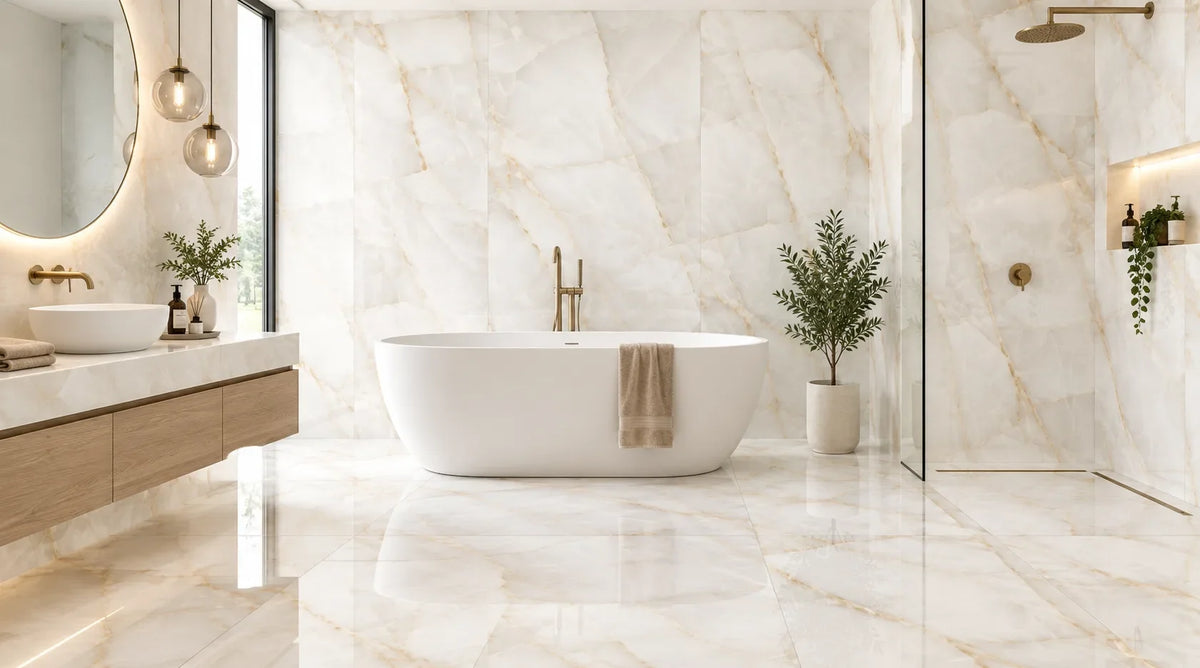
Persian Onyx porcelain wall and floor tiles are glossy, rectified porcelain tiles printed to look like banded onyx stone from Persia (modern Iran). At Tiles Paradise the range comes in three colourways: Gold White, Pink and Gold Blue. It comes in two sizes, 60x60cm and 60x120cm. Prices run from £19.99 to £27.99 per m².
This guide answers the questions buyers ask before they order. It covers how each colour looks and the exact specification. It shows the cost per m², per tile and per box, and how many tiles a room needs. It also explains where a polished tile is safe, how to fix it, which grout to pick and how to keep the shine.
Persian Onyx Porcelain Tiles at a Glance
Persian Onyx is a polished porcelain tile with a translucent, crystal-cut onyx pattern and fine gold or grey veins. The table below lists every Persian Onyx tile sold at Tiles Paradise, with the live data from each product page.
| Persian Onyx tile | Size | Thickness | Tiles per box | Coverage per box | Price per m² | Stock (16 Sept 2026) |
|---|---|---|---|---|---|---|
| Persian Onyx Gold White Glossy 60x120cm | 600x1200mm | 9mm | 2 | 1.44 m² | £27.99 (RRP £36.95) | In stock |
| Persian Onyx Gold White Glossy 60x60cm | 600x600mm | 9mm | 4 | 1.44 m² | £27.99 (RRP £37.99) | In stock |
| Persian Onyx Pink Gloss 60x120cm | 600x1200mm | 9.5mm | 2 | 1.44 m² | £24.99 (RRP £34.99) | In stock |
| Persian Onyx Gold Blue Glossy 60x60cm | 600x600mm | 9mm | 4 | 1.44 m² | £19.99 (RRP £37.99) | Sold out |
Listed below are the attributes shared by the whole range.
- Material: porcelain
- Finish: polished, high gloss
- Edges: rectified
- Use: walls and floors, indoors
- Underfloor heating: suitable
- Sold by: the square metre
- Samples: cut sample £1.99 on every colour; 20x50cm sample £7.99 on Gold White and Gold Blue
Prices and stock are correct at the time of writing (16 September 2026). The product page always shows the live price.

What Are Persian Onyx Porcelain Wall & Floor Tiles?
Persian Onyx porcelain tiles are fired porcelain tiles that carry a high-resolution print of Persian onyx stone under a polished glaze. The tile body is porcelain, not stone. The onyx look is a design, so every tile is equally hard, equally waterproof and equally easy to clean.
Porcelain is a dense ceramic fired at a very high temperature. Standard BS EN 14411 places porcelain in Group BIa, which means water absorption of 0.5% or less. That low porosity is why the tiles suit bathrooms, kitchens and heated floors.
The "Persian" part of the name describes the look, not the origin of the tile. It refers to the pale, banded onyx that is quarried in Iran and has been used in Persian architecture for centuries.
What Is Persian Onyx Stone?
Persian onyx is a trade name for banded, translucent onyx quarried in Iran. Iranian stone suppliers name East Azerbaijan, Khorasan, Kerman and Kurdistan as the main quarrying provinces.
Most decorative "onyx" used on walls and floors is a banded calcite, sometimes called onyx marble. It is softer than true onyx, which is a chalcedony (silica) gemstone (Wikipedia). True onyx measures 6.5–7 on the Mohs scale. Calcite measures 3, so building-grade onyx scratches and etches far more easily.
Is Persian Onyx Porcelain Real Onyx?
No, Persian Onyx porcelain is not real onyx. It is porcelain printed with an onyx design. You get the look of Iranian onyx without its softness, its need for sealing or its high price.
What Do Persian Onyx Tiles Look Like?
Persian Onyx tiles look like cracked, cloudy crystal. Soft angular facets overlap across the face, and fine amber-gold veins cut through them in long diagonal lines. The polished glaze adds depth, so the pattern seems to sit below the surface.
The pattern is not a uniform repeat. Each tile shows a different part of the design, so walls and floors look natural rather than printed. Open several boxes and lay tiles out before fixing, so you can spread the stronger veins evenly.

Which Persian Onyx Colourway Should You Choose?
Choose the Persian Onyx colourway by the metal finish and light in your room. Gold White suits most spaces, Pink adds warmth, and Gold Blue gives a cool, spa-like look. The table below compares the three.
| Colourway | Base colour | Vein colour | Sizes | Best with | Mood |
|---|---|---|---|---|---|
| Gold White | Soft white | Amber-gold | 60x60cm, 60x120cm | Brushed gold, brass, walnut, white sanitaryware | Bright, classic luxury |
| Pink | Blush pink | Amber-gold | 60x120cm | Matt black frames, brushed gold, grey or white vanities | Warm, soft, boutique |
| Gold Blue | Pale ice blue-grey | Grey and bronze-gold | 60x60cm | Matt black, chrome, dark grey furniture | Cool, calm, spa |
Persian Onyx Gold White
Persian Onyx Gold White is a white onyx-effect tile with amber-gold veining. It is the most flexible colourway, because white reflects light and gold works with warm or neutral schemes. It is the only colourway in both 60x60cm and 60x120cm, so you can use one size on the floor and the other on the walls.
Persian Onyx Pink
Persian Onyx Pink is a blush-pink onyx-effect tile with the same gold veining. The pink is gentle rather than bright, so it reads as warm stone. It comes in 60x120cm only and is 9.5mm thick, slightly thicker than the other colourways.
Persian Onyx Gold Blue
Persian Onyx Gold Blue is a pale blue-grey onyx-effect tile with grey and bronze-gold veins. It suits shower walls and cool bathroom schemes. It comes in 60x60cm only and was sold out at the time of writing.

Room image for colour and scale. Inside the shower tray area, choose a matt anti-slip floor tile.
Which Size Is Better: 60x60cm or 60x120cm?
60x120cm is better for larger floors, full-height walls and showers, because it gives fewer grout lines. 60x60cm is better for small rooms, floors with many cuts and walls that are not perfectly flat. Both sizes cover 1.44 m² per box.
| Feature | 60x60cm (600x600mm) | 60x120cm (600x1200mm) |
|---|---|---|
| Area of one tile | 0.36 m² | 0.72 m² |
| Tiles per m² | 2.78 | 1.39 |
| Tiles per box | 4 | 2 |
| Grout lines | More | Fewer, near-seamless |
| Handling | One person | Two people and suction lifters |
| Flatness needed | Standard | Very high |
| Best for | Cloakrooms, small bathrooms, kitchens with many cuts | Open floors, hallways, feature walls, shower walls |
| Colourways | Gold White, Gold Blue | Gold White, Pink |
1200x600mm is the same size as 60x120cm. The first figure is in millimetres and the second is in centimetres.
How Much Do Persian Onyx Tiles Cost?
Persian Onyx tiles cost £24.99 to £27.99 per m² for the in-stock colourways. The Gold Blue 60x60cm is listed at £19.99 per m² but is sold out. The table below shows the price per m², per tile and per full box.
| Tile | Per m² | Per tile | Per box (1.44 m²) |
|---|---|---|---|
| Gold White 60x120cm | £27.99 | £20.15 | £40.31 |
| Gold White 60x60cm | £27.99 | £10.08 | £40.31 |
| Pink 60x120cm | £24.99 | £17.99 | £35.99 |
| Gold Blue 60x60cm | £19.99 | £7.20 | £28.79 |
Per-tile and per-box figures are worked out from the per-m² price and rounded to the nearest penny.
Is There a Persian Onyx Pallet Deal?
Yes, Persian Onyx Pink has a pallet deal of 60 tiles (about 43 m²) for £999. That is about £23.13 per m², against £24.99 per m² when bought by the box. It saves about £80 on the same area. The Gold White 60x120cm pallet and the Gold White 60x60cm job lot (111 tiles, 40 m²) were sold out at the time of writing.
How Much Does Delivery Cost?
Standard pallet delivery is free on orders over £499 to UK mainland addresses. Orders between £100 and £499 pay £39.99. Tiles arrive on a pallet at the kerbside, so someone needs to be home to move them inside.
How Many Persian Onyx Tiles Do You Need?
To work out how many Persian Onyx tiles you need, multiply length by width, add 10% for cuts, then divide by the area of one tile. Round up to whole tiles and whole boxes. Listed below are the steps.
- Measure each wall or floor in metres.
- Multiply length by width to get the area in m².
- Take away doors, windows and bath fronts you will not tile.
- Add 10% for cuts and breakage. Add up to 15% for rooms with many corners.
- Divide by 0.72 for 60x120cm tiles or 0.36 for 60x60cm tiles.
- Round up to whole boxes of 1.44 m².
Worked Example: Bathroom Floor
A 2.4m x 1.8m bathroom floor is 4.32 m². Adding 10% gives 4.75 m². That needs 7 tiles in 60x120cm, or 14 tiles in 60x60cm. Both round up to 4 boxes, which cover 5.76 m².
- Gold White: 4 boxes = £161.22
- Pink: 4 boxes = £143.94
Worked Example: Walk-In Shower Walls
Three shower walls of 0.9m, 0.9m and 1.2m, tiled 2.2m high, total 6.6 m². Adding 10% gives 7.26 m². That needs 11 tiles in 60x120cm, which rounds up to 6 boxes covering 8.64 m².
- Gold White: 6 boxes = £241.83
- Pink: 6 boxes = £215.91
These totals are tile costs only. Orders between £100 and £499 add £39.99 for standard pallet delivery.
Buy every tile for one room in a single order. Tiles from one production batch share the same shade, so later top-up orders may not match exactly. Keep one or two spare tiles for future repairs.
Where Can You Use Persian Onyx Tiles?
You can use Persian Onyx tiles on indoor walls and on indoor floors that stay mostly dry. They are not an anti-slip tile, so avoid them on shower floors, wet-room floors, steps and outdoor areas. The table below shows each common location.
| Location | Suitable? | Notes |
|---|---|---|
| Bathroom walls | Yes | Ideal; the gloss reflects light around the room |
| Shower walls | Yes | Fix to cement backer board or tanked masonry |
| Wet-room or shower floor | No | Choose a matt anti-slip tile with an R10 or R11 rating |
| Bathroom floor outside the shower | Yes, with care | Use bath mats and wipe splashes quickly |
| Kitchen splashback | Yes | Porcelain resists heat, steam and grease |
| Kitchen floor | Yes, with care | Use a mat at the sink; wipe spills straight away |
| Living room and dining room floors | Yes | Pairs well with underfloor heating |
| Hallway floor | Yes, with care | Add a large entrance mat to stop grit and rain |
| Fireplace surround | Yes | Use a heat-rated adhesive |
| Stairs | No | Polished treads are slippery |
| Outdoor patios and terraces | No | Indoor use only |
| Reception and boutique walls | Yes | Dry commercial wall areas only |
Is Persian Onyx Good for a Small Bathroom?
Yes, Persian Onyx is good for a small bathroom. Gold White and Pink reflect light, which makes a small room feel brighter and larger. On walls, 60x120cm tiles give fewer grout lines. On small floors with a toilet and basin to cut around, 60x60cm tiles are easier to fit.
Can Persian Onyx Tiles Go in a Shower?
Yes, Persian Onyx tiles can go on shower walls, but not on shower floors. The walls must be waterproof and strong enough to carry heavy porcelain. The shower floor needs a textured anti-slip tile.
Are Persian Onyx Tiles Slippery?
Persian Onyx tiles are safe when dry but slippery when wet, like most polished floor tiles. No DIN 51130 "R" slip rating is published for the range, so treat it as a wall tile and a dry-floor tile. Listed below are simple ways to use it safely on floors.
- Keep it out of showers, wet rooms and entrances that get rain.
- Place absorbent mats by the bath, basin, sink and front door.
- Wipe spills and splashes straight away.
- Never use wax, silicone or "shine" floor products on the surface.
- Choose a matt tile with a published R10 or R11 rating for wet floors.
The R rating comes from the DIN 51130 ramp test, where R9 is the lowest slip resistance and R13 the highest. R10 is the usual choice for kitchens, and R11 or above for wet rooms and shower floors.
Are Persian Onyx Tiles Suitable for Underfloor Heating?
Yes, Persian Onyx tiles are suitable for underfloor heating. Porcelain conducts heat well, so warmth passes quickly to the surface. Listed below are the rules for a heated floor.
- Use a flexible S1 or S2 cementitious adhesive rated for heated floors.
- Commission a new screed's heating with a full heat-up and cool-down cycle before tiling.
- Keep the heating off while the adhesive and grout cure.
- Raise the temperature slowly when you switch it back on.
- Leave movement joints at the room edges and where your installer specifies them.
Can Any Wall Hold Persian Onyx Tiles?
No, not every wall can hold Persian Onyx tiles safely. Porcelain 9mm thick weighs roughly 21 kg per m² before adhesive, so walls need checking before fixing. The table gives the commonly used UK guide limits for tile, adhesive and grout combined.
| Wall surface | Typical maximum load | Suitability for Persian Onyx |
|---|---|---|
| Skimmed plaster or skimmed plasterboard | 20 kg per m² | Usually too low; ask your tiler to check |
| Unskimmed plasterboard (bare paper face) | 32 kg per m² | Possible in dry areas after checking total weight |
| Cement tile backer board | Typically 50 kg+ per m² (check the board maker) | Recommended, and best for showers |
| Sound, flat masonry or render | Higher loads | Suitable once flat, primed and waterproofed where wet |
How Do You Install Persian Onyx Tiles?
Install Persian Onyx tiles on a flat, sound, primed surface with a flexible adhesive, full adhesive contact and a levelling clip system. A polished face shows every dip, so preparation matters more than speed. Listed below are the tools and materials.
- Flexible S1 cementitious tile adhesive (heat-rated for underfloor heating)
- 10–12mm notched trowel, plus a flat trowel for back-buttering
- Tile levelling clips and wedges
- 2–3mm spacers
- Rail cutter long enough for 120cm cuts, or a wet saw with a diamond blade
- Diamond hole saws for pipes and wastes
- Suction lifters and a second person for 60x120cm tiles
Follow the steps below for a flat, clean result.
- Check the tiles. Open several boxes and dry-lay tiles to confirm shade, vein spread and quantity.
- Check flatness. The surface should be flat to within 3mm over 2 metres.
- Prime the surface. Use the primer your adhesive maker names for that substrate.
- Spread and back-butter. Comb adhesive onto the surface and skim the back of each tile for full contact.
- Set the joint. Use 2–3mm spacers. Very tight joints leave no room for size tolerance.
- Limit the offset. Keep a brick-bond offset to one-third of the tile length or less (40cm on 60x120cm). A half offset exaggerates the slight bow in long tiles and causes lipped edges.
- Level each joint. Fit levelling clips while the adhesive is wet.
- Clean as you go. Remove adhesive from the polished face before it sets.
- Grout after curing. Wait for the adhesive's stated cure time, then grout.
- Seal the edges. Use flexible silicone at internal corners, baths, shower trays and movement joints.
Cut polished porcelain face-up on a rail cutter or face-up on a wet saw. Drill holes with diamond core bits on a slow speed with the hammer action switched off.
What Grout Colour Suits Persian Onyx Tiles?
The best grout colour for Persian Onyx tiles is a pale shade that matches the base, not the veins. A close match hides joints and keeps the onyx look continuous. The table below suggests a grout for each colourway.
| Colourway | Seamless look | Soft definition | Avoid |
|---|---|---|---|
| Gold White | White or ivory | Silver grey | Dark grey or black, which frames every tile |
| Pink | Warm beige or ivory | Light grey | Bright white, which can look stark against blush |
| Gold Blue | Silver grey | Light grey | Beige, which clashes with the cool base |
Test a cured grout sample against a real tile before you commit. Wet grout looks darker than it will once dry.
How Do You Clean and Maintain Persian Onyx Tiles?
Clean Persian Onyx tiles with warm water, a pH-neutral cleaner and a microfibre cloth, then dry the surface to prevent water marks. The glazed polished face is non-porous, so it does not stain or need a sealer. Listed below are the care rules.
- Daily: squeegee shower walls and wipe splashes.
- Weekly: mop or wipe with a pH-neutral tile cleaner, then buff dry.
- Limescale: use a cleaner labelled safe for porcelain and grout; rinse well.
- After fitting: remove grout haze with a haze remover suited to polished porcelain.
- Grout: apply a grout protector in showers to slow staining.
- Avoid: scouring pads, abrasive powders, wax and oil soaps.
- Floors: fit felt pads under chair legs and use doormats to trap grit.
Is Persian Onyx Porcelain Better Than Natural Onyx Stone?
Persian Onyx porcelain is better than natural onyx for most homes, because it is harder, waterproof and far cheaper to buy and maintain. Natural onyx is better only when you want true translucency, such as a backlit panel. The table below compares them.
| Attribute | Persian Onyx porcelain | Natural Persian onyx |
|---|---|---|
| Material | Fired porcelain with a printed glaze | Banded calcite stone |
| Hardness | Hard glazed porcelain | Mohs 3; scratches easily |
| Water absorption | 0.5% or less | Porous; needs sealing |
| Acid reaction | Unaffected by lemon juice or vinegar | Etches and dulls |
| Maintenance | Wipe clean | Regular sealing and specialist cleaning |
| Backlighting | Not possible; porcelain is opaque | Possible; light glows through thin slabs |
| Pattern | Designed variation across tiles | Every slab unique |
| Price | £24.99–£27.99 per m² in stock | Usually far higher per m², plus sealing and specialist fitting |
Is Persian Onyx the Same as a Persian Pattern Tile?
No, Persian Onyx is not a Persian pattern tile. Persian Onyx copies a natural stone. A "Persian tile" often means a patterned tile inspired by Persian rugs and hand-painted Iranian ceramics, with repeating flowers, stars and borders.
Choose Persian Onyx for a stone look with gold veins. Choose a decorative tile for a rug-style floor. Our guide to patterned floor tiles types, sizes and materials explains that second style, and the patterned tiles collection shows the designs in stock.
How Does Persian Onyx Compare With Other Onyx Tiles?
Persian Onyx sits between the bright white onyx tiles and the dark, dramatic ones. Its gold veins make it warmer than plain white onyx. The table below compares it with close alternatives at Tiles Paradise.
| Tile | Look | Finish | Best when you want |
|---|---|---|---|
| Persian Onyx Gold White | White crystal with amber-gold veins | Polished | Warm, bright luxury |
| Aurora Onyx Gold Glossy 60x120cm | White onyx with gold veins | Glossy | A similar look at £24.99 per m² |
| Venetia Onyx Pink 60x120cm | Pink onyx | Polished | A second pink option |
| Rossato Onyx (four colours) | Onyx banding | Matt | A calmer, lower-glare surface |
| Nebula Black Onyx 60x120cm | Black with bronze-gold veins | Polished | Dark drama, or a floor to pair with Gold White walls |
For a matt onyx surface, read the Rossato onyx effect matt porcelain tile guide. For a dark partner to Gold White walls, see the Nebula Black Onyx polished porcelain tile guide. The full onyx tiles collection lists every colour and size.
Which Colours and Finishes Pair With Persian Onyx?
Warm metals, soft neutrals and one dark accent pair best with Persian Onyx. Listed below are proven pairings for each colourway.
- Gold White + brushed gold: brushed gold taps, shower sets and mirror frames echo the veins. Our gold, white and black bathroom tile ideas show this scheme in full.
- Gold White + walnut: a walnut or oak vanity warms the white base.
- Pink + matt black: black shower frames and brassware sharpen the blush tone. See more shade and layout advice in pink bathroom tiles.
- Gold Blue + chrome or black: cool metals suit the blue-grey base. The blue bathroom tiles guide covers grout and slip choices for blue schemes.
- Kitchen splashbacks: Gold White works with cream, sage or navy units. Our gold kitchen splashback tile pairing guide matches worktops and cabinets.

Room image for colour and scale. Keep polished tiles out of the wet shower floor area.
What Should You Buy With Persian Onyx Tiles?
You need adhesive, grout, spacers, levelling clips and, for showers, backer board and tanking. Listed below are the items most buyers add.
- Adhesive: a flexible S1 adhesive from the tile adhesive range.
- Grout: a colour from the table above, chosen from the tile grout range.
- Wet-floor tile: a textured partner tile from the bathroom anti-slip tiles collection for the shower area.
- Bulk savings: larger projects can check the pallet deals before ordering by the box.
For grouting times, see how long grout takes to dry. For a heated floor over concrete, follow the steps in how to lay porcelain floor tiles on concrete and underfloor heating.
What Should You Check on Delivery?
Check every box on the pallet before signing, and report damage within 2 working days of delivery. Listed below are the checks.
- Count the boxes against your order.
- Photograph any damage while the goods are still on the pallet.
- Check that the shade and batch codes match on every box.
- Open a few boxes and dry-lay tiles before fixing any.
- Keep all packaging until the tiles are checked.
You can add Extended Delivery Protection for £9.99 at checkout, which gives a longer window to report damage.
Persian Onyx Porcelain Tiles: Questions Answered
Is Persian Onyx a porcelain or a ceramic tile?
Persian Onyx is a porcelain tile. Porcelain is a denser, harder type of ceramic with water absorption of 0.5% or less.
Are Persian Onyx tiles rectified?
Yes, every Persian Onyx tile is rectified. The edges are machine-cut square after firing, which allows narrow 2–3mm grout joints.
Do Persian Onyx tiles need sealing?
No, the polished glazed face of Persian Onyx does not need sealing. A grout protector is still useful in showers.
Do Persian Onyx tiles scratch?
Persian Onyx tiles resist everyday wear, but grit dragged across a glossy floor can dull it over time. Entrance mats and felt pads under furniture prevent most marks.
Do polished Persian Onyx tiles show water marks?
Yes, dried water droplets can show on the glossy surface, especially in hard-water areas. A quick squeegee or microfibre buff keeps the shine clear.
Can Persian Onyx tiles be backlit?
No, Persian Onyx tiles cannot be backlit. Porcelain is opaque, so light does not pass through it the way it does through thin natural onyx.
Can Persian Onyx tiles be used outside?
No, Persian Onyx tiles are for indoor use. The polished surface becomes slippery in rain, and no outdoor frost or slip rating is published for the range.
Can I lay Persian Onyx over existing tiles?
Sometimes. The old tiles must be firmly bonded, flat and able to carry the extra weight. Our guide to tiling over tile explains the checks.
Does Persian Onyx look good on both walls and floor?
Yes, using Persian Onyx on walls and floor creates a continuous stone look. Use a matt anti-slip tile for the shower floor to keep the room safe.
Will Persian Onyx make my room look dated?
Persian Onyx is unlikely to date quickly, because onyx and marble looks have been used in interiors for centuries. Pairing it with simple fittings keeps it modern.
Can I order a Persian Onyx sample?
Yes, every Persian Onyx colourway offers a cut sample for £1.99. Gold White and Gold Blue also offer a 20x50cm sample for £7.99.
How long does Persian Onyx delivery take?
Standard pallet delivery usually takes a few working days. Next-working-day delivery is available on many postcodes and shows at checkout.
What is the difference between Persian Onyx Gold White and Aurora Onyx Gold?
Both are white onyx-effect tiles with gold veins. Persian Onyx Gold White has a crystal-faceted pattern with fine amber veins and costs £27.99 per m². Aurora Onyx Gold costs £24.99 per m². Order a cut sample of each to compare the veining side by side.
Last Thoughts on Persian Onyx Porcelain Wall & Floor Tiles
Persian Onyx porcelain wall and floor tiles give the look of Iranian onyx on a hard, waterproof porcelain body. Gold White is the most flexible colourway, Pink is the warmest and Gold Blue is the coolest. Use them on walls and dry floors, pick a matt anti-slip tile for showers, and fix large formats to a flat, strong surface. Order samples, buy every tile in one batch and choose a grout that matches the base colour.