





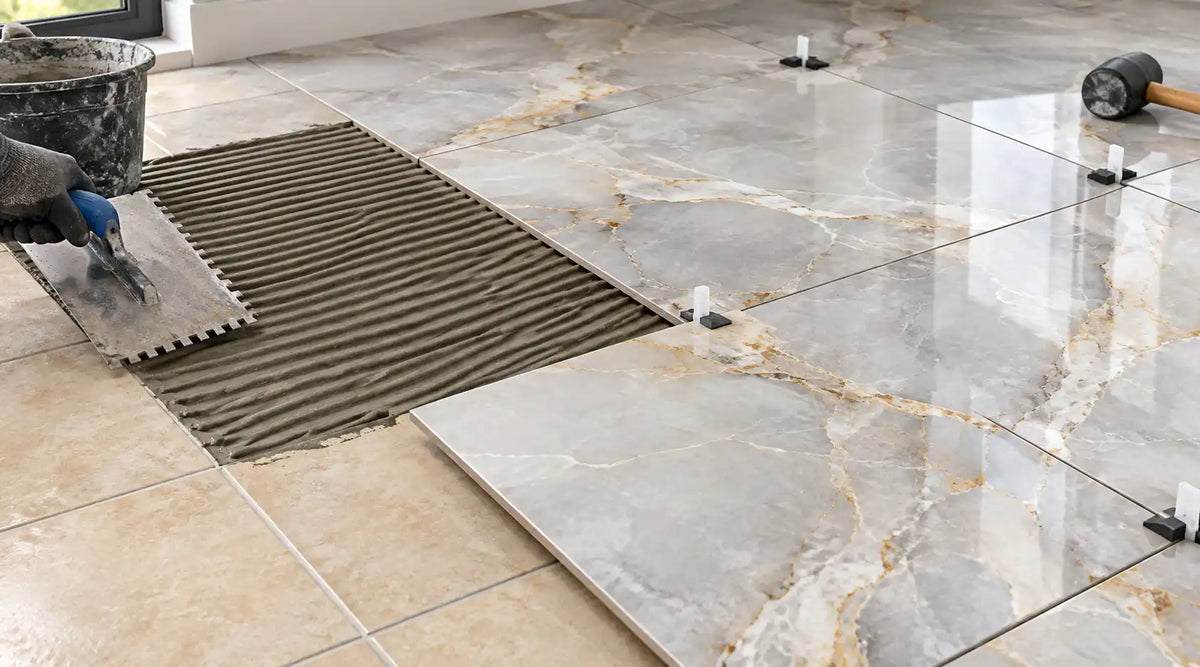
Yes, you can tile over tile when the existing tiles are firmly bonded, flat to within 3 mm over 2 m, clean and dry, and the wall or floor can carry the weight of both layers. Tiling over tile (also called tile-on-tile) is a renovation method where new tiles are fixed with primer and flexible adhesive directly onto old tiles, without removing them. It saves strip-out time, dust and waste. It also adds weight and height, and it hides whatever is behind the old tiles.
This guide explains when tiling over tiles works and when it fails. It covers UK weight limits for plaster, plasterboard and render, height build-up on floors, showers and wet rooms, underfloor heating, the right adhesive and primer, a step-by-step method, and real material costs.
When Can You Tile Over Existing Tiles?
You can tile over existing tiles when all six conditions below are true. If one condition fails, remove the old tiles first.
- Every old tile is firmly bonded. No tile sounds hollow, moves, or is cracked.
- The surface is flat. Gaps under a 2 m straightedge are no more than 3 mm.
- The background is dry. There are no leaks, damp patches, mould behind grout, or failed silicone.
- The background can carry the extra weight. This is the condition most walls fail (see the weight section below).
- The room can take the extra height. A second layer adds roughly 12–15 mm with a 9 mm tile.
- The area is not a shower enclosure or wet room, unless you know the waterproofing behind the old tiles is intact.
Tiling over tile works best on floors laid on a concrete slab, on walls with old tiles fixed to sand and cement render or cement backer board, and on small areas such as kitchen splashbacks.
When Should You Not Tile Over Tiles?
You should not tile over tiles when the old layer is loose, damaged, wet, or too heavy for the background. The new tiles are only as secure as the tiles underneath them. If the old layer fails later, both layers fail together.
Do not tile over tiles in these situations:
- Tiles sound hollow when tapped, or more than a few tiles are loose.
- Tiles or grout lines are cracked. Cracks usually mean the background is moving.
- The wall is skimmed plaster or plasterboard and the combined weight exceeds its limit.
- The old tiles are inside a shower or wet room with unknown waterproofing.
- The floor is suspended timber that flexes when you walk on it.
- The old tiles are vinyl, cork, laminate or peel-and-stick. These must be removed.
- The extra height would stop a door, dishwasher, oven, WC or shower tray fitting.
- The tiles are outdoors. Water and frost get between the layers.
How Do You Check Your Existing Tiles Before Tiling Over Them?
You check existing tiles with four tests: a tap test for bond, a straightedge test for flatness, a visual check for damp, and a background check for weight.
- Tap test. Tap every tile with a screwdriver handle or a small rubber mallet. A solid "click" means bonded. A dull, hollow sound means the tile has come loose.
- Flatness test. Hold a 2 m straightedge or spirit level against the tiles in several directions. Gaps over 3 mm need correcting.
- Damp check. Look for dark grout, black mould, bubbling paint near the tiles, or soft plaster at the edges.
- Background check. Find out what is behind the tiles. Look at an exposed edge, a socket back box, or the wall behind the bath panel. Knock between tiles: a hollow sound across the whole wall usually means plasterboard.
If more than one or two tiles fail the tap test, remove the whole layer. Re-fixing a few loose tiles and then tiling over them rarely lasts.

How Much Weight Can a Wall Hold When You Tile Over Tiles?
A wall can hold between 20 kg/m² and 64 kg/m² of tiling, depending on the background, and the old tiles count towards that limit. UK adhesive manufacturers publish these approximate maximum loads, based on BS 5385 (the British Standard code of practice for tiling):
| Wall background | Maximum tiling weight |
|---|---|
| Gypsum plaster (skimmed wall) | 20 kg/m² |
| 12.5 mm gypsum plasterboard (no skim) | 32 kg/m² |
| Gypsum fibreboard | 40 kg/m² |
| Glass-reinforced cement board | 50 kg/m² |
| Foam-cored tile backer board | 60 kg/m² |
| Sand and cement render | 64 kg/m² |
An old layer of standard ceramic wall tiles, with its adhesive and grout, typically weighs around 12–16 kg/m². Installed weights for new tiles (tile + adhesive + grout) are roughly:
| New tile | Approximate installed weight |
|---|---|
| 8.5 mm ceramic wall tile | 19–22 kg/m² |
| 9–9.5 mm porcelain tile | 24–28 kg/m² |
Always check the weight on your tile's box or product page and your board manufacturer's data. You can compare more figures in our guide to wall tile weight limits by background.

Can You Tile Over Tiles on a Plastered Wall?
No, tiling over tiles on a skimmed plaster wall almost always exceeds the 20 kg/m² limit. The old layer uses around 14 kg/m² of that allowance. That leaves about 6 kg/m², which is less than any ceramic or porcelain tile weighs once fixed. Remove the old tiles, check the plaster, and tile directly onto it or onto a backer board.
Can You Tile Over Tiles on Plasterboard?
Tiling over tiles on plasterboard is usually not possible with modern tiles. Plasterboard takes 32 kg/m². After an old layer of around 14 kg/m², about 18 kg/m² remains. An 8.5 mm ceramic wall tile needs 19–22 kg/m² once fixed, and porcelain needs more. On plasterboard, the safe choice is to remove the old tiles or replace the board with cement backer board.
Can You Tile Over Tiles on a Rendered, Brick or Block Wall?
Yes, tiling over tiles on sand and cement render usually passes the weight check. Render takes 64 kg/m². An old layer of around 14 kg/m² plus a new porcelain layer of 24–28 kg/m² totals about 38–42 kg/m², which stays within the limit. Brick or block walls finished with gypsum plaster count as plaster walls, so the 20 kg/m² limit applies.
Can You Tile Over Floor Tiles?
Yes, you can tile over floor tiles when the old tiles sit on a solid concrete slab, are fully bonded and flat, and the room can take the extra height. Weight is rarely the problem on concrete floors. Height, bond and movement are the problems.
Floors on suspended timber joists are different. Timber floors flex, and two rigid tile layers crack when the floor moves. If an old tiled timber floor shows cracked tiles or grout, the floor is moving. Strip back, stiffen the floor, and tile onto a suitable cement backer board.
How Much Height Does Tiling Over Floor Tiles Add?
Tiling over floor tiles adds the thickness of the new tile plus the adhesive bed, which is usually 12–15 mm with a 9 mm porcelain tile.
| New tile thickness | Typical adhesive bed | Approximate height added |
|---|---|---|
| 8.5 mm | 3–5 mm | 11.5–13.5 mm |
| 9 mm | 3–6 mm | 12–15 mm |
| 10 mm | 3–6 mm | 13–16 mm |
Measure these before you buy tiles:
- The gap under each door. Doors may need trimming.
- Dishwasher, washing machine and fridge heights under the worktop.
- Kitchen plinths and skirting boards.
- WC pan and pedestal fixings, and the waste connection.
- The step down into the next room. Plan a threshold trim or ramp profile.
Can You Tile Over Tiles With Underfloor Heating?
Yes, you can tile over tiles that already have underfloor heating below them, if the heating works and the old tiles are sound. The extra layer slows heat-up time, because the heat passes through two layers of tile and adhesive. Use a flexible S1 or S2 adhesive that is rated for underfloor heating.
You can also add an electric underfloor heating mat on top of sound old tiles. Lay it on an insulation board to stop heat going down into the old floor. This adds another 6–10 mm of height. Our guide on laying porcelain floor tiles over concrete and underfloor heating explains the fixing method.
Can You Tile Over Tiles in a Shower or Wet Room?
You should not tile over tiles inside a shower enclosure or wet room unless you know the waterproofing behind them is intact. Tiles and grout are not waterproof. Water gets through grout and reaches the wall behind. In a shower, the old tiles may already hide wet plaster, rotten board or failed tanking.
Tiling over them seals the problem in. The new tiles then fail from behind, often within a few years. For showers and wet rooms, remove the old tiles, check and dry the background, fit a waterproof board or tanking system, and then tile.
Areas that only get splashes, such as the wall behind a basin or a half-tiled bathroom wall, are lower risk. They still need the bond, flatness and weight checks.
Which Tiles Can You Put Over Existing Tiles?
You can put ceramic, porcelain or mosaic tiles over existing tiles, as long as the combined weight and height work for the surface. The table below compares common choices.
| New tile | Over old tiles on walls | Over old tiles on floors | Notes |
|---|---|---|---|
| 30x60cm ceramic wall tile, 8.5 mm | Only on render or backer board | Not for floors | Lightest option for walls |
| 30x60cm porcelain, 8.5 mm | Only on render or backer board | Yes, on concrete | Porcelain suits walls and floors |
| 60x60cm porcelain, 9 mm | Only on render or backer board | Yes, on concrete | Needs a very flat old floor |
| 60x120cm porcelain | Not recommended on old tiles | Yes, if the old floor is very flat | Large tiles show every dip; use S2 adhesive |
| Mosaic sheets | Yes, if weight allows | Yes, small areas | Many joints hide minor unevenness |
For walls, our 30x60cm wall tiles include lighter formats such as the Trevi New White gloss ceramic (8.5 mm, wall use, £34.99 per m² at the time of writing). For floors, 60x60cm floor tiles such as the Afyon Grey Gold polished porcelain (9 mm, rectified, underfloor-heating compatible, £19.99 per m² at the time of writing) suit tile-over-tile on concrete because the format is manageable and the thickness is standard.
Can You Put Porcelain Tiles Over Ceramic Tiles?
Yes, you can put porcelain tiles over ceramic tiles. Porcelain is denser and heavier than ceramic, so the weight check matters more on walls. Porcelain also has a very low-porosity back, so use a C2-class flexible adhesive rather than a basic ready-mixed paste.
Can You Lay Large Format Tiles Over Old Tiles?
You can lay large format tiles over old floor tiles only when the old floor is very flat. A 60x120cm tile bridges old grout lines and dips, which causes rocking and lippage. Use an S2 adhesive, back-butter each tile, and use a levelling clip system. Large format tiles are not a good choice over old wall tiles, because of their weight. Our large format floor tile size guide explains which sizes suit which rooms.
What Adhesive and Primer Do You Need to Tile Over Tiles?
You need a bond-promoting primer for non-porous surfaces and a flexible cementitious adhesive classed at least C2 S1. Old glazed tiles do not absorb water, so ordinary adhesive has nothing to grip.
Primer. Use a primer that the manufacturer states is suitable for tiling onto existing tiles or other non-porous surfaces. Apply it after cleaning and abrading. Let it dry fully before tiling. Always use the primer recommended for your chosen adhesive, because some adhesives and primers are sold as a system.
Adhesive. Adhesive classes come from the European standard EN 12004:
| Class | Meaning | Use for tile-over-tile |
|---|---|---|
| C2 | Improved cementitious adhesive (higher bond strength) | Minimum class for porcelain and tile-on-tile |
| S1 | Deformable (flexible) | Standard wall and floor tiles over old tiles |
| S2 | Highly deformable (very flexible) | Large format tiles, underfloor heating, heavier tiles |
| F | Fast-setting | Quick jobs; shorter working time |
| E | Extended open time | Larger areas; more time to position tiles |
Our tile adhesive range includes flexible options at these prices at the time of writing:
- BritFlex Rapid RS S1 Flexible Tile Adhesive, 20 kg — £18.99
- Mapei Keraflex Maxi S1 White Adhesive, 20 kg — £37.99
- Ultra-Tile ProFlex S2 Flexible Fibre Reinforced Adhesive, 20 kg — £29.99 (C2 F S2)
Use white adhesive under light or translucent tiles. Use S2 for 60x120cm tiles and heated floors.
How Do You Tile Over Existing Tiles Step by Step?
You tile over existing tiles by fixing any defects, cleaning, abrading, priming, and then setting the new tiles in flexible adhesive with full coverage.

- Test the old tiles. Tap every tile and check flatness with a 2 m straightedge. Remove and re-fix any single loose tile with adhesive, or strip the whole area if several fail.
- Remove fittings. Take off the silicone, trims, socket fronts (use an electrician), radiators, and the WC or basin if needed.
- Repair the grout. Rake out loose, cracked or mouldy grout. Fill deep gaps with adhesive and let them set.
- Deep clean and degrease. Wash the tiles with sugar soap or a tile degreaser. Rinse with clean water and let the surface dry fully.
- Abrade the glaze. Scuff the tile surface with 80–120 grit abrasive or a diamond pad until the shine is gone. Vacuum the dust.
- Prime. Apply the bond-promoting primer with a roller or brush. Leave it to dry for the time on the tub.
- Plan the layout. Offset new joints from old joints where possible, so the old grout lines do not sit directly under the new ones. Carry existing movement joints through to the new layer.
- Fix the tiles. Spread flexible adhesive with a notched trowel sized for the tile. Back-butter porcelain and large tiles. Aim for full, void-free coverage on floors.
- Grout and seal. Leave the adhesive to cure for the time the manufacturer states, then grout. Finish internal corners and edges with flexible silicone.
For grouting technique, see our step-by-step guide on how to grout tiles. Before you walk on or wet the floor, check how long grout takes to dry.
Do You Need to Remove Grout Before Tiling Over Tiles?
No, you do not need to remove all the grout before tiling over tiles. You only need to remove grout that is loose, cracked, crumbling or mouldy. Sound grout can stay once it is cleaned, degreased and primed with the rest of the surface.
Deep or recessed grout lines should be filled flush with adhesive before tiling. This stops the new tiles bridging hollows.
If the old tiles are sound and only the grout looks tired, you may not need new tiles at all. Regrouting tiles can refresh a bathroom for the cost of a few bags of grout.
How Much Does It Cost to Tile Over Tiles in the UK?
Tiling over tiles in the UK costs the same as a normal tiling job for materials and labour, minus the cost of removing the old tiles. You also pay for a primer, which a standard job on plaster or board may not need.
| Cost item | Typical UK figure |
|---|---|
| Tiling labour | £20–£60 per m² (£150–£350 per day) |
| Old tile removal (saved) | £25–£40 per hour |
| Surface preparation | £10–£20 per m² |
| Porcelain tiles (Tiles Paradise, at the time of writing) | from £19.99 per m² |
| Flexible adhesive, 20 kg bag | £18.99–£37.99 |
| Grout | £16.99 (3 kg flexible) to £34.99 (5 kg Mapei Ultracolor Plus) |
Worked example: 5 m² bathroom floor over sound tiles on concrete
| Material | Quantity | Cost (at the time of writing) |
|---|---|---|
| Afyon Grey Gold 60x60cm porcelain, 1.44 m² per box | 4 boxes (5.76 m², covers 10% waste) | ≈ £115 |
| Ultra-Tile ProFlex S2 adhesive, 20 kg | 2 bags | £59.98 |
| Ultra Tile Fix ProGrout Flexible, 3 kg | 1 bag | £16.99 |
| Bond-promoting primer | 1 small tub | extra |
| Materials total (before primer) | ≈ £192 |
Adhesive use depends on the trowel notch and the flatness of the old floor, so buy one extra bag for uneven floors. Our bathroom tile quantity guide shows how to measure each area, and our full bathroom tiling cost guide breaks down labour, hidden costs and waste.
Tiling Over Tile vs Removing Old Tiles: Which Is Better?
Removing old tiles is better when the background is weak, wet or unknown. Tiling over tile is better when the old tiles are sound, the background is strong, and time, dust or budget matter most.
| Factor | Tile over tile | Remove and retile |
|---|---|---|
| Time | Faster (no strip-out) | Slower (strip, repair, dry) |
| Dust and mess | Low | High |
| Waste to skip | Minimal | Heavy (old tiles and adhesive) |
| Weight on the background | Doubles | Starts from zero |
| Floor height | Rises 12–15 mm | Stays the same or less |
| Hidden damp or damage | Stays hidden | Found and fixed |
| Waterproofing | Unchanged | Can be upgraded |
| Long-term risk | Depends on old bond | Lowest |
What Are the Pros and Cons of Tiling Over Tiles?
The main advantage of tiling over tiles is speed with less mess. The main disadvantage is that the new tiles depend completely on the old tiles and the background.
Pros
- Saves the time and labour of removal.
- Avoids damaging plaster or boards during strip-out.
- Creates far less dust and skip waste.
- Keeps the room usable for longer.
Cons
- Adds weight that many UK walls cannot take.
- Raises floor height by 12–15 mm.
- Hides damp, leaks or failed tanking.
- Makes the next renovation harder, because two layers must come off.
- Needs a primer and a better-class adhesive.
What Are the Alternatives to Tiling Over Tile?
The main alternatives to tiling over tile are stripping and re-tiling onto backer board, click vinyl flooring over old floor tiles, wall panels, and tile paint.
- Strip and retile onto backer board. This is the most durable option for walls and wet areas. Cement boards carry far more weight than plaster. Our tile backer boards include 6 mm cement board from £12.99 and 6 mm XPS insulation board from £10.99 per board at the time of writing. Our guide on how to tile bathroom walls and floors covers the full retiling process.
- Click vinyl over floor tiles. Rigid-core SPC click flooring floats over flat, sound tiles without adhesive. It adds 6.5 mm instead of 12–15 mm. Fill deep grout lines first so they do not show through.
- Wall panels. PVC or acrylic panels fix over old wall tiles. They are light and grout-free, but they are not tiles and have a different look and feel.
- Tile paint. Specialist tile paint is the cheapest short-term fix. It wears in wet, high-traffic areas such as floors and shower walls.
What Mistakes Cause Tile-Over-Tile Jobs to Fail?
Most tile-over-tile failures come from skipping preparation or ignoring the background. These are the most common mistakes:
- Tiling over hollow tiles. One loose old tile becomes a loose new tile.
- Skipping the primer. Adhesive cannot bond to shiny glaze on its own.
- Using ready-mixed paste. Paste adhesives are not designed for non-porous surfaces or porcelain.
- Not checking the weight. Walls fail at the plaster, not at the adhesive.
- Spot-fixing floor tiles. Dabs of adhesive leave voids that crack under load.
- Lining up new joints with old joints. Old grout lines can telegraph cracks upwards.
- Covering movement joints. Joints at room edges and changes of background must continue through both layers.
- Tiling over a leaking shower. Hidden water destroys the new work from behind.
Frequently Asked Questions About Tiling Over Tile
Can you tile over tile without removing grout?
Yes, you can tile over tile without removing sound grout. Rake out only grout that is loose, cracked or mouldy, fill deep joints flush, then clean and prime the whole surface.
Can you tile over cracked tiles?
No, you should not tile over cracked tiles. A crack means the tile has lost its bond or the background is moving. Remove the cracked tiles and find the cause first.
Can you tile over tiles in a kitchen splashback?
Yes, a kitchen splashback is one of the easiest places to tile over tiles. The area is small, dry and away from standing water. Check the weight if the wall is plasterboard or skim plaster. Sockets and switches will need spacers or deeper back boxes, fitted by an electrician.
Can you put mosaic tiles over existing tiles?
Yes, you can put mosaic tiles over existing tiles when the old tiles are sound and the surface is flat. Mosaics are light and their many joints hide small unevenness. Use a white flexible adhesive under glass mosaics.
Can you tile over vinyl or peel-and-stick tiles?
No, you cannot tile over vinyl, cork or peel-and-stick tiles. These materials are soft and flexible, so ceramic and porcelain tiles on top will crack. Remove them and tile onto the sound surface below.
Can you put peel-and-stick tiles over existing tiles?
Yes, peel-and-stick tiles can go over smooth, clean, sound tiles. Deep grout lines may show through, and they do not perform like real tiles in showers or on floors.
Does tiling over tiles trap moisture?
Tiling over tiles does not create moisture, but it can hide and trap moisture that is already there. That is why a damp check and a sound background matter more than any adhesive choice.
How long does tiling over tile last?
Tiling over tile lasts as long as a standard tiling job when the old layer is sound and the preparation is correct. If the old layer loses its bond, both layers fail together.
Can you tile over tiles outside on a patio?
No, tiling over outdoor tiles is not recommended. Rain and frost get between the two layers and push them apart. Outdoor areas need tiles laid on a proper base, as explained in our patio tile floor guide.
Is tiling over tiles allowed under UK standards?
BS 5385 treats existing tiling as a usable background when they are sound, clean, well bonded and primed, and when the background can carry the total load. The weight limits in this guide follow the figures used by UK adhesive manufacturers under BS 5385.
Last Thoughts on Tiling Over Tile
Tiling over tile is a sound method when the old tiles pass four checks: bond, flatness, dryness and weight. Floors on concrete, walls on render or backer board, and kitchen splashbacks are the best candidates. Skimmed plaster walls, plasterboard, timber floors, showers and wet rooms usually need stripping back first. When the checks pass, a C2 flexible adhesive, the right primer and careful preparation give a result that lasts as long as a new installation.