





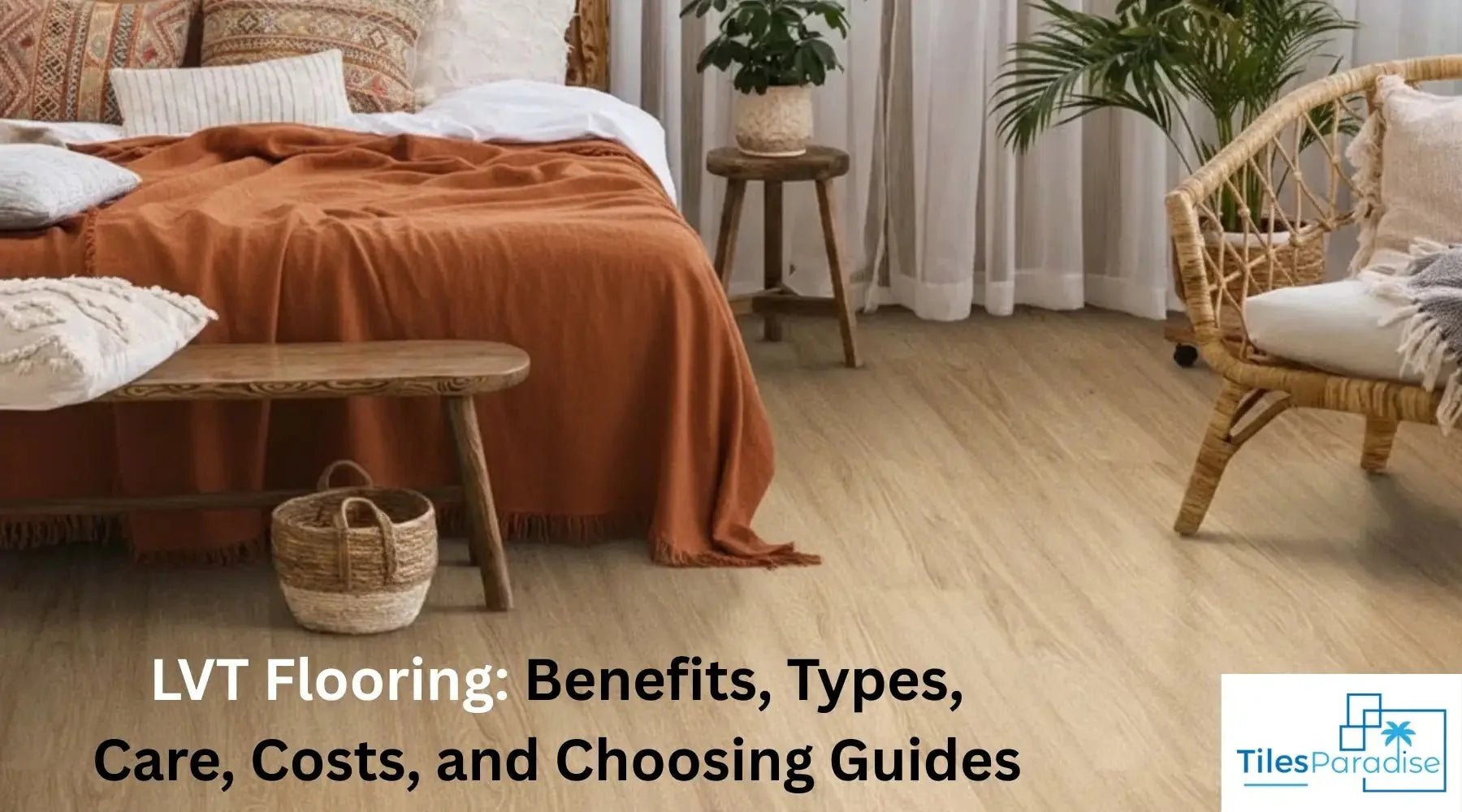
Selecting the perfect foundation requires balancing high-end aesthetics with daily practicality. If you are wondering what is LVT flooring, it is a premier flooring solution that bridges the gap between the raw beauty of natural oak or stone and the resilient engineering of modern vinyl.
Whether you are renovating a moisture-heavy bathroom or a high-traffic kitchen, LVT offers the glamour of herringbone and parquet without the high maintenance of timber. Its popularity in the flooring market is driven by its 100% waterproof nature and superior warmth underfoot.
This guide covers everything from multi-layer construction and installation to cost-effectiveness and the latest trends. Discover why this versatile floor choice is the ultimate investment for a stylish, durable home.
What is Luxury Vinyl Tile (LVT) flooring?
Luxury Vinyl Tile (LVT) is a high-performance, multi-layered flooring engineered to flawlessly replicate the aesthetic of natural oak, slate, and stone. Unlike traditional sheet vinyl, LVT is supplied in individual planks or tiles, offering a premium finish with remarkable dimensional stability.

Each plank is constructed from a series of compressed layers, including a high-definition photographic film protected by a resilient wear layer. This results in a floor that provides the glamour of herringbone or parquet designs but with superior water resistance and acoustic control.
Crucially, LVT solves the cold feeling of ceramic tiles. It offers significantly more warmth underfoot and a softer texture, making it a versatile floor choice for every room in the home, from moisture-heavy bathrooms to high-traffic kitchens. By balancing decorative realism with abrasion resistance, LVT has become the UK's fastest-growing alternative to laminate and real hardwood.
What is Luxury Vinyl Flooring Made of?
Modern luxury vinyl is typically constructed from four to eight distinct layers:

Protective Top Coating: A clear polyurethane (PU) or urethane coating that provides a maintenance-free shine and protects against scratches, stains, and UV fading.
Wear Layer: A transparent heavy film layer that acts as the primary barrier against rips, tears, and heavy foot traffic. Its thickness (typically 0.3mm to 0.7mm) determines the floor's overall durability.
Design/Print Layer: A high-definition photographic film that gives the flooring its realistic appearance, mimicking materials like natural wood, stone, or ceramic tile.
Core Layer: The structural heart of the plank that provides strength and stability. Cores come in three main types:
-
Flexible PVC: Standard LVT core made of compressed PVC vinyl.
-
SPC (Stone Plastic Composite): A rigid core made of pulverised limestone, PVC, and stabilisers, known for being nearly indestructible.
-
WPC (Wood Plastic Composite): A core made of wood pulp, plasticisers, and foaming agents that is softer and warmer underfoot.
Backing/Underlay Layer: The foundational layer providing insulation, sound reduction, and cushioning. Some premium planks include an integrated underlay made of cork or foam.
What are the Benefits of LVT Flooring?
LVT is widely used in both residential and commercial settings due to its practical benefits over traditional flooring.
1. Core Performance & Durability
-
Surface Durability: LVT's high-density construction (often 2mm to 8mm total gauge) is significantly stronger than thicker alternatives like 8mm HDF laminate.
-
The Wear Layer: This transparent top coating (typically 0.1mm to 0.7mm) acts as the primary shield against scuffs, scratches, and stains.
-
0.3mm layer: Generally lasts 10–15 years in residential settings.
-
0.5mm to 0.7mm layer: Suitable for high footfall areas; can extend the lifetime to 25–30 years.
-
Water Resistance: LVT is 100% waterproof, making it the go-to choice for bathrooms, kitchens, and laundry rooms where moisture, splashes, and spills are frequent.

2. Comfort & Thermal Efficiency
-
Underfoot Feeling: Unlike cold ceramic tiles or stone, LVT provides a softer, warmer touch.
-
Underfloor Heating: Fully compatible with most systems, provided the surface temperature does not exceed 27°C (80.6°F).
-
Acoustic Control: LVT products include integrated acoustic layers (such as EVA or cork backings) that can reduce impact sound by 18dB to 21dB, making it much quieter than laminate.
3. Aesthetic & Design Versatility
-
High-Fidelity Visuals: Advanced embossing processes and large print rollers create realistic textures, including wood grains, knots, and stone veining.
-
Trending Layouts: Easy to cut into various shapes, allowing for complex patterns like herringbone, parquet, and basket weave.
4. Maintenance & Lifecycle Cost
-
Low Upkeep: Requires only regular sweeping, vacuuming, or damp mopping with mild cleaners. It eliminates the need for expensive oiling, waxing, or buffing required by natural wood.
-
Economic Value: While initial fitting and material costs are higher than basic laminate, LVT offers a lower ownership lifecycle cost due to its durability and the ability to replace individual planks if damaged.
What are the downsides of LVT flooring?
While LVT is a powerhouse for durability, it does come with specific challenges and limitations:
-
Subfloor Perfection: Any bumps or dips in the subfloor will telegraph through the thin vinyl, causing visible lumps or joint failure.
-
UV Sensitivity: Direct sunlight in conservatories can cause the design layer to fade or discolour.
-
Indentation: Heavy furniture or chairs can leave permanent dents in the PVC core if you don't use floor protectors.
-
No Refinishing: Unlike wood flooring, LVT cannot be sanded or re-oiled; damaged planks must be replaced.
-
Eco-Impact: It is non-biodegradable and carries a higher environmental footprint than natural materials like stone or timber.
What are the Different Types of LVT Available?
The main types of LVT (Luxury Vinyl Tile) flooring are categorised primarily by their core composition and installation method, including-
1. Glue-Down LVT: The Commercial Standard
Glue-down LVT is the most permanent solution, bonded directly to the subfloor. It requires an adhesive application rate of 250–350 g per square metre.
-
Best for: High-traffic retail or hospitality where shifting is not an option.
-
Stability: Offers superior dimensional control because the adhesive restricts the natural expansion and contraction of the vinyl.
2. Click-Lock LVT: The DIY Favourite
This system uses a tongue-and-groove mechanical joint to create a floating floor. It is highly valued in residential settings because it doesn't require messy adhesives.
-
Expansion Gap: It requires an average expansion tolerance of 1.5 mm per linear metre around the perimeter of the room.
-
Speed: Favoured for residential renovations where installation speed is a priority.

3. Loose-Lay LVT: The High-Friction Option
Loose-lay planks rely on their own weight and a specialised friction-backed base to stay in place.
-
Mass: These planks are significantly heavier, weighing between 4.5 kg and 6.5 kg per square metre.
-
Flexibility: Because they aren't locked in, individual planks can be replaced easily, reducing total reinstallation time by roughly 35% compared to glue-down systems.
4. Rigid Core LVT (SPC & WPC): The Heavy-Duty Hybrid
Rigid core combines the waterproof nature of vinyl with a solid, non-flexible centre (Stone Plastic Composite or Wood Polymer Composite).
-
Durability: These planks offer approximately 25% more impact resistance than standard flexible vinyl.
-
Subfloor Tolerance: Because the core is rigid, it doesn't telegraph (show) minor bumps or dips from the subfloor as easily as thinner, flexible LVT.
Which Room is Perfect for LVT Flooring?
LVTis versatile enough for almost any space, but it is considered perfect for rooms that require a balance of waterproof performance, high durability, and comfort underfoot.
The Perfect Rooms for LVT
Bathrooms: As the wettest and most humid rooms, bathrooms are ideal for LVT because it is 100% waterproof. Unlike ceramic tiles, it remains warm and soft underfoot, making it more comfortable for barefoot use.
Kitchens: This high-traffic zone benefits from LVT's resistance to spills, stains, and dropped items. It can also handle the weight of heavy appliances without warping.
Hallways & Entryways: These areas face constant foot traffic, mud, and dirt. LVT's tough wear layer protects against scratches and scuffs, and it is very easy to mop clean.
Utility & Laundry Rooms: Like bathrooms, these rooms are prone to moisture and potential leaks from washing machines. LVT's waterproof nature ensures the floor remains unaffected by water damage.
Basements: Basements often deal with dampness or fluctuating temperatures, making traditional wood flooring risky. LVT (especially SPC or rigid core varieties) is stable and resistant to moisture and mildew.
Secondary Ideal Locations
Living Rooms: Homeowners choose LVT for its ability to realistically mimic wood or stone at a lower cost. It is also compatible with underfloor heating, adding extra cosiness.
Playrooms: Its durability and hygienic, allergen-resistant surface make it a practical choice for children's spaces.
Home Offices: LVT provides sound insulation and can withstand the movement of rolling office chairs.
What is LVT Flooring Cost?
In the UK, the material cost for LVT flooring generally ranges from £15 to £60 per m², while professional installation adds approximately £15 to £30 per m². The overall cost is influenced by the quality, thickness, installation method (click-fit versus glue-down), and subfloor preparation requirements.

Material Costs (Supply Only)
The price of LVT materials varies based on quality, design, and features such as thickness and wear layer.
|
Type |
Average Cost per m² |
|
Budget LVT |
£15 – £25 |
|
Mid-range LVT |
£25 – £40 |
|
Premium LVT |
£40 – £60+ |
Installation and Additional Costs
Professional installation is a significant factor in the total cost. Click-fit LVT is generally cheaper to install than glue-down (dryback) LVT because it requires less labour and can be a viable DIY option.
|
Item |
Estimated Cost (per m²) |
|
Click LVT fitting |
£15 – £25 |
|
Glue-down LVT fitting |
£25 – £30 |
|
Underlay (if required) |
£3 – £8 |
|
Subfloor preparation |
£5 – £15 |
|
Old floor removal |
Approx. £6.50/m² (or £100-£300 for the job) |
Complex patterns, such as herringbone or chevron, require more precise cutting and fitting, which can increase labour costs to as much as £50–£70 per m².
What is LVT Flooring vs Vinyl?
LVT (Luxury Vinyl Tile) and standard sheet vinyl differ significantly in construction, lifespan, and technical performance. While both are waterproof, LVT is a high-end modular product, whereas sheet vinyl is a budget-friendly continuous roll.
LVT vs. Sheet Vinyl Comparison
|
Feature |
Sheet Vinyl (Traditional) |
LVT (Luxury Vinyl Tile/Plank) |
|
Format |
Large rolls (typically 2m, 3m, or 4m wide) |
Individual modular planks (LVP) or tiles (LVT) |
|
Core Material |
Single/double layer; often felt or fibreglass backing |
Multi-layered, rigid PVC, WPC, or SPC (Stone Plastic Composite) |
|
Total Thickness |
Thin and flexible (typically 1mm – 2mm) |
Thicker and rigid (typically 2mm – 8mm) |
|
Wear Layer |
Very thin (often <0.1mm) |
Robust protective coating (0.3mm – 0.7mm+) |
|
Average Lifespan |
10 – 20 years |
20 – 30 years (some offer lifetime warranties) |
|
Installation |
Glue-down (difficult to handle large rolls) |
DIY-friendly Click-lock or professional Glue-down |
|
Repairability |
Poor; usually requires replacing the entire room |
High; individual pieces can be replaced if damaged |
|
Realism |
Flat photographic layer; repeats patterns often |
High-definition 3D printing with textured embossing |
|
Cost (sqm) |
£10 – £50 (Standard) |
£20 – £45+ (Premium) |
What Should You Look For Before Choosing The Right LVT?
To choose the right Luxury Vinyl Tile (LVT), focus on these five essential factors:
Wear Layer Thickness: This is the most critical indicator of durability.
0.3mm: Suitable for low-traffic areas like bedrooms.
0.55mm: Standard for high-traffic domestic areas (kitchens, hallways).
0.7mm+: Best for heavy-traffic commercial use.
Core Material (Rigid vs. Flexible):
SPC (Stone Plastic Composite): Extremely rigid, stable, and dent-resistant; ideal for temperature-fluctuating rooms like conservatories.
WPC (Wood Plastic Composite): Thicker and softer, offering better sound absorption and comfort underfoot.

Installation Method:
Click-Lock: A floating floor that snaps together; most DIY-friendly.
Glue-Down: Adhered directly to the subfloor; highly stable for large or commercial spaces but requires professional fitting.
Subfloor Preparation: LVT requires a perfectly level, dry, and clean subfloor. Any imperfections in the base will eventually telegraph through to the surface of the tiles.
Room Specifics:
Waterproofing: Ensure the product is 100% waterproof for bathrooms or kitchens.
Heating Compatibility: Check the manufacturer's maximum temperature limits if installing over underfloor heating.
Slip Resistance: Look for an R10 rating or higher for safety in wet areas.
How to Install LVT Flooring?
Installing Luxury Vinyl Tile (LVT) is a popular DIY project that can be completed using either a floating (click-lock) or glue-down method.
1. Preparation & Acclimatisation
-
Acclimatise the Planks: Leave unopened boxes flat in the room for 48 hours at a stable temperature (18–28°C) to prevent post-install expansion or bowing.
-
Subfloor Readiness: Ensure the surface is level, dry, and clean. Use a spirit level to check for dips; any variation over 2–3mm per metre should be fixed with a self-levelling compound.
-
Underlay: If your LVT doesn't have a pre-attached backing, roll out a specific LVT underlay. Secure seams with aluminium joining tape to prevent shifting.
2. Planning the Layout
-
Measure & Dry Run: Measure the room and add 10% for wastage. Lay out planks without clicking them to ensure you don't end up with tiny slivers at the edges.
-
Direction: For the best aesthetic, lay planks parallel to the longest wall or towards the main light source.
-
Stagger Joints: Offset end joints by at least 20–30cm between rows to ensure structural stability.
3. Installation Methods
Click-Lock (Floating)
-
Start at a Corner: Place the first plank with the tongue side facing the wall.
-
Use Spacers: Insert 7–10mm spacers between the planks and the wall to allow for natural expansion.
-
Lock Planks: Insert the next plank's end at a 45° angle, then press flat. For fold-down systems, simply tap the joint with a rubber mallet until flush.
-
Cutting: Score the top of the plank with a utility knife and a straight edge, then snap it.
Glue-Down
-
Establish a Centre Line: Find the centre of the room and strike a chalk line to ensure symmetry.
-
Apply Adhesive: Spread a thin layer of vinyl adhesive using a notched trowel, following the manufacturer’s recommended tacky time.
-
Roll the Floor: Once laid, use a floor roller to firmly bond the tiles to the substrate and remove air pockets.
4. Finishing Touches
-
Obstacles: For pipes, drill a hole roughly 10mm wider than the pipe and cut a channel to the edge. For door jambs, use a multi-tool to undercut the casing so the plank slides underneath.
-
Trim: Remove spacers and install skirting boards or Scotia trim to cover the expansion gap. Nail these to the wall, never to the floor itself.
How to Care for and Maintain LVT Flooring?
To care for and maintain LVT flooring, sweep or vacuum daily to remove grit, and mop weekly with a pH-neutral cleaner and a damp, not wet, mop.

-
Daily Care: Sweep, dust mop, or vacuum (using a hard floor setting or soft brush attachment) to remove abrasive dirt.
-
Weekly Cleaning: Use a damp mop with a pH-neutral cleaner designed for luxury vinyl.
-
Spill Management: Clean up spills immediately with an absorbent cloth to prevent staining.
-
Deep Cleaning: Use a specialised LVT cleaner or a solution of water and 2ml of lemon juice for greasy residue.
-
Protection:
-
Furniture: Use felt pads under furniture legs to prevent scratches.
-
Mats: Place non-staining mats at exterior doors.
-
Sunlight: Use curtains or blinds to protect against direct, long-term sunlight, which can fade the flooring.
-
Moving: Lift furniture rather than dragging it.
What to Avoid
-
NEVER use steam mops.
-
Do not use abrasive powders or steel wool.
-
Avoid wax, polish, or harsh solvent-based cleaners.
-
Do not use rubber-backed or latex-backed mats, as they can cause permanent discolouration.
What Are The Latest LVT Trends in UK?
Final Insights:
LVT blends strong construction with refined design. It mirrors the look of oak, slate, and stone while offering waterproof protection and reliable durability for kitchens, bathrooms, and busy spaces.
It also improves everyday comfort. The surface feels warmer and softer than ceramic, works with underfloor heating, and reduces impact noise. Flexible layouts, such as herringbone or plank, add design freedom without added upkeep.
Over time, costs remain steady. Cleaning is simple, damaged planks can be replaced, and performance stays consistent. For homes that need style, strength, and practicality in one solution, LVT is a dependable choice.