





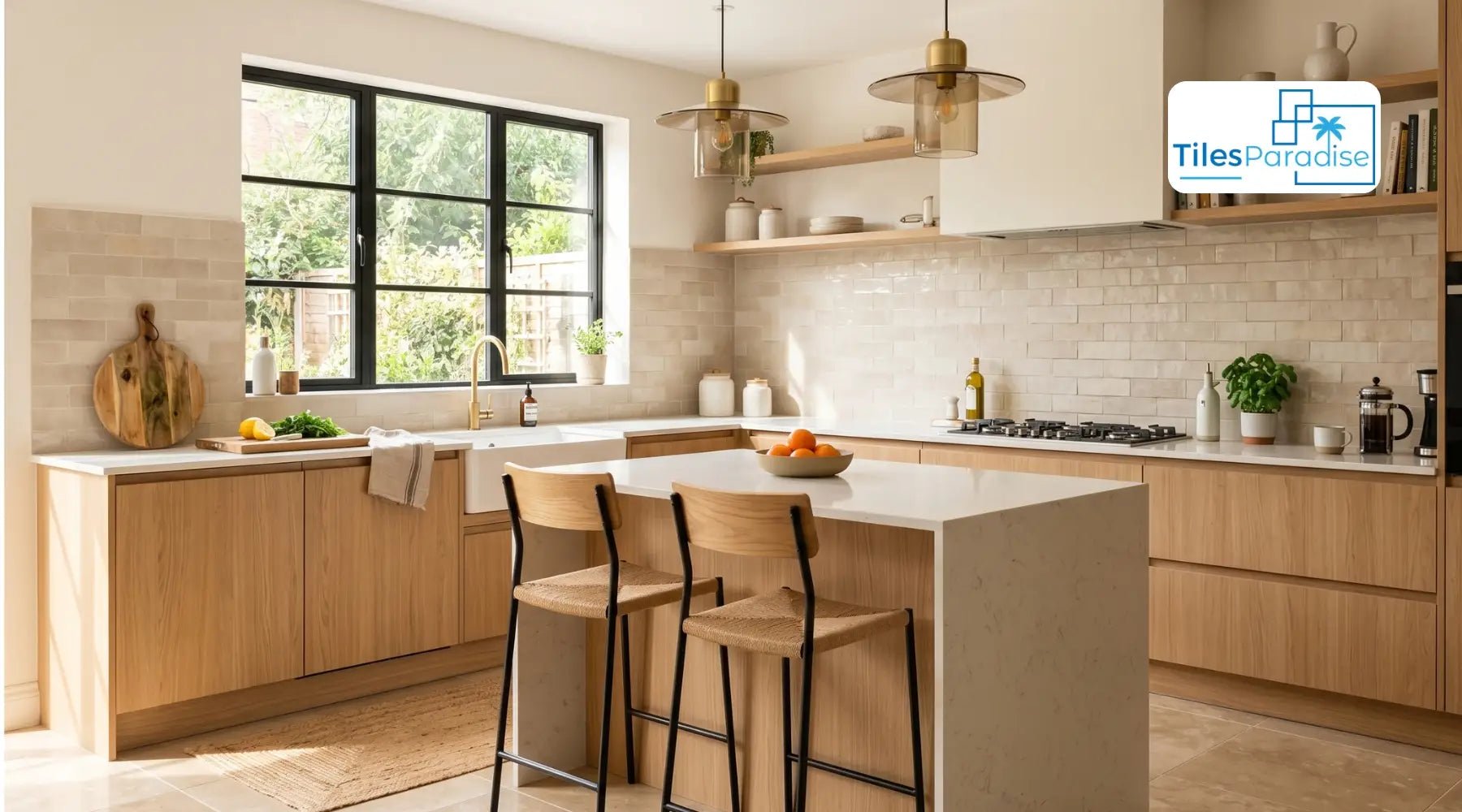
Choosing beige porcelain kitchen floor and wall tiles with matt finish gives UK homeowners a surface that combines warmth, durability, and effortless versatility. Porcelain has a water absorption rate below 0.5%, making it an ideal material for kitchen environments where steam, grease, and daily moisture are constants.
A kitchen with beige tiles works across traditional Shaker units, contemporary handleless cabinetry, and everything in between. This guide covers finishes, sizes, grout pairings, cabinet combinations, and laying patterns to help find the right beige tiles for kitchen floors, walls, and splashbacks.
Why Beige Porcelain Outperforms Ceramic on Kitchen Floors
Porcelain has a water absorption rate below 0.5%, compared to ceramic kitchen tiles at 3 to 7%, giving it a clear advantage in kitchens where daily moisture exposure is unavoidable. On high-traffic beige kitchen floor tiles, porcelain's denser body resists chipping from dropped pans and heavy footfall far better than standard ceramic alternatives.
For busy UK kitchens, particularly open-plan layouts, porcelain kitchen tiles carry a longer lifespan with minimal surface wear, lower sealing demands, and full compatibility with most underfloor heating systems, making porcelain the practical first choice for a beige kitchen tile floor.
Matt vs Gloss Beige Tiles: Which Finish Suits Floor and Wall?
Matt finish beige kitchen floor tiles offer a subtle, non-reflective surface that hides watermarks, fingerprints, and light surface dust more effectively than gloss. On kitchen floors, a matt surface provides natural grip, reducing slip risk in a space where spills are frequent.
Gloss finish beige kitchen wall tiles amplify light reflection, making a compact kitchen with beige tile floor appear noticeably brighter and more open. Combining a matt beige kitchen tile floor with gloss beige kitchen tiles wall creates contrast and depth within a single, unified colour palette.
Grout Colour Guide for Beige Kitchen Tiles: Matching and Contrasting Options
Grout colour directly influences how a beige tile in kitchen settings reads at scale. A warm ivory or sand-toned grout blends with beige kitchen tiles for a continuous, low-maintenance look, while charcoal or mid-grey grout creates definition that highlights tile shape, particularly on large beige kitchen floor tiles in herringbone or grid layouts.
|
Grout Colour |
Visual Effect |
Best Application |
|
Sand / Ivory |
Seamless and natural |
Beige kitchen floor tiles, wall tiles |
|
Warm Grey |
Subtle definition |
Beige kitchen wall, splashback |
|
Charcoal |
Bold contrast, tile shape highlight |
Large beige kitchen floor tiles, herringbone |
|
White |
Bright and clean |
Cream and beige kitchen wall tiles |
Right Tile Size for Beige Kitchen Floors and Walls
Tile format significantly affects how a kitchen reads spatially. Matching size to application and room scale is one of the most impactful decisions in a kitchen tile project:
• 600x600mm square tiles reduce grout lines in compact kitchens, making the beige kitchen tile floor read as larger and more continuous.
• 60x120cm rectangular large tiles create near-seamless beige tile floor expanses in open-plan spaces with minimal cutting waste. See full options for large format kitchen tiles.
• 300x600mm formats suit kitchen wall tiles and splashback applications, offering proportional balance for standard UK kitchen heights.
• Metro and subway formats (75x300mm and 100x300mm) remain a top choice for beige kitchen wall tiles and splashbacks due to easy installation and flexible laying patterns.
Beige Subway Tile Kitchen Splashbacks: Metro Format Ideas
Beige subway tile kitchen splashbacks remain one of the most requested applications in UK kitchen renovations because the format works behind hobs, sinks, and prep areas without competing with other design elements. A beige glass subway tile kitchen splashback adds luminosity to the wall, amplifying natural light in north-facing kitchens where brightness is limited.
Laid in a classic brick bond or rotated to a vertical stack pattern, metro tiles in a beige tone complement wood-effect and stone-effect floor tiles effectively. Pairing a metro beige kitchen wall with marble effect kitchen tiles on the floor delivers a premium, layered finish popular across modern UK kitchen schemes.
Cabinet and Worktop Colour Pairings with Beige Kitchen Tiles
Beige tiles sit between warm and cool on the colour spectrum, making kitchen with beige tiles compatible with a wide range of cabinet finishes. Below is a practical pairing reference for kitchens with beige floor tiles or beige kitchen wall combinations:
|
Cabinet Colour |
Tile Finish Recommendation |
Overall Effect |
|
Natural oak / warm wood |
Matt beige floor + gloss wall |
Warm, organic, Scandinavian |
|
Navy blue |
Matt beige porcelain floor |
Bold contrast, coastal scheme |
|
Sage green |
Matt beige wall and floor |
Earthy, botanical palette |
|
Cream / off-white |
Gloss beige kitchen wall |
Soft monochromatic layering |
|
Charcoal grey |
Polished large beige floor |
Modern and dramatic contrast |
Pairing cream kitchen tiles on a splashback with a beige kitchen tile floor creates a tonal scheme that suits country-style, Shaker, and transitional kitchens across the UK.
Best Large Format Porcelain Kitchen Floor Tiles for Open Plan Kitchens with Underfloor Heating
Large format porcelain floor tiles perform exceptionally well with underfloor heating systems because porcelain's low thermal resistance, typically below 0.10 m²K/W, allows heat to transfer efficiently from the substrate into the room. In open-plan kitchens, 60x120cm beige porcelain floor slabs create near-seamless surfaces with fewer grout lines, simplifying cleaning around kitchen islands and dining zones.
Full guidance on sizing, slip resistance ratings (R9 to R11), and full UFH compatibility is available in the large kitchen floor tiles guide.
Vinyl Floor Tiles for Kitchen with Underfloor Heating
Vinyl kitchen floor tiles offer a cost-effective warm-toned alternative for kitchens where a hard tile installation is not practical, and many beige formats replicate stone and wood visuals convincingly. Vinyl is compatible with most low-temperature underfloor heating systems, although maximum surface temperatures should not exceed 27 degrees Celsius to preserve dimensional stability.
Detailed advice on vinyl selection, adhesive compatibility, and UFH pairing is available in the vinyl floor tiles kitchen guide.
Marble and Stone-Effect Beige Tiles: Natural Aesthetics, No Sealing Required
Natural marble requires periodic sealing and remains vulnerable to acidic kitchen substances, while marble effect kitchen tiles in beige porcelain deliver a comparable visual without the maintenance demands. Stone-effect beige porcelain replicates the organic veining, fossil movement, and surface variation of travertine and limestone in a non-porous body that resists staining from oils and kitchen acids.
Both marble effect and onyx kitchen tiles in beige tones suit floor and wall applications and are available in large-format slabs for a seamless, contemporary finish. A stone-effect beige kitchen floor tile paired with plain beige kitchen wall tiles creates a natural, layered aesthetic that requires no special cleaning products.
Cream and Beige Kitchen Wall Tiles: Tonal Layering Ideas
Using cream and beige kitchen wall tiles together builds a monochromatic layered scheme that adds depth without introducing contrasting colours. Cream beige kitchen wall tiles work particularly well in smaller kitchens, as the tonal variation draws the eye across the wall surface rather than breaking it with hard transitions.
Pairing cream kitchen tiles on the splashback with a beige kitchen tile floor creates a cohesive palette that stays timeless through multiple kitchen updates. For a coordinated tone-on-tone result, explore options in both the beige kitchen tiles and cream kitchen tiles ranges to find shades that sit harmoniously together.
Laying Patterns That Change How Beige Kitchen Tiles Look
The same beige kitchen tile applied in different laying patterns produces noticeably different finished results across both kitchen floors and walls:
1. Brick bond (offset): The most widely used pattern for beige kitchen wall tiles and metro formats, creating a classic horizontal rhythm suited to both traditional and contemporary kitchens.
2. Herringbone: Adds strong directional movement to a beige tile floor kitchen, working particularly well in elongated 600x300mm rectangular formats on larger kitchen floors.
3. Grid (stacked): Clean and minimal, suited to contemporary kitchens with handleless cabinets and a preference for straight visual lines across the floor and wall.
4. Diagonal: Makes compact kitchen floors read as wider by drawing the eye toward corner angles rather than flat walls, maximising perceived floor space.
5. Vertical stack: Large format beige porcelain in a vertical bond maximises perceived ceiling height on kitchen walls, a popular choice for standard-height UK kitchens.
Exploring patterned kitchen tiles alongside plain beige options opens possibilities for accent splashbacks and feature wall sections within a cohesive neutral scheme.
Beige vs White vs Grey Kitchen Tiles: Practical Comparison
White kitchen tiles show watermarks, limescale splash, and fingerprints more readily than beige, requiring more frequent cleaning in an active kitchen. Grey kitchen tiles offer a similar neutral tone but carry a cooler, more industrial character that suits fewer cabinet colour palettes compared to beige.
A beige kitchen tile floor hides dust and light debris more effectively than white, making it a practical, low-maintenance choice for busy UK households where the kitchen sees constant daily use. Reviewing grey kitchen tiles and white kitchen tiles alongside beige options clarifies why beige continues to hold strong as the preferred warm neutral for kitchen beige tiles in UK homes.
Final Insights
Beige kitchen tiles continue to hold a strong position in UK kitchen design because the tone works with almost every cabinet colour, material, and kitchen size. Porcelain in a matt finish delivers the best balance of grip, stain resistance, and visual warmth, particularly in high-traffic kitchens and open-plan spaces with underfloor heating.
From large format beige porcelain floor slabs to cream and beige kitchen wall tiles and beige subway tile splashbacks, the range of applications within the beige colour family is extensive. Matching the right tile size, finish, and grout colour to the kitchen layout and cabinet scheme ensures a result that looks cohesive, intentional, and built to last.