





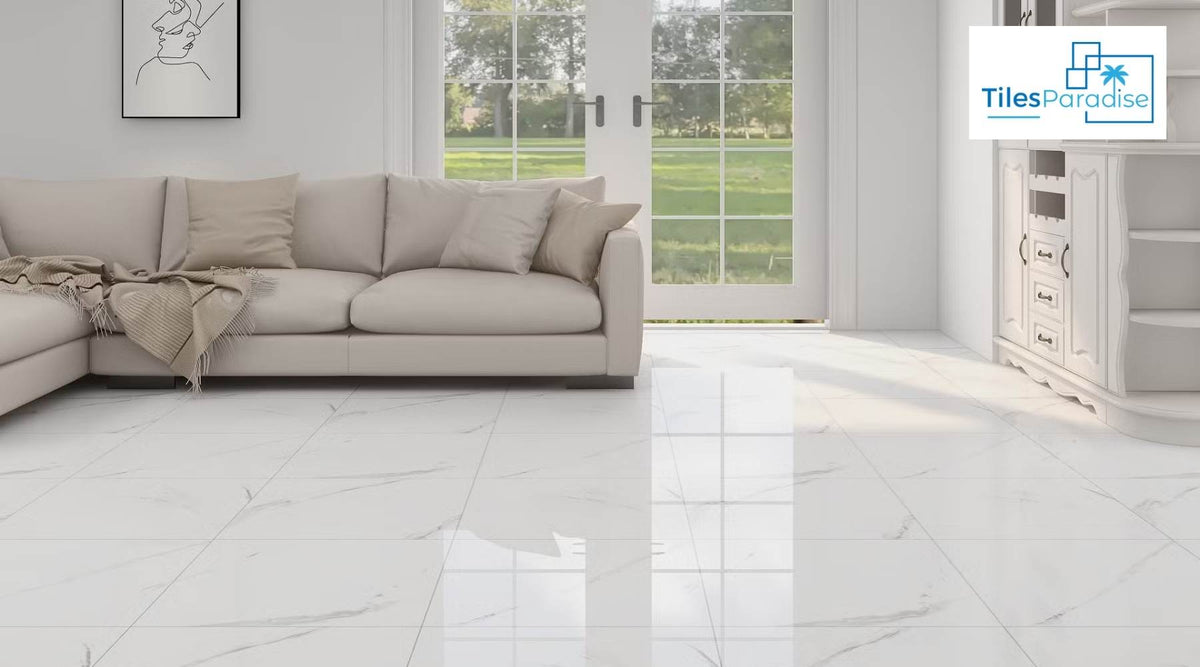
Floor tiles are hard-wearing tiles made to take foot traffic, usually porcelain, ceramic or natural stone, fixed to a prepared subfloor with adhesive and grout. To choose floor tiles, match five things to the room: material, slip rating, size, finish and thickness. Then check the price per m² and order the right number of boxes.
This guide works through those five checks for every room in a UK home. It uses live data from more than 400 floor tiles in the Tiles Paradise range, so the sizes, thicknesses and prices you see here are the ones you can actually buy.
| Check | What to look for | Safe default for most UK homes |
|---|---|---|
| 1. Material | Water absorption and strength | Porcelain (≤0.5% water absorption) |
| 2. Slip rating | R rating or PTV on the product page | R10 in kitchens and bathrooms, R11 in showers and wet rooms |
| 3. Size | Room size, shape and subfloor flatness | 60×60cm for most rooms, 60×120cm for open-plan |
| 4. Finish | How wet and busy the floor gets | Matt for wet or busy floors, polished for dry rooms |
| 5. Thickness | Indoor or outdoor, door clearance | 8.5–9.5mm indoors, 20mm outdoors |
On this page
What to check first · Floor tiles by room · Porcelain or ceramic · Tile size · Finish and slip rating · Thickness · Price per m² · How many tiles · Cold floors and underfloor heating · Laying for a flat floor · Quick picks · Buyer questions
What should you check first when choosing floor tiles?
Check how wet the floor gets and how many people walk on it before you look at colour. Those two facts decide the material, the slip rating and the finish. Colour and pattern come last, because they are the only choices with no safety cost.
Work through the decision in this order:
- Name the room's job. A hallway takes grit and wet shoes. A bathroom floor gets splashed barefoot. A living room stays dry.
- Set the minimum slip rating. Wet or busy floors need a matt tile with a stated R10 or R11 rating.
- Choose the material. Porcelain suits every indoor floor and the outdoors. Ceramic suits light-use, dry floors.
- Pick a size that fits the room and the subfloor. Bigger tiles need a flatter base.
- Choose the finish, colour and grout. Then order a sample and look at it in your own daylight and lamp light.
A tile that passes steps one to three will stay safe and look good for decades. A tile chosen on looks alone can fail at step two the first time someone steps out of the shower.
Which floor tiles suit each room in a UK home?
Porcelain suits every room in a UK home. The finish and slip rating change from room to room. The table pairs each room with the specification that keeps it safe and easy to clean.
| Room | Finish and slip | Sizes that work | Watch out for |
|---|---|---|---|
| Hallway and entrance | Matt, R10 or higher | 60×60, 30×60, 20×20 patterned | Grit from shoes, rain at the door |
| Kitchen | Matt, R10–R11 | 60×60, 60×120 | Spills, grease, dropped pans |
| Bathroom and en-suite | Matt, R10 minimum | 30×60, 60×60 | Bare wet feet |
| Walk-in shower and wet room | Matt, R11 | Smaller tiles or mosaics on the falls | Standing water, drainage slope |
| Living and dining room | Polished or matt | 60×120, 80×80 | Cold underfoot without heating |
| Conservatory | Matt porcelain | 60×60, 60×120 | Big temperature swings, strong sun |
| Utility room and downstairs WC | Matt, R10 | 30×60, 60×60 | Leaks from appliances |
| Patio and garden | Outdoor porcelain, R11 | 60×60, 60×90, 40×80 at 20mm | Frost, moss, rain |
Hallway floor tiles
A hallway floor needs a matt porcelain tile rated R10 or higher, because wet shoes come straight in from the street. Mid-tone colours hide grit better than pure white or jet black. Victorian-style 20×20cm patterned tiles suit period terraces. Plain 60×60cm tiles suit modern, wider halls. Our guide to marble-effect hallway floor tiles covers narrow halls and veining direction in more depth.
Kitchen floor tiles
A kitchen floor needs a matt porcelain tile with a stated R10 or R11 rating, because oil and water on a smooth floor cause most kitchen slips. Porcelain does not absorb wine, oil or coffee. Light textures clean better than deep, rough ones, which trap grease. The R10 vs R11 kitchen floor tile guide explains when the extra grip is worth it.
Bathroom floor tiles
A bathroom floor needs a matt tile rated R10 or above, because people walk on it barefoot and wet. Keep polished tiles for bathroom walls. Inside a level-access shower, step up to R11 or use smaller tiles, which follow the drainage slope and give more grout lines for grip.
Living room and open-plan floor tiles
A living room floor can take a polished tile, because the room stays dry. Large 60×120cm or 80×80cm formats make an open-plan ground floor look like one continuous surface. If the living area joins the kitchen, use the kitchen's matt, slip-rated tile throughout so there is no change of grip at the join.
Conservatory, utility room and downstairs toilet
A conservatory floor needs porcelain fixed with a flexible adhesive, because the room heats and cools fast. Utility rooms and downstairs toilets need a matt R10 tile, since washing machines and cisterns can leak. A 30×60cm or 60×60cm tile cuts neatly around the pipes and tight corners in these small rooms.
Outdoor floor tiles
An outdoor floor needs 20mm porcelain paving rated R11, not an indoor tile. Indoor tiles are thinner, and most are not tested for frost or for laying on a gravel or pedestal base. Our patio tile floor guide covers bases, joints and outdoor slip ratings.
Is porcelain or ceramic better for floor tiles?
Porcelain is better for most floors. It is denser, harder and absorbs almost no water. Under the European tile standard BS EN 14411, porcelain absorbs 0.5% of its weight in water or less. That low absorption is why porcelain survives frost, steam and spilt drinks without staining or cracking.
Ceramic floor tiles are lighter and easier to cut. They cost less to fit and suit dry, low-traffic floors such as a bedroom or a spare room. Ceramic chips more easily under a dropped pan, and the clay body under the glaze shows a different colour when it chips.
| Attribute | Porcelain | Ceramic |
|---|---|---|
| Water absorption | 0.5% or less | Higher, varies by tile |
| Best for | Every room, wet areas, outdoors | Dry, light-use floors, walls |
| Frost resistance | Yes, in outdoor grades | Not for outdoor use |
| Cutting and fitting | Harder; needs a good cutter | Easier to cut and drill |
| Large formats | Up to 60×120cm and beyond | Mostly smaller sizes |
Porcelain also copies natural stone without stone's upkeep. Marble and travertine need sealing and react with acidic spills. The marble-effect porcelain vs real marble comparison sets the two side by side.
What size floor tiles should you choose?
Choose 60×60cm for most rooms and 60×120cm for large or open-plan rooms. Those two sizes make up most of the Tiles Paradise floor range: over 180 tiles come in 60×120cm and over 120 in 60×60cm. Smaller 30×60cm tiles suit narrow rooms and small bathrooms. Patterned 20×20cm tiles suit hallways and period homes.
Large tiles often suit small rooms too. Fewer grout lines make the floor read as one surface, so the room looks bigger. The limit is the subfloor, not the room. A 60×120cm tile needs a flat base, or the edges will sit at different heights. The large format floor tiles size guide shows how each size behaves in different room shapes.
| Size | Best rooms | Why |
|---|---|---|
| 20×20cm | Hallways, porches, period kitchens | Pattern repeats, more grout for grip |
| 30×60cm | Small bathrooms, cloakrooms, utility rooms | Easy to handle, easy to cut around pipes |
| 60×60cm | Kitchens, bathrooms, halls, most rooms | Forgiving on slightly uneven floors |
| 60×120cm | Open-plan, living rooms, large kitchens | Fewer grout lines, seamless look |
| 80×80cm | Large square rooms, entrance halls | Bold scale without long, narrow cuts |
For open-plan rooms, the 60×120cm floor tiles show how far a single large format can run. For tight spaces, the guide to small porcelain floor tiles explains when a smaller format is the better call.
Are matt or polished floor tiles safer?
Matt floor tiles are safer on wet or busy floors. A matt or anti-slip surface has a fine texture that keeps grip when wet. Polished porcelain has a glass-smooth face that reflects light but gives little grip under water. Use polished floor tiles in dry rooms and matt tiles wherever water reaches the floor.

What do R9, R10, R11 and R12 slip ratings mean?
The R rating comes from the German ramp test DIN 51130. A tester in work shoes walks on an oiled tile while the ramp tilts. The steeper the angle at which they slip, the higher the R number.
- R9: dry indoor floors, such as living rooms and bedrooms.
- R10: the usual minimum for domestic kitchens, bathrooms and hallways.
- R11: shower areas, wet rooms, utility rooms and outdoor patios.
- R12 and R13: commercial kitchens, ramps and industrial floors.
Two other tests appear on UK specifications. The pendulum test (BS 7976) gives a Pendulum Test Value, or PTV. A wet PTV of 36 or more means low slip potential. The barefoot test DIN 51097 grades tiles A, B or C, with C the most grip for showers and pool surrounds.
How do you check the slip rating before you buy?
Read the slip rating line on the product page, not the product name. A tile called "anti-slip" or "textured" still needs a stated R or PTV number. In the Tiles Paradise range, the tiles with a stated R11 rating include the Apollo Black & Gold 60×60cm matt anti-slip tile and the Gobi Terrazzo Nude 60×60cm matt tile. If a product page shows no rating, ask us before you order it for a wet floor. The full non-slip floor tiles range groups the matt and anti-slip options in one place, and the matt porcelain floor tile guide compares textures.
What is a PEI rating, and do porcelain floor tiles need one?
A PEI rating measures how well a glazed tile's surface resists wear, on a scale of 0 to 5. PEI 3 suits most home floors. PEI 4 suits busy home floors and light commercial use. Through-body and full-body porcelain is often tested a different way, because its colour runs through the whole tile. For these tiles, a missing PEI number is not a warning sign.
How thick should floor tiles be?
Indoor porcelain floor tiles are usually 8.5–9.5mm thick, and outdoor porcelain paving is 20mm thick. That matches the Tiles Paradise range: most indoor floor tiles are listed at 8.5mm, 9mm or 9.5mm, and outdoor paving is 20mm.
Plan for the adhesive as well as the tile. A solid adhesive bed adds a few millimetres, so a finished floor often sits around 12–16mm above the old surface. Check three places before you order:
- Internal doors: will they still clear the new floor, or need trimming?
- Thresholds: where tile meets carpet or wood, plan a trim or transition strip.
- Underfloor heating: a heating mat and leveller add height under the tile.
Thicker tiles are not always stronger indoors. A 9mm porcelain tile fully bedded on a flat, rigid base will outlast a thicker tile laid on hollow spots of adhesive.
How much do floor tiles cost per m² in the UK?
Porcelain floor tiles at Tiles Paradise start at £17.99 per m², and most sizes sit near £29–£30 per m². Premium designs reach about £80 per m². Prices are per square metre and include VAT. The figures below come from the live floor tile range, checked on 20 October 2026. Sale prices change, so the product page always shows the current price.
| Size | Tiles in range | From | Typical (median) | Usual box |
|---|---|---|---|---|
| 60×120cm | 180+ | £19.99 | £29.99 | 2 tiles = 1.44m² |
| 60×60cm | 120+ | £17.99 | £29.99 | 4 tiles = 1.44m² |
| 30×60cm | 50+ | £19.99 | £28.99 | See product page |
| 80×80cm | 14 | £22.99 | £43.99 | See product page |
Two patterns stand out in the data. Matt anti-slip versions of a 60×120cm tile tend to cost a little more than polished ones: the typical matt 60×120cm tile is £34.95 per m², against £29.99 for polished. Bigger projects also cost less per m² to deliver. Standard pallet delivery is free on orders over £499 to the UK mainland, and £39.99 for orders between £100 and £499, usually within 2–4 working days. For whole-house jobs, a full pallet usually brings the price per m² down further.
Fitting is a separate cost. A tiler's day rate depends on your region, the tile size and the state of the subfloor, so get a written quote that includes preparation and levelling.
How many floor tiles do you need?
Measure the floor area in m², add 10% for cuts and breakages, then round up to whole boxes. Add 15% instead of 10% for herringbone, diagonal or patterned layouts, because these waste more tile at the edges. The tile calculator does the sum for you and adds the 10% by default.
Here is a worked example for a 4.2m × 3.6m kitchen using a 60×60cm tile:
- Floor area: 4.2m × 3.6m = 15.12m².
- Add 10%: 15.12m² × 1.1 = 16.63m².
- Divide by box coverage: 16.63m² ÷ 1.44m² = 11.55, so order 12 boxes (17.28m²).
- Cost at £29.99 per m²: 17.28m² × £29.99 = £518.23, which qualifies for free pallet delivery.
Order every box at the same time, so all the tiles come from one batch with the same shade. Keep one or two spare tiles in the loft. A cracked tile five years later is easy to replace if you have a match.
Are floor tiles cold, and do they work with underfloor heating?
Floor tiles feel cold because porcelain and stone conduct heat away from bare feet quickly. That same property makes tiles one of the best floor finishes for underfloor heating. The heat passes through a thin, dense tile faster than through wood, carpet or vinyl.
Almost every tile in the Tiles Paradise floor range is marked suitable for underfloor heating: 391 of 410 listings. Use a flexible S1 adhesive over heating. Run a new heated screed through a full heat-up and cool-down before tiling, as BS 5385-3 advises. The porcelain floor tiles with underfloor heating guide covers warm-up times, and the underfloor heating range lists the electric mats that sit under the tiles.

A living room is the one place where a polished floor makes full sense. The Black Gold Marble Effect polished 60×60cm tile in the photo shows how a reflective floor lifts a darker room. Add rugs where people sit if the room has no underfloor heating.
How should floor tiles be laid so they stay flat and crack-free?
Floor tiles stay flat and crack-free when the subfloor is rigid, flat and dry, and every tile is fully bedded in adhesive. Most cracked or lifting tiles trace back to the base underneath, not to the tile itself.

How do you prepare the subfloor?
- Concrete or sand and cement screed: it must be dry, flat and free of dust. A hygrometer reading of 75% relative humidity or lower is the usual target before tiling.
- Anhydrite (calcium sulphate) screed: sand off the surface laitance and prime it before you tile.
- Timber floorboards: do not tile straight onto boards. Screw down exterior-grade plywood or tile backer boards first, so the floor stops flexing.
- Existing tiles: you can often tile over them if they are sound and well bonded. The guide to tiling over existing tiles explains the checks.
Which way should floor tiles run, and how much offset?
Run rectangular tiles with the long edge along the longest wall or the main line of sight from the door. In a narrow hallway, that means running the tiles down the length of the hall. For 60×120cm tiles, keep any brick-style offset to one-third or less. A half offset puts the slight bow of large porcelain tiles in the worst place, so neighbouring edges stand proud.
How wide should the grout joints be?
Rectified tiles have machine-cut edges, so they can take a narrow 2–3mm joint. Non-rectified tiles need about 3–5mm to absorb small size differences. Most Tiles Paradise floor tiles are rectified. The guide to rectified porcelain tiles explains the difference. Use a flexible S1 adhesive on heated floors and on overboarded timber floors.
Which fitting steps prevent cracks?
- Back-butter large tiles, so there are no hollow spots under the corners.
- Use levelling clips on 60×120cm and larger tiles to control lippage.
- Leave a perimeter movement gap at the walls, hidden by the skirting.
- Add movement joints on large or heated floors, at the spacings set out in BS 5385-3.
- Keep off the floor until the adhesive and grout have cured.
For the full fixing sequence on a concrete or heated floor, follow the step-by-step guide on how to lay porcelain floor tiles.
Which floor tile should you choose for your situation?
The table below answers the most common real-life briefs in one line each. Every pick follows the five checks above.
| Situation | Recommended floor tile |
|---|---|
| Open-plan kitchen-diner with underfloor heating and a dog | Matt porcelain, R10–R11, 60×60cm or 60×120cm, mid-tone with veining to hide paw prints |
| Small downstairs toilet or cloakroom | Matt R10 porcelain, 30×60cm or 60×60cm, light colour with matching grout |
| Victorian terrace hallway | 20×20cm patterned porcelain or a 60×60cm matt tile, with a doormat zone at the door |
| Family bathroom with a walk-in shower | Matt R10 on the main floor, R11 or smaller tiles inside the shower area |
| Adults-only living room, no water use | Polished porcelain, 60×120cm or 80×80cm |
| Conservatory with strong sun | Matt porcelain on flexible adhesive, with movement joints |
| Quick refresh without adhesive | Rigid-core SPC click flooring instead of tiles |
| Patio or garden path | 20mm outdoor porcelain paving, R11 |
Two products show how the open-plan brief looks in practice. The Calacatta Borghini 60×120cm grey matt tile and the Alhambra Bianco 60×120cm matt anti-slip tile both list R11 and underfloor heating compatibility on their product pages. For a quick refresh without adhesive, SPC click flooring locks together over a flat floor. For the full range of sizes, colours and finishes, start from the porcelain floor tiles collection and filter by room.
What else do buyers ask about floor tiles?
The answers above cover the buying decision. These shorter answers cover the follow-up questions buyers ask most.
Can you use floor tiles on walls?
Yes, you can use floor tiles on walls if the wall can carry the weight. Plasterboard is commonly limited to 32kg per m² for tile plus adhesive, and a plaster skim to 20kg per m². Large porcelain floor tiles can be heavy, so check the tile weight against the wall before you start. Most Tiles Paradise floor tiles are sold as wall and floor tiles: 386 of 410 listings are rated for both.
Can you use wall tiles on floors?
No, you should not use wall-only tiles on floors. Wall tiles are often thinner, softer-glazed ceramic with no slip or wear rating for foot traffic. They can crack under furniture and become slippery when wet. Check that the product page says "floor" or "wall and floor".
Do porcelain floor tiles scratch, and are they good with dogs?
Porcelain floor tiles resist scratches from claws, chair legs and normal use. Grit dragged in on shoes causes most fine marks, and those show more on polished tiles than on matt ones. For dogs, a matt tile with an R10 rating or higher gives paws more grip. Porcelain also does not absorb pet urine, so accidents wipe clean.
Why do floor tiles crack?
Floor tiles usually crack because the base moves or the tile was not fully bedded. Common causes include flexing timber floors, hollow spots of adhesive under corners, no movement joints, and tiles laid across a crack in the screed. A tile that sounds hollow when tapped is more likely to crack later.
Should floor tiles be lighter or darker than the walls?
Floor tiles are most often a shade darker than the walls, which grounds the room. That is a convention, not a rule. Light floors make small and north-facing rooms brighter. Mid-tones, especially with veining or speckles, hide dirt best in hallways and kitchens.
What colour grout should you use on floor tiles?
Use a grout one shade darker than the tile for floors that get dirty, such as hallways and kitchens. A matching grout makes the floor look seamless. A contrasting grout shows off the tile layout. Light grout on a busy floor will darken over time. The guide on how to grout tiles covers mixing and finishing.
Do floor tiles need sealing?
Porcelain and glazed ceramic floor tiles do not need sealing. Some polished porcelain benefits from a sealer at installation if the maker recommends it. Cement-based grout can be sealed to resist stains. Natural stone, such as marble, slate or travertine, does need sealing.
Are floor tiles waterproof?
Porcelain floor tiles are waterproof, but a tiled floor is not watertight on its own. Grout lines let water through. In wet rooms and level-access showers, apply a tanking membrane under the tiles before you lay them.
Do old floor tiles contain asbestos?
Some do. Vinyl and thermoplastic floor tiles in UK homes built or refurbished before 2000 can contain asbestos. Do not sand, drill or break them up. Have a sample tested, or tile over them if they are sound, rather than lifting them.
Which floor tiles look like wood?
Wood-effect porcelain planks look like timber but take water, heat and pets like tile. They work in kitchens, bathrooms and over underfloor heating, where real wood can move or swell. The wood effect porcelain floor tiles guide covers plank sizes and laying patterns.
Large or small floor tiles for a small bathroom?
Large tiles usually suit a small bathroom floor better, because fewer grout lines make the room look bigger. The exception is a shower floor laid to falls. There, smaller tiles follow the slope and add grip.
Last Thoughts on Choosing Floor Tiles
Choosing floor tiles comes down to matching the tile to the room's job. Porcelain is the safe material for almost every UK floor. The slip rating follows the water, the size follows the room and the subfloor, and the finish follows how the room is used. Get those right, order the correct number of boxes from one batch, and prepare the base properly. The floor will then outlast the kitchen or bathroom built around it.