





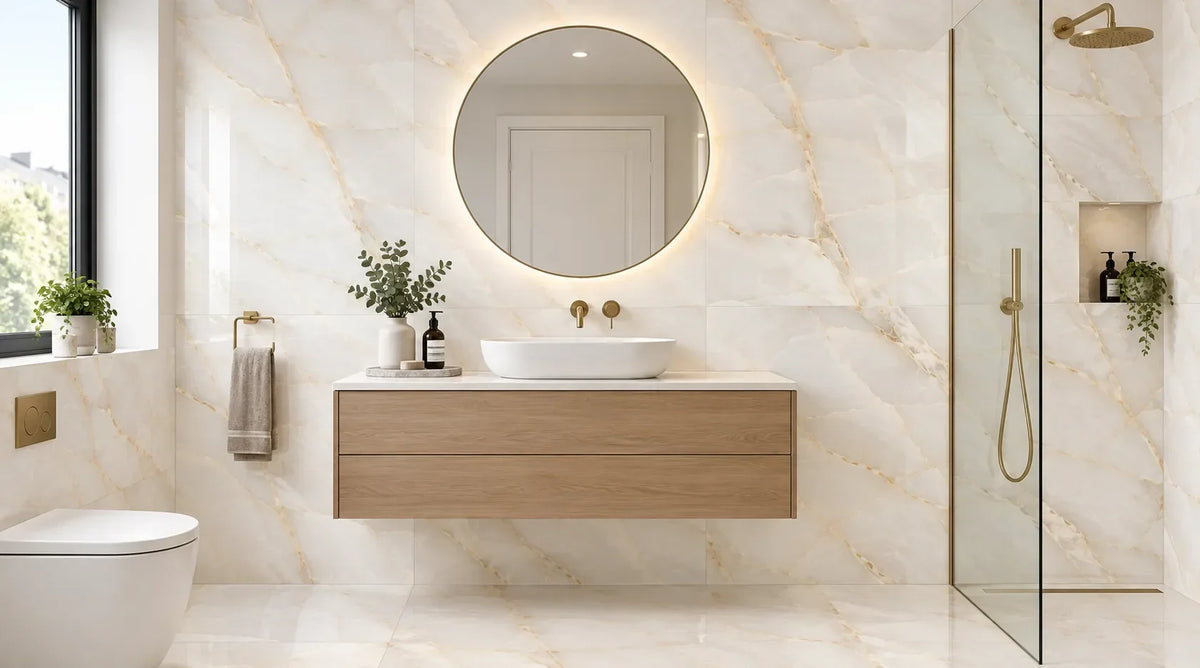
Porcelain wall tiles are dense, fully vitrified ceramic tiles that absorb 0.5% water or less, which makes them one of the most water-resistant and hard-wearing ways to finish a bathroom, shower, kitchen or feature wall. They are fired at around 1,200–1,400°C from refined clay and feldspar, so the body is harder and heavier than a standard ceramic wall tile.
That extra density is the reason porcelain lasts. It is also the reason you need to check your wall, your adhesive and your tile size before you buy. This guide answers every question buyers ask us about porcelain on walls, using real sizes, weights and prices from our own range.
Quick answers
- Are porcelain tiles good for walls? Yes. Porcelain resists water, stains, steam and heat, which suits bathrooms, showers and splashbacks.
- Main downside? Weight. A 9.5mm porcelain tile weighs about 23kg per m² before adhesive.
- Can porcelain go on plasterboard? On unskimmed 12.5mm plasterboard, usually yes (limit 32kg/m² under BS 5385). On gypsum plaster or skimmed walls, the limit drops to 20kg/m².
- Price? Most porcelain wall tiles on our site cost £19.99–£29.99 per m² (September 2026 sale prices).
- Popular sizes: 30x60cm, 60x60cm and 60x120cm.
What Are Porcelain Wall Tiles?
Porcelain wall tiles are porcelain tiles sold for vertical surfaces, and most of them are rated for both walls and floors. The European tile standard (EN 14411) places porcelain in Group BIa, which means water absorption of 0.5% or less.
Porcelain is made from finely ground clay, feldspar and quartz. The mix is pressed under high pressure and fired at a higher temperature than ceramic. This process fuses the particles into a glass-like, low-porosity body.
Listed below are the parts of a porcelain wall tile that matter to a buyer:
- Body: the fired clay base. Glazed porcelain has a coloured surface layer; full-body porcelain carries colour through the whole tile.
- Surface finish: polished, gloss, matt, satin or textured.
- Edges: rectified (machine-cut square) or pressed (slightly rounded).
- Thickness: usually 8–10mm for indoor wall and floor tiles. Our 60x60cm Onyx White is 9mm, and our 60x120cm tiles are typically 9.5mm.
- Print: digital inkjet printing creates marble, onyx, stone, concrete and wood effects.
Most porcelain tiles in our range are labelled "wall and floor". That label means you can use the same tile on the floor and up the wall for a seamless look.
Are Porcelain Tiles Good for Walls?
Porcelain tiles are very good for walls because they combine low water absorption, stain resistance and a long service life. Their main drawbacks are weight, harder cutting and a higher need for good wall preparation.
| Advantages on walls | Disadvantages on walls |
|---|---|
| Absorbs 0.5% water or less, so it suits showers and wet rooms | Heavier than ceramic — around 2.4kg per mm of thickness per m² |
| Resists stains from make-up, toothpaste, oil and cooking splashes | Needs a diamond blade or wheel to cut cleanly |
| Handles steam and heat near hobs and heated towel rails | Needs a flexible cement-based adhesive, not ready-mixed paste |
| Colour and print do not fade in sunlight | May exceed the weight limit of plaster walls |
| Same tile can run from floor to wall | Large formats need two people and levelling clips |
| Large sizes mean fewer grout lines to clean | Drilling for shelves needs diamond core bits |
The consensus among UK tilers is that porcelain is the better long-term wall tile for wet areas. The opposing view is that glazed ceramic is enough for dry walls, such as a half-tiled cloakroom, because it is lighter and easier to cut. Both views are correct for their situations.
Porcelain vs Ceramic Wall Tiles: Which Is Better?
Porcelain is better for showers, wet rooms and kitchens, while ceramic is lighter and easier to fit on dry walls. The key difference is density: porcelain absorbs 0.5% water or less, and pressed ceramic wall tiles often absorb more than 10%.
| Attribute | Porcelain wall tiles | Ceramic wall tiles |
|---|---|---|
| Water absorption | 0.5% or less (EN 14411 Group BIa) | Often over 10% for wall-only tiles (Group BIII) |
| Firing temperature | About 1,200–1,400°C | About 1,000–1,150°C |
| Weight | About 2.4kg per mm per m² | About 1.75kg per mm per m² |
| Weight of a 9mm tile | About 22kg per m² | About 16kg per m² |
| Showers and wet rooms | Excellent | Good, if the glaze is intact |
| Floor use | Usually rated for walls and floors | Wall-only ceramic must not go on floors |
| Cutting | Diamond wheel, harder work | Standard scorer, easier |
| Typical sizes | 30x60cm up to 120x120cm | Mostly up to 30x60cm |
Porcelain is not always the more expensive option. On our site, the Emola Cream Onyx Effect Polished Porcelain 30x60cm costs £19.99 per m², while the Trevi New White Marble Effect Gloss Ceramic 30x60cm costs £34.99 per m². Price depends on the design and the range, not only the material.
What Sizes Do Porcelain Wall Tiles Come In?
Porcelain wall tiles come in sizes from small 30x30cm squares up to 120x120cm slabs. The three most popular formats for UK walls are 30x60cm, 60x60cm and 60x120cm.
| Size | Area per tile | Tiles per m² | Minimum grout joint (BS 5385-1:2018) | Best use on walls |
|---|---|---|---|---|
| 30x60cm | 0.18m² | 5.6 | 3mm | Small bathrooms, splashbacks, niches, brick-bond layouts |
| 60x60cm | 0.36m² | 2.8 | 3mm | Matching floor and wall, shower enclosures |
| 60x120cm | 0.72m² | 1.4 | 3mm | Feature walls, floor-to-ceiling bathrooms, few grout lines |
| 80x80cm | 0.64m² | 1.6 | 3mm | Large open walls, modern living spaces |
| 90x90cm | 0.81m² | 1.2 | 3mm | Large bathrooms and wet rooms |
| 120x120cm | 1.44m² | 0.7 | 3mm or more (check the product) | Statement walls with almost no joints |
BS 5385-1:2018 sets a 2mm minimum joint only for tiles smaller than 0.1m² with no side longer than 600mm. Every size in the table above is larger than 0.1m², so each one needs a joint of at least 3mm.
Do large porcelain wall tiles make a small bathroom look bigger?
Large porcelain wall tiles can make a small bathroom look bigger because fewer grout lines break up the wall. A 60x120cm tile, fitted vertically, also draws the eye upwards and makes a low ceiling feel taller.
The limit is the number of cuts. In a very small room with a window, a boxed-in pipe and a niche, a 60x120cm tile can leave thin slivers. In that case, a 30x60cm tile gives a cleaner finish.
Should porcelain wall tiles go vertical or horizontal?
Vertical tiles make a room feel taller, and horizontal tiles make a wall feel wider. For rectangular 30x60cm and 60x120cm tiles, use a maximum one-third offset in a brick-bond layout, because porcelain tiles can have a slight bow in the centre.

Which Finish Is Best for Porcelain Wall Tiles: Polished, Gloss or Matt?
Polished and gloss porcelain wall tiles reflect light and make small rooms brighter, while matt porcelain hides water marks and fingerprints better. Slip resistance matters little on walls, so the choice comes down to light, cleaning and style.
| Finish | Look | Cleaning on walls | Best rooms |
|---|---|---|---|
| Polished | Mirror-like shine, deep veining on marble and onyx effects | Shows water spots and limescale; wipe dry after showers | Feature walls, bathrooms with good ventilation |
| Gloss (glazed) | Bright and reflective | Easy wipe-clean | Small bathrooms, kitchen splashbacks |
| Matt | Soft, natural stone look | Hides marks; may need a little more scrubbing | Shower walls, hard-water areas, modern kitchens |
| Matt anti-slip | Textured feel | Same as matt | Walls that continue onto a shower floor |
A useful rule is to match the floor. If you use a matt anti-slip porcelain tile on a shower floor, running the same tile up the wall avoids a change in colour at the join. Our Statuario Carrara White Matt Anti-Slip 60x120cm is rated R10, so it works on a domestic bathroom floor and on the wall.
How Heavy Are Porcelain Wall Tiles?
Porcelain wall tiles weigh about 2.4kg per millimetre of thickness per square metre. A typical 9.5mm porcelain tile therefore weighs about 23kg per m², and about 29kg per m² once a 3mm bed of cement adhesive is added.
| Tile thickness | Tile weight per m² (approx.) | With 3mm adhesive bed (approx.) |
|---|---|---|
| 8mm | 19kg | 26kg |
| 9mm | 22kg | 28kg |
| 9.5mm | 23kg | 29kg |
| 10mm | 24kg | 31kg |
| 12mm | 29kg | 35kg |
These figures use 2.4kg per mm per m² for porcelain and about 2.16kg per mm per m² for compressed cement adhesive. The real figure varies by product and by how thick the adhesive bed ends up. Treat the table as a planning guide and check the product data before you fit.
Can You Put Porcelain Tiles on Plasterboard or Plaster?
You can put porcelain tiles on unskimmed 12.5mm plasterboard, because BS 5385 allows up to 32kg per m² on it. Gypsum plaster, including skimmed plasterboard, is limited to 20kg per m², which is less than the weight of most porcelain tiles on their own.
| Wall background | Maximum tiling weight (BS 5385) | Is 9.5mm porcelain (~29kg/m² with adhesive) OK? |
|---|---|---|
| Gypsum plaster / skimmed wall | 20kg/m² | No. Remove the plaster or overboard with backer board |
| 12.5mm gypsum plasterboard (unskimmed) | 32kg/m² | Yes, but close to the limit. Use a solid adhesive bed |
| Gypsum fibreboard | 40kg/m² | Yes |
| Glass-reinforced cement board | 50kg/m² | Yes |
| Lightweight foam-cored backer board | 60kg/m² (check the board maker) | Yes |
| Sand and cement render | 64kg/m² | Yes |
Source: BS 5385 weight limits as published by ARDEX UK.
The 2018 update to BS 5385-1 adds one more rule. If the tiles weigh more than 70% of the wall's limit, they need a solid bed of adhesive with no voids, whatever their size. On plasterboard, 70% of 32kg is 22.4kg, so almost every porcelain wall tile falls into this group.
What about painted walls and old tiles?
A painted wall has an unknown weight limit, because the tile only holds as well as the paint holds to the wall. Remove the paint, or fix backer board over it. Tiling over old tiles adds the weight of both layers, so porcelain over existing tiles is only safe on a strong background such as render. Our guide on tiling over existing tiles explains how to check this first.
How Much Do Porcelain Wall Tiles Cost in the UK?
Porcelain wall tiles on Tiles Paradise cost from £19.99 to £29.99 per m² for most ranges, with premium imported designs up to about £45 per m². The prices below were checked on our site in September 2026 and can change with offers and stock.
| Tile (our range) | Size | Finish | Thickness | Price per m² |
|---|---|---|---|---|
| Statuario Carrara White Matt Anti-Slip Marble Effect | 60x120cm | Matt, R10 | 9.5mm | £19.99 (RRP £29.99) |
| Onyx White Polished Porcelain | 60x120cm | Polished, rectified | 9.5mm | £23.99 (RRP £29.99) |
| Onyx White Polished Porcelain | 60x60cm | Polished, rectified | 9mm | £23.99 (RRP £29.99) |
| Emola Cream Onyx Effect Polished Porcelain | 30x60cm | Polished | — | £19.99 (was £36.95) |
| Statuario Mercury Grey Marble Effect Polished | 30x60cm | Polished | — | £23.95 (was £34.99) |
| Onyx Green Marble Effect Polished Porcelain | 60x120cm | Polished | — | £25.99 (was £41.65) |
You can browse every current price in our 60x120cm wall tiles and 30x60cm wall tiles collections.
Delivery on our site costs £39.99 for orders between £100 and £499 and is free on orders over £499 to UK mainland addresses. Tiles arrive on a pallet with kerbside delivery. A cut sample costs £1.99 and a 20x50cm sample costs £7.99, which is a small price for checking colour and veining in your own light.
Fitting costs are separate. Labour for porcelain usually costs more than for ceramic, because cutting and levelling large tiles takes longer. Our guide to how much it costs to tile a bathroom breaks down labour and materials.
How Many Porcelain Wall Tiles Do I Need?
Measure the height and width of each wall in metres, multiply them, subtract windows and doors, and add 10% for cuts and breakages. For a 60x120cm tile, each tile covers 0.72m², and our boxes of 2 tiles cover 1.44m².
Worked example: a bathroom with 10m² of tiled wall
- Wall area: 10m²
- Add 10% wastage: 10 × 1.10 = 11m²
- 60x120cm boxes needed: 11 ÷ 1.44 = 7.6, so order 8 boxes (11.52m²)
- Cost at £23.99 per m² (Onyx White Polished): 11.52 × £23.99 = £276.36
- Delivery: £39.99, because the order is between £100 and £499
Order all your tiles in one go, because a later batch can differ slightly in shade. Keep a few spare tiles for future repairs. For more room-by-room sums, see our guide to working out bathroom tile quantities.
Where Can You Use Porcelain Wall Tiles?
Porcelain wall tiles can go anywhere indoors and on many outdoor walls, because they resist water, frost, heat and stains. The rooms below are where they add the most value.
Bathrooms
Porcelain suits every bathroom wall, from a half-tiled wall behind a basin to floor-to-ceiling tiling. Large marble or onyx effect tiles give a hotel look with few grout lines. Our bathroom wall tiles collection groups the sizes and colours that work best here.
Showers and wet rooms
Porcelain is one of the best tiles for shower walls because it absorbs almost no water. The tile is not the whole waterproof layer, though. Grout and the wall behind it still let moisture through, so a shower or wet room wall still needs tanking or a waterproof backer board before tiling.
Kitchen splashbacks and walls
Porcelain resists grease, tomato sauce and cooking heat, so it suits splashbacks and full kitchen walls. A gloss finish is easiest to wipe. Large 60x120cm tiles fitted as a splashback mean fewer grout lines to catch grease. If you want more detail on heat near hobs, read our guide to porcelain kitchen splashback tiles and heat ratings, or see how white gloss porcelain works in small kitchens.

Feature walls, living rooms and hallways
A single wall of polished onyx or marble effect porcelain creates a focal point behind a bed, a TV or a staircase. Onyx effects look especially rich under warm lighting. Our onyx wall tiles show how different vein colours read on a large wall.
Fireplaces
Porcelain can clad a fireplace surround because it does not burn and handles heat well. Use an adhesive and grout rated for heat, and keep to the stove maker's clearance distances.
Outdoor walls
Porcelain is frost-resistant because it absorbs so little water. Outdoor walls need an exterior-grade flexible adhesive, a sound render background and movement joints. Indoor wall-only ceramic tiles must never be used outside.
How Do You Install Porcelain Wall Tiles?
You install porcelain wall tiles with a flexible cement-based adhesive, a notched trowel sized to the tile, full back-buttering on large formats and a joint of at least 3mm. The steps below apply to most 30x60cm, 60x60cm and 60x120cm porcelain tiles.
- Check the wall. Confirm the background can carry the weight (see the table above). The wall should be flat, dry, clean and free of dust and paint.
- Prime if needed. Gypsum surfaces need a primer before cement adhesive, or the two can react and lose their bond.
- Choose the adhesive. Use a C2-class flexible cement-based adhesive made for porcelain (look for C2 and S1 on the bag). Ready-mixed tub adhesive does not bond well to dense porcelain.
- Set out the wall. Mark a level line one tile up from the bottom and fix a straight batten. Plan cuts so you avoid thin slivers at corners.
- Spread and back-butter. Use a 10–12mm notched trowel for 60x60cm and 60x120cm tiles. Comb the adhesive in straight lines, then skim a thin coat on the back of each tile for a solid bed.
- Level as you go. Use a tile levelling clip system on large formats to prevent lippage between edges.
- Keep the joints even. Use 3mm spacers or clips as a minimum on every size in this guide.
- Cut with diamond tools. Use a wet tile saw or a manual rail cutter longer than the tile. A 60x120cm tile needs a cutter of at least 125cm.
- Grout after curing. Wait for the adhesive to set (usually 24 hours) before grouting. Use a flexible grout, and seal corners and wall-to-floor joints with sanitary silicone, not grout.
Our step-by-step guide to tiling bathroom walls and floors goes deeper into set-out, and our grouting guide covers the finishing stage.

Can you drill porcelain wall tiles?
You can drill porcelain wall tiles with a diamond core bit on a low speed with the hammer action switched off. Keep the bit cool with water, start at an angle to stop it wandering, then bring it upright.
Should You Choose Rectified or Non-Rectified Porcelain Wall Tiles?
Rectified porcelain wall tiles have edges ground perfectly square after firing, so they sit closer together with narrow, even joints. Non-rectified tiles have slightly softer edges and suit wider joints and rustic looks.
Most large-format porcelain wall tiles, including our 60x60cm and 60x120cm Onyx White, are rectified. Rectified edges make a large wall look more seamless, but they also show any unevenness in the wall more clearly. Our guide to rectified porcelain tiles explains the difference in detail.
How Do You Clean and Maintain Porcelain Wall Tiles?
You clean porcelain wall tiles with warm water and a pH-neutral cleaner, then dry polished surfaces with a microfibre cloth to stop water spots. Glazed porcelain does not need sealing, because the glaze is already impervious.
- Avoid acid descalers and bleach on grout, as they weaken it over time.
- Wipe shower walls with a squeegee after use to cut limescale in hard-water areas.
- Remove grout haze within the first few days with a dedicated haze remover made for porcelain.
- Some polished porcelain has a factory surface treatment. Follow the product's care advice before using a sealer.
For a full routine, read our guide to cleaning bathroom tiles and grout.
What Mistakes Should You Avoid With Porcelain Wall Tiles?
The most common mistakes are fixing porcelain onto plaster that is too weak, using the wrong adhesive and leaving hollow spots behind large tiles.
- Tiling onto skimmed plaster. The 20kg/m² limit is lower than most porcelain tiles weigh.
- Using ready-mixed adhesive. It is made for light ceramic, not dense porcelain.
- Dot-and-dab fixing. Hollow spots behind the tile cause cracks when something knocks the tile.
- Joints narrower than 3mm. BS 5385-1:2018 sets 3mm as the minimum for tiles larger than 0.1m².
- A 50% brick-bond offset on long tiles. Use a one-third offset to avoid lippage from tile bow.
- Ordering too few tiles. Always add 10%, and buy from one batch.
- Skipping tanking in the shower. Porcelain is waterproof; grout and plasterboard are not.
Frequently Asked Questions About Porcelain Wall Tiles
Can porcelain wall tiles be used on floors?
Porcelain wall tiles can be used on floors when the product is rated "wall and floor", which applies to most porcelain in our range. For wet floors, choose a matt anti-slip finish such as R10 or higher.
Are porcelain wall tiles waterproof?
Porcelain wall tiles are almost waterproof, because they absorb 0.5% water or less. The complete wall is only waterproof when the background is tanked or built from waterproof backer board.
Do porcelain wall tiles need special adhesive?
Porcelain wall tiles need a flexible cement-based adhesive, usually C2 class, because their dense back gives ordinary adhesives very little to grip.
Are porcelain wall tiles hard to cut?
Porcelain wall tiles are harder to cut than ceramic, but a diamond wheel or wet saw cuts them cleanly. Large formats need a rail cutter longer than the tile.
Can I use porcelain tiles behind a cooker or hob?
You can use porcelain tiles behind a cooker or hob because porcelain does not burn and resists heat and grease. Use a heat-resistant flexible adhesive and grout on walls near gas flames.
Can you put porcelain tiles on plasterboard in a shower?
You can put porcelain tiles on 12.5mm plasterboard in a shower only after tanking it, and only within the 32kg/m² limit. Many tilers prefer a cement or foam backer board in showers for extra strength and water resistance.
Do porcelain wall tiles crack easily?
Porcelain wall tiles rarely crack when they sit on a full, solid bed of adhesive. Cracks usually come from hollow spots, a weak background or movement in the wall.
Can you paint porcelain wall tiles?
You can paint porcelain wall tiles with a tile primer and tile paint, but the finish wears faster than the original glaze, especially in showers. Retiling gives a longer-lasting result.
What grout should I use with porcelain wall tiles?
Use a flexible cement-based grout for most porcelain walls, or an epoxy grout for showers and splashbacks where stain resistance matters most. Choose a joint width of at least 3mm.
How long do porcelain wall tiles last?
Porcelain wall tiles can last for decades, often the life of the bathroom or kitchen, because the body does not absorb water or fade. Grout and silicone usually need refreshing long before the tiles do.
Can I order a sample of porcelain wall tiles first?
Yes. A cut sample costs £1.99 and a 20x50cm sample costs £7.99 on Tiles Paradise. Check the sample in your own room lighting, beside your cabinets or sanitaryware.
Last Thoughts on Porcelain Wall Tiles
Porcelain wall tiles give walls the lowest water absorption, best stain resistance and longest life of any common tile type, at prices that start from £19.99 per m² in our range. The one thing to plan carefully is weight. Check the wall background against BS 5385, use a flexible porcelain adhesive on a solid bed, and choose a size that keeps cuts tidy in your room.
When you know your wall and your size, compare colours and finishes across our full range of porcelain wall tiles, or view every porcelain design for walls and floors in our porcelain tiles collection.