





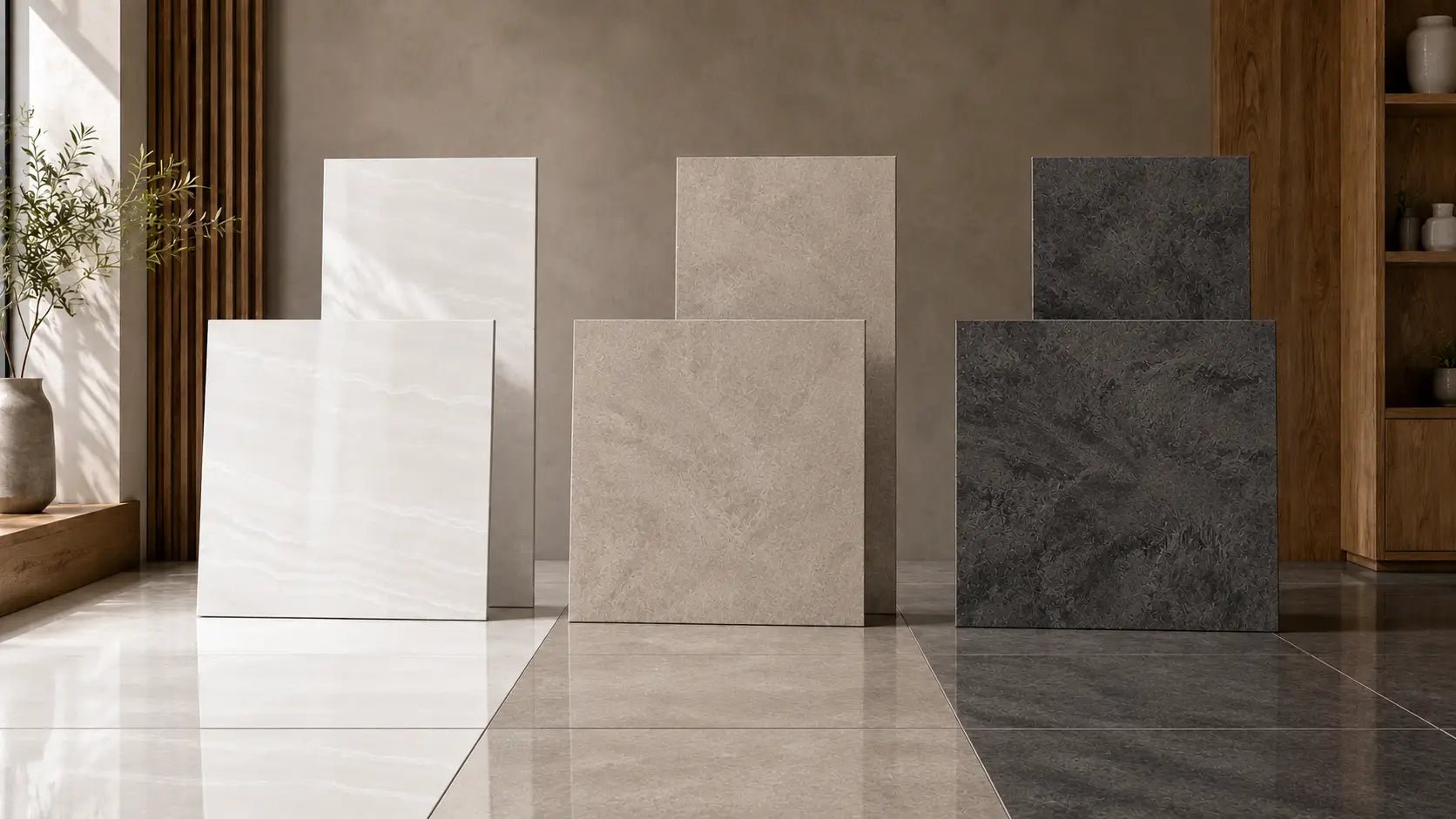
Oceanic Stone Effect Polished Porcelain is an 8.5mm rectified indoor wall-and-floor tile range with a glossy surface and soft, organic stone movement. Tiles Paradise UK currently lists five verified options: Bianco and Gris in 30x60cm and 60x60cm, plus Nero in 60x60cm. The range suits buyers who want the visual depth of stone with straightforward porcelain care, but its polished finish needs a considered approach in wet or slip-sensitive floor areas.
This guide compares every currently listed Oceanic option, explains where each colour and size works best, and separates confirmed product information from details that should be checked before purchase.
Oceanic tiles at a glance
| Decision | Quick answer |
| Available colours | Bianco, Gris and Nero |
| Verified sizes | Bianco: 30x60cm and 60x60cm; Gris: 30x60cm and 60x60cm; Nero: 60x60cm |
| Material and finish | Polished porcelain with a rectified edge |
| Thickness | 8.5mm on all five current listings |
| Placement | Listed for indoor walls and floors |
| Rooms named in current listings | Bathrooms and kitchens; 60x60cm listings also name living areas |
| Underfloor heating | Listed as compatible |
| Sealing | Current product copy describes porcelain as not requiring sealing |
| Buying allowance | Add approximately 10% for cuts and wastage; allow more for complex layouts after speaking to the fitter |
| Important wet-floor check | No Oceanic wet slip-test value is published on the current product pages; request current test data before specifying it for a shower floor, wet room or other slip-sensitive area |
What makes the Oceanic range distinctive?
Oceanic combines three elements: an organic stone-effect pattern, a reflective polished surface and clean rectified edges. Together, they create a more refined, continuous-looking installation than a heavily textured rustic tile.
The name “Oceanic” describes the collection; it does not mean the tiles are blue. The currently listed palette is bright white Bianco, soft grey Gris and deep black Nero. Because another retailer uses “Oceanic Polished” for a different oversized marble-effect product, check the colour, dimensions, seller and SKU rather than relying on the collection name alone.
Rectification means the fired tile has been mechanically finished to produce more consistent edges. This helps an installer form orderly grout lines, especially across a large-format layout. It does not mean the tiles should be butt-jointed: a functional grout joint and any required movement joints remain part of the installation design.
Which Oceanic colours and sizes are currently available?
The following matrix is based only on live product listings reviewed on 15 August 2026.
| Variant | Size | SKU | Finish | Thickness | Listed price at review |
| Oceanic Bianco | 30x60cm | DSL-2164 | Polished | 8.5mm | £37.99/m² |
| Oceanic Bianco | 60x60cm | DSL-2036 | Polished | 8.5mm | £39.99/m² |
| Oceanic Gris | 30x60cm | DSL-2512 | Polished | 8.5mm | £37.99/m² |
| Oceanic Gris | 60x60cm | DSL-2052 | Polished | 8.5mm | £39.99/m² |
| Oceanic Nero | 60x60cm | DSL-2034 | Polished | 8.5mm | £39.99/m² |
Prices can change and exclude delivery, adhesive, grout, trims, preparation and labour. Check the product page and checkout before ordering. A 30x60cm Nero listing was not found during the review, so this guide does not present that format as available.
Should you choose Bianco, Gris or Nero?
Choose Oceanic Bianco for a bright, open scheme
Bianco is the lightest option. Its white stone movement works well where the aim is to keep a bathroom, kitchen or hallway visually fresh. The polished surface reflects nearby light, so the appearance can change between cool daylight, warm lamps and directional spotlights.
Pair it with off-white or pale grey grout for a calm transition. Brushed nickel, chrome and light timber support a clean scheme, while black fittings create sharper contrast. Order a sample and view it vertically and horizontally: light meets a wall differently from a floor.

Choose Oceanic Gris for a balanced neutral base
Gris provides a softer grey background that can bridge warm and cool materials. It is a practical design choice when cabinets, sanitaryware, worktops or furniture already carry the stronger visual character.
A mid-grey grout usually gives the most blended appearance; a lighter joint makes the tile grid more visible. Gris can sit comfortably beside oak tones, off-white paint, charcoal accents or muted metal finishes. Test the sample next to the actual paint and joinery because a grey tile can look warmer or cooler under different lamps.

Choose Oceanic Nero for depth and contrast
Nero creates the darkest and most dramatic scheme. It can anchor a feature wall, cloak-room, kitchen zone or larger room with strong natural light. Pale grout will outline every tile; a deep grey or black joint produces a quieter grid.
Dark polished surfaces can make dust, dried water droplets or residue more visible under raking light, so consider the cleaning routine as well as the visual impact. Warm lighting, timber and brass-toned details can soften the contrast, while white sanitaryware creates a graphic monochrome look.

Is 30x60cm or 60x60cm the better format?
Choose by surface, room proportions, cutting plan and handling—not by room size alone.
| Consideration | 30x60cm | 60x60cm |
| Best starting point | Walls, narrower surfaces, offsets and areas with more fittings | Open floors, broad walls and a calmer square grid |
| Handling | Easier to manoeuvre around some wall details | Heavier and less forgiving on an uneven background |
| Visual rhythm | More joints and a directional rectangular pattern | Fewer joints and a broader, more continuous appearance |
| Cutting plan | Can reduce awkward cuts around some niches and fixtures | Works best where the layout avoids thin perimeter pieces |
| Current colours | Bianco and Gris | Bianco, Gris and Nero |
| Current listed price | £37.99/m² | £39.99/m² |
A larger tile does not automatically make a small room look bigger. Joint colour, cut symmetry, pattern movement and the amount of uninterrupted surface all influence the result. Before fixing, dry-plan the layout from the room’s main sightline and avoid narrow slivers at highly visible edges.
Where can Oceanic polished porcelain tiles be used?
Bathroom walls
Bathroom walls are a strong use for the range. The polished surface gives light and stone movement a prominent role, while the 30x60cm format can be easier to plan around mirrors, niches and sanitaryware. In a shower enclosure, the tile is only one part of the system: the background still needs appropriate preparation and waterproofing before tiling.
Bathroom and kitchen floors
The live listings describe Oceanic as a floor tile, including for bathrooms and kitchens. However, “suitable for floors” is not the same as having a verified wet slip-resistance classification for every use. Polished surfaces can become more slip-sensitive when wet or contaminated.
For an ordinary bathroom or kitchen floor, assess how the area will be used, how quickly spills are removed and whether vulnerable users are present. For a shower tray, wet-room floor, entrance exposed to rain or another consistently wet zone, request current wet slip-test data for the exact product and batch. If that evidence is unavailable, select a tile with documented performance for the intended wet condition.
Living rooms, hallways and open-plan areas
The 60x60cm product listings name living areas, and the square format can create a calmer grid across an open floor. The substrate must be sufficiently flat and stable, and the specification should match the expected traffic. No Oceanic PEI or equivalent traffic-class value is published on the current pages, so request supporting data before choosing it for unusually heavy residential or commercial use.
Conservatories and areas with strong sunlight
Judge the tile under the room’s real daylight because a polished finish can show stronger reflections and the perceived colour will shift throughout the day. For a conservatory floor, also confirm the substrate, movement-joint strategy, temperature changes and underfloor-heating build-up with the installer.
Outdoor areas
Do not assume indoor Oceanic polished tiles are suitable outdoors. The current listings do not publish an exterior-use claim, frost classification or wet slip value. Choose a product explicitly documented for the relevant outdoor exposure instead.
How does Oceanic polished porcelain compare with matt tile and natural stone?
| Attribute | Oceanic polished porcelain | Matt stone-effect porcelain | Natural stone |
| Appearance | Glossy, reflective stone-effect pattern | Softer reflection and usually a quieter surface | Naturally occurring variation unique to the stone |
| Routine care | Current Oceanic copy describes no-seal porcelain care | Commonly straightforward; follow the exact product instructions | Varies by stone and often includes sealing requirements |
| Wet-floor decision | Needs exact wet slip data; polish alone is not proof of safety | Texture may help, but test data is still the deciding evidence | Depends on stone, finish, treatment and test data |
| Consistency | Manufactured format and rectified edges | Manufactured format; edge type varies | Colour, veining and calibration can vary naturally |
| Installation | Porcelain cutting tools and suitable adhesive system required | Similar porcelain installation principles | Stone-specific adhesive, preparation and care may be required |
| Best reason to choose | Reflective, refined interior finish | Lower-glare or more slip-conscious schemes when appropriately tested | Authentic natural material and unique variation |
The best option depends on the room and risk, not on a universal winner. Choose Oceanic when its polished visual character and verified specifications fit the project; choose a tested matt or anti-slip product where wet grip is the priority; choose natural stone when its material authenticity justifies the additional variation and maintenance.
What do the verified specifications mean in practice?
| Confirmed attribute | Practical implication |
| Porcelain | Use cutting and fixing methods intended for porcelain |
| Polished finish | Reflects light and gives a high-end appearance; wet-floor performance must be checked separately |
| Rectified edge | Supports consistent, visually restrained joints when the surface and installation allow |
| 8.5mm thickness | Useful for build-up planning, but adhesive bed and substrate preparation also affect the finished level |
| Indoor wall and floor listing | Supports the room uses stated on the product page, subject to substrate, wet-risk and traffic assessment |
| Underfloor-heating compatibility | The complete heated-floor build-up, adhesive, grout, movement provision and commissioning sequence must also be compatible |
| Sold per square metre | Calculate the tiled area plus cuts and wastage, then order according to the current pack coverage |
Thickness is not a durability score. Likewise, a rectified edge is not a reason to omit joints, and a polished finish is not a slip rating. Each attribute answers a different project question.
How should Oceanic porcelain tiles be installed?
The following sequence is a planning guide, not a substitute for a site assessment or the instructions supplied with the fixing products.
-
Confirm the substrate. It must be stable, clean, suitably dry and flat enough for the chosen format. Repair or prepare it before tiling rather than trying to correct major variation with adhesive.
-
Inspect the tiles before fixing. Check the shade, calibre, finish and quantity. Mix pieces from several boxes to distribute the printed stone movement, and stop if the supplied goods do not match the order.
-
Plan the layout. Mark primary sightlines, doorways, sanitaryware and perimeter cuts. Check both formats against the actual room; do not rely only on a digital visualisation.
-
Prepare wet areas as a system. A tiled shower or wet area needs an appropriate water-resistant background or tanking system. Tile and grout alone do not waterproof the construction.
-
Select a compatible adhesive. The installer should choose an appropriate cement-based adhesive for porcelain, the tile format, substrate, room conditions and any underfloor heating. Ready-mixed adhesive should not be assumed suitable for these formats.
-
Achieve the required contact. Apply adhesive using the method and trowel specified for the tile and location; large formats may require adhesive on both the background and tile back to obtain the necessary coverage.
-
Use functional joints. Set the grout width according to the tile, substrate, fixing system and applicable installation standard. Never butt-joint rectified tiles. Carry through or form movement joints where the design requires them.
-
Protect the polish. Remove adhesive and grout residue using compatible methods before it hardens. Protect the completed surface from other trades.
-
Commission heating correctly. Allow the fixing system to cure and follow the heating manufacturer’s staged start-up procedure rather than applying full heat immediately.

Can Oceanic tiles be installed as a DIY project?
An experienced DIY installer may be able to tile a simple, dry, well-prepared area. Porcelain cutting, large-format coverage, wet-area waterproofing and underfloor-heating interfaces leave less room for error. Use a competent professional for a wet room, shower enclosure, heated floor, complex substrate or layout with multiple mitres and penetrations.
What tools are normally needed for porcelain?
The exact kit depends on the cuts and installation, but it commonly includes a porcelain-rated manual cutter or wet saw, diamond drill bits for penetrations, mixing equipment for cement-based adhesive, suitable notched trowels, levelling and measuring tools, grout floats, clean sponges and personal protective equipment. Cutting can generate hazardous dust, so follow the tool manufacturer’s dust-control and safety instructions.
How many tiles should you order?
Measure each rectangular surface in metres and multiply length by width. Add separate areas together, subtract only large openings that genuinely reduce tile use, then apply the cutting allowance.
Order area = measured tile area × 1.10
The Oceanic listings recommend approximately 10% extra for cuts and wastage. A diagonal layout, intricate pattern, many corners or future repair allowance may need more. Confirm the final quantity with the fitter and round up to whole packs using the live pack coverage. Keep spare tiles from the same batch because a later batch may differ slightly.
Indicative tile-only cost examples
These examples apply the current listed square-metre price to the measured area plus 10%. They are planning figures, not checkout quotes, and do not account for whole-pack rounding.
| Measured area | Area after 10% allowance | 30x60cm at £37.99/m² | 60x60cm at £39.99/m² |
| 4m² | 4.4m² | £167.16 | £175.96 |
| 6m² | 6.6m² | £250.73 | £263.93 |
| 10m² | 11m² | £417.89 | £439.89 |
| 20m² | 22m² | £835.78 | £879.78 |
Add delivery, preparation, waterproofing where required, adhesive, grout, trims, labour and waste removal to compare complete project costs. Installation cost per square metre varies too much by location, substrate, format, pattern and cutting complexity to quote responsibly without a survey.
Which grout, paint and lighting work with Oceanic tiles?
Grout colour
-
Bianco: off-white or light grey for a soft transition; mid-grey to reveal the grid.
-
Gris: a close mid-grey for blending; pale grey for more contrast.
-
Nero: dark grey or black for continuity; light grey for a graphic outline.
These are design starting points, not colour matches. Test cured grout beside a tile sample, because wet grout and printed charts can look different from the final joint. Consider stain resistance and cleaning needs as well as shade.
Paint and fittings
Warm off-whites, putty tones and timber soften all three colours. Crisp white and black fittings make the scheme more graphic. Bianco can take stronger wall colour without losing brightness; Gris is a flexible bridge between warm and cool finishes; Nero benefits from controlled contrast and enough light to preserve detail.
Lighting
View a sample in daylight, evening light and the exact lamp colour temperature planned for the room. Directional light can emphasise reflections and surface residue, while diffuse light produces a softer reading. Place the sample on the intended plane: a floor sample viewed flat on a table will not predict a wall installation.
Combining tile styles
Keep one dominant surface and use a second tile as a deliberate accent. A matt or textured tile can introduce contrast beside Oceanic polish, but align thicknesses, module sizes and joint positions before ordering. In a wet scheme, use the surface with documented wet performance on the risk-critical floor and reserve Oceanic polish for walls or appropriately assessed zones.
How do you clean and maintain polished Oceanic porcelain?
-
Remove loose grit with a soft broom or vacuum attachment so it does not abrade the surface.
-
Use warm water and a mild, pH-neutral cleaner compatible with polished porcelain.
-
Rinse with clean water and dry with a soft cloth or mop to reduce streaks and water marks.
-
Wipe spills promptly, particularly oils, cosmetics and coloured residues.
-
Avoid abrasive pads, harsh powders and unverified acidic or alkaline products.
-
Follow the grout manufacturer’s care instructions separately.
Current Oceanic product copy says porcelain and glazed ceramic do not require sealing. That statement applies to the tile surface; grout, cut edges, specialist treatments or site conditions may have separate requirements. Do not apply a sealer merely because a natural stone would need one—confirm that any treatment is compatible with polished porcelain first.
What should you confirm before ordering?
Confirmed on current Oceanic listings
-
Five live variants: Bianco 30x60cm and 60x60cm, Gris 30x60cm and 60x60cm, and Nero 60x60cm.
-
Porcelain material, polished finish and rectified edge.
-
8.5mm thickness.
-
Indoor wall-and-floor positioning.
-
Underfloor-heating compatibility.
-
Approximate 10% cutting and wastage allowance.
Ask for current documentation when it affects the project
-
Wet slip-resistance result for the exact product and intended condition.
-
Traffic or abrasion classification for high-traffic or commercial use.
-
Current declaration, applicable product standard and technical data sheet.
-
Pack quantity, pack coverage, batch details and exact delivered weight.
-
Exterior and frost suitability.
-
Product warranty terms and exclusions.
-
Environmental declarations, recycled content and packaging claims.
-
Availability of special sizes, anti-slip treatments or bespoke manufacturing.
-
Written compatibility with a project-specific adhesive, substrate or heating build-up.
If a detail is not in the listing or a current technical document, treat it as unconfirmed rather than inferring it from another porcelain tile.
Final buying checklist
-
Choose the colour under the room’s actual daylight and evening lighting.
-
Compare 30x60cm and 60x60cm using a real cut plan.
-
Confirm the current price, stock, pack coverage and batch.
-
Add approximately 10% for cuts and wastage, then round to whole packs.
-
Request wet slip data for any wet or slip-sensitive floor.
-
Confirm traffic performance for demanding residential or commercial areas.
-
Match the adhesive, substrate, waterproofing and heating build-up.
-
Review kerbside-delivery access, damage-reporting window and return terms.
-
Keep spare same-batch tiles for future repairs.
Oceanic is most persuasive when the choice is made on evidence: the right colour and format for the room, a suitable installation system, and a documented answer to any safety-critical question. That approach preserves the polished stone-effect look without asking the product to prove a specification that has not been published.
Explore the Oceanic range and plan your order
Shop the verified Oceanic variants
Compare, sample and specify
Frequently asked questions
What are the main advantages of Oceanic polished porcelain tiles?
They combine a reflective stone-effect appearance, rectified edges, indoor wall-and-floor positioning, two useful formats and straightforward porcelain care. The range also gives three distinct colour directions without requiring natural-stone maintenance assumptions.
Is polished porcelain slippery when wet?
It can be more slip-sensitive when wet or contaminated, but the product’s actual wet performance must be determined from appropriate test data and intended use. No Oceanic wet slip value is published on the current listings, so request it before using the tile in a wet or risk-sensitive floor area.
Are Oceanic polished tiles suitable for a wet-room floor?
Do not specify them for a wet-room or shower floor solely because the listing says “floor tile”. Ask for a current wet slip-test result for the exact tile. If suitable evidence is unavailable, choose a product expressly documented for wet-floor use. Oceanic can still be considered for wet-room walls when the background and waterproofing system are appropriate.
Can Oceanic porcelain be used with underfloor heating?
Yes, all five reviewed listings state underfloor-heating compatibility. The substrate, heating system, adhesive, grout, movement joints, curing time and commissioning procedure must also be designed as one compatible build-up.
Do Oceanic polished porcelain tiles need sealing?
The current product copy describes porcelain as a no-seal surface. Use compatible cleaners and check the separate instructions for grout or any specialist site treatment. Do not apply a natural-stone sealer without confirming compatibility.
What grout colour looks best with light grey stone-effect tiles?
A close mid-grey normally reduces contrast and makes the Gris surface read more continuously. A light grey outlines each tile more clearly. Test a cured grout sample beside the tile under the room’s actual lighting before deciding.
Is 60x60cm too large for a small bathroom?
Not automatically. A 60x60cm format can reduce the number of joints, but the result depends on the cut plan, floor shape and obstructions. Compare a dry layout with 30x60cm and avoid narrow cuts at the doorway, bath or main sightline.
What adhesive should be used for Oceanic porcelain tiles?
Use an appropriate cement-based adhesive selected for porcelain, the tile size, substrate, room conditions and any underfloor heating. The installer should follow the adhesive manufacturer’s current instructions and the applicable installation standard; ready-mixed adhesive should not be assumed suitable for these formats.
Can Oceanic polished porcelain be used outdoors?
Outdoor use is not confirmed by the current listings. Without documented exterior, frost and wet slip suitability, choose a tile specifically rated for the exposure instead.
Can I order a custom Oceanic size or anti-slip treatment?
The current pages do not advertise custom sizing, bespoke manufacture or an Oceanic anti-slip treatment. Ask Tiles Paradise UK for written confirmation of any special-order service before building it into the design.
What certification or warranty comes with Oceanic tiles?
The reviewed listings do not publish a product-specific certification file, PEI value, wet slip value or warranty period. Request the current technical and warranty documents needed for the project rather than applying another product’s credentials to Oceanic.
Can I see Oceanic tiles in a local showroom?
Tiles Paradise UK currently describes itself as an online-only retailer without a showroom. Use the sample service to assess colour and finish at home; a cut sample may not display the full pattern, so consider asking whether a full tile can be supplied when pattern scale is critical.
Can I request a sample before buying?
Yes. The current sample service offers cut samples so buyers can inspect colour and finish before a full order. Review the live sample terms because price, sample dimensions, limits and credit conditions can change.
How long does UK delivery take?
The current shipping policy gives a standard pallet-delivery estimate of 2–7 working days for tiles and SPC flooring, subject to stock, postcode and exclusions. Delivery is kerbside, and the checkout provides the current location-specific charge and available service.
Can unused leftover tiles be returned?
Do not plan on returning surplus individual tiles. The current returns policy says leftover tiles are not returnable and describes separate conditions, time limits, fees and transport responsibilities for eligible whole-order change-of-mind returns. Order carefully while retaining a sensible same-batch repair allowance.
Are trade pricing, bulk orders or finance available?
The site advertises trade accounts, bulk pricing and checkout finance options, but an Oceanic-specific discount or package deal is not guaranteed. Request a project quote using the exact SKUs, quantities and delivery postcode, then compare the complete delivered cost.