





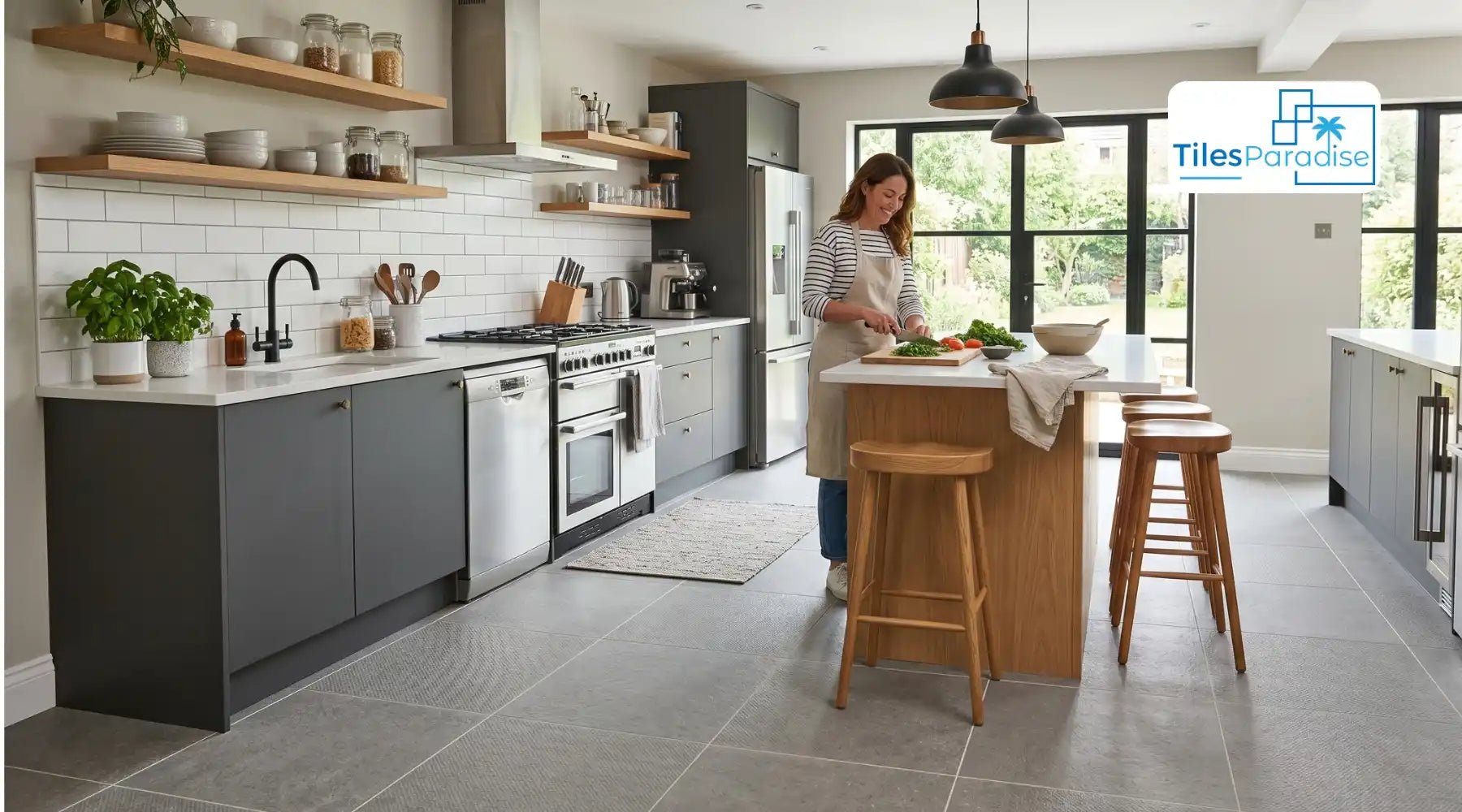
Choosing the best non-slip porcelain kitchen floor tiles means balancing safety, durability, and design in one of the busiest rooms in any home. From daily cooking spills to wet shoes tracked in from outside, kitchen floors face constant pressure, and the wrong tile surface can become a slip hazard in seconds.
Anti-slip tiles for kitchens have evolved well beyond plain, industrial-looking surfaces. Modern non-slip kitchen tiles now combine R10 and R11 ratings with striking designs, from marble effects and geometric patterns to bold encaustic motifs, giving UK homes and commercial kitchens a safe and genuinely stylish flooring solution.
What Makes a Kitchen Floor Tile Truly Non Slip?
A non-slippery tile for kitchens earns its classification through a standardised ramp test, known as the DIN 51130 method in Europe. During the test, a person walks on an oil-coated, angled surface, and the precise angle at which slippage occurs determines the R rating. The higher the R number, the greater the friction and resistance underfoot.
Anti-skid kitchen floor tiles achieve slip resistance through surface texture, matt glazes, micro-structured finishes, or an unglazed porcelain body. Anti-slip floor tiles for kitchen use are not visually rougher than standard options but are engineered at a microscopic level to increase friction, particularly when wet surfaces and cooking grease are present.
Kitchen flooring ideas that prioritise non-slip performance focus on three core attributes: R rating, material density, and surface finish. Slip-proof tiles for a kitchen meet at least one of those criteria; the best options address all three simultaneously.
R10 vs R11: Which Anti-Slip Rating Fits a Kitchen Floor?
|
Rating |
Angle of Resistance |
Recommended Use |
|
R9 |
3 to 10 degrees |
Dry indoor areas only (living rooms, bedrooms) |
|
R10 |
10 to 19 degrees |
Domestic kitchens, cloakrooms, utility rooms |
|
R11 |
19 to 27 degrees |
Commercial kitchens, wet rooms, food prep zones |
|
R12+ |
27+ degrees |
Industrial kitchens, outdoor walkways, pool surrounds |
For most UK family homes, an R10 anti-slip kitchen floor tile provides sufficient traction for everyday kitchen use. Spills, splashes from cooking, and wet mopping are frequent occurrences, and R10 kitchen non-slip tiles handle that level of moisture safely without feeling excessively rough underfoot or making cleaning difficult.
Non-slip restaurant floor tiles and non-slip floor tiles for commercial kitchens, however, demand an R11 rating at minimum. Grease, constant water exposure, and heavy foot traffic in a professional kitchen environment push beyond the threshold R10 can handle reliably. For non-slip commercial kitchen tile installations, consult UK HSE guidelines before specifying.
Why Porcelain Outperforms Ceramic for Non-Slip Kitchen Floors
Porcelain is the material of choice for non-slip kitchen floor tiles because of its density and near-zero porosity. Porcelain has a water absorption rate below 0.5%, compared to ceramic's 3 to 10%, which means less moisture penetrates the tile body and grip stays consistent even after years of heavy kitchen use.
Kitchen non-slip tiles made from porcelain also resist chips, scratches, and staining far better under the daily punishment of a working kitchen. The hard, vitrified surface retains its anti-slip texture longer than softer ceramic equivalents, making porcelain the better long-term investment for any kitchen flooring project.
For budget-conscious projects, ceramic kitchen tiles remain a practical option in kitchens with moderate use and lower moisture exposure. For high-traffic or moisture-intensive kitchens, browse the full range of porcelain kitchen tiles to find an R-rated option that suits the space.
Matt Finish or Textured Surface: What Grips Better on a Kitchen Floor?
Matt-finish tiles are the standard recommendation for anti-slip kitchen floor tiles in UK homes. The diffused surface creates natural micro-friction, particularly effective for non-slip floor tiles in kitchen zones where water and cooking oils are a constant presence. Matt tiles also mask watermarks and light soiling better than polished finishes between cleans.
Textured tiles take grip further and are the preferred anti-skid tiles for kitchen areas near sinks, hobs, and exterior doorways. A light surface texture adds meaningful traction without creating deep grooves that trap grease and debris. Gloss or polished tiles, regardless of R rating, should generally be avoided on kitchen floors because a wet polished surface presents a consistent and unpredictable slip risk.
Non-slip floor tiles for living rooms that flow into open-plan kitchens benefit from a consistent matt or lightly textured finish across both areas, maintaining safety without creating a visual break between spaces.
What Tile Sizes Work Best for Non-Slip Kitchen Floor Tiles?
Tile size directly affects grip distribution across a kitchen floor. Larger formats reduce the number of grout lines, which naturally diminishes the additional traction that grout joints provide. Smaller tiles with more frequent joints create a more segmented grip surface, which is why many commercial and restaurant kitchen floors historically used smaller formats.
For domestic kitchens, a balanced size approach delivers both safety and style:
• 60x60cm square tiles: A clean, modern look with adequate grout line frequency for residential anti-slip performance. Browse 60x60cm square kitchen tiles for a balanced option.
• 60x120cm rectangular large format tiles: Suit open-plan kitchens and create a flowing layout with fewer joints. Best paired with a higher R-rated surface finish. Browse 60x120cm large tiles.
• Metro tiles: Work as non-slip wall tiles and feature zone splashbacks near sinks and hobs rather than on the kitchen floor itself. Browse metro tiles for wall applications.
Can Patterned Kitchen Tiles Be Non Slip and Safe?
A common misconception is that patterned kitchen tiles sacrifice safety for style. In reality, many encaustic, geometric, and Victorian-style designs are now produced in porcelain with a matt or lightly textured glaze, meeting R10 anti-slip standards without compromising the sharpness or depth of the decorative pattern.
The key is specifying the correct finish. A patterned tile with a gloss overglaze introduces slip risk; a patterned tile with a matt or satin glaze retains all the visual impact while delivering the anti-skid kitchen floor performance a busy family kitchen demands.
Browse the full patterned kitchen tiles range alongside the complete kitchen floor tiles collection for slip-resistant designs across a wide variety of patterns and finishes.
Beige Porcelain Kitchen Floor and Wall Tiles with Matt Finish
Beige porcelain kitchen floor tiles with a matt finish are among the most versatile non-slip kitchen flooring choices for UK homes. The warm neutral tone conceals everyday dust and light soiling between cleans, while the matt glaze delivers an R10-compatible surface suitable for both floor and wall application in the same kitchen space.
Beige also works across a wide range of kitchen styles, from traditional Shaker designs to contemporary open-plan layouts, making it a consistently popular choice when selecting anti-slip kitchen floor tiles that also coordinate with kitchen wall tiles and splashbacks. Read more about beige porcelain kitchen tiles with matt and gloss finish for floor, wall, and splashback to find the right option for a kitchen renovation project.
Patterned Porcelain Kitchen Floor and Wall Tiles: Geometric, Encaustic, and Victorian Designs
Geometric and encaustic patterns, alongside traditional Victorian tile motifs, are now widely available in non-slip porcelain formats for UK kitchens. The porcelain body provides superior durability and water resistance compared to original encaustic cement tiles, and the matt glaze ensures kitchen anti-skid performance is built into the tile rather than requiring an additional treatment.
Victorian-style floor patterns work particularly well in period kitchen renovations where both character and safety are priorities. Geometric formats suit contemporary kitchen layouts, and encaustic designs bridge the gap between traditional craft and modern tile engineering. Explore detailed guidance on patterned kitchen tiles including geometric, encaustic, and Victorian designs to identify the right decorative floor tile for a specific kitchen project.
Non-Slip Kitchen Tiles for Commercial and Restaurant Kitchens
Non-slip floor tiles for commercial kitchens carry stricter specification requirements than domestic environments. UK HSE guidelines recommend a minimum R11 rating for food preparation areas with wet processes, and R12 for zones exposed to oils and fats on a regular basis. Non-slip commercial kitchen tile surfaces must also resist aggressive chemical cleaning agents and withstand the weight of heavy catering equipment.
Non-slip restaurant floor tiles typically use unglazed porcelain or heavily textured porcelain with a pronounced surface profile. This is distinct from the matt-glazed porcelain recommended for residential anti-slip kitchen floor tiles, where aesthetics and ease of cleaning carry equal weight alongside grip performance. Specifying the correct R rating for a commercial kitchen is a legal health and safety requirement, not simply a design preference.
How Easy Are Non-Slip Kitchen Floor Tiles to Clean and Maintain?
Non-slippery kitchen floor tiles sometimes carry a reputation for being difficult to clean, because surface texture can harbour grease. Modern anti-slip floor tiles for kitchen use, however, are engineered with open, shallow textures rather than deep grooves, meaning standard floor cleaning products shift grease and food residue without the need for aggressive scrubbing.
Porcelain non-slip kitchen tiles are almost maintenance-free because the low porosity means spills sit on the surface rather than absorbing into the tile body. The key maintenance rule is straightforward: avoid wax-based polishes and oil-based cleaning products, as both reduce the surface friction and gradually convert slip-resistant tiles into a slip risk over time.
For the best cleaning results on anti-skid kitchen floor tiles, use a pH-neutral tile cleaner, clean spills promptly, and ensure grout lines are sealed at installation to prevent staining and bacteria build-up between tiles.
Which Colours Work Best for Non-Slip Kitchen Floor Tiles?
Non-slip kitchen floor tiles are available across a full colour spectrum, and colour choice does not compromise anti-slip performance when the correct finish and R rating are specified. Lighter tones such as white, cream, and beige reflect light and make compact kitchens feel more spacious, while grey and black options suit contemporary or industrial kitchen schemes.
Browse popular colour collections for non-slip kitchen flooring:
• White kitchen tiles for bright, light-reflective kitchen floors
• Grey kitchen tiles for contemporary and industrial kitchen designs
• Black kitchen tiles for bold, high-contrast kitchen flooring
• Beige kitchen tiles for warm, neutral kitchen floors that hide everyday dust
• Cream kitchen tiles for classic and traditional kitchen aesthetics
• Green kitchen tiles for nature-inspired, biophilic kitchen schemes
• Blue kitchen tiles for coastal and Scandi-inspired kitchen designs
• Gold kitchen tiles for a luxurious metallic accent on kitchen floors and walls
For coordinated floor and wall design, explore the full range of kitchen wall tiles and the complete kitchen tiles collection to find matching or complementary options across both surfaces.
Final Insights
Non-slip kitchen floor tiles sit at the intersection of safety engineering and interior design. For UK homes, an R10 porcelain tile with a matt finish covers the vast majority of domestic kitchen safety requirements, and R11-rated surfaces address the more demanding needs of commercial kitchen and restaurant flooring. Tile size, colour, and pattern are no longer a compromise when selecting anti-slip kitchen flooring.
For a bold patterned encaustic floor, a classic beige porcelain surface, or a large-format grey tile in an open-plan kitchen, slip-proof tile options now exist across every style category. Exploring marble effect kitchen tiles and onyx kitchen tiles reveals just how far non-slip kitchen tile design has advanced in the UK market.