





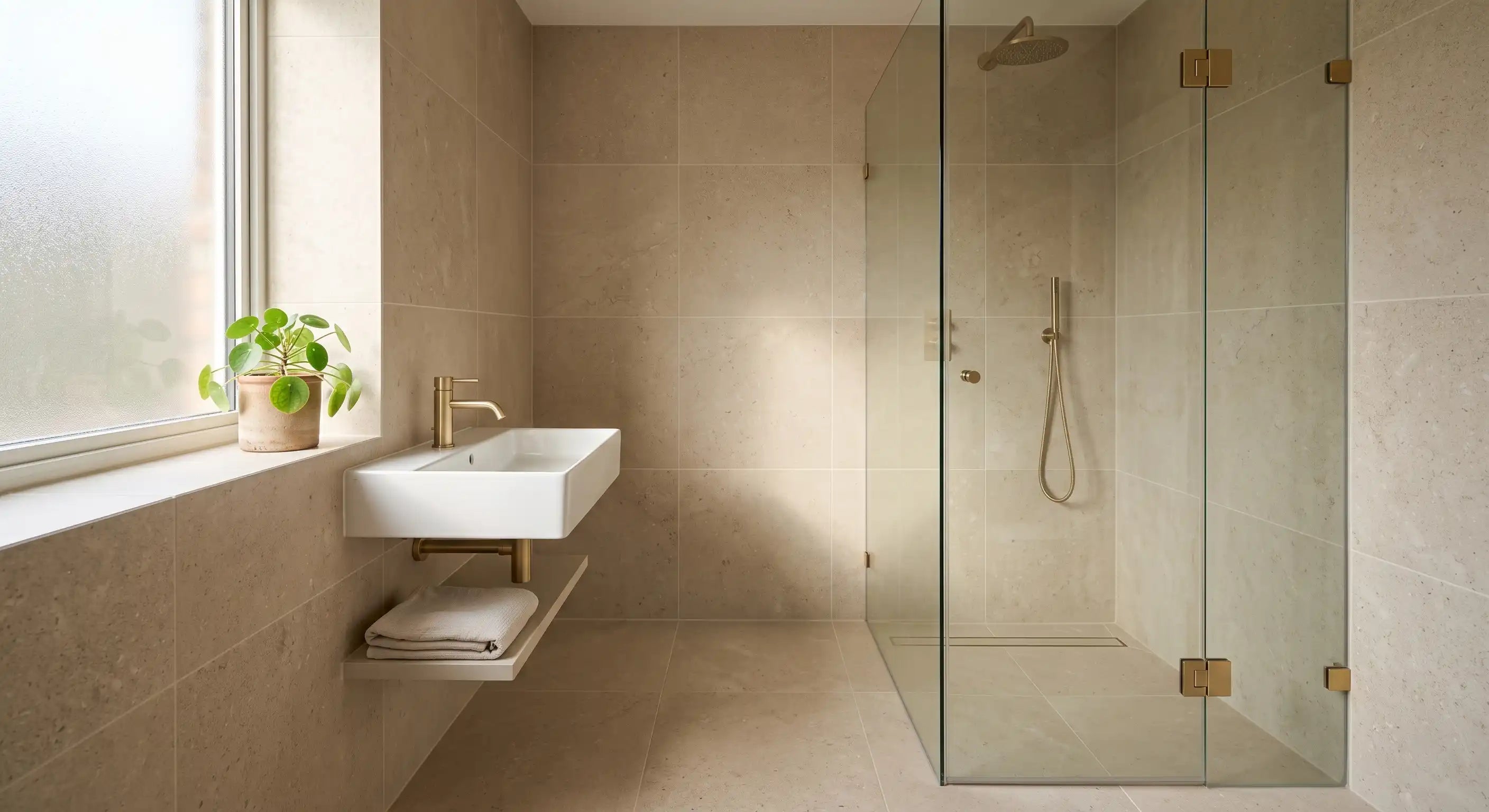
Portland stone effect matt porcelain is a porcelain tile that reproduces Portland stone, the Jurassic oolitic limestone quarried on the Isle of Portland in Dorset.
It gives you the pale, fine-grained, fossil marked character of Britain's most recognisable building stone. What it does not give you is the porosity, the sealing schedule or the long lead time that comes with the real thing.
Two things are worth settling straight away.
This tile imitates Portland stone, which is a natural limestone. It is not a "Portland" concrete effect tile. Those imitate Portland cement, an unrelated material that happens to share the name. The two look nothing alike.
"Matt" is a surface finish, not a lower grade. Matt porcelain is fired to the same density as polished porcelain. It simply skips the final polishing pass. That is exactly why it grips better underfoot, and it is how the Portland range earns its R10 anti-slip rating.
The Tiles Paradise Portland range covers six shades in two different tile constructions. This guide walks through the geology behind the look, the verified specification of each tile, what each one costs, and which one belongs in your room.
What Is Portland Stone, and Where Does It Come From?
Portland stone is a fine-grained oolitic limestone formed in the Late Jurassic period and quarried on the Isle of Portland, a tidal island on the Dorset coast.
The stone is built from ooids. These are microscopic spheres of calcium carbonate that formed in a warm, shallow sea roughly 145 million years ago and later cemented together.
The result is dense enough to carry structural load, soft enough to carve cleanly, and pale enough to throw light back off a building façade. That combination is why it became Britain's default monumental building stone.
Its colour sits between off-white and pale creamy grey, and it weathers lighter with age. Scattered through it are fossil traces: bivalve shell casts, and in the upper beds the spiral moulds of Aptyxiella portlandica, better known as the Portland Screw.
Reproducing those fossil markings is what separates a genuine Portland effect from a generic pale stone effect.
Roach, Whitbed and Basebed: The Three Portland Beds
Portland stone comes out of three distinct geological beds, and each one produces a visually different stone. That is why Portland tile ranges ship in several shades rather than one.
| Bed | Position | Character | Traditional use |
|---|---|---|---|
| Roach | Uppermost | Heavily fossiliferous, open voids, rugged surface with shell and Portland Screw casts | Sea defences, harbour works, architectural cladding |
| Whitbed | Middle | Even texture, moderate shell content, consistent tone | The classic building bed, used on most major landmarks |
| Basebed | Lowest | Finest grain, almost no shell, smooth and uniform | Carving, sculpture, ashlar detail |
Read a tile range through this lens and the shade names stop being marketing words.
A calm, near uniform pale shade is a Basebed interpretation. A warmer mid-tone with visible marking is Whitbed. A rugged, texture-heavy face is reaching for Roach.
Which British Landmarks Are Built From Portland Stone?
Portland stone clads a large share of Britain's civic and ceremonial architecture, and that association is exactly what the porcelain version borrows.
St Paul's Cathedral was rebuilt in it by Christopher Wren after the Great Fire of London. The east façade of Buckingham Palace, the Cenotaph on Whitehall, the British Museum, the Bank of England and the Palace of Westminster all use it. The United Nations Headquarters in New York is faced in it. Commonwealth War Graves Commission headstones are cut from it.
That is why a Portland floor reads as formal and quietly serious to a British eye, even to someone who could not name the stone if you asked them. A generic beige stone effect does not carry that weight.

Portland Stone or Portland Cement? Clearing Up the Confusion
Portland stone and Portland cement are unrelated materials that share a name by coincidence, and tile ranges called "Portland" split into two completely different looks as a result.
Portland stone is natural Jurassic limestone from Dorset. Its tile effect is pale, warm, granular and fossil marked.
Portland cement is a manufactured binder, patented in the nineteenth century. It was named because its set colour was thought to resemble Portland stone. Its tile effect is flat, cool grey, uniform and industrial. The trade calls this a concrete effect.
Here is how to tell them apart when you are shopping.
A "Portland" range in white, pearl, grey and ivory with a featureless flat face is almost certainly a cement effect. A "Portland" range in sand, taupe, cream and silver with visible granularity and geological marking is a stone effect. Look closely at the product photography for surface texture before you order samples.
The distinction also decides which interior each one belongs in. Concrete effect suits industrial and Scandi industrial schemes. Portland stone effect suits classical, transitional and quiet luxury schemes, where the floor should feel geological rather than poured.
If the flat industrial look is what you actually want, you are looking for a concrete effect ceramic tile, not this range.
Which Portland Shades and Sizes Are Available?
The Tiles Paradise Portland range covers six shades across two tile constructions, in 30x60cm and 60x60cm formats.
| Shade | Construction | Sizes | Character | Works with |
|---|---|---|---|---|
| White | Glazed porcelain, R10 | 30x60cm | Pale neutral, maximum light reflection | Small bathrooms, cloakrooms, north-facing rooms |
| Silver | Glazed porcelain, R10 | 30x60cm | Cool light grey | Matt black and chrome fittings, contemporary schemes |
| Sand | Glazed porcelain, R10 | 30x60cm, 60x60cm | Warm sandy beige, closest to natural Whitbed tone | Oak, brass, warm neutral schemes |
| Taupe | Glazed porcelain, R10 | 30x60cm, 60x60cm | Deeper warm grey brown | Transitional schemes, mid-tone cabinetry |
| Cream | Full body porcelain | 60x60cm | Warm pale cream | Light schemes that want full body durability |
| Black | Full body porcelain | 60x60cm | Deep black with natural rock fissure detail | Dramatic feature floors, cloakrooms, boutique interiors |
One honest note on Black. Deep charcoal is not a natural Portland stone tone. No Dorset bed produces it.
It is a designer extension of the palette, built to coordinate with the rest of the collection rather than to replicate the quarried material. Specify it because you want drama, not because you want authenticity.
The collection also includes a Black Flagstone Effect tile in the same 60x60cm full body construction. It is designed as a feature area partner to the plain Black field tile.
Glazed or Full Body: Which Portland Tile Should You Buy?
Glazed porcelain carries the stone effect on the surface only. Full body porcelain carries it through the entire thickness of the tile.
This is the most consequential decision in the range, and almost nobody explains it. So here it is plainly.
Glazed porcelain covers White, Silver, Sand and Taupe. The tile is digitally printed, then glazed and fired, so the stone effect sits on the face. This is the standard construction for the vast majority of tiles sold in the UK. It looks excellent, and at 8.5mm it is lighter to handle and easier to cut.
Full body porcelain covers Cream and Black. The tile is coloured throughout its 9mm thickness. If it chips, whether at a doorway, on a step nosing or under a dropped pan, the exposed edge shows the same tone as the face instead of a white ceramic core. The damage effectively hides itself.
| Glazed Portland | Full Body Portland | |
|---|---|---|
| Shades | White, Silver, Sand, Taupe | Cream, Black |
| Sizes | 30x60cm, 60x60cm | 60x60cm |
| Thickness | 8.5mm (verified on Sand 60x60) | 9mm (verified on Black) |
| Effect depth | Surface printed | Through the full body |
| Chip visibility | Shows a lighter core | Shows the same tone |
| Slip rating | R10 | R10 |
| Rectified | Yes | Yes |
| Underfloor heating | Yes | Yes |
Choose full body for hallways, entrances, doorway thresholds, step nosings, commercial floors, and anywhere a hard knock is likely.
Choose glazed for bathroom walls, shower surrounds and ensuite floors, or when you want the 30x60cm format or a shade that only exists in that family.
How Much Do Portland Stone Effect Tiles Cost?
Portland Black full body 60x60cm is £24.99 per square metre, and Portland Sand glazed 60x60cm is £39.99 per square metre. Both are sold by the square metre with prices including VAT.
| Product | Price per m² | Verified |
|---|---|---|
| Portland Black Stone Effect Matt Full Body 60x60cm | £24.99 (RRP £69.99) | Yes |
| Portland Sand Stone Effect Matt 60x60cm R10 | £39.99 | Yes |
| Portland White 30x60cm R10 | £37.99 | Yes |
| Portland Silver, Sand, Taupe 30x60cm | See product page | n/a |
| Portland Taupe 60x60cm | See product page | n/a |
| Portland Cream Full Body 60x60cm | See product page | n/a |
Quarried Portland limestone is a very different proposition. It arrives in bespoke or random length pieces at 20mm to 40mm thickness. It requires sealing at installation and periodic resealing afterwards. UK suppliers of the natural stone quote lead times running to several weeks.
Porcelain is a single purchase with no maintenance schedule attached, and the Portland range is held in stock.
Add 10% to your measured area for cuts and wastage. Order it all in one go, so every box comes from the same production batch.
What Are the Technical Specifications?
Portland Black full body 60x60cm has a water absorption rate below 0.5%, an R10 slip rating, rectified edges and full underfloor heating compatibility.
| Attribute | Portland Black (full body 60x60) | Portland Sand (glazed 60x60) |
|---|---|---|
| Material | Full body porcelain | Porcelain |
| Effect | Stone effect, limestone effect | Stone effect |
| Size | 60 x 60cm | 60 x 60cm |
| Thickness | 9mm | 8.5mm |
| Finish | Matt | Matt |
| Rectified | Yes | Yes |
| Water absorption | Less than 0.5% | Not published |
| Slip rating | R10 | R10 |
| Wall and floor | Yes | Yes |
| Underfloor heating | Compatible | Yes |
| Coverage per tile | 0.36m² | Not published |
| Box quantity | 2 tiles | Not published |
| Sold by | Per m² | Per m² |
Every figure above comes from the product specification. Where a cell says "not published", that value is not currently listed. Ask our team before specifying it for a project that depends on it.
Water Absorption and Why It Removes Sealing
A water absorption rate below 0.5% classifies porcelain as impervious, which is why these tiles never need sealing.
This single number is the reason porcelain outperforms the stone it imitates.
Natural Portland limestone is porous. Water enters the surface, and in a British winter that trapped water freezes, expands and spalls the face off the stone. It also absorbs red wine, oil and citrus, and it etches permanently under acidic cleaners. That is why quarried limestone floors come with a sealing schedule attached.
Vitrified porcelain gives water almost nowhere to go. The tile itself never needs a sealer. Grout joints in showers and wet rooms may still benefit from a penetrating grout sealer.
What Does an R10 Slip Rating Mean?
R10 is a shod ramp slip rating under DIN 51130 that indicates good grip underfoot, suitable for domestic bathroom floors, kitchens, hallways and other interior areas where the floor gets wet.
The scale works like this:
- R9. Low grip, dry areas only.
- R10. Interior floors, including domestic bathrooms.
- R11. Wet rooms and external paving.
- R12 and R13. Commercial and industrial.
The entire Portland range is rated R10. That makes it correct for bathroom floors, ensuite floors, kitchens, hallways and utility rooms.
For a wet room floor or a shower tray, which is a continuously drenched surface with falls to a gully, step up to an R11-rated tile instead. R10 is the right answer for a standard domestic bathroom. It is not the right answer for a fully tanked wet room floor.
One more point. Matt finishes outperform polished finishes here without exception. Polishing closes the micro texture that generates grip, which is why a polished stone effect tile that looks identical when dry becomes noticeably slipperier when wet.
Rectified Edges and the 2mm Grout Joint
Every tile in the Portland range is rectified. That means it is mechanically cut after firing to an exact dimension, so it can be laid with a narrow 2mm grout joint.
This matters more than almost any other detail on a stone effect floor.
A non-rectified pressed tile needs a 3mm to 5mm joint to absorb dimensional variation. A rectified tile does not. Narrow 2mm joints in a grout tone matched to the tile are what make a floor read as continuous stone rather than as a tiled grid.
If you specify a rectified tile and then lay it with a wide contrasting joint, you have paid for rectification and thrown away the entire benefit.

How Do You Choose the Right Portland Shade?
Choose the shade by the light in the room and the metal on the fittings, then confirm it with a physical sample.
North facing or low-light rooms. Go with White or Cream. Cool northern light drains warmth from a floor, and the palest shades hold their tone best.
Warm schemes with oak, walnut or brass. Go with Sand or Taupe. Both carry a warm undertone that sits with timber and warm metals without fighting them.
Cool contemporary schemes with matt black or chrome. Go with Silver. Its cool grey base reads cleanly against black fittings.
Drama, feature floors and cloakrooms. Go with Black. It works best against warm metals. Brushed brass and antique bronze lift the deep tone and stop the space feeling heavy.
Two cautions before you order.
Shade names are not standardised across manufacturers. A "Sand" from one brand can be visibly warmer than a "Sand" from another, so never specify from a name alone.
And stone effect ranges are printed from a finite set of face designs, so tiles vary between boxes by design. That variation is the point of the product. It also means you should dry lay and shuffle tiles from several boxes before you fix anything.
Where Can You Install Portland Stone Effect Tiles?
The Portland range is rated for interior walls and floors throughout the home, with R10 grip and full underfloor heating compatibility.
Bathrooms and ensuites. R10 grip suits a domestic bathroom floor, and the pale limestone tone builds a calm, spa-like envelope. Running the same tile from floor to full height wall removes visual breaks and makes a compact bathroom read as larger. For a fully tanked wet room floor, specify R11 instead.
Kitchens. The tile is impervious and unaffected by oil, wine, citrus or acidic spills, with no sealing schedule in the room most likely to get spilled on. The full body shades are the safer choice here if you drop things.
Hallways and entrances. This is the highest traffic, wettest underfoot part of a British house, and the strongest case for full body construction. Doorway thresholds are exactly where chips happen.
Living and open plan spaces. Porcelain conducts and retains heat efficiently, so the whole range works over underfloor heating. Bring the system up to temperature gradually after installation, following your adhesive manufacturer's commissioning schedule.
Walls and feature areas. Every tile in the range is rated for wall as well as floor use, so you can carry one shade across both surfaces.
The Portland range is specified for indoor use. For patios, terraces and garden paths you need a 20mm frost-proof paver with an R11 rating, which is a different product class.

Portland Stone Effect Porcelain vs Real Portland Limestone
Porcelain wins on performance, cost and availability. Quarried Portland limestone wins on authenticity and on the way it ages.
| Criterion | Portland effect porcelain | Quarried Portland limestone |
|---|---|---|
| Water absorption | Below 0.5% | Porous |
| Sealing | Never | At installation, then periodically |
| Acid resistance | Unaffected | Etches permanently |
| Stain resistance | Very high | Low until sealed |
| Colour consistency | Controlled variation | Genuinely random |
| Size accuracy | Rectified to the millimetre | Random lengths, hand-finished |
| Thickness | 8.5mm to 9mm | Commonly 20mm to 40mm |
| Availability | Held in stock | Bespoke cutting, weeks of lead time |
| Ageing | Stable indefinitely | Develops patina, softens with wear |
| Pattern repeat | Finite set of printed faces | None |
The honest limitation of porcelain is pattern repetition. Every digitally printed range works from a finite set of face designs, so across a very large floor the same face eventually recurs. Shuffling boxes during installation is what keeps that invisible.
The honest limitation of natural stone is that it is a living surface. It marks, etches and patinates. For a period property restoration that is the entire appeal. For a family bathroom it is a maintenance liability.

How Many Tiles Do You Need?
Multiply the room's length by its width to get the square meterage, then add 10% for cuts and wastage.
A 60x60cm Portland tile covers 0.36m². So a 3m by 4m floor is 12m². Adding 10% gives 13.2m², which works out at roughly 37 tiles.
Because the range is sold by the square metre, you order the area rather than the tile count, but knowing the count helps you sanity-check a delivery.
Allow 15% rather than 10% for diagonal, herringbone or modular layouts, and for rooms with a lot of cut-ins around sanitaryware. Order the full quantity in one transaction so every box comes from the same batch.
The Tiles Paradise tile calculator will do the arithmetic for you, including deductions for doors and windows. If you would rather see the shade in your own light before committing, order a cut sample through the tile sample service.
How Do You Lay and Grout Portland Tiles?
Rectified porcelain needs a flat, fully supported substrate, a flexible cement-based adhesive, and a 2mm joint in a grout tone matched to the tile.
Start with flatness. Over a 2m straightedge, aim for no more than 3mm deviation. Level the substrate before tiling rather than trying to correct it with adhesive depth. On timber floors, overboard with tile backer board. On heated screeds, complete the commissioning and cooling cycle before you fix anything.
Then adhesive. Use a flexible cement-based adhesive and aim for full coverage. Back butter the tile and comb the substrate in one direction so air can escape as the tile beds down. Voids under the tile, not the tile itself, cause most cracking. Pick the right adhesive class for your build-up from the tile adhesive and grout range.
Dry lay before you fix. Pull tiles from several boxes at once so shade variation is distributed evenly across the floor, rather than leaving one box worth of tone sitting in a single corner.
Then grout colour. Match it to the tile's base tone so the joints recede. A warm off-white suits Sand and Cream. A pale grey suits Silver and White. A mid grey brown suits Taupe. Charcoal suits Black.
Contrasting grout turns a seamless stone floor into a visible grid and defeats the rectified edge you paid for. Choose from the grout colour range and use 2mm spacers.
If you are working over an existing tiled floor with tired joints, our guide to regrouting existing tiled surfaces covers removal and colour matching.
How Do You Clean and Maintain Matt Porcelain?
Matt porcelain needs sweeping and a pH-neutral cleaner, and nothing else.
Sweep or vacuum first to lift grit. Abrasive debris dragged under a mop is the only thing that will dull a matt surface over time.
Then mop with a pH neutral tile cleaner diluted in warm water. Work in sections and avoid oversaturating the floor, so water does not sit in the joints.
Avoid acids, bleach and ammonia. They will not damage the vitrified body, but they degrade grout and can dull the surface texture with repeated use.
Avoid wax, polish and shine restorer products entirely. They leave a film on matt porcelain that traps dirt and produces the patchy look people wrongly blame on the tile. On the darker shades, a streak-free specialist porcelain cleaner helps maintain depth of colour.
Cloudiness after installation is almost always grout haze rather than a defect. Remove it with a proprietary cement film remover in the first few weeks.
For textured and anti-slip surfaces generally, a soft brush lifts dirt out of the surface profile better than a flat mop. That is the same principle covered in our guide to choosing and maintaining non-slip bathroom floor tiles.
The tile itself never needs sealing.
Frequently Asked Questions
Is Portland stone effect the same as concrete effect?
No. Portland stone effect imitates natural Dorset limestone, with a warm granular texture and geological marking. Concrete effect imitates Portland cement, with a flat, cool, uniform grey face. Ranges called "Portland" exist in both categories, so check the surface photography before ordering.
What is the difference between the glazed and full body Portland tiles?
Glazed tiles (White, Silver, Sand, Taupe) carry the stone effect on the surface. Full body tiles (Cream, Black) carry it through the entire 9mm thickness, so a chip shows the same tone rather than a white core.
Do Portland stone effect tiles need sealing?
No. Water absorption below 0.5% makes the tile impervious. Grout joints in showers and wet rooms may benefit from a grout sealer.
What does R10 mean, and is it enough for a bathroom?
R10 is a good grip-rated ramp rating, suitable for domestic bathroom floors, kitchens and hallways. For a fully tanked wet room floor or shower tray, specify R11 instead.
Can Portland tiles be used with underfloor heating?
Yes. The range is confirmed underfloor heating compatible. Bring the system up to temperature gradually after installation, following your adhesive manufacturer's schedule.
What grout joint should I use?
2mm. Every tile in the range is rectified, which is exactly what allows the narrow joint and the seamless stone appearance.
How much does one 60x60cm tile cover?
0.36m². Tiles are sold by the square metre.
Which shade suits a small bathroom?
White or Cream, in the largest format you can lay. Pale shades with matched 2mm joints minimise visual breaks, and carrying the same tile up the walls extends the effect.
How much extra should I order?
10% for straight lay, and 15% for diagonal, herringbone or modular layouts. Order it all at once so every box comes from the same batch.
Can I use these outdoors?
No. The Portland range is specified for indoor wall and floor use. Outdoor paving needs a 20mm frost-proof paver with an R11 rating.
Explore the Portland range
The full Portland collection sits within our wider matt tile range.
For warm neutral schemes, Portland Sand 60x60cm is the closest match to natural Whitbed tone, with Portland Taupe 60x60cm offering a deeper alternative. In the smaller 30x60cm format, Portland White and Portland Silver suit compact bathrooms and cloakrooms, alongside Portland Sand 30x60cm and Portland Taupe 30x60cm.
If chip resistance matters more to you than format choice, the full body pair is where to look: Portland Cream for light schemes, and Portland Black for dramatic feature floors.
Beyond Portland, compare the wider stone effect and porcelain tile collection, the bathroom porcelain range for matched wall and floor schemes, and the non-slip floor tile range if you need R11 for a wet room.
If you want the flat industrial grey look instead of natural limestone, that is a concrete-effect ceramic tile rather than a stone-effect one.