





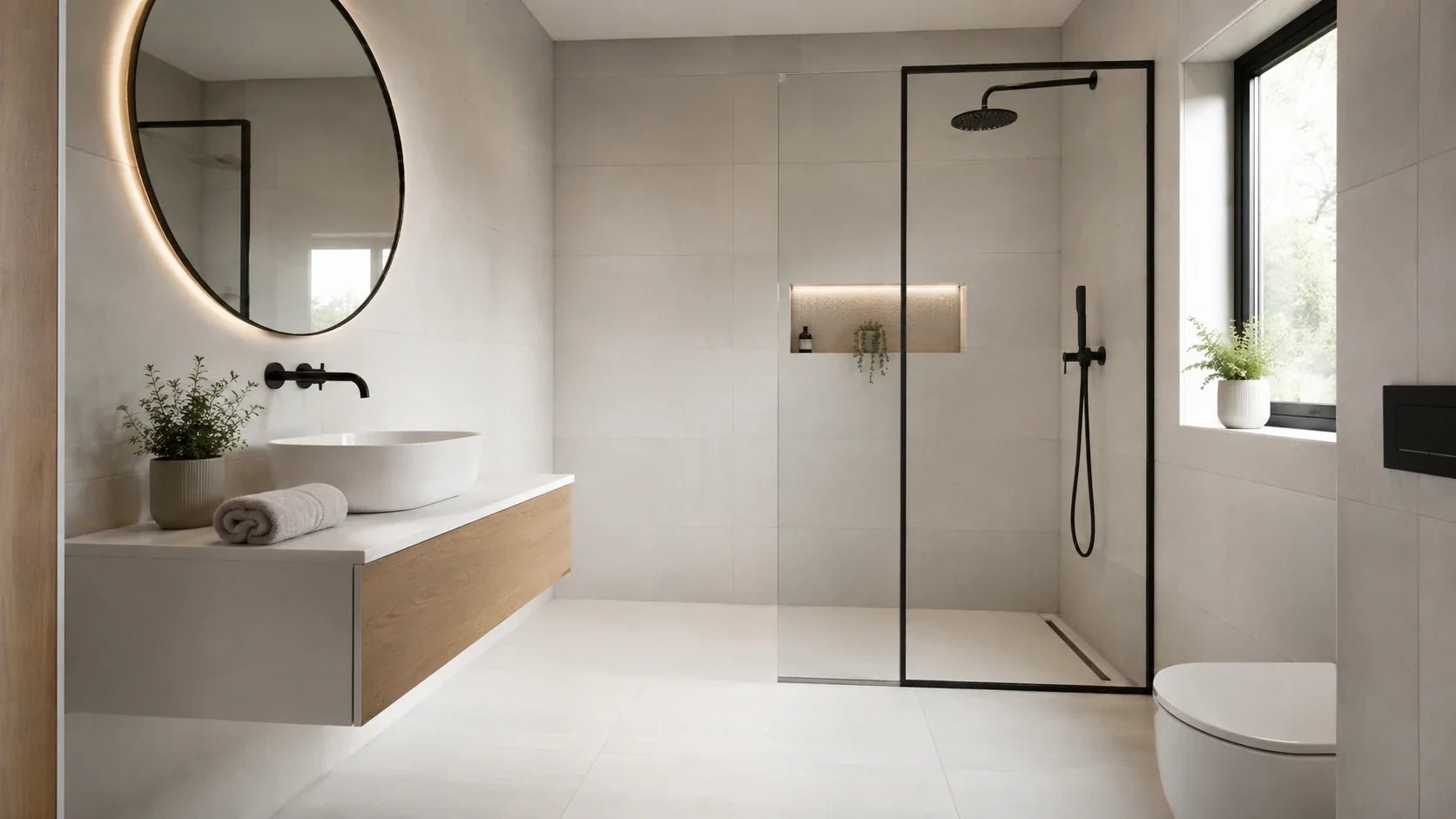
White bathroom tiles are wall and floor tiles in a white or near-white colour body, produced mainly in porcelain and ceramic, and specified for bathrooms because they reflect light, suit every fixture colour, and do not date. Choosing the right one is not really about white at all. It comes down to four decisions made in the right order: the undertone of the white, the format and size, the surface finish, and the grout colour that sits between every tile.
Get those four right and a white bathroom looks calm, expensive and timeless. Get them wrong and the same tiles look cold, clinical, or grubby within two years. This guide walks through each decision with UK bathrooms in mind, covering small ensuites in terraced houses, family bathrooms, and wet rooms.
Why White Remains the Most Specified Bathroom Tile Colour in the UK
White reflects more visible light than any other tile colour, which is why it dominates British bathrooms where natural light is limited and rooms are small.
Three practical reasons keep it at the top:
- Light gain. A white surface bounces ambient light back into the room instead of absorbing it. In a windowless cloakroom or a north-facing ensuite, this is the difference between a room that feels usable and one that feels like a cupboard.
- Zero clash risk. White works with chrome, brushed brass, matt black, oak, walnut, sage, navy and terrazzo. No other colour offers that range, so the tile never limits future decor changes.
- Resale neutrality. Estate agents consistently favour neutral bathrooms. A white tiled bathroom appeals to the widest buyer pool, which matters if you plan to sell within five years.
The honest counterpoint: white shows limescale, hair and grout discolouration faster than mid-tones. That is a maintenance question, not a design flaw, and the sections below solve it.
Decision One: Choose the Right White Undertone
Not all whites are the same white. This is the mistake that causes most regret, and almost no retailer explains it.
White tiles fall into three undertone families.
Cool White (blue or grey base)
Cool whites read crisp, modern and slightly clinical. They pair naturally with chrome, polished nickel, grey grout and glass. In a bright, south-facing bathroom they look sharp and clean. In a dark north-facing room they can look cold and slightly blue, especially under LED lighting rated above 4000K.
Best for: modern bathrooms, south or west-facing rooms, monochrome schemes.
Neutral or True White
A balanced white with no visible colour cast. It is the safest specification and the one most marble-effect porcelains sit closest to, since Carrara and Statuario tiles carry a white field with soft grey veining that keeps the tone neutral.
Best for: almost every UK bathroom, and the default choice if you are unsure.
Warm White (cream, ivory or pearl base)
Warm whites carry a faint yellow, beige or pearl cast. They soften the room and read as calm rather than sterile. Under warm 2700K lighting they feel spa-like. Against a stark white bath or basin, however, a warm white tile can look slightly dirty by contrast.
Best for: north-facing bathrooms, period properties, schemes with oak or brass, rooms where "cosy" beats "crisp".

The UK light rule
| Your bathroom | Recommended undertone | Reason |
|---|---|---|
| North-facing or windowless | Neutral to warm white | Counteracts the cool blue-grey daylight typical of north aspects |
| South or west-facing | Cool to neutral white | Warm afternoon light already adds yellow; a cool tile balances it |
| East-facing | Neutral white | Morning light is bright but short; neutral holds up all day |
| Artificial light only | Warm white with 2700K to 3000K bulbs | Prevents the hospital-corridor effect |
Always order samples and view them flat against the wall at three times of day. A tile that looks perfect under showroom halogen can look completely different at 7am in a Manchester bathroom in November.
Decision Two: Choose the Format and Size
Format changes the personality of white far more than the shade does. The same white tile in metro format and in 60x120cm slab format produce two entirely different bathrooms.
White Metro and Subway Tiles
The classic rectangular wall tile, usually 75x150mm, 100x200mm or 100x300mm. Metro is the most recognisable white bathroom tile idea for a reason: it suits Victorian terraces, new builds and everything between.

Layout changes everything:
- Brick bond (half offset): the traditional look, forgiving of slightly uneven walls.
- Stack bond (straight grid): modern, architectural, but demands perfectly level walls because every joint lines up.
- Herringbone: adds movement and a boutique-hotel feel. Expect 12 to 15 percent extra tiles for cuts.
- Vertical stack: visually lifts a low ceiling, which is useful in loft conversions and under-stairs cloakrooms.
- Bevelled edge metro: catches light along every edge and adds depth without pattern.
Large Format White Tiles
Sizes from 60x60cm up to 60x120cm and beyond. Fewer grout lines means fewer visual interruptions, so the room reads as larger and calmer. Large format also means dramatically less grout to clean, which is the single biggest maintenance advantage in a white bathroom.
The old advice that small rooms need small tiles is outdated. A 60x60cm white tile in a 2m x 2m bathroom looks more expensive and more spacious than 100 small tiles, provided the floor is properly levelled first.
White Hexagon and Mosaic Tiles
Hexagons bring geometry without colour. Used on a shower floor they provide extra grout lines, which improves grip and helps water fall towards the drain. Small-format white mosaics work well in shower niches, where a slightly different texture defines the recess without introducing a new colour.
White Marble Effect Porcelain
Carrara, Statuario and Calacatta effects give the veining of natural stone on a porcelain body. Porcelain does not need sealing, does not etch when it meets acidic bathroom cleaners, and costs a fraction of quarried marble. For most UK bathrooms this is the highest-impact white specification available.
White Textured, Ribbed and Fluted Tiles
Texture solves the flatness problem. A ribbed or fabric-effect white wall tile creates shadow lines that change through the day, so the wall has depth without a single extra colour. This is the most effective way to keep an all-white bathroom from feeling clinical.
Format guide by room type
| Room | Wall format | Floor format |
|---|---|---|
| Small ensuite (under 3m²) | 60x120cm or vertical metro | 60x60cm matt |
| Family bathroom | 30x60cm or 60x120cm | 60x60cm or 60x120cm matt anti-slip |
| Cloakroom | Metro or textured 30x60cm | Hexagon or 30x30cm |
| Wet room | Large format, minimal joints | Textured or R11 rated |
| Period property | Bevelled metro | Hexagon or chequerboard |
Decision Three: Choose Gloss, Matt or Polished
Finish controls both how much light the tile returns and how safe the floor is.
| Finish | Light reflection | Shows watermarks | Floor use | Best application |
|---|---|---|---|---|
| Gloss | Highest | Yes, noticeably | Not recommended in wet zones | Walls, splashbacks, small dark bathrooms |
| Polished | Very high | Yes | No, in showers and wet rooms | Feature walls, marble-effect statements |
| Matt | Moderate | Rarely | Yes, when correctly rated | Floors, family bathrooms, wet rooms |
| Textured | Low to moderate | No | Yes, best grip | Shower floors, wet rooms, feature walls |
The practical UK combination
Use gloss or polished white on the walls to gain light, and matt or textured white on the floor for grip. This is the specification most UK bathroom fitters recommend, and it solves the brightness problem and the safety problem at the same time.
Decision Four: Choose the Grout Colour
Grout occupies roughly 3 to 8 percent of a tiled surface, but it decides whether the scheme reads as one clean plane or as a grid.

| Grout choice with white tiles | Visual result | Maintenance reality |
|---|---|---|
| Bright white | Seamless, expansive, softest look | Shows staining fastest, needs sealing and regular cleaning |
| Light grey | Almost seamless, hides soil | The best all-round choice for UK bathrooms |
| Mid grey | Defined tile shape, subtle grid | Very forgiving, excellent on floors |
| Charcoal or black | Strong graphic contrast, industrial or heritage feel | Hides dirt well but locks you into a bold look |
| Warm beige or greige | Softens cool whites, period-friendly | Good for warm white and cream-toned tiles |
Joint width matters as much as colour
- Rectified tiles (mechanically squared edges) can be laid with 2mm joints, producing a near-seamless white surface.
- Non-rectified tiles need 3mm or wider joints to absorb small size variations between tiles.
Narrow joints plus grey grout is the specification that produces the "expensive hotel" look people are usually trying to describe when they ask for white bathroom tile ideas.
White Bathroom Schemes by Interior Style
Modern minimalist
Large format neutral white porcelain, wall and floor, 2mm light grey joints, matt black brassware, wall-hung vanity. Almost no visual noise.
Boutique hotel
White marble effect porcelain on the walls, matt white floor, brushed brass fittings, a full-height shower wall as the feature. Warm 2700K lighting.
Victorian and period
Bevelled white metro in brick bond to dado height, painted wall above, black and white hexagon or chequerboard floor, chrome or nickel fittings.
Scandinavian and warm minimal
Warm white or pearl tiles, oak vanity, sage or clay accents, textured wall tile behind the basin, soft diffused lighting.
Monochrome graphic
Stack bond white metro with charcoal grout, black shower frame, black tapware, white floor with dark grout to match.
Spa and wet room
Textured or ribbed white walls, large format matt white floor with R11 rating, linear drain, frameless glass, minimal joint lines.

Practical Specification: The Details That Prevent Regret
Slip resistance on white bathroom floors
Polished and gloss white tiles are the most slippery surface commonly sold for bathrooms. Slip performance is measured two ways in the UK:
- R rating (DIN 51130): R9 is dry-area only, R10 is the minimum sensible bathroom floor, R11 and above suits wet rooms and shower floors.
- Pendulum Test Value (BS 7976): a PTV of 36 or above is the widely used benchmark for low slip potential in wet conditions.
If a white floor tile does not list an R rating, treat it as a wall tile.
Porcelain or ceramic
| Property | Porcelain | Ceramic |
|---|---|---|
| Water absorption | Below 0.5 percent | Typically 3 to 10 percent |
| Floor suitable | Yes | Wall only in most cases |
| Underfloor heating | Excellent conductor | Acceptable |
| Price per m² | Higher | Lower |
| Best use | Floors, wet rooms, large format | Wall tiles, metro, splashbacks |
For a white bathroom floor, porcelain is the correct specification. For white wall tiles, ceramic is often the better value choice.
Underfloor heating
White porcelain works well over both electric mats and wet systems because dense porcelain conducts and holds heat efficiently. Use a flexible adhesive rated C2TE S1 or S2 to EN 12004 so thermal movement does not crack the grout, and confirm the tile is listed as underfloor heating compatible before ordering.
How many tiles do you need
- Measure each wall and the floor in metres, then multiply length by height or width to get m².
- Add every area together.
- Subtract large openings such as a window or door only if they exceed 1m².
- Add wastage: 10 percent for straight layouts, 12 to 15 percent for herringbone or diagonal, 15 percent for rooms with many cuts.
- Order the full quantity in one go so every box comes from the same batch. Shade and calibration vary between production batches, and this is far more visible on white tiles than on patterned ones.
Why white bathroom tiles turn yellow, and how to fix it
Yellowing is almost never the tile. Diagnose it in this order:
- Limescale film. In hard water areas, dissolved calcium leaves a dull film that reads as yellow. Clean one small area with a limescale remover suitable for glazed porcelain. If brightness returns, the tile was fine.
- Soap and product residue. Body wash and conditioner leave a greasy layer that traps dirt. Degrease with a mild alkaline cleaner, then rinse fully.
- Grout discolouration. Darkened grout makes clean white tiles look yellow by contrast. Clean one grout line with a grout brush and an oxygen-based cleaner. If the tile suddenly looks whiter, grout was the problem, not the tile.
- Mould behind sealant. Grey or yellow patches near the bath edge usually mean mould under the silicone. Cut it out and reseal rather than scrubbing the surface.
Prevention is simpler than cure: squeegee the shower walls after use, ventilate for 20 minutes after bathing, avoid acidic cleaners on cement grout, and reseal cement-based grout every 12 to 18 months.
When white is the wrong choice
White is not universally correct, and pretending otherwise leads to disappointment.
Reconsider if:
- Your bathroom already has cool north light, no window and no dimmable warm lighting. The result reads clinical.
- The room is used by young children and cleaning frequency is realistically low. Mid-tone or patterned floors hide daily use far better.
- Your fixtures are an off-white or cream older suite. A bright cool white tile will make the sanitaryware look dated and yellowed by comparison.
In each case, the fix is usually a warm white or a textured white rather than abandoning the colour completely.
Explore the Range at Tiles Paradise
Ready to move from ideas to samples? These collections cover every white specification discussed above.
- Browse the complete bathroom white tiles collection for gloss, matt and marble-effect options in one place.
- For walls, splashbacks and shower enclosures, see the white wall tiles range in porcelain and ceramic.
- For floors, compare matt and anti-slip options in the white floor tiles collection.
- Planning the floor first? Start with bathroom floor tiles and filter by finish and size.
- Tiling more than one room? The full white tiles collection covers bathrooms, kitchens and hallways for a continuous scheme.
- For a matt anti-slip marble-effect floor, the Statuario Carrara White Matt Anti-Slip Porcelain 60x120cm is the specification most often chosen for UK bathrooms.
- For a high-shine feature wall, see the Statuario Carrara White Polished Marble Effect Porcelain 60x60cm.
Frequently Asked Questions About White Bathroom Tiles
Are white bathroom tiles still in style in 2026?
Yes. White remains the most specified bathroom tile colour in the UK. The change in 2026 is tonal rather than a move away from white: softer, warmer whites and textured surfaces have replaced stark, flat, bright white as the default choice.
How do I stop an all-white bathroom looking cold?
Introduce variation in texture rather than in colour. A ribbed, fluted or fabric-effect white wall tile creates shadow lines that give the room depth, and pairing it with 2700K to 3000K lighting and a warm material such as oak or brushed brass removes the clinical edge without breaking the white scheme.
Should I choose gloss or matt white bathroom tiles?
Use gloss on walls for maximum light, and matt on floors for grip. Gloss walls plus a matt anti-slip floor is the most practical combination for UK bathrooms and remains the most common professional specification.
What grout colour goes best with white bathroom tiles?
Light grey is the best all-round choice. It sits close enough to white to keep the surface looking seamless, while hiding soap residue and general soiling far better than bright white grout.
Are white bathroom tiles hard to keep clean?
They are not harder to clean, but they show marks sooner. Glazed porcelain and ceramic wipe clean with warm water and a mild detergent. Most of the perceived difficulty comes from grout, not from the tile surface.
What size white tiles suit a small bathroom?
Larger tiles usually work better. A 60x60cm or 60x120cm format reduces grout lines and makes a compact room read as one continuous surface. Vertical metro is the alternative when you want to lift a low ceiling.
Can white wall tiles be used on the bathroom floor?
Only if the product is certified for floor use and carries a slip rating. Many white wall tiles are ceramic with higher water absorption and no R rating, which makes them unsuitable underfoot in a wet area.
Should the wall tile and the floor tile be the same white?
Only if both are the same batch and finish family, otherwise two slightly different whites read as a mistake rather than a design choice. The safer route is a deliberate contrast: keep the wall white and drop the floor half a tone, or change the finish so the difference looks intentional.
Are white bathroom tiles slippery?
Polished and gloss finishes are, when wet. Choose matt or textured white tiles rated R10 or higher for bathroom floors, and R11 or higher for shower floors and wet rooms.
Is white a good choice for a north-facing bathroom?
Yes, provided you choose a warm or neutral white rather than a cool blue-grey white, and pair it with 2700K to 3000K lighting. A cool white in north light can look grey and cold.
How do I stop white grout going black?
Ventilate the room properly, seal cement-based grout after installation and every 12 to 18 months afterwards, and clean with a pH-neutral or oxygen-based product rather than bleach, which degrades grout over time.
Should I use white tiles on both the walls and the floor?
You can, and in wet rooms it creates a seamless envelope. In family bathrooms, most designers vary the finish instead: gloss or textured white walls with a matt white or soft grey-white floor keeps the scheme calm without looking like one flat box.
Keep Reading
- Now you know how to choose, see the tiles themselves: white bathroom tile ideas with 13 specific designs covers marble effect, onyx effect and textured whites in detail.
- Deciding between finishes? The matt bathroom tiles buying guide covers anti-slip styles and grout maintenance in detail.
- Safety first on the floor: read the non-slip bathroom floor tiles guide for R ratings explained.
- Want depth without colour? See the textured bathroom tiles style guide for ribbed, fluted and fabric-effect whites.
- Working with a compact space? The small bathroom tile guide covers layout and format for tight footprints.
- Tiling to dado height instead of full height? See half tiled bathroom style ideas.
- For the full cleaning routine beyond the white-specific fixes above, read how to clean bathroom tiles and grout.
- Looking wider than white? Browse modern bathroom tile ideas for the full colour and format picture.