





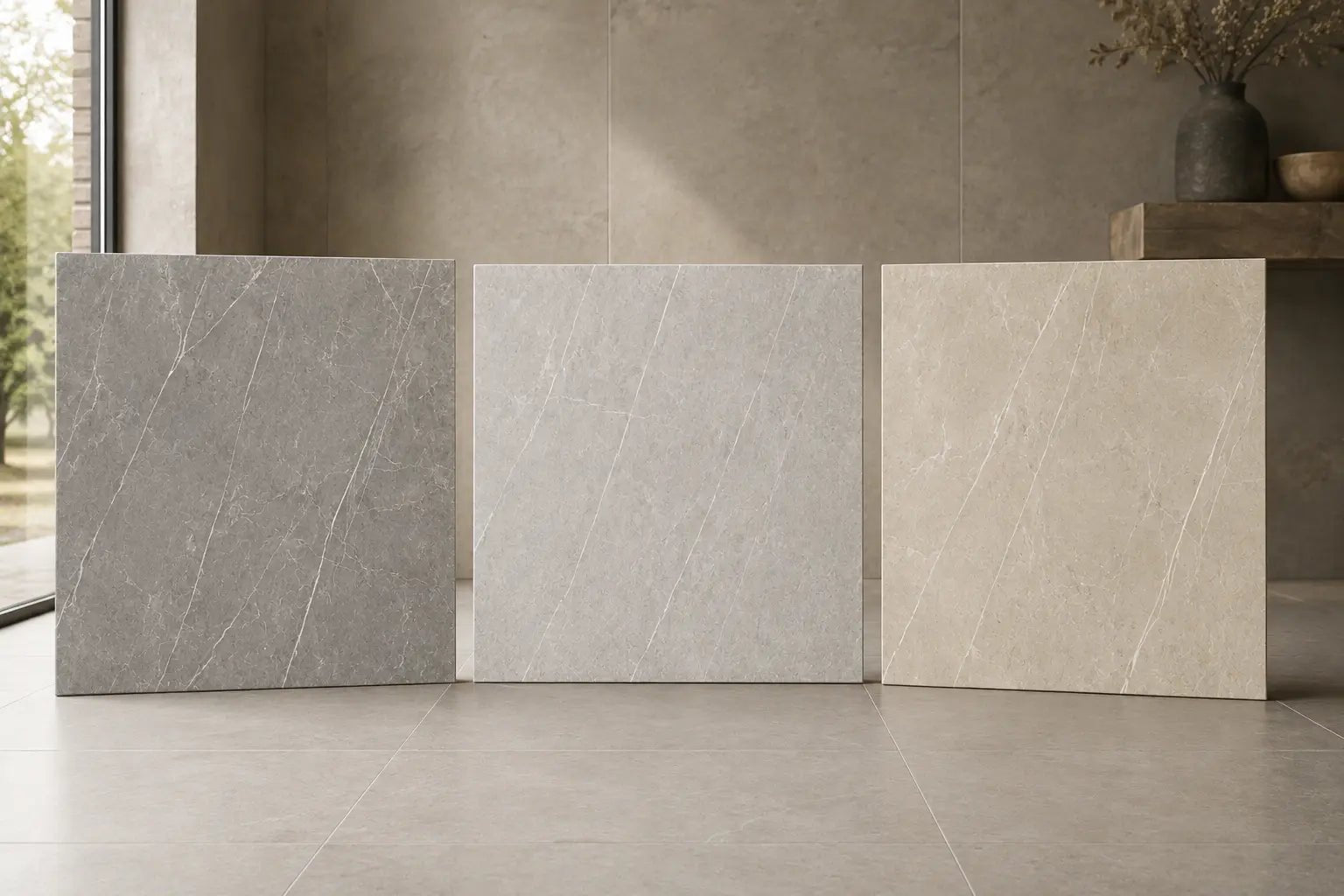
Montagna stone effect tiles are 80x80cm matt porcelain tiles designed for both walls and floors. The three Montagna variants available in the supplied product information are Jet, Steel and Tortilla, and each is listed as 8.5mm thick, rectified and suitable for underfloor heating.
The size is what gives the range much of its visual character. An 80x80cm square creates fewer grout interruptions than smaller formats, so the stone effect can read as a broad surface rather than a repeated small pattern.
The main decision is therefore not just which Montagna colour you like. It is how the colour, large format, matt finish, grout layout and room context work together.
This guide covers the actual product specifications, the difference between Jet, Steel and Tortilla, where the format works best, how to plan an installation and what to check before buying.
What are Montagna Stone Effect Tiles?
Montagna is a stone-effect porcelain tile range in a large 80x80cm square format. The supplied product information lists a matt finish, rectified edges, wall and floor suitability, 8.5mm thickness and underfloor heating suitability for Jet, Steel and Tortilla.
The range is built around three colour directions.
Jet gives the deepest visual weight.
Steel provides a balanced grey neutral.
Tortilla brings a warmer beige and cream direction.
That gives the collection a useful spread for modern bathrooms, kitchens, hallways and open-plan living spaces.
The format is large enough to reduce the visual density created by grout joints, while the square shape creates a different rhythm from long rectangular large-format tiles.
Montagna specifications at a glance
| Specification | Jet | Steel | Tortilla |
| SKU | DSL-6376 | DSL-6375 | DSL-6374 |
| Thickness | 8.5mm | 8.5mm | 8.5mm |
| Finish | Matt | Matt | Matt |
| Wall and floor | Yes | Yes | Yes |
| Format | 80x80cm | 80x80cm | 80x80cm |
| Rectified | Yes | Yes | Yes |
| Underfloor heating | Yes | Yes | Yes |
| Weight | 26KG | 26KG | 26KG |
The live product pages should be used for current price and availability.
Montagna Jet, Steel and Tortilla: Which Colour Is Right?
Colour choice becomes easier when you start with the room rather than the tile.
| Colour | Visual character | Strong pairings | Best suited to |
| Jet | Deep grey | White, black, oak | High-contrast contemporary schemes |
| Steel | Mid grey | White, oak, charcoal | Flexible modern interiors |
| Tortilla | Warm beige and cream | Timber, warm white, brass | Warm natural interiors |
Montagna Jet
Jet is the strongest option when the floor or wall needs to carry more visual weight.
A deep grey surface can create a sharp contrast with white bathroom fittings, pale walls and warm timber. In a kitchen, it can provide a darker base beneath light cabinetry.
Jet is also a good choice when black fittings form part of the wider design. The dark colour creates a natural relationship between the floor and darker hardware without requiring a highly patterned surface.
The main design risk is not the colour itself. It is using too much dark material without enough contrast.
In a compact room, lighter walls, good lighting and a small number of supporting materials can stop the dark tile from making the space feel heavy.
The current product can be viewed at Montagna Jet Stone Effect Matt Porcelain Wall and Floor Tile.

Montagna Steel
Steel is the most adaptable colour in the group.
A medium grey can sit beside both warm and cool materials, which makes it useful when the room contains oak, white cabinetry, charcoal accents, stone-coloured walls or simple black hardware.
Steel is especially useful in open-plan rooms because the floor does not force the furniture and cabinetry into one narrow colour family.
It provides enough definition to make the 80x80cm grid visible while staying neutral enough to support different finishes around it.
See the current Montagna Steel Stone Effect Matt Porcelain Wall and Floor Tile for the live product details.

Montagna Tortilla
Tortilla is the warmest colour direction.
Its beige, cream and ivory character works naturally with timber, warm white paint, brass hardware and earthy textures.
It is the stronger choice when a room already has warm materials and a grey floor would create too much visual coolness.
Tortilla can also work well where the objective is a softer stone-inspired appearance rather than a high-contrast architectural floor.
The Montagna Tortilla Stone Effect Matt Porcelain Wall and Floor Tile provides the current specification for this colour.

Are Montagna Tiles Good for Bathrooms?
Yes. The product information lists all three variants for both wall and floor use.
The 80x80cm format can work particularly well on a bathroom floor because fewer joints interrupt the surface. That can make the room feel calmer and more architectural.
The same tile can also be carried onto a selected wall, such as a vanity backdrop or shower wall, where the installation system allows.
That does not mean every wall needs the same tile.
A more controlled bathroom scheme often uses the main tile on the floor and one important wall, then lets the remaining surfaces stay quieter.
For a wider look at stone-effect bathroom design, the stone-effect bathroom tiles guide is the natural next step because it explores how porcelain and stone-effect surfaces work within a bathroom scheme.
Are 80x80 tiles too large for a small bathroom?
Not necessarily.
The deciding factor is the layout rather than the room's dimensions alone.
An 80x80cm tile can work in a small bathroom when the grid is positioned carefully so the visible edges do not end in awkward narrow strips.
Before installation, check the relationship between the tile joints and:
-
The doorway
-
Shower or bath
-
Basin
-
Vanity
-
Toilet
-
Window
-
Main wall lines
The aim is to make the cuts look intentional.
This is one reason large-format tiling should be planned before the first tile is fixed.
Can Montagna be used in a wet room?
The product pages establish wall and floor use, but a wet-room installation involves more than the tile.
Waterproofing, falls, drainage, substrate preparation, adhesive, grout and movement requirements all form part of the system.
Do not assume that a matt finish proves a specific slip classification. A formal slip rating is a separate technical property and should be confirmed where the project requires one.
Are Montagna Tiles Suitable for Kitchens?
Yes. The products are listed for both floors and walls, and the 80x80cm format is well suited to kitchens that need a broad floor with fewer visible joints.
Steel is the easiest neutral for mixed kitchen palettes.
Jet works well with white or pale cabinetry when the floor needs stronger contrast.
Tortilla suits timber, cream and warm neutral schemes.
The floor can then support the kitchen rather than compete with the worktop, cabinetry or splashback.
For broader kitchen planning, the porcelain kitchen tiles guide covers size, finish, material and layout decisions.
For shoppers specifically comparing the same format, the 80x80cm floor tile collection is the most relevant commercial category.
Can the Same Montagna Tile Be Used on Walls and Floors?
Yes. All three supplied product pages show Floor or Wall: Both.
Using one tile across two surfaces can create a strong sense of continuity.
A bathroom might use Montagna on the floor and one wall.
A kitchen might use it across the floor and a smaller feature area.
A living space can carry the same floor through a hallway or connected dining area where the wider design allows.
The trick is to avoid making every surface identical.
The strongest results usually have one dominant material, then a few supporting textures that break up the room.
What Does the Matt Finish Add?
The matt finish changes the way the surface responds to light.
Instead of creating strong reflections, it gives the tile a softer and more restrained appearance.
That suits stone-effect design because the surface can feel more architectural and less decorative.
Matt also changes how other materials read beside the tile.
Timber can feel warmer.
Black fittings can feel sharper.
Cream walls can feel softer.
The finish therefore forms part of the room's overall material balance rather than acting as an isolated tile specification.
For a wider selection of matt porcelain options, the matt finish tile collection is useful when comparing the finish against other stone, marble and concrete effects.
What Does a Rectified Edge Mean?
All three Montagna variants are listed as rectified.
A rectified edge is mechanically finished to provide greater dimensional consistency.
That helps installers create a more controlled grout layout.
It does not mean that zero-joint installation is appropriate.
A large-format tile still needs:
-
A suitable substrate
-
Correct adhesive selection
-
Adequate coverage
-
Accurate alignment
-
Suitable joint planning
-
Movement provision where required
Rectification improves dimensional consistency. It does not remove the technical requirements of tiling.
Why Does the 80x80cm Size Matter So Much?
Large-format tile size affects both appearance and installation.
An 80x80cm tile covers a larger visual field than a small square tile. The result is fewer visible joints and a stronger sense of continuity.
But the larger the tile, the more obvious poor planning can become.
A small tile can absorb minor layout decisions because there are more joints.
An 80x80cm tile makes every major cut and joint position more visible.
That is why the format should be planned around the room.
Is 80x80cm better for large rooms?
It can be.
Large rooms give the format enough space to show its visual rhythm without creating excessive cuts.
The square grid also works well in open-plan interiors because it creates a clear floor structure without the long directional line created by a 60x120cm rectangle.
Is 80x80cm good for hallways?
It can work, but the proportions need attention.
A narrow hallway can produce long edge cuts if the grid is not centred correctly.
The best approach is to position the main visual line first, then work the tile cuts back toward less visible edges.
How Should Montagna 80x80cm Tiles Be Installed?
Large-format porcelain should be treated as a planning exercise before it becomes a laying exercise.
1. Measure each area separately
Record the dimensions of each section and include fixed objects.
A bathroom, kitchen or open-plan floor rarely behaves like one simple rectangle.
2. Draw the tile grid
Place the 80x80cm grid on a plan or dry-lay the first rows.
Look at the size of the edge cuts before adhesive is applied.
3. Prepare the substrate
Large tiles span more area, so substrate variation can become more visible.
The base needs to be sound, clean and appropriately flat for the installation system.
4. Choose the correct adhesive
The adhesive must suit the porcelain, substrate and installation conditions.
Follow the adhesive manufacturer's instructions.
5. Aim for appropriate coverage
Large-format tiles need careful adhesive coverage.
The correct application method depends on the tile, substrate and adhesive system.
6. Control lippage
Lippage is the difference in height between adjacent tiles.
Large tiles make unevenness more noticeable, so alignment and substrate preparation matter.
7. Plan movement
Movement joints are part of the installation system.
Grout should not be expected to compensate for structural or thermal movement.
Are Montagna Tiles Suitable for Underfloor Heating?
Yes.
The supplied product information shows Suitable for Underfloor Heating: Yes for Jet, Steel and Tortilla.
That makes the range useful for kitchens, bathrooms and open-plan spaces where underfloor heating forms part of the room specification.
The tile is still one component of the system.
The substrate, adhesive and heating system should all be installed and commissioned according to their respective requirements.
For a deeper kitchen-specific perspective, the large format porcelain kitchen floor guide covers the relationship between large-format flooring, underfloor heating and installation considerations.
What Grout Colour Works Best with Montagna?
Grout changes how the tile reads.
Jet with grout
A dark grey grout can make the surface feel more continuous.
A lighter grout makes each 80x80cm square more obvious.
Steel with grout
A close grey supports a quiet architectural look.
Contrast creates a clearer grid.
Tortilla with grout
A warm beige or stone grout keeps the palette soft.
A darker grout gives the square pattern more definition.
The rule is simple.
Use tonal grout when you want a continuous stone effect. Use contrast when you want to emphasise the tile geometry.
Always test the grout against an actual tile before installing the full room.

Does Montagna Need Sealing?
Do not automatically treat a stone-effect porcelain tile like quarried natural stone.
Montagna is porcelain, so maintenance should follow the actual tile and grout manufacturer's guidance.
The distinction matters because the appearance of stone and the maintenance behaviour of natural stone are not the same thing.
The porcelain surface and the grout joints should also be considered separately.
If a project requires a specific sealing product or maintenance regime, check the technical guidance for the exact system rather than relying on the appearance of the tile.
Montagna Porcelain vs Natural Stone
Montagna reproduces the visual language of stone with a manufactured porcelain tile.
Natural stone is a quarried material with its own mineral composition and natural variation.
| Factor | Montagna porcelain | Natural stone |
| Material | Manufactured porcelain | Quarried natural material |
| Appearance | Stone inspired | Naturally occurring |
| Pattern control | Designed | Naturally variable |
| Format consistency | Manufactured | Varies by material |
| Finish | Matt | Depends on stone and treatment |
| Maintenance | Follow product guidance | Depends on stone and treatment |
| Buying consistency | Defined product | More natural variation |
The decision therefore depends on what matters most.
Choose a stone-effect porcelain tile when you want a controlled product with a clear manufactured specification and a stone-inspired appearance.
Choose natural stone when the natural material itself is central to the design.
How Many Montagna Tiles Do You Need?
Start with the actual area.
Then account for cuts and breakage.
The exact allowance depends on the room shape and the layout.
A simple rectangular room may generate less waste than a room with many corners, doorways and fixed units.
Large 80x80cm tiles also require careful planning because a single large cut represents a greater amount of material than a cut from a smaller tile.
For quantity planning:
-
Measure each area.
-
Calculate the total square metres.
-
Draw the 80x80cm layout.
-
Identify the cut-heavy areas.
-
Add an appropriate waste allowance.
-
Keep suitable spare tiles for future repair if practical.
Do not finalise the purchase quantity from the room area alone.
Should You Order a Sample?
Yes.
Stone-effect tiles contain colour, texture and pattern relationships that are difficult to judge on a screen.
A sample allows you to test the actual tile against:
-
Daylight
-
Warm artificial lighting
-
Wall paint
-
Cabinetry
-
Worktops
-
Timber
-
Black or brass fittings
-
Existing flooring
This matters most when comparing Steel and Tortilla, because their difference is not only hue.
It changes the temperature of the room.
Jet should also be tested in the actual room because darker surfaces can change significantly between natural daylight and evening lighting.
How to Choose Montagna for an Open-Plan Space
Open-plan rooms need a floor that can connect several zones.
That makes Steel particularly versatile because grey works across kitchen cabinetry, dining furniture and living-room materials.
Jet can define the floor more strongly, which suits spaces where the floor is intended to create contrast.
Tortilla can help link warm timber and neutral upholstery, especially where the room contains beige, cream or brass details.
The best choice is not always the colour that looks strongest on its own.
It is the colour that creates the fewest conflicts with everything else in the room.
How Does Lighting Affect Montagna Jet, Steel and Tortilla?
Lighting can change how a large stone-effect surface is perceived, so colour should be judged in the room where it will be installed.
Jet can look almost charcoal under low evening light and softer grey when daylight reaches the surface. That makes it a strong option for dramatic rooms, but it also means the surrounding wall colour matters.
Steel is usually the easiest colour to keep visually balanced because a mid-grey sits between darker furniture and lighter walls. In a north-facing room, however, cool daylight can make grey feel cooler, so warm timber and warmer white finishes can help.
Tortilla reacts differently because its beige and cream direction already carries warmth. It can support rooms with oak, natural stone accents, woven textures and brushed brass without creating a hard contrast.
The safest test is to place the sample near the main surfaces at different times of day. Check it in daylight, under the evening lighting and beside the materials that will remain in the room.
Why does this matter more with 80x80cm tiles?
A large tile occupies more of the visual field. A small sample may therefore understate the effect that a colour has when the same finish covers a large floor or wall.
The sample still matters, but the surrounding palette matters just as much.
How Should You Choose the Grout Joint?
A rectified 80x80cm tile can create a very clean layout, but the joint should be selected as part of the installation system rather than chosen for appearance alone.
The correct joint depends on the actual tile guidance, substrate, environment and installation method.
From a design perspective, the joint changes the balance between tile and pattern.
A low-contrast joint makes the individual tile boundaries recede, so the room reads as a broader stone surface.
A contrasting joint makes the 80x80cm geometry much more visible. That can be useful when the square grid is part of the design.
The best visual result comes from deciding this before installation. A grout colour chosen at the end can make the finished room look noticeably different from the original tile plan.
What Maintenance Should You Plan for?
Daily maintenance should be considered before choosing any floor or wall finish.
The porcelain surface should be cleaned according to the product manufacturer's instructions, while grout may require a different cleaning approach.
Avoid treating every stone-effect tile as if it were the same product. A matt porcelain surface, a textured surface and a polished natural stone surface can react differently to cleaning products and residue.
For a new installation, ask the installer or manufacturer for the correct post-installation cleaning process, including the removal of adhesive or grout haze where relevant.
Routine care is generally easier when spills, dirt and residue are dealt with before they build up.
What About Batch and Shade Variation?
A tile that is ordered later may not appear exactly the same as the original installation.
This is why it is sensible to check the quantity before the project begins and retain suitable spare tiles where storage allows.
For a large-format room, a replacement tile can be visually obvious if the colour or pattern is different from the surrounding field.
The four-face or visual variation concept also means that tiles should be mixed from the available pieces during installation rather than arranged in an overly repetitive sequence.
A good installer will normally distribute the visual variation across the room so the finished surface feels balanced rather than mechanically repeated.
How to Create a More Expensive Look with 80x80 Stone Effect Tiles
A premium result usually comes from control rather than complexity.
Keep the material palette tight
Stone effect porcelain works best when it is not surrounded by too many competing patterns.
Plan the grout
A close tonal grout can reduce visual noise.
Align the layout with architecture
Use walls, cabinetry and doorways as planning references.
Let the texture do the work
Do not add multiple decorative surfaces when the tile already contains visual movement.
Use lighting carefully
Directional light can reveal surface texture, while broad daylight gives a more even reading of the stone effect.
Common Buying Mistakes
Choosing from a screen alone
Digital images cannot reproduce your exact room lighting.
Assuming matt means anti-slip
A matt finish does not itself establish a specific slip classification.
Ignoring the tile grid
Large-format tiles make poor cut planning more visible.
Ordering only the measured area
Cuts and breakages can create a shortfall.
Selecting grout after installation
Grout can change the perceived strength of the tile grid.
Treating a large-format installation like a small-format installation
Substrate preparation and alignment become more important as tile size increases.
Buying replacement tiles much later without checking the batch
A later production batch may not appear identical.
Take The Right Decision
The main product intent should be satisfied before strong commercial navigation is introduced.
Once the buyer knows which colour and format suits the project, the relevant next step is the corresponding product page.
Choosing Jet
Go directly to Montagna Jet 80x80cm to check the live product information.
Choosing Steel
Compare Montagna Steel 80x80cm when a balanced grey neutral is the preferred direction.
Choosing Tortilla
See Montagna Tortilla 80x80cm when warmth is the priority.
Comparing the broader format
The 80x80cm wall tiles collection is relevant when the project is focused on large square wall surfaces.
The 80x80cm floor tiles collection is relevant when the buying decision is centred on large-format flooring.
The bathroom porcelain tiles collection is the more useful next step when the project is a bathroom and material choice still needs to be compared.