





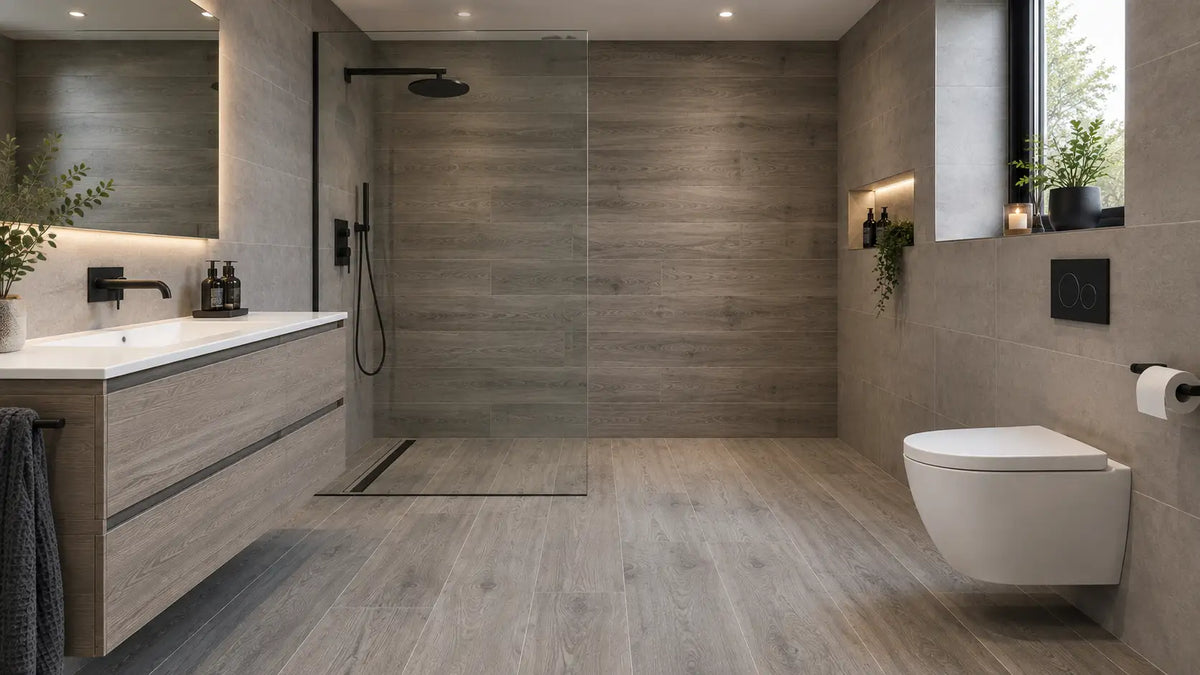
Wood effect bathroom tiles are porcelain planks printed with real timber grain. They bring the warmth of oak, ash or walnut into a bathroom without swelling, rot or water stains. The most convincing results come from matt planks in a soft undertone, laid with a short offset and tone-matched grout.
The trouble is that a tile can look perfect in a bright showroom and wrong at home. Warm bathroom bulbs can turn honey oak orange, and long planks can crack or sit unevenly on a sloping shower floor. A cheap range may repeat the same knot every metre, and a real oak vanity can clash with a floor that is almost the same wood. Each of these mistakes costs money to fix once the tiles are down.
This guide shows you how to avoid every one of those problems, starting with how to choose a wood tone by its undertone and by the light in your room. You will see which taps and vanities suit each tone, how plank size and grout shape the final look, what is safe inside the shower, and how to order without running short.
Why Wood Effect Porcelain Works Where Real Timber Fails
A bathroom is a hard place for real wood. Steam, splashes and puddles soak into timber fibres, and the boards swell, cup and slowly turn grey at the edges. Wood effect porcelain avoids that problem completely, because the tile is made from fine clay fired at very high temperatures and the body absorbs less than 0.5% of its weight in water. The wood grain is a high-resolution print sealed under a glaze, so there is nothing for water to damage.
Modern printing is what makes the look believable. Good ranges copy real knots, saw marks and colour shifts, and many add a brushed texture you can feel under bare feet. Porcelain wood effect tiles also differ from ceramic wood effect tiles in one important way: ceramic wood effect tiles have a softer, more porous body and suit walls best. Porcelain wood effect tiles are harder and denser, which makes porcelain the safer choice for bathroom floors and showers.
Homeowners often compare wood effect tiles with vinyl flooring and engineered timber, so it helps to see them side by side.
| Feature | Wood effect porcelain | Wood effect ceramic | Luxury vinyl (LVT) | Engineered timber |
|---|---|---|---|---|
| Water resistance | Excellent, safe in showers | Good on walls, weaker on floors | Good on surface, joints can lift | Poor, swells when wet |
| Feel underfoot | Cool, warm with underfloor heating | Cool | Soft and warm | Warm and natural |
| Scratch resistance | Very high | Moderate | Low to moderate | Low |
| Suits shower floors | Yes, with a slip-rated finish | No | No | No |
| Long-term wear | Lasts for decades with basic care | Long-lasting on walls | Wear layer can scratch and dull | Needs sanding and refinishing |
Choosing a Wood Tone by Its Undertone
Every wood effect tile has a main colour and a hidden undertone. The main colour is what you notice first, such as pale, mid-brown or dark, while the undertone is the quieter tint underneath, usually yellow, red, grey or pink. Undertone matters more than shade, because it decides whether the floor sits happily with your walls, taps and light.
| Wood tone | Undertone | Best room type | Best light | Fixture finish that suits it |
|---|---|---|---|---|
| Bleached ash | Grey or beige | Small bathrooms, en-suites | Any, great in low light | Chrome, brushed nickel |
| Natural and honey oak | Yellow or golden | Family bathrooms | Neutral white | Brushed brass, matt black |
| Grey weathered timber | Cool grey | Modern, minimal rooms | Warm white | Matt black, gunmetal |
| Smoked walnut | Red or chocolate | Large bathrooms | Warm white, plenty of it | Brushed gold, bronze |

Bleached Ash and Whitewashed Oak
Bleached ash tiles have a pale, creamy base with a soft grey or beige undertone. Bleached ash suits small bathrooms and en-suites, because the light surface bounces daylight around the room. The look is calm and Scandinavian, and it works well with white basins and pale stone walls. Choose a visible grain, because a very plain pale plank can read as flat vinyl.
Natural and Honey Oak
Natural oak tiles sit in the middle of the range, with a warm yellow or golden undertone. Honey oak is the most classic choice and feels friendly in family bathrooms. Honey oak does need care with lighting, because very warm bulbs can push the yellow towards orange. Pair natural oak with off-white walls rather than bright white, which can make the wood look brassy.
Grey Weathered Timber
Grey timber tiles copy driftwood and aged barn boards, with a cool grey or silver undertone. Grey timber looks modern and suits concrete effect walls, matt black fittings and minimal spaces. The risk is coldness, because grey timber can feel flat in a north-facing room with cool lighting, so add warmth through towels, plants or a timber shelf.
Smoked Walnut and Dark Oak
Dark wood tiles have a deep brown base with a red or chocolate undertone. Walnut creates a rich, hotel-style bathroom and hides everyday marks well. Dark planks do shrink a small room visually, so they work best in larger spaces or as a floor under pale walls. Water spots and soap residue show more on dark matt tiles, so a quick wipe after showering keeps walnut looking clean.
How Does Bathroom Lighting Change a Wood Tone?
Light changes wood effect tiles more than almost any other tile style. The key is colour temperature, which is measured in Kelvin (K). Warm white bulbs sit around 2700K and give a yellow glow, while neutral and cool white bulbs sit around 4000K and give a crisp, bluish light. Warm light deepens the yellow in honey oak and the red in walnut. Cool light strips warmth out of grey timber and can make it look like cement.
Room direction matters too. A north-facing bathroom gets cool, even daylight all day, so warm oak tones help balance it. A south-facing room gets strong warm light, so pale ash or grey timber can stop the space from feeling too golden. Windowless en-suites depend entirely on artificial light. In those rooms, choose your bulbs first and the tile second, because the bulbs will decide how the floor looks every single day.
Pale tones also reflect more light than dark tones. A bleached ash floor can make a small bathroom feel noticeably bigger and brighter, while walnut absorbs light and pulls the room inward. The simplest test costs nothing: place a sample tile on the bathroom floor at night, switch on your real lights and look at it from the doorway. If the tone still feels right, it will feel right when the whole floor is tiled.
Pairing Wood Effect Floors with Brassware, Vanities and Wall Tiles
A wood effect floor sets the mood, but taps, furniture and wall tiles finish the story. The most successful schemes repeat the undertone of the wood somewhere else in the room. That visual link can be a metal finish, a towel colour or a vein in a marble effect wall tile.
Start with the vanity, because a real timber unit needs careful thought. Two woods that are nearly the same colour tend to clash, because the eye spots the small difference at once. Either match the undertone closely (a warm oak unit on a warm oak floor) or create clear contrast, such as a white or dark green vanity on a mid-oak floor. Wood effect floors also sit beautifully under marble effect or plain matt wall tiles. You can explore more combinations in our bathroom tile ideas guide to layouts, colours and finishes.
Brushed Brass with Warm Oak
Brushed brass taps and natural oak floors share the same golden undertone, so the pairing feels warm and joined-up. Add cream or soft green wall tiles for a calm, spa-like result. Keep brass to a brushed or satin finish, because polished brass beside honey oak can look too yellow.

Matt Black with Grey Timber
Matt black brassware gives grey timber floors a sharp, modern edge. Black shower screens, frames and mirror trims pick up the dark knots in the grain. For more ideas on using dark finishes well, our black bathroom tiles guide to finish, format and grout explains how to keep black from overpowering a room.
Chrome and White Ceramic with Pale Ash
Chrome taps, white basins and bleached ash floors create a clean, airy bathroom. The cool shine of chrome matches the grey hint in pale ash. Add a large mirror and light-coloured walls to make a compact room feel open and relaxed.
Plank Size, Laying Pattern and Grout Joints
Plank size changes the feel of a bathroom as much as colour does. Long, wide planks such as 20x120cm create a calm floor with few joints, which suits larger rooms. Narrow planks such as 15x90cm look closer to classic floorboards and fit smaller bathrooms well. Square 60x60cm wood effect tiles are useful when you want the grain without long planks.
Grout joints matter whichever pattern you choose, because grout is what separates a convincing timber floor from an obvious tiled one. Rectified planks have precision-cut edges, which allow narrow joints that almost disappear, while pressed-edge planks vary slightly in size and need wider joints. Always match the grout to the darkest shade in the plank, not the lightest. Darker grout hides the natural wear that joints collect over time and blends into the grain. Browse our wood effect porcelain tiles collection for rectified planks in pale, mid and dark tones at factory-direct prices.
| Grout decision | Recommended choice | Why it works |
|---|---|---|
| Joint width, rectified planks on walls | About 2mm | Joints almost disappear |
| Joint width, rectified planks on floors | About 3mm | Allows for small floor movement |
| Joint width, pressed-edge planks | 4–5mm | Covers small size differences |
| Grout colour | Match the darkest shade in the plank | Hides wear and blends with the grain |
| Grout type in showers | Flexible, water-resistant grout | Resists mould and cracking |

Straight Lay with a One-Third Offset
A straight lay runs planks in rows, like real floorboards. For planks longer than about 60cm, keep the offset to one-third of the plank length or less. Long porcelain planks have a very slight natural curve from the firing process. A 50% brick offset lines up the high middle of one plank with the low ends of the next, which creates uneven edges called lippage. A one-third offset hides the curve and looks more natural too. Run planks towards the main window or along the longest wall to stretch the room.
Herringbone and Chevron
Herringbone arranges short planks in a zigzag at right angles, while chevron cuts plank ends at an angle so the points meet in a clean line. Both patterns bring a tailored, heritage look to bathroom floors and shower walls. Smaller planks create a busier pattern that suits large rooms, while larger planks keep the pattern bold and simple in smaller spaces. Check the product details before ordering, because some herringbone ranges need separate left and right planks.
Vertical Planks on Walls
Wood effect planks fixed vertically draw the eye upwards and make a low ceiling feel higher. Vertical planks work well behind a bath, on a shower wall or as a feature panel behind a vanity. Use a lighter or thinner plank on walls than on the floor, so the wall does not feel heavy.
Can Wood Effect Tiles Go on a Shower Floor?
Yes, wood effect porcelain can go on a shower floor, but the finish and layout must be right. Shower floors stay wet and soapy, so slip resistance comes first, and a general bathroom floor usually needs an R10 rating. A walk-in shower or wet room floor needs at least R11 on the DIN 51130 ramp test, or a Pendulum Test Value of 36 or more on a wet surface. Matt and structured wood effect finishes can reach these ratings. Polished and satin wood effect tiles cannot, so keep glossy planks for walls only.
| Bathroom zone | Minimum slip rating | Best wood effect finish |
|---|---|---|
| Bathroom walls and shower walls | No rating needed | Matt, satin or polished |
| Main bathroom floor | R10 | Matt |
| Walk-in shower or wet room floor | R11 or PTV 36+ | Structured or anti-slip matt |
The layout of the shower floor matters just as much. Most shower floors slope towards the drain so water runs away. A square centre drain needs the floor to slope in four directions, like a shallow funnel. A long, rigid plank cannot bend to follow those folds, so the tiler must make diagonal cuts and the edges often sit at uneven heights. A linear drain along one wall solves this neatly. The floor then slopes in a single direction, so long planks lie flat and run straight into the drain. If you prefer a centre drain, use smaller planks or a mosaic on the shower floor, and continue the wood effect planks outside the shower.
Waterproofing sits under every tile, whatever the pattern. The porcelain itself is waterproof, but grout joints and the floor underneath are not. A tanking membrane beneath the shower area protects the subfloor from slow leaks. Some homeowners prefer a stone or marble look inside the shower and wood effect planks everywhere else, and our non-slip bathroom floor tiles for showers and wet rooms are made for exactly that wet zone.
Stop the Same Knot Appearing Twice
Nothing gives away a fake wood floor faster than a repeating pattern. Every wood effect range is printed from a set number of designs, called faces. A range with only a few faces will show the same knot or dark streak again and again across a floor. A range with many faces looks random and far more like real timber. Before you buy, check how many faces the range has. As a rough guide, larger floors need more faces to avoid obvious repeats.
Mix your planks before fixing any of them. Open three or four boxes at once and pick planks from each box in turn, which spreads colour and pattern evenly across the room. Then dry-lay a few rows on the floor without adhesive, step back to the doorway and look for two identical planks sitting close together. Swap any repeats apart before the adhesive goes down, because moving them afterwards means lifting and breaking tiles. Ask your tiler to follow the same habit on walls, since repeats on a shower wall sit at eye level and are even easier to spot than repeats on the floor.
Ordering Planks: Waste, Batches and Box Mixing
Wood effect planks create more cutting waste than square tiles, because long planks are cut at every wall, pipe and corner. Patterned layouts need even more extra tiles, so order the extra from the start, because a top-up order months later may not match your floor.
| Laying pattern | Extra tiles to order | Reason |
|---|---|---|
| Straight lay | About 10% | Cuts at walls and around fittings |
| One-third offset | 10–12% | Offset cuts at the end of each row |
| Herringbone | About 15% | Angled cuts at every edge |
| Chevron | 15–20% | Pointed ends waste more tile |
Every tile production run has its own batch number and shade code. Two batches of the same tile can differ slightly in colour, and that difference shows clearly on a wood effect floor. Buy the full amount in one order from a single batch. Store a few spare planks after the job is done, so you can replace a cracked tile years later with a perfect match.
Budget also shapes your choice of plank size and pattern. Herringbone takes longer to lay than a straight lay, so labour costs rise. For real numbers on labour and materials, read our guide on how much it costs to tile a bathroom. Tiles Paradise imports directly from factories, which keeps large-format porcelain planks at trade-level prices, and full-pallet orders unlock extra volume discounts for bigger renovations. Order a sample first and test it under your own bathroom lights before committing to the full floor.
Wood Effect Bathroom Tiles FAQ
Do wood effect tiles look cheap in a bathroom?
Wood effect tiles only look cheap when three things go wrong: too few faces, bright contrasting grout or a glossy finish. A matt porcelain plank with many faces, a one-third offset and tone-matched grout looks convincing even up close. Brushed or textured surfaces add realism, because they catch the light like real grain.
Can you use wood effect tiles with underfloor heating?
Yes. Wood effect porcelain works very well with underfloor heating, because porcelain conducts and holds heat efficiently. Porcelain tiles also handle higher floor temperatures than real timber, which can shrink and gap when heated. Use a flexible tile adhesive and follow the heating maker's warm-up schedule before tiling.
Do wood effect porcelain tiles need sealing?
Glazed wood effect porcelain tiles do not need sealing, because the glaze already blocks water and stains, but the grout joints are more porous than the tile. A grout sealer in the shower area helps grout resist mould and soap marks for longer.
Should grout be lighter or darker than wood effect tiles?
Grout should match or sit slightly darker than wood effect tiles. Pick the darkest shade you can see in the plank and choose a grout close to that colour. Lighter grout frames every plank and breaks the timber illusion, and light grout also shows dirt quickly on a bathroom floor.
Can the same wood effect tile go on bathroom walls and floors?
Yes, many porcelain wood effect ranges are rated for both walls and floors. Using one tile throughout creates a warm, wrapped look that suits wet rooms. Check that the floor planks carry the right slip rating, and consider laying the wall planks vertically to add height and gentle contrast.