





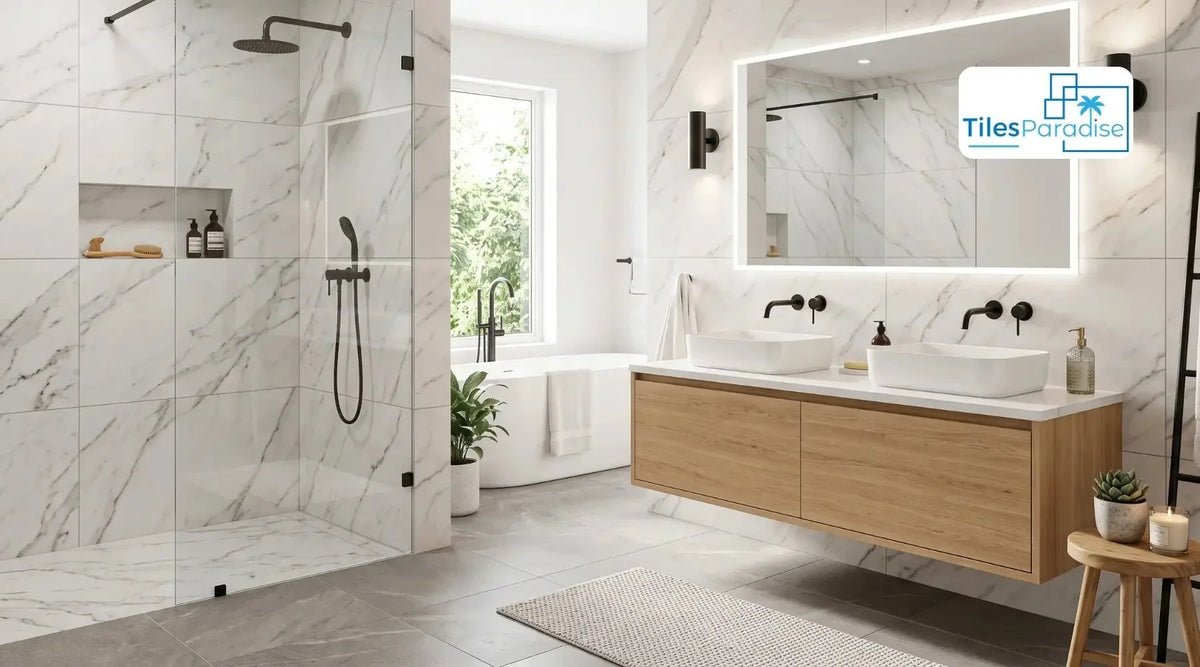
Marble wall tiles are wall coverings made from natural marble stone or from porcelain and ceramic printed with marble veining, used to line bathrooms, showers, kitchen splashbacks and feature walls. Natural marble gives you real stone that needs sealing. Marble-effect porcelain gives you the same look with water absorption of 0.5% or less and no sealing at all. This guide explains how the two compare, which sizes and finishes suit which walls, what they cost per m² in the UK, and how much weight your wall can carry.
Quick answer:
| Question | Short answer |
|---|---|
| Best material for most UK walls | Marble-effect porcelain (no sealing, ≤0.5% water absorption) |
| Most popular wall sizes | 30x60cm, 60x60cm and 60x120cm |
| Typical price at Tiles Paradise | From £19.95 per m² (September 2026) |
| Can they go in a shower? | Yes, over a tanked (waterproofed) wall |
| Can they go on plasterboard? | Yes, up to 32 kg/m² on 12.5mm board |
| Minimum grout joint (30x60cm and larger) | 3mm under BS 5385-1:2018 |
What Are Marble Wall Tiles?
Marble wall tiles are tiles designed to fix vertically onto plaster, plasterboard or tile backer board with a marble surface pattern. The term covers two different products. The first product is natural marble, a metamorphic rock made mostly of calcium carbonate (calcite). The second product is marble-effect tile, a porcelain or ceramic body with a high-definition marble print fired into its glaze.
Most UK shoppers who search for marble wall tiles buy marble-effect porcelain. Porcelain costs less, weighs less than the same thickness of stone and does not react with acids. Natural marble suits buyers who want every tile to be unique stone and accept regular sealing.
What Is the Difference Between Real Marble and Marble-Effect Wall Tiles?
Real marble is quarried stone, while marble-effect wall tiles are fired clay tiles that copy the veining of stone. The table below compares the attributes that matter on a wall.
| Attribute | Natural marble wall tiles | Marble-effect porcelain wall tiles | Marble-effect ceramic wall tiles |
|---|---|---|---|
| Material | Calcium carbonate stone | Dense fired clay and feldspar | Fired clay with a glazed face |
| Water absorption | Low, but the stone is porous | 0.5% or less (EN 14411 group BIa) | Usually above 10% (group BIII) |
| Sealing | Before grouting and every 6–12 months | Never needed | Never needed on the glaze |
| Reaction to acid (lemon, vinegar, limescale remover) | Etches and dulls | No reaction | No reaction on the glaze |
| Typical thickness | 10–12mm | 8.5–9.5mm | 8–8.5mm |
| Approximate weight | 27–32 kg/m² | 21–23 kg/m² | 16–17 kg/m² |
| Pattern | Every tile unique | Several print faces repeat across a batch | Several print faces repeat |
| Floor use | Yes, if honed | Yes, if rated for floors | Walls only |
The weights above are calculated from typical densities (marble about 2.7 g/cm³, porcelain about 2.35–2.4 g/cm³). Always confirm the box weight on the product page before you plan a wall.
Are Marble Tiles Good for Walls?
Marble tiles are good for walls because walls carry no foot traffic, so the softer surface of natural stone lasts longer there than on a floor. Walls still face water, steam, soap and cleaning products. Natural marble on a wall needs a penetrating sealer and pH-neutral cleaners. Marble-effect porcelain handles the same conditions with a damp cloth. For a shower or a family bathroom, porcelain is the lower-maintenance choice.

Which Marble Looks Work Best on Walls?
The marble look you choose sets the colour, the vein strength and the mood of the room. Six stone patterns dominate UK wall tiling.
| Marble look | Base colour and veining | Best wall use | Tiles Paradise example |
|---|---|---|---|
| Carrara | White to light grey, soft feathery grey veins | Small bathrooms, calm kitchens | Statuario Carrara White Matt 60x120cm (£19.99/m²) |
| Statuario | Bright white, bold grey veins | Feature walls, shower backs | Statuario Mercury Grey Polished 30x60cm (£23.95/m²) |
| Calacatta | Warm white or ivory, thick gold or grey veins | Luxury bathrooms, splashbacks | Calacatta Cremino Ivory Polished 60x60cm (£21.99/m²) |
| Nero Marquina / black and gold | Near-black base, white or gold veins | One dramatic wall, cloakrooms | Black & Gold Marble Effect Polished 60x60cm (£24.99/m²) |
| Onyx | Translucent-look bands of green, blue, pink or cream | Statement showers, powder rooms | Onyx Green Marble Effect Polished 60x120cm (£25.99/m²) |
| Crema / beige | Cream base, fine brown veins | Warm, traditional bathrooms | Calacatta Cremino and beige ranges |
Light marbles such as Carrara reflect more daylight and make a small room feel larger. Dark marbles such as Nero Marquina absorb light, so they work best on one wall rather than all four. You can compare the white and grey options in the Carrara marble tiles collection.
What Sizes Do Marble Wall Tiles Come In?
Marble wall tiles come in five common UK sizes: 25x50cm, 30x60cm, 60x60cm, 60x120cm and 80x80cm. Smaller ceramic formats suit walls only. Porcelain formats from 30x60cm upwards usually work on walls and floors.
| Tile size | Area per tile | Tiles per m² | Minimum grout joint (BS 5385-1) | Best wall use |
|---|---|---|---|---|
| 25x50cm | 0.125 m² | 8 | 3mm | Budget bathrooms, half-tiled walls |
| 30x60cm | 0.18 m² | 5.6 | 3mm | Kitchen splashbacks, small bathrooms, DIY projects |
| 60x60cm | 0.36 m² | 2.8 | 3mm | Bathroom walls that match the floor |
| 60x120cm | 0.72 m² | 1.4 | 3mm | Shower walls, feature walls, hotel-style bathrooms |
| 80x80cm | 0.64 m² | 1.6 | 3mm | Open-plan feature walls, large bathrooms |
BS 5385-1:2018 sets a minimum joint width of 3mm for tiles between 0.1 m² and 1 m² in area. BS 5385-1 sets 2mm as the minimum only for smaller tiles under 0.1 m², such as 20x20cm or 30x30cm. Every size in the table above therefore needs a joint of at least 3mm. The joint gives the tiles room to move with temperature and building movement.

Which Marble Tile Size Makes a Small Bathroom Look Bigger?
Large-format 60x120cm tiles make a small bathroom look bigger because they cut the number of grout lines the eye reads. A 2.4m high wall needs only two rows of 60x120cm tiles fixed upright. The same wall needs eight rows of 30x60cm tiles fixed landscape. Fewer lines make the wall read as one continuous slab of stone.
Small bathrooms with many pipes, niches and boxed-in areas are the exception. Every cut on a 60x120cm tile wastes more material, so 30x60cm tiles often cost less overall in a room full of corners.
Can You Put 60x120cm Tiles on a Wall?
You can put 60x120cm tiles on a wall if the wall is flat, strong enough for the weight and fixed with a solid adhesive bed. Two people should lift each tile, because one 9.5mm porcelain tile of this size weighs about 15–17 kg. Levelling clips stop lippage (edges sitting at different heights). A brick-bond offset of one third, not one half, reduces lippage caused by the slight bow in long tiles. The 60x120cm wall tiles range lists rectified tiles cut to exact size for tight, straight joints.
Should You Choose Polished or Matt Marble Wall Tiles?
Polished marble wall tiles suit most walls because the mirror-like face reflects light and makes the veining look deep, like polished natural stone. Matt marble wall tiles suit walls that continue onto a floor, because the same matt tile is often rated R10 for slip resistance. Walls do not need a slip rating.
| Finish | Look | Cleaning | Best wall use |
|---|---|---|---|
| Polished / gloss | High shine, deep veining, reflects light | Shows water spots; wipe with a microfibre cloth | Feature walls, splashbacks, dark or windowless bathrooms |
| Matt | Soft, natural stone look, no glare | Hides water spots and fingerprints | Walls that run onto a matching floor, modern minimal schemes |
A popular choice pairs a polished tile on the walls with the matt version of the same design on the floor. The pattern matches while the floor keeps its grip.
How Much Do Marble Wall Tiles Cost in the UK?
Marble-effect porcelain wall tiles at Tiles Paradise cost from £19.95 to about £50 per m², with most 60x60cm and 60x120cm designs priced around £30 per m² (in-stock prices checked September 2026). Ceramic marble-effect wall tiles in 30x60cm cost about £35 per m². Natural marble costs more per m² and adds the cost of sealer and specialist cleaning products.
| Size and material | Tiles Paradise price range per m² | Example |
|---|---|---|
| 30x60cm porcelain | £22.99 – £44.99 | Statuario Mercury Grey Polished, £23.95 |
| 30x60cm ceramic (wall only) | £34.99 – £35.99 | Carrara Gold White Gloss, £34.99 |
| 60x60cm porcelain | £19.95 – £44.99 | Black & Gold Marble Effect Polished, £24.99 |
| 60x120cm porcelain | £19.99 – £49.99 | Statuario Carrara White Matt, £19.99 |
| 80x80cm porcelain | £29.99 – £44.99 | Statuario Mercury Grey Polished, £29.99 |
| Pallet deals (44–68 m²) | About £22 – £28 per m² | 68 tiles (49 m²) of 60x120cm for £1,099 |
Delivery changes the total. Standard pallet delivery costs £39.99 on orders between £100 and £499. Delivery is free on orders over £499 to the UK mainland. All tiles arrive on a pallet at the kerbside. You can browse every current price in the marble-effect wall tiles range.
What Does It Cost to Tile a Bathroom Wall in Marble-Effect Tiles?
A single 2.4m x 2.0m bathroom wall costs about £115 in tiles at £19.99 per m². The wall measures 4.8 m². Adding 10% for cuts gives 5.28 m². At 0.72 m² per tile, that rounds up to 8 tiles of 60x120cm, or 5.76 m². Eight tiles at £19.99 per m² cost £115.14.
A full bathroom costs more but can reach free delivery. A 2.5m x 2.0m bathroom with 2.4m high walls has 21.6 m² of wall. Subtracting a door (1.6 m²) and a window (0.5 m²) leaves 19.5 m². Adding 10% gives 21.45 m², or 30 tiles of 60x120cm (21.6 m²). At £19.99 per m², the tiles cost £431.78 plus £39.99 delivery. At £29.99 per m², the tiles cost £647.78 with free delivery.
Where Can You Use Marble Wall Tiles?
You can use marble wall tiles in bathrooms, showers, kitchens, living rooms, hallways and around fireplaces. Each room puts a different stress on the tile.
Bathroom Walls
Bathroom walls suit every marble look and size. Polished white or Carrara tiles brighten windowless bathrooms. Half-height tiling to about 1.2m keeps costs down in a cloakroom.
Shower Walls and Wet Rooms
Shower walls need a waterproof system behind the tile, because grout is not waterproof. Apply a liquid tanking membrane or a tanking board over the substrate before tiling. Marble-effect porcelain is the safer choice inside a shower because shampoo, soap and limescale remover will not etch it. Natural marble in a shower needs sealing and pH-neutral products only.
Kitchen Splashbacks
Kitchen splashbacks suit 30x60cm and 60x120cm marble-effect tiles because food splashes wipe off a glazed surface. Porcelain is non-combustible, so it can sit behind a hob. Always follow the hob maker's minimum clearance to the wall. Lemon juice, vinegar and tomato sauce etch natural marble, so porcelain is the practical option behind a worktop. The marble effect kitchen tiles collection groups the designs sized for splashbacks.

Living Room Feature Walls and Fireplaces
Living room feature walls suit bold looks such as black and gold, green onyx or Calacatta. A TV wall or chimney breast tiled floor to ceiling in 60x120cm tiles looks like stone cladding. Fireplace surrounds need a heat-resistant adhesive and grout suitable for the stove or fire's surface temperature, so check both products' data sheets.
Hallways
Hallway walls take knocks from bags, bikes and prams. Porcelain resists chips better than soft stone. A half-height marble-effect dado in a hallway protects the paint above it.
Can Marble Wall Tiles Go on Plasterboard?
Marble wall tiles can go on 12.5mm plasterboard if the total weight stays under 32 kg/m², the limit set in BS 5385-1. Gypsum plaster carries less, at 20 kg/m². Treat each limit as the weight of the tile plus the adhesive, to keep a safety margin.
| Substrate | Maximum weight (BS 5385-1) |
|---|---|
| Gypsum plaster (skim) | 20 kg/m² |
| 12.5mm gypsum plasterboard | 32 kg/m² |
| Gypsum fibreboard | 40 kg/m² |
| Glass-reinforced cement board | 50 kg/m² |
| Foam-core tile backer board | 60 kg/m² (check the maker's figure) |
| Sand and cement render | 64 kg/m² |
A solid bed of cement-based adhesive adds roughly 3–5 kg/m² once set. That gives these approximate totals:
- Marble-effect ceramic, 8.5mm: about 19–22 kg/m². Borderline on plaster, fine on plasterboard.
- Marble-effect porcelain, 9–9.5mm: about 24–28 kg/m². Too heavy for plaster, fine on plasterboard.
- Natural marble, 10mm: about 30–32 kg/m². At the limit of plasterboard, so use cement board or backer board.
- Natural marble, 12mm: about 35–37 kg/m². Needs backer board or render.
Plaster over 20 kg/m² is the most common failure point. Strip the plaster back to brick or board over it before fixing porcelain.
How Do You Install Marble-Effect Wall Tiles?
You install marble-effect wall tiles by preparing a flat, primed wall, spreading a flexible adhesive with full coverage and grouting with joints of at least 3mm. The steps below apply to porcelain tiles from 30x60cm to 60x120cm.
- Check the wall is flat. A 2m straight edge should show no gap wider than 3mm.
- Tank wet areas. Apply a tanking membrane inside showers and around baths.
- Prime the surface. Use the primer your adhesive maker specifies for plaster or board.
- Choose the adhesive. Use a C2 (improved) cementitious adhesive to EN 12004. Choose S1 (deformable) for large formats and T (reduced slip) so tiles do not slide down the wall.
- Back-butter large tiles. Spread adhesive on the wall and on the back of 60x60cm and 60x120cm tiles for full contact.
- Fix a batten and start low. Screw a level timber batten one tile up from the bottom so the first full row sits straight.
- Use levelling clips. Clips hold neighbouring edges flush and stop lippage.
- Grout after the adhesive cures. Most standard adhesives need about 24 hours. Use a joint of 3mm or wider for tiles over 0.1 m².
- Silicone the corners. Use flexible silicone, not grout, in internal corners and where tiles meet the bath or tray.
Light polished tiles and translucent onyx looks can show adhesive through thin areas of glaze on rare occasions. A white adhesive removes that risk under white and cream tiles.
How Do You Clean and Maintain Marble Wall Tiles?
You clean marble-effect porcelain wall tiles with warm water, a drop of pH-neutral cleaner and a microfibre cloth, and you never need to seal them. Natural marble needs more care.
| Task | Marble-effect porcelain | Natural marble |
|---|---|---|
| Daily or weekly cleaning | Warm water and mild detergent | pH-neutral stone cleaner only |
| Limescale | Standard limescale remover is fine on the glaze | Never use acid descalers; they etch the surface |
| Sealing | Not needed | Penetrating sealer before grouting and every 6–12 months |
| Water spots on polished tiles | Squeegee after showering | Squeegee after showering |
| Grout | Seal cement grout or use epoxy grout in showers | Same |
A simple water-drop test tells you when natural marble needs resealing. If a drop darkens the stone within a few minutes, the sealer has worn off.
How Many Marble Wall Tiles Do You Need?
You need the wall area in m² plus 10% for cuts and breakage. Measure the width and height of each wall, multiply them, and subtract doors and windows. Add 10% to the total. Divide by the area of one tile and round up to a whole tile.
For patterned layouts such as herringbone, or for walls with many cuts, add 15% instead. Keep two or three spare tiles after the job. Print runs change between batches, so a spare tile from your own batch is the best repair match.
What Else Do Buyers Ask About Marble Wall Tiles?
The questions below come from Google searches, forum threads and the questions people type into AI assistants such as ChatGPT, Gemini and Claude.
Is Marble-Effect Porcelain Better Than Real Marble for a Bathroom?
Marble-effect porcelain is the better choice for most bathrooms because it resists water, steam and acidic products without sealing. Real marble is better for buyers who value natural uniqueness over low maintenance. Our comparison of white marble-effect porcelain vs real marble tiles covers slip resistance, heat and long-term cost in more detail.
Can You Use Marble Floor Tiles on Walls?
You can use marble floor tiles on walls when the product is rated for "wall and floor", which most porcelain marble-effect tiles are. A tile such as the Statuario Carrara White Matt 60x120cm porcelain tile carries an R10 slip rating for the floor and works on the walls of the same room. Ceramic tiles labelled "wall only" should never go on a floor.
Should Marble Tiles in a Shower Be Different From the Rest of the Bathroom?
Shower walls can use the same marble tiles as the rest of the bathroom, but the shower floor needs a matt or textured, slip-rated tile. Zoning the bathroom into wet walls, dry walls and floors is explained step by step in the marble bathroom tiles specification guide.
Do Marble Wall Tiles Look Fake?
Good marble-effect tiles do not look fake because modern inkjet printing uses high-resolution scans of real slabs and several different faces per design. Cheaper tiles repeat one face, so the same vein appears on every tile. Order a cut sample and lay out several tiles from the same box before you commit.
Which Grout Colour Suits Marble Wall Tiles?
White or light grey grout suits white and Carrara marble wall tiles because it disappears into the base colour. Charcoal or black grout suits black and gold tiles. Matching the grout to the base colour, not the veins, gives the most stone-like finish.
Are Marble-Effect Tiles Good for Kitchen Splashbacks Behind a Hob?
Marble-effect porcelain tiles are good behind a hob because porcelain is non-combustible and stain-resistant. Heat ratings, splashback heights and the best sizes are covered in the porcelain kitchen splashback tiles guide.
Which Marble Wall Tiles Suit a Small Kitchen or Cloakroom?
A 30x60cm polished tile suits a small kitchen or cloakroom because the size needs fewer awkward cuts around sockets and pipes. The Statuario Mercury Grey Polished 30x60cm porcelain tile combines bold statuario veining with a light grey base that keeps a small room bright.
Is Black and Gold Marble Too Dark for a Bathroom Wall?
Black and gold marble is not too dark for one feature wall, but it can shrink a small bathroom if used on all four walls. A polished finish reflects light back into the room. The Black & Gold Marble Effect Polished 60x60cm tile works well behind a bath or vanity with white walls elsewhere.
What Are Onyx Wall Tiles, and Are They a Type of Marble?
Onyx sold for interiors is usually a banded calcite stone, often called onyx marble, with a more translucent, layered look than standard marble. Onyx-effect porcelain copies those bands in green, blue, pink, cream and gold. The onyx wall tiles collection shows the full colour range.
Can You Tile Marble Over Existing Wall Tiles?
You can tile over existing wall tiles if they are firmly bonded, clean and flat, and if the combined weight stays within the substrate limit. Old tiles on plaster often already use part of the 20 kg/m² limit, so removing them is safer for heavy porcelain. The guide to tiling bathroom walls and floors explains wall preparation before any new tile goes up.
How Do You Work Out Tile Quantities for a Whole Bathroom?
You work out tile quantities for a whole bathroom by measuring each wall and floor separately, subtracting openings and adding 10% wastage. The bathroom tile quantities guide includes adhesive and grout amounts per m².
Last Thoughts on Marble Wall Tiles
Marble wall tiles give a room the look of natural stone, and marble-effect porcelain gives that look with no sealing, lower weight and a lower price per m². Choose the marble look by the light in the room, the size by the number of cuts on the wall, and the finish by whether the design continues onto the floor. Check the substrate weight limit before you order, keep joints at 3mm or wider, and order 10% extra from a single batch.