





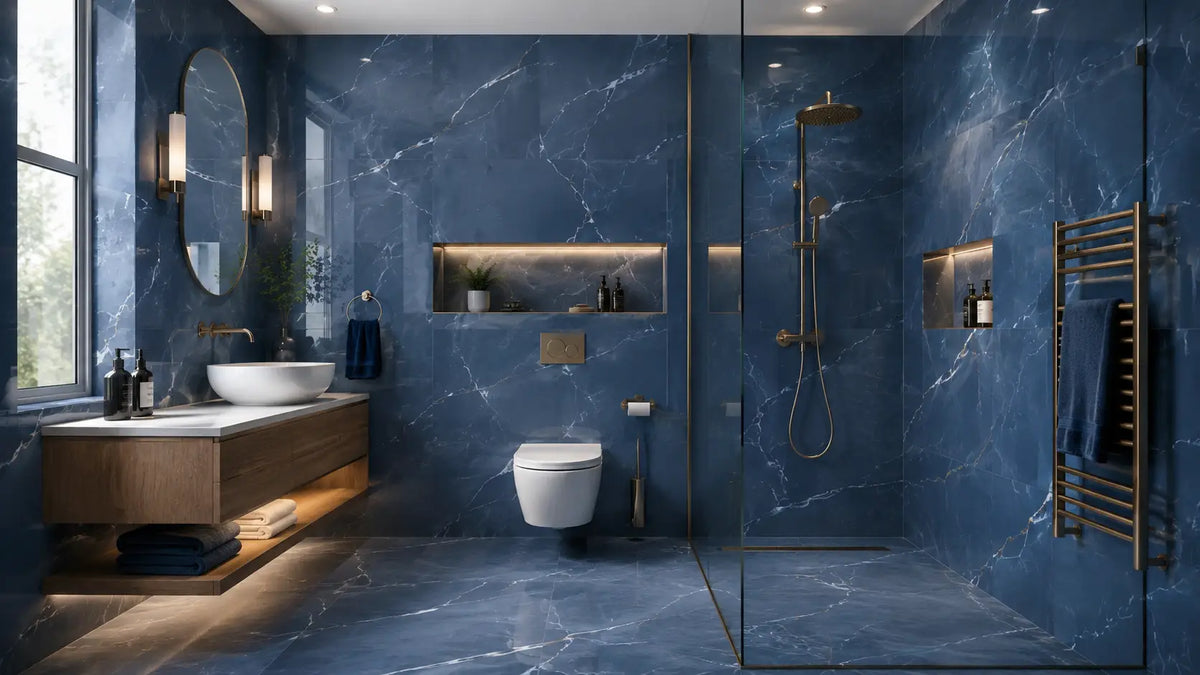
Blue bathroom tiles work best when the shade, finish, size and grout are chosen for the room rather than from colour alone. Pale blues can keep a compact bathroom visually light, while navy and deep blue work well as feature surfaces or deliberately dramatic schemes. Polished and gloss finishes are useful on walls where reflection is wanted; floors need product-specific suitability and wet-slip evidence, especially in showers and wet rooms.
For most UK projects, start by deciding where the blue will go, then choose the tile construction and finish for that location. Use this guide to compare light blue, navy, marble effect, metro, patterned and matt porcelain ideas, then test physical samples in your own bathroom lighting before placing the full order.
Quick Blue Bathroom Tile Decision Table
| Design goal | Strong starting point | Grout direction | Main point to check |
|---|---|---|---|
| Make a small room feel calmer | Pale blue, fewer grout lines | Close match or light grey | Tile module against actual wall dimensions |
| Create a luxury feature | Navy, blue-gold marble or onyx effect | Tonal / discreet | Keep surrounding surfaces quieter |
| Add blue without committing the whole room | Metro tile, niche or splashback | Contrast or light grey | Wall-only vs floor suitability |
| Add floor pattern | Matt patterned porcelain | Mid-tone practical grout | Floor suitability and cleaning |
| Create a spa look | Soft blue/onyx + warm white + wood | Warm off-white | Undertone under real lighting |
| Use blue in a wet zone | Matt/textured floor-rated option | Product-compatible grout | Wet-use evidence and waterproofing system |
| Reduce maintenance lines | Large-format porcelain | Close match | Substrate flatness and cut plan |

1. Use Light Blue Large-Format Tiles to Open Up a Small Bathroom
Light blue is one of the easiest blue families to use in a compact bathroom because it gives colour without the visual weight of navy. A larger format can reduce the number of grout lines, so the walls read as broader surfaces rather than a grid of small pieces.
That does not mean “the bigger the tile, the better.” Measure the wall first. A 60x120cm tile can look clean and calm when the dimensions produce balanced cuts, but it can be wasteful on short returns, boxed pipework or narrow shower walls. In an awkward ensuite, 30x60cm can be the more practical format even when the design goal is minimal grout.
Use closely matched grout when visual continuity matters. White grout creates a sharper grid; a pale grey or blue-adjacent grout can make the surface quieter.
2. Make Navy Blue a Feature Instead of Filling Every Surface
Navy tiles create depth, but a small bathroom does not need to be wrapped in navy to benefit from them. A single shower wall, vanity backdrop, bath wall or tiled niche can carry the colour while white sanitaryware and a lighter floor keep the room balanced.
This is especially useful in rooms with limited daylight. Dark blue absorbs more light than pale tile, so the design needs enough light on faces, mirrors and working zones. A navy feature under poor cool-white lighting can look flat; the same tile beside warm white light, oak and brass can read richer.
If you love dark blue but are uncertain about commitment, start with the surface that already has a natural boundary—the shower wall or vanity wall—rather than stopping a dark field arbitrarily in the middle of a room.
3. Use Blue-and-Gold Marble Effect for a Hotel-Style Statement Wall
Blue-and-gold marble-effect porcelain works when the bathroom needs one obvious focal point. The strongest location is usually behind a freestanding bath, across a walk-in-shower wall or behind a vanity where the veining can be viewed as a full composition.
The mistake is adding too many competing “luxury” elements. A bold blue-gold tile already has colour, pattern and reflectance. Pair it with quieter surrounding materials: warm white walls, a plain floor, restrained brassware or simple timber.
Large-format tiles are especially effective for this look because fewer joints interrupt the printed stone pattern. Check the product’s actual dimensions, thickness, rectification and intended wall/floor use before planning the layout.
4. Create a Spa Look with Blue Onyx Effect
Blue onyx-effect porcelain gives a softer, cloudy movement than many high-contrast marble prints. It can suit a spa-style shower or bath wall when paired with warm white, beige, pale wood and diffused lighting.
Use the tile sample as a material sample, not just a colour chip. Look at it vertically and horizontally, because a polished surface can reflect ceiling lights very differently from a tile lying flat on a table.
For a calm result, choose one main onyx surface and repeat one of its quieter colours elsewhere. If the tile includes warm cream, grey or amber veining, use that secondary colour for grout, paint, towels or vanity material instead of introducing another unrelated accent.
5. Put Matt Blue Porcelain on Floors Where Grip Matters
A bathroom floor has a different job from a feature wall. It must cope with foot traffic, cleaning, water and the exact conditions of the room. A matt or structured blue porcelain is therefore a stronger starting point than a mirror-polished surface when floor grip is a priority.
Do not select a shower-floor tile from appearance alone, and do not assume the word “anti-slip” tells you everything. Check the exact product’s declared floor suitability and ask for wet-condition test information that matches the intended use. A general ramp rating is not automatically the same as barefoot shower-floor performance.
In an open wet room, the tile is only one part of the system. The substrate, drainage fall, tanking or waterproof membrane, penetrations, adhesive, grout and movement details all need to work together.
6. Use Blue Metro Tiles for a Smaller, More Flexible Feature
Blue metro tiles are useful when you want a strong colour in a controllable area. Their smaller format works around niches, returns, vanity splashbacks and awkward walls more easily than a large slab.
The layout changes the mood:
- horizontal stack or brick bond feels familiar and relaxed;
- vertical stack emphasises height;
- herringbone turns the joint pattern into a feature;
- straight stack looks cleaner and more contemporary.
Grout matters more on a small-format tile because there are more joints. Warm off-white softens a blue metro wall; light grey is quieter and practical; a darker grout makes the geometry much more visible.
7. Add Pattern with a Blue Victorian-Style Floor
A patterned blue floor is an efficient way to add character without covering every wall in colour. Keep the wall treatment simpler so the floor remains the intentional focal point rather than one pattern competing with another.
This approach works particularly well in cloakrooms, period homes and smaller bathrooms because the pattern is contained within a defined plane. White walls, a simple metro wall tile or warm painted surfaces can prevent the room from becoming visually crowded.
Before buying, lay several sample pieces together if possible. A single patterned tile does not show the full repeat, border behaviour or how dominant the blue will feel across several square metres.
8. Use Blue Terrazzo for Texture Without Heavy Veining
Blue terrazzo-effect tile sits between plain blue and dramatic marble. The small chips or flecks break up a single block of colour, which can make a floor or lower wall more forgiving visually.
A matt terrazzo-style finish suits bathrooms that need texture but not a large directional vein. It also pairs easily with plain white, warm grey, pale timber and simple metal finishes.
Use terrazzo as one “busy” material. If the floor is speckled, keep the shower wall quiet. If the terrazzo runs up a feature wall, a plain floor usually produces a cleaner hierarchy.
9. Pair Blue with White for the Safest Long-Term Scheme
Blue and white is durable as a design combination because both colours can change proportion without changing the whole scheme. White sanitaryware already gives most bathrooms a large neutral element, so blue can be added through wall tile, floor tile, a niche or a vanity backdrop.
For a brighter result, use white above or beside a mid-to-dark blue. For a more immersive result, use blue on larger surfaces and let the sanitaryware become the contrast.
Avoid treating every white as identical. Some whites are cool and blue; others are creamier. Hold the blue tile beside the actual bath, basin, paint and grout before committing.
10. Warm Blue Tiles with Brass or Natural Wood
Blue can feel cool when every surrounding material is also cool. Brushed brass, warm oak, walnut or a warm off-white can change the balance without changing the tile.
Brass works especially well with navy, blue marble and blue-gold veining because it repeats the warm part of the palette. Chrome creates a crisper, cooler result. Matt black gives the highest contrast and can make a blue scheme feel more graphic.
If the bathroom already has a strong timber vanity, choose the blue by undertone. A warm, slightly green or teal blue often sits naturally with honey-toned wood; a colder sapphire blue creates a sharper contrast.
11. Use One Blue Tile Family in Multiple Sizes
Using the same or closely related blue design in more than one size can make a bathroom feel coordinated without forcing the same format onto every surface.
A larger format can suit a broad shower wall, while a smaller coordinating size can handle boxed pipework, returns or a tighter wall. This is more practical than cutting large tiles into awkward fragments simply to keep every surface identical.
When using a coordinated range, check that the colours are genuinely designed to work together. Products sold under similar names can still differ in shade, calibre, thickness or finish.
12. Control “Too Much Blue” with a 60/30/10 Surface Plan
If you are worried that a blue bathroom will become overwhelming, decide the proportion before choosing products.
A practical starting framework is:
- 60% quiet base: warm white, off-white, pale grey or a restrained tile;
- 30% blue: the shower wall, floor, lower wall or vanity zone;
- 10% accent: brass, black, wood, towels or a second blue tone.
This is not a design law. It is a simple way to stop every surface competing. A deliberate colour-drenched bathroom can work too, but then the variation should come from texture and light rather than adding multiple unrelated patterns.
Which Shade of Blue Works Best in a Bathroom?
Light Blue
Light blue suits small, low-light or intentionally relaxed bathrooms. It generally creates less visual weight than navy and works well with warm white, soft grey, pale timber and chrome.
Mid Blue and Teal
Mid blues are easier to use as a larger field because they still have character without becoming as dark as navy. Teal-leaning blues work particularly well with warm wood and brass.
Navy and Deep Blue
Navy is strongest when the room has deliberate lighting or when it is used as a focal surface. In a windowless bathroom, either commit to the darker mood with good layered lighting or use navy in a contained area against a lighter base.
What Grout Colour Works with Blue Bathroom Tiles?
Grout changes both the colour balance and the visibility of the layout.
| Grout choice | Effect with blue tile | Best used when |
|---|---|---|
| Warm off-white | Soft contrast; warmer overall | Coastal, traditional or blue-and-brass schemes |
| Light grey | Quiet, practical separation | Most modern blue walls |
| Mid grey | Makes joints more visible | Patterned or metro layouts |
| Close colour match | Creates a more continuous field | Large-format tile or small rooms |
| High contrast | Turns the layout into a graphic feature | Herringbone, metro and geometric designs |
Test grout beside a real tile sample. A grout colour viewed on a screen can shift dramatically once surrounded by a large amount of blue.

Gloss, Polished or Matt: Which Finish Goes Where?
Walls
Gloss and polished blue tiles can reflect light and show the depth of marble or onyx patterns. They work well on feature walls, shower walls and vanity backdrops when the product is approved for that application.
General Floors
A matt or structured floor-rated tile is a sensible starting point where grip and day-to-day practicality matter. Always check the exact specification rather than assuming every matt tile has the same slip performance.
Shower and Wet-Room Floors
Use a product explicitly suitable for the intended wet floor and ask for appropriate wet-use evidence. Do not assume that a polished wall-and-floor tile, a generic R rating or extra grout joints automatically make a shower floor appropriate.
Porcelain vs Ceramic Blue Bathroom Tiles
Porcelain is dense, durable and widely used across bathroom walls and floors. Ceramic is common on walls and can be lighter and easier to cut. Neither material label replaces the product specification.
Choose by location:
- feature wall or splashback: ceramic or porcelain can both work when approved;
- general bathroom floor: use a floor-rated product;
- shower or wet-room floor: use the exact product’s wet-area suitability and test information;
- underfloor heating: check the product and fixing-system compatibility.
Are Blue Tiles Good for Small Bathrooms?
Yes, but colour is only one variable. A compact bathroom usually benefits most from controlling visual interruptions.
To keep the room calmer:
- limit the number of different tile designs;
- reduce unnecessary grout contrast;
- choose a format that lands cleanly on the actual wall dimensions;
- continue a surface to a natural boundary;
- use lighting that shows the blue accurately;
- keep sanitaryware and storage visually simple.
A dark blue can still work in a small bathroom when it is deliberate. The mistake is not “dark colour”; it is dark colour combined with poor lighting, too many transitions and competing patterns.
Can Blue Tiles Be Used in a Wet Room?
Blue is only a colour. Wet-room suitability depends on the product and the installation system.

The tile is not the waterproofing system
A correctly built wet room uses a suitable substrate, designed falls, a compatible tanking or membrane system, sealed penetrations, drainage and the correct fixing products. Tile and grout form the finished surface; they should not be expected to compensate for a failed waterproofing layer.
Check wet-use evidence
For wet floors, ask what test supports the product’s slip claim and whether the result is relevant to the intended condition. If the product page does not clearly support shower-floor use, ask before ordering.
How Does Lighting Change Blue Tile Colour?
Blue tile is highly sensitive to surrounding light and materials.
Before ordering:
- place the sample in the actual bathroom;
- view it during daylight;
- view it again under the lighting you will use at night;
- stand it next to the basin, bath, paint, vanity and brassware;
- wet part of the surface to see how colour and reflection change;
- compare at least two grout samples.
Do not make the final choice from a phone screen alone.

How Many Blue Bathroom Tiles Should You Order?
Measure each surface in square metres, then add an allowance for cuts, breakages and future repair.
A straight, simple layout often needs less waste than herringbone, diagonal work or a room with many niches and returns. The exact allowance should be based on the layout and installer’s cutting plan rather than a universal percentage.
Keep a small number of spare tiles and the batch information after installation. Replacing one damaged deep-blue or patterned tile several years later can be difficult if the range has changed.
How to Keep Dark Blue Tiles Looking Clean
Dark blue and high-polish surfaces can make dried water droplets and limescale easier to see, particularly in hard-water areas.
A practical routine is:
- remove standing water after showers where convenient;
- use a soft cloth or squeegee;
- clean with a product approved for the exact tile and grout;
- avoid aggressive acids or abrasives unless the manufacturer explicitly allows them;
- ventilate the room well;
- clean grout before discolouration becomes established.
The safest cleaner is the one approved for the tile material, finish and grout system—not simply the strongest bathroom cleaner on the shelf.
Shop and Explore Blue Bathroom Tiles at Tiles Paradise
The design ideas above solve the planning decision first. When you are ready to compare actual formats and finishes, use the live Tiles Paradise range rather than relying on a static product list.
- Browse the live blue bathroom tiles collection.
- Compare the wider premium bathroom tile range.
- For floors where added slip consideration matters, review anti-slip bathroom tiles.
- Compare larger wall and floor modules in the 60x120cm bathroom tile collection.
- For a dramatic blue-gold wall, see Thunder Blue Gold marble-effect porcelain.
- For a cloudy polished stone look, see Onyx Blue marble-effect porcelain.
- For a matt blue floor option, compare Sylvan Blue matt anti-slip porcelain.
- For a smaller-format feature wall, see Savela Blue gloss metro wall tile.
- For a pattern-led floor or wall, see Victorian Vertex Blue patterned porcelain.
- For a smaller matt marble-effect format, see Crystal Blue 30x60cm matt porcelain.
- For a large-format stone look, compare Arizona Blue Stone 60x120cm porcelain.
- For a coordinated deep-blue onyx range, see Rodas Onyx Blue 60x120cm porcelain.
Stock, prices and individual product specifications can change. Check the live product page before ordering or specifying a tile for a particular wet area.
Related Bathroom Tile Guides
Continue the planning process with:
- Bathroom Tile Ideas: Layouts, Colours, Sizes & Finishes
- Small Bathroom Tile Ideas: Size, Colour & Layout Guide
- Mosaic Bathroom Tiles: UK Materials, Costs, Installation and Care
- Porcelain Tiles: Water Absorption, Slip Rating, Thickness & Size
- Large Bathroom Tiles: Pros, Cons, Layout & Trends
- How to Choose White Bathroom Tiles
- Order a physical tile sample before committing to the full room.
Frequently Asked Questions
What are the best grout colours for blue bathroom tiles?
Light grey is the safest all-round option because it separates the joints without producing the stark grid of bright white. Warm off-white suits coastal or blue-and-brass schemes, while a closer colour match makes large blue surfaces look more continuous. Use darker contrast grout only when you want the layout itself to become a feature.
Are blue subway or metro tiles suitable for small bathrooms?
Yes. Their smaller format works well around short walls, niches and boxed pipework. Keep the number of patterns low and choose the grout intentionally, because the many joints of a metro layout can either add useful rhythm or make a small room feel busy.
Do navy blue bathroom tiles make a small bathroom look smaller?
Not automatically. Navy increases visual weight, but a small room can still work with navy when the dark area has a clear boundary, the lighting is good and the remaining surfaces are controlled. A navy shower wall with white sanitaryware is lower-risk than several unrelated dark patterns across every surface.
What wall paint colours complement dark blue bathroom tiles?
Warm white, soft off-white, pale greige and muted beige are dependable partners. The best choice depends on whether the tile itself leans cool, warm, teal or violet. Always compare a paint sample beside the physical tile in the real room.
What sanitaryware colours work with blue bathroom tiles?
White is the simplest and most flexible because it gives a clean contrast across almost every blue. Coloured basins, baths or toilets can work, but they add another dominant colour and should be tested against the tile before ordering.
Are polished blue tiles suitable for shower floors?
Do not assume so. A product may be sold for walls and floors but still not be the right choice for a wet barefoot shower floor. Ask for the exact product’s intended-use statement and relevant wet-condition slip evidence.
Are blue bathroom tiles suitable for wet rooms?
Blue tiles can be used in wet rooms when the exact product is appropriate for the location. The wet room itself still needs a correctly designed waterproofing, drainage and fixing system behind the finished tile surface.
Are porcelain or ceramic blue tiles better?
Porcelain is generally the more versatile starting point for floors and demanding wet areas because of its dense body, while ceramic is widely used for walls and can be easier to cut. The exact product specification matters more than the material label alone.
Do dark blue tiles show water marks?
They can. Mineral deposits and dried droplets are often more visible on dark, glossy or polished surfaces. A squeegee, ventilation and a cleaner approved for the exact tile and grout help control the problem.
How should I clean matt blue bathroom tiles?
Use warm water and a mild cleaner approved for the tile and grout, then agitate with a non-scratch cloth or brush and rinse. Avoid leaving cleaner residue on a textured matt finish, because residue can hold dirt and change the appearance.
How many extra tiles should I order?
The correct allowance depends on room geometry, tile size and layout. Straight layouts normally waste less than herringbone, diagonal layouts, multiple niches or complex cuts. Ask the installer to confirm the cutting plan and keep spare tiles for future repairs.
Should shower wall and floor tiles match?
They can, but they do not have to. The wall and floor have different performance requirements. A coordinated colour family with a polished or gloss wall and a suitable matt floor can look more coherent than forcing the exact same finish onto both surfaces.
What flooring pairs with blue bathroom wall tiles?
A neutral porcelain floor in warm white, beige, light grey, stone effect or quiet terrazzo gives the blue wall room to lead. If the floor is also blue, use a different scale or texture rather than adding another unrelated pattern.
How can I get a coastal look with blue bathroom tiles?
Use a softer blue, warm white, light timber and simple chrome or brushed metal. Keep the styling natural rather than adding literal seaside motifs. Texture and colour temperature create a more durable coastal feel than themed accessories.
Is it difficult to install large-format blue bathroom tiles yourself?
Large porcelain requires accurate substrate preparation, handling, cutting, adhesive coverage and layout. A small dry wall is very different from a shower, floor or wet room. If the project involves waterproofing, large heavy tiles, floor falls or complex cuts, a competent professional is usually the lower-risk choice.
Should I remove old tiles before installing new blue bathroom tiles?
Often yes, because removal reveals the substrate and allows defects to be corrected. Tiling over existing tile can work only when the old surface is sound, flat, well bonded, structurally suitable and compatible with the new fixing system.
How do I prevent mould around blue tile grout?
Control moisture rather than relying on tile colour. Use effective extraction, remove persistent standing water, keep joints clean, repair failed sealant and address leaks quickly. In a shower, mould around grout can be a ventilation or moisture-management problem rather than a defect in the blue tile.
Can I repair a chipped blue bathroom tile?
Small cosmetic chips may be repairable with a colour-matched repair product, but a badly cracked or loose tile should normally be replaced after the cause is checked. Keeping spare tiles and batch labels makes colour matching much easier.
Where can I buy blue bathroom tile samples in the UK?
Tiles Paradise offers a tile sample service and many live product pages show cut-sample options. Check the exact product page for current sample size, price and availability before ordering.
What is the best way to choose a blue tile online?
Shortlist by intended location, material, finish and size first, then order physical samples. View them in the actual bathroom in daylight and artificial light, beside the sanitaryware, paint, grout and fittings. The physical sample should make the final colour decision, not the phone screen.